Greek Mythology
The Return of Neoptolemus and Philoctetes — Greek Mythology
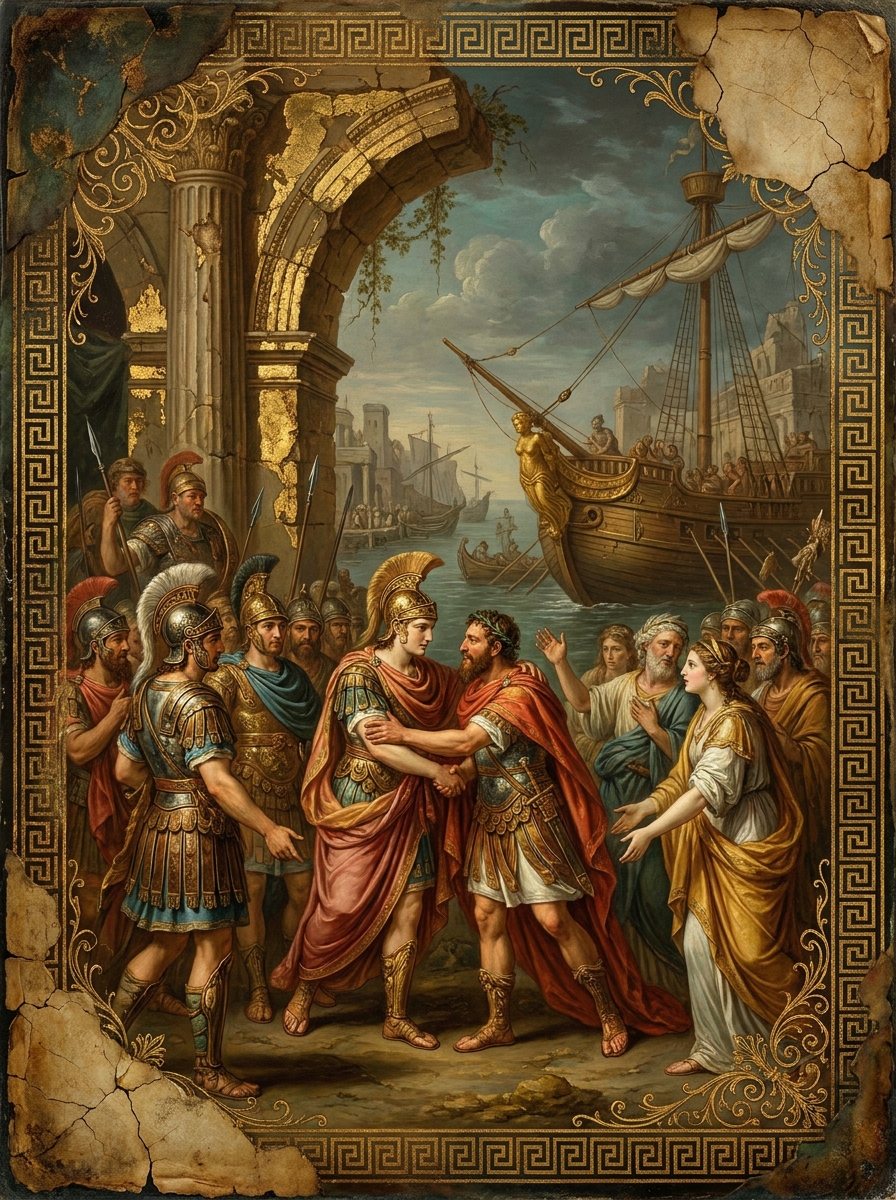
After Achilles died, the Greeks learned that Troy could not yet be taken unless Achilles’ son Neoptolemus came to the battlefield, and Philoctetes returned with the divine bow of Heracles. So Odysseus sailed out with the young Neoptolemus to seek a wounded hero whom the Greeks themselves had abandoned years before.
Article
Summary
After Achilles died, the Greeks still surrounded Troy, but they knew they lacked the powers needed to break the walls. A prophecy told them that the city would not fall unless Achilles’ son Neoptolemus came to the war and Philoctetes returned with the divine bow of Heracles. Odysseus was therefore sent to find them both. Odysseus first came to Scyros and told the young Neoptolemus that Achilles was dead and the Greek army needed him. The boy had never truly fought beside his father, yet he could not escape the name of Achilles’ son. He sailed for Troy, received his father’s armor, and inherited the unfinished war left behind by Achilles. Then Odysseus and Neoptolemus sailed to Lemnos to seek Philoctetes, whom the Greeks had abandoned years before. A snake wound in his foot had never healed, and he had survived on the deserted island only because he possessed the bow of Heracles. Odysseus knew Philoctetes must hate the Greeks, so he urged Neoptolemus to win his trust and the bow by deception. At first Neoptolemus followed the plan, pretending that he too had been wronged by the Greek chiefs, until Philoctetes saw him as a fellow sufferer. When the wound seized him with pain, Philoctetes handed him the bow for safekeeping, and the scheme seemed to have succeeded. Yet the young man could not bear to betray someone who had suffered so long, and at last he told the truth, defied Odysseus, and returned the bow. Philoctetes wanted only to go home and refused to fight again for the Greeks who had abandoned him. Then Heracles appeared and commanded him to go to Troy, declaring that his wound would be healed and that he would kill Paris with the divine bow. Philoctetes finally boarded the ship, and Neoptolemus returned with him to the battlefield; the blood of Achilles and the bow of Heracles had come together, bringing Troy’s end nearer.
The Prophecy After Achilles’ Death
After Achilles died, the Greek camp seemed to have lost its backbone.
The ships still stood in their long rows by the sea. The watchfires still burned at night. Shields still hung from wooden posts. Yet everyone knew that the man who had always rushed first into battle, the man whose very footsteps had made the Trojans afraid, would never again come out of his tent.
Achilles’ burial mound stood in the sea wind. When warriors passed it, they often slowed their steps. Some remembered his anger. Some remembered his spear. Some remembered how, even near the end, he had chased his enemies across the field. But grief would not take Troy for them. The walls still stood high. The gates of Priam’s city were still shut. The Greeks had fought for ten years, and before them still rose the city they could not break.
Then a prophecy reached the camp: Troy would not fall to the men who were there now. The Greeks still lacked two things.
One was the bow and arrows left by Heracles. That bow was in the hands of Philoctetes, and Philoctetes had long ago been left behind by the Greeks on the island of Lemnos.
The other was Neoptolemus, the son of Achilles. The young man had not sailed to war with his father. He had grown up far away, on the island of Skyros. Now the father was dead, and the son had to come to the battlefield.
When the chiefs heard the prophecy, they were silent for a while. Neither task was easy.
To summon Achilles’ son might be possible. But to face Philoctetes was to return to an old wrong. Years before, they had left that man on a desolate island with their own hands. Now they needed him to bring his bow back and fight for them.
In the end, Odysseus was sent to accomplish both tasks. He understood well enough that the siege mattered more than whether the words used were pleasant or fair. If he could bring the men back, the gods and the army would accept the result.
The Young Man on Skyros
Skyros did not smell of blood as the Trojan shore did.
There was a palace there, and hillsides, and waves striking the stone coast. Neoptolemus had grown up in that place. He had heard his father’s name, but he had never truly seen Achilles as men saw him in war. To him Achilles was like a distant fire: bright, terrible, and far away.
When Odysseus came to the island, he did not waste many words. He told the young man that Achilles had fallen in battle, and that the Greek army needed Achilles’ son. The walls of Troy had not yet come down, and the glory his father had left behind was waiting for someone to inherit it.
Neoptolemus listened and did not answer at once.
It is no small thing for a young man to be told suddenly that his father has become a grave, and that he himself must go to the place where that father died. Yet the blood of Achilles was in him. He could not remain hidden on the island and pretend he had not heard.
So he boarded the ship.
The sea wind filled the sail, and Skyros slowly fell away behind him. For the first time, Neoptolemus set his course toward Troy. When he reached the Greek camp, the warriors gave him Achilles’ armor. The bronze shone in the sunlight; the plates were heavy, the shield broad, as if his father’s whole shadow had been laid upon his shoulders.
Some looked at his young face and seemed to see Achilles standing among them again. Others knew in their hearts that this was not Achilles, but Achilles’ son. Yet the prophecy had been spoken, and every eye turned toward him.
Neoptolemus did not draw back. He accepted the armor, and with it the battlefield his father had left behind.
But before the assault on Troy, they still had to find another man.
That man would not board a ship so easily.
The Wound on the Deserted Island
Lemnos lay far from the noise of the camp. As the ship drew near, Neoptolemus saw no walls, no tents, no army, but scattered rocks, seabirds, and grass bent low by the wind.
It did not look like a place where anyone lived.
Yet Philoctetes had lived there for years.
Long ago, while the Greeks were still on their way to Troy, a venomous snake had bitten his foot. The wound would not heal. Blood and pus seeped from it, and the stench was foul. He cried out in pain beside the altar, and his cries disturbed the sacrifice and troubled the hearts of the men. The army had to sail on. The leaders feared he would burden them all, and in the end they left him on that island, giving him only a few tools and leaving him to survive by shooting birds and beasts with the bow of Heracles.
After that, the ships vanished, and his comrades did not return. Philoctetes lived alone in a rocky cave. By day he dragged his injured foot in search of water and food. By night, when the wound flared, he rolled on the stone floor and clenched his teeth against the pain. The wind blew through the cave mouth and scraped across his body like a cold blade.
Odysseus knew that Philoctetes must hate them.
So he did not mean to begin with the truth.
He told Neoptolemus that Philoctetes would never listen to him, since he too had had a share in abandoning the man. If they wanted the bow, the best course was for Neoptolemus to deceive him. The young man could say that he too had been wronged by the Greeks and was on his way home. Then Philoctetes would take him for a fellow sufferer.
When Neoptolemus heard this, his face changed.
He was the son of Achilles. Achilles could be angry and stubborn, but he had no love for stealthy tricks. Neoptolemus would rather seize the bow by force than cheat a man who had suffered for so many years.
Odysseus answered that force alone might not be enough. The bow was the bow of Heracles, and if Philoctetes held it in his hands, no one could easily come near him. Whether Troy could be taken depended on this moment.
The young man fell silent.
The waves struck the rocks, and birds cried in the distance. At last Neoptolemus went toward the cave mouth, following Odysseus’ plan.
The Meeting at the Cave Mouth
When Philoctetes appeared, he looked more wretched than Neoptolemus had imagined.
His clothes were ragged. He limped as he walked. His wounded foot was wrapped in torn cloth, but dark, filthy blood still showed through. Sea wind and hunger had worn his face thin, yet his eyes were bright. The moment he saw a stranger, he tightened his grip on the bow in his hand.
“Who are you?” he asked.
Neoptolemus gave his name and said that he was the son of Achilles.
At that name, Philoctetes softened a little. He honored Achilles, and when he heard that the stranger carried Achilles’ blood, his voice grew gentler. He asked how the Greek army fared, what had become of Achilles, and whether the old leaders were still alive.
Neoptolemus spoke as Odysseus had taught him. He said that Achilles was dead, and that when he himself came to the camp, he should have inherited his father’s armor, but the Greek chiefs had wronged him. In anger, he said, he had left them and was going home.
Philoctetes clenched his teeth as he listened.
“They did the same to me,” he said, looking out toward the sea. “They left me here to live among birds and beasts. Now they have mistreated you too. Child, do not go back among those men.”
He told how, year after year, he had begged passing ships to take him away; how he had seen sails appear and then seen those sails vanish again; how, when the pain seized him, he had cried until his throat went hoarse. Neoptolemus stood nearby, and the longer he listened, the heavier his heart grew.
This was not an enemy.
This was a man who had once sailed beside the Greeks, and whom the Greeks had afterward cast aside.
Philoctetes did not know that the young man before him was deceiving him. He thought he had at last found someone he could trust, and he begged Neoptolemus to take him aboard and carry him home, not leave him to die on that lonely island.
Neoptolemus agreed.
Once the word had left his mouth, he himself could no longer tell how much of it was false and how much was true.
The Divine Bow in His Hands
Just as they were preparing to leave, Philoctetes’ pain suddenly returned.
At first it was only a spasm in his foot. Then the agony surged upward from the wound like poisonous fire. His face went pale. Sweat broke across his brow. His fingers dug into the rock, and a groan forced its way from his mouth.
Neoptolemus tried to support him, but Philoctetes first handed him the bow.
“Hold it for me,” he said. “Let no one else touch it.”
It was the bow of Heracles.
The wood was hard, the string so taut it seemed it could cut the fingers. Divine arrows lay in the quiver. For years Philoctetes had survived because of that bow; and because of that bow, the Greeks had been forced to come back for him.
Neoptolemus took it, and his heart sank.
The thing Odysseus wanted was now in his hands. If he turned and left at once, the ship waited by the shore, and half the prophecy concerning Troy would be fulfilled. Philoctetes was nearly unconscious with pain and could not stop him.
Odysseus, hidden nearby, urged him on. The chance had come. He must not hesitate.
But Neoptolemus looked down at Philoctetes on the ground, at the rotting foot, at the man who had placed his last trust in his hands, and suddenly the bow felt terribly heavy.
Philoctetes fainted from the pain. After a long while he slowly woke, and the first thing he sought was his bow.
Neoptolemus stood there. He had not hidden it, but he did not immediately return it either.
Philoctetes saw that something was wrong.
“What are you going to do?” he asked.
At last the young man told the truth: the Greeks did not mean to send him home. They meant to take him to Troy. The prophecy said that without him and without this bow, the city would not fall.
It was as if Philoctetes had been bitten a second time.
First he stared in disbelief; then anger rose in him. He cursed Odysseus, cursed the Greek chiefs, and cursed Neoptolemus too. Years before, they had taken his comrades and his road home from him; now they wanted to take his bow as well, and even to make him serve the very men who had abandoned him.
He reached out and demanded the bow.
Neoptolemus held it, his thoughts in turmoil. Odysseus came out from his hiding place and sharply ordered him not to give it back. For the sake of the army, for the sake of Troy, for the sake of the prophecy, Philoctetes had to come with them, and the bow had to go with them.
Philoctetes would rather die on the island than agree.
He stood at the cave mouth, stone beneath his feet, the dark cavern of his long exile behind him. He was utterly alone, yet he would not bow his head.
The Bow Returned
At last Neoptolemus could bear it no longer.
He could go to war. He could face spears and fire. But he could not deceive a suffering man until even the last of his dignity was gone. He turned to Odysseus and said that he had done wrong.
Odysseus was furious. He reminded him that the whole Greek army was waiting for that bow. He reminded him that this was the command by which Troy would be taken. But Neoptolemus no longer obeyed. He went to Philoctetes and returned the bow to him.
Philoctetes took it, his fingers closing again around the wood, like a drowning man clutching a plank. He looked at Neoptolemus. His anger did not vanish at once, but there was something like astonishment in his eyes.
This young man had deceived him, yet had also spoken the truth. He had taken his bow, yet had restored it with his own hands. Philoctetes hated the Greeks, but he could not simply see Neoptolemus as another Odysseus.
Neoptolemus urged him to understand that going to Troy would not be for the sake of the chiefs who had wronged him, but for the path the gods had laid before him. There his wound could be healed, and there he would win great honor with the bow of Heracles.
Philoctetes shook his head.
He was too weary, and he hated too deeply. He wanted only to leave the island, return to his homeland, and see his own earth and his own kin again. Troy, prophecies, Greek victory or defeat—none of it mattered to him.
For a moment Neoptolemus had no answer. He even agreed to carry Philoctetes home. Since he had chosen not to deceive him anymore, he could not force him with fine words.
So it seemed the matter would end there: the bow restored to its master, Philoctetes returned to his homeland, and the Greeks still unable to take Troy.
Then Heracles appeared.
The Words of Heracles
Philoctetes had once helped Heracles, and at that hero’s death he had received the divine bow. To him, Heracles was not only a mighty figure from old tales, but the true master of the bow he held.
Now the voice of Heracles came from above, carrying over the sea wind and falling upon the rocks.
He told Philoctetes to resist fate no longer. Go to Troy, he said. There his wound would be healed. There he would shoot Paris with this bow. There he would receive the honor that belonged to him. Neoptolemus too must go with him. One carried the blood of Achilles, the other the bow of Heracles, and both had their deeds to accomplish beneath the walls of Troy.
Philoctetes listened for a long time without speaking.
If the words had come from Odysseus, he would have answered with bitter laughter. If they had come from the Greek chiefs, he would not have believed them. But this was the command of Heracles. The bow had once passed from Heracles’ hands to his, and now Heracles himself had shown him the road ahead.
At last Philoctetes bowed his head and agreed to go to Troy.
Neoptolemus helped him onto the ship. The sea rose and fell alongside the hull, and the caves of Lemnos remained behind. That island had heard his cries, his hunger, and his loneliness. Now at last it saw him leave.
When the ship returned to the Trojan shore, the men in the Greek camp came out to watch.
They saw the son of Achilles standing aboard, and they saw the man they had abandoned years before returning with the bow of Heracles. Philoctetes’ wound was later healed, and he took up the bow and arrows again and went out to battle. Neoptolemus too, wearing his father’s armor, joined the Greek army.
The walls of Troy had not yet fallen. But from that day onward, the besieging army was no longer what it had been.
The son of Achilles had come.
And the bow of Heracles had returned.