Greek Mythology
The Nemean Lion — Greek Mythology
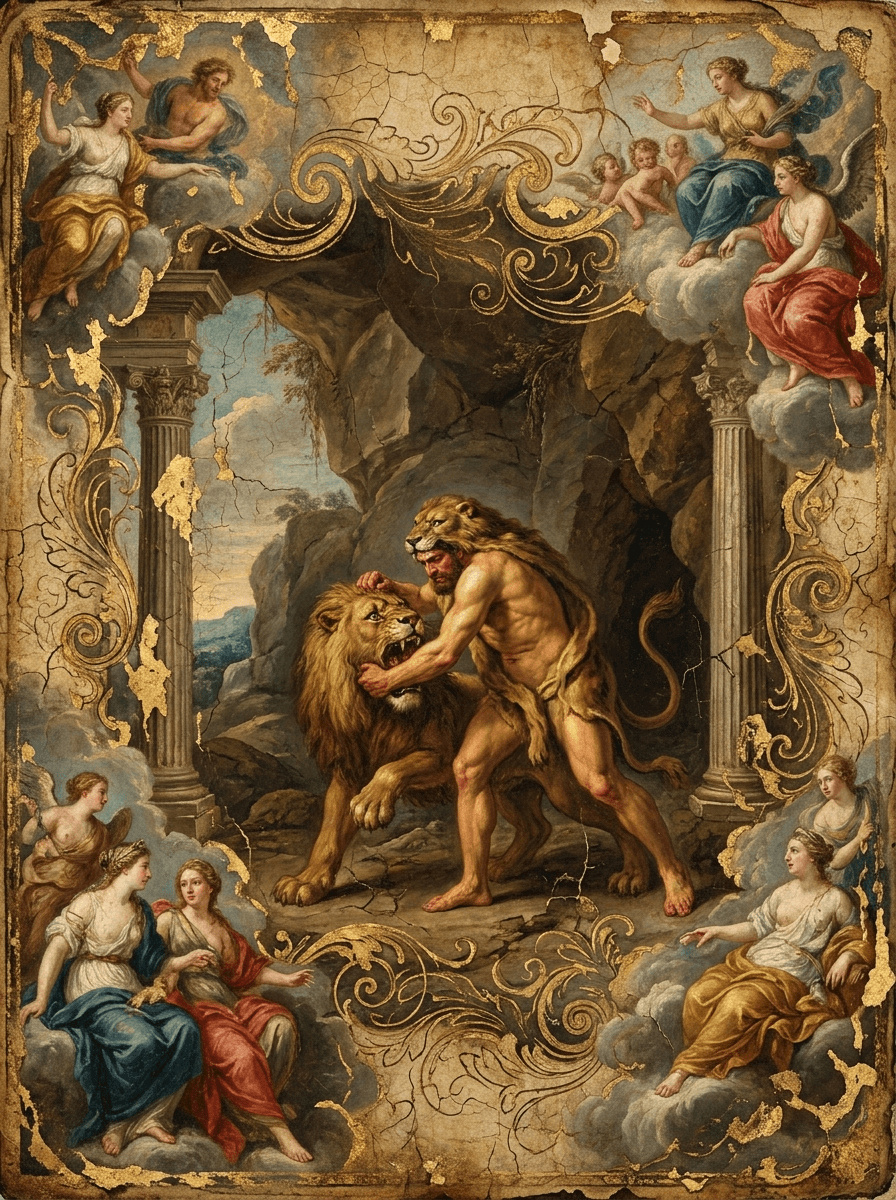
At Eurystheus’ command, Heracles went to Nemea to kill the great lion that devoured people and livestock and whose hide no weapon could pierce. Arrows and blades failed against it, so Heracles sealed one mouth of its cave, strangled the beast with his bare hands, and returned to Mycenae wearing its skin.
Article
Summary
As punishment, Heracles entered the service of Eurystheus, and his first task was to go to Nemea and kill the lion. The beast was of a monstrous breed, its hide so hard that iron could not enter it. It prowled between valleys and caves, until the people of Nemea no longer dared work their fields or walk the roads alone.
The Command from Mycenae
After Heracles came to Mycenae, the first task Eurystheus set before him was to kill the lion of Nemea.
This was no ordinary beast of the hills. Nemea lay in the region of Argos, among slopes, valleys, and vineyards where shepherds should have been driving their flocks and farmers tending their fields. But after the lion appeared, people no longer dared travel far. Cattle and sheep were dragged into the mountains, and at night a deep roar often rolled down from the caves among the rocks. Men had tried to spear it; others had loosed arrows at it. The points struck its hide and glanced away as if they had hit stone. Its claws tore open wooden pens, its teeth crushed bone, and little by little the country around Nemea became a place people feared to approach.
Old tradition said that this lion came from a terrible monstrous bloodline, and that Hera had reared it in the country of Nemea so that it would become a scourge to the people there. Eurystheus had heard these tales, and so he pushed the most dangerous of labors onto Heracles. He hoped the lion’s claws and teeth would rid him of this mighty kinsman; and if Heracles failed, he wanted to see him humbled.
Heracles said little. He took his bow and arrows, slung the quiver over his shoulder, and carried a blade and a great club. Then he left Mycenae and set out for Nemea.
The Hut on the Barren Slope
Along the road, when people heard that he was going to seek the lion, fear came over their faces. Some begged him not to enter the hills. Others merely pointed out the way from a distance and hurried back behind their doors. Fields lay untilled, fences had fallen, and in the sheepfolds only broken stakes remained. The wind moved over the slopes, bending the grass low, as if something had just passed through it.
Heracles came to a poor little hut whose owner was named Molorchus. The old man had almost nothing in his house, yet he welcomed the stranger inside and offered him a place to rest. When he heard that Heracles meant to kill the lion, he was filled with both admiration and dread. He wanted to slaughter an animal at once and sacrifice to the gods, asking them to protect the hero.
Heracles stopped him.
“Do not hurry to sacrifice yet,” he said. “Wait thirty days for me. If I return within that time, offer the victim to Zeus and celebrate that I have come back alive. If I do not return, then offer it to me, as one makes an offering for the dead.”
The old man listened and nodded in silence. He watched Heracles take up his weapons again and walk toward the deep hills. The hero’s figure grew smaller in the dust and sunlight, until shrubs and rocks hid him from sight.
The Hide No Arrow Could Pierce
Heracles searched the mountains for the lion’s trail. He found huge pawprints pressed into the ground, the earth torn open beside them. He saw the bones of cattle that had been dragged away, with fresh cracks still showing in them. Broken stains of blood led upward through the stones toward a heap of rough rocks.
Before long, he heard a roar.
The lion came out from behind the stones. Its mane was wild, its shoulders high and massive, its eyes like burning coals. When it saw Heracles, it did not flee as ordinary beasts would have done. Instead it lowered its body, lashed its tail, and slowly came nearer.
Heracles first took down his bow, drew the string to its full length, and shot. The arrow struck the lion’s body squarely, but it did not enter; it bounced away and fell to the ground. A second arrow and a third did the same. The sharp heads scraped against the hide, but did not wound it at all.
The lion, now enraged, sprang at him. Heracles slipped aside and struck with his sword. The blade fell on the beast’s body as if it had struck hard bronze armor. The lion wheeled and opened its jaws, and its hot, rank breath rushed into Heracles’ face. Heracles swung his great club and brought it down heavily on the lion’s head.
The blow rang out as if the very stones of the mountain had sounded. The lion staggered, dazed, and backed away a few paces. But it was not dead. It shook its head and slipped into a nearby cave.
The Two Mouths of the Cave
Heracles followed it to the cave, and there he saw that it was no dead end. The passage ran through the belly of the hill and had two openings. If the lion was pressed from one side, it could escape by the other; if a man pursued it into the dark, the beast might circle behind and spring upon him.
Heracles stood outside for a while, looking at the place. Then he brought up great stones and blocked one mouth of the cave. The rocks were heavy, and he pushed them one by one into place, packing smaller stones tight into the gaps. Only when that entrance was sealed did he grip his club, bend low, and enter by the other mouth.
Inside, the cave was dark and cold. Underfoot lay broken bones and damp earth. The daylight behind him shrank away little by little, until only the sound of breathing came from the depths ahead. The lion crouched hidden in the darkness, growling low; the sound rolled along the stone walls, as though the whole cave were snarling.
Heracles did not retreat. He went forward until the two bright eyes suddenly drew close in the dark. The lion leapt. He raised his club to strike, but in the narrow passage it was not as useful as it had been outside; it hit the stone wall and sent a numbing shock through his arm. The lion’s claws swept along his side, tearing his clothing and cutting bloody marks into his flesh.
Then Heracles threw the club aside and hurled himself at the lion.
With one hand he seized its throat, and with the other he locked his arm around its neck. The lion rolled, kicked, and twisted its body; its claws scraped against the rock with a harsh, grating sound. It tried to open its jaws and bite, but the hero’s arms tightened around its throat like iron bands. Heracles pressed his whole strength down upon it, bracing his knee against its body, drawing his arms tighter inch by inch.
The roaring in the cave slowly changed into choking gasps. The lion’s struggles weakened. Its claws still raked blindly at the ground for a while, and then they too fell still.
The lion of Nemea was dead.
The Lion’s Hide Cut with Its Own Claws
Heracles dragged the dead lion out of the cave. Sunlight fell upon its hide, and even in death it looked hard and shining. He wanted to skin the beast and carry the hide back as proof, but his blade would not cut it. Just like the arrows before, the knife was useless against that skin. After several attempts, he understood that no mortal iron could wound it.
At last he used the lion’s own claws. Since those claws belonged to the beast itself, they at last opened the thick hide. Heracles stripped the skin away little by little, keeping the enormous lion’s head as a helmet and throwing the pelt over his shoulders and back. The hide that no spear or sword could pierce became his armor from that day onward. With the lion’s head hanging over his brow and the mane covering his back, he stood upon the hillside looking, from a distance, like an even more terrible beast come out of the cave.
As the thirtieth day drew near, Molorchus was preparing the sacrifice. He did not know whether Heracles was alive or dead; he could only wait as they had agreed. Then he saw someone coming along the mountain road, wearing a lion’s skin over his shoulders and dragging the fearful trophy behind him. At first the old man was startled, but when he recognized Heracles, his heart was eased.
So together they offered the victim to Zeus, thanking the god for letting the hero return alive. And the people of Nemea finally learned that the lion which had devoured their flocks and their kin would never again come out of its cave.
The King in the Bronze Jar
Heracles returned to Mycenae wearing the lion’s skin. When the people of the city saw him from afar, they drew back from the road. The pelt looked too much like a living creature: the lion’s head covered his own, and the empty eye sockets and fangs still carried a savage look. Some thought the monster itself had come to the city gates, and cried out in terror.
When Eurystheus heard the news, he had expected Heracles to die in Nemea. Instead the hero had come back, and had killed the lion besides. At the sight of that lion skin, the king’s fear grew even greater. He did not dare receive Heracles face to face; he even hid inside a bronze jar and asked from within it what was happening outside.
From then on, Eurystheus would no longer allow Heracles to enter the city in person to report his labors. He sent his herald Copreus to speak for him, and ordered Heracles, in future, to leave his trophies outside the walls. Though the king still sat upon the throne, the voice that gave commands hid behind another man.
Heracles had completed his first labor. The roads of Nemea were traveled again, and in time the fields and pastures showed the footprints of shepherds once more. As for the lion skin that no weapon could pierce, it remained upon Heracles’ shoulders, following him into one danger after another.