Greek Mythology
Nausicaa and the Phaeacians — Greek Mythology
After many days adrift at sea, Odysseus is cast by the waves onto the shore of the Phaeacians. Princess Nausicaa finds him while washing clothes by the river, gives him garments and guidance, and helps him reach the royal palace, where the Phaeacians receive him with honor and set him on a ship bound for home.
Article
Summary
After leaving Calypso, Odysseus is struck by another storm raised by Poseidon, and his raft is shattered on the open sea. Clinging to broken timber, he reaches the coast of Scheria only after praying to the river god at its mouth. Naked, exhausted, and wounded by salt and surf, he hides beneath the leaves of two olive trees and falls asleep in a strange land. Scheria is the home of the Phaeacians, a people famed for their swift ships, and Nausicaa is the young daughter of King Alcinous and Queen Arete. Athena enters the princess’s dream and urges her to wash the household clothes at dawn, using thoughts of marriage and family honor to send her toward the river. Nausicaa asks her father for a mule cart and goes out with her attendants, carrying linen, food, and oil. After washing the clothes, the girls play ball beside the river, and a missed throw sends the ball into the water. Their cry wakes Odysseus in the thicket. Covering himself with a leafy branch and keeping a respectful distance, he begs Nausicaa for help. The other girls flee, but Athena gives Nausicaa courage; she stays, offers clothing, food, and oil, and tells him he has come among the Phaeacians. Once Odysseus has washed away the salt and put on clean garments, Nausicaa instructs him carefully. He must not walk into the city beside her and provoke gossip; instead he should wait in Athena’s grove, then enter the palace and appeal first to Queen Arete. Shielded by the goddess’s mist, Odysseus follows her plan, clasps Arete’s knees as a suppliant, and is received by Alcinous, who promises to gather sailors and send him home. At the feast, the blind bard Demodocus sings of Troy, and Odysseus repeatedly hides his tears. Alcinous notices that these songs touch a hidden wound and gently asks who the stranger truly is. Odysseus at last reveals that he is Odysseus of Ithaca and begins the tale of his wanderings. The Phaeacians prepare gifts and a ship to carry him home, while Nausicaa’s courage at the river becomes one of the bright turning points on his road back.
The Waves Drive a Man Ashore
When Odysseus left Calypso’s island, there was only one thought in his heart: to return to Ithaca, to stand once more beneath his own roof. He lashed together a raft from timber, raised a sail, and set out across the sea. By day he watched the sun to keep his course; by night he fixed his eyes on the stars, afraid to let sleep drag him down.
But Poseidon was still upon the sea.
The sea-god saw that Odysseus yet lived, and anger rose in him at once. He pressed the clouds low over the water and called the winds from every side. The sea darkened in a moment. Wave piled upon wave, rolling toward him like ridges of mountains. First the raft shuddered; then the surf struck it apart. The mast snapped, the sail tore, and Odysseus was flung into the bitter salt water.
He clung to a broken piece of timber, rising and sinking among the waves. The sea drove him out, then hurled him back again. He tried to draw near the shore, but the rocks showed their sharp edges through the white foam. If he were dashed straight against them, his bones would be broken on the stone. So he clenched his teeth, swam with the current, and searched for a place where a man might come safely to land.
At last he saw the mouth of a river. Its water flowed down from within the island and, near the sea, grew calmer. In his heart Odysseus prayed to the river-god, begging him to receive a man tormented by the waves. The river checked its rushing stream, and Odysseus struggled toward the bank.
When he crawled onto the sand, he had no clothing. His skin ached from the seawater, and his hands and feet were covered with wounds. He had no strength to go far. Near the river he found a dense thicket, where two trees grew close together: one wild olive, one cultivated olive. Their branches held off wind and rain. He crept beneath them, drew a thick covering of fallen leaves over his body, and buried himself as if under a rough blanket.
Night came down. At last weariness overcame fear. Odysseus closed his eyes and fell asleep on a land he did not know.
The Princess Dreams of a Morning Cart
The island was called Scheria, and the Phaeacians lived there. They dwelt far from the clamor of battle, and their ships ran swift and steady, as if they understood men’s thoughts. Through mist and spray they could carry a guest wherever he wished to go.
The king of the Phaeacians was Alcinous, and his queen was Arete. They had a daughter named Nausicaa. She was still young and lived deep within the palace, surrounded by maidens of her own age. In her chamber lay bright garments; fine cloth was folded in chests; veils and girdles hung along the wall for the days when she went out.
That night Athena came to the palace. She did not disturb the guards, nor did she make the torches flicker. Silently she went to Nausicaa’s bedside and took the shape of one of the princess’s familiar companions. In a dream she spoke to her.
“Nausicaa, why are you still sleeping? Your garments lie unwashed. You are near the age of marriage. Then you must have clean clothing for yourself, and those who escort you must be properly dressed as well. At daybreak go to your father and ask him for a mule-cart, so that you may take the clothes to the river and wash them.”
The voice faded gently, and Athena departed.
In the morning Nausicaa woke with the words of the dream still in her ears. She rose, dressed, and went before her father. Alcinous was preparing to leave and meet with the elders of the city. Nausicaa did not speak openly of marriage. She lowered her eyes and said, “Father, please have a high cart made ready for me. The clothes of the household need washing. When you go to the council, and when my brothers go out, all of you need clean garments.”
The king understood the thought his daughter had not said aloud, but he did not expose it. Smiling, he ordered the servants to prepare the cart. They harnessed the mules, loaded the clothing, and added food and wine. Queen Arete also gave her daughter a little flask of oil, so that she and her companions might rub it on themselves after bathing.
Nausicaa took up the whip. Her maidens followed beside the cart, and together they went out from the city toward the river.
Clothes by the River and a Ball
The river ran clear over the stones, and beside it were level washing-pools. When the girls arrived, they first unyoked the mules and let them graze in the grass along the bank. Then they lifted the garments down from the cart one by one, trod them in the water, and rubbed them clean against the stones. White foam drifted away with the current. The wet clothes were wrung out and spread on the pebbles and sand beside the sea to dry.
The sun climbed higher. Wind passed over the river mouth, and the garments shone in bright rows. When the girls had finished their work, they washed their hands, ate the food they had brought, and drank wine. After the meal, they took off their veils and played ball by the river. Nausicaa stood in the middle, light in her movements, tossing the ball to one girl and catching it from another. Their laughter spread along the water like a flock of birds suddenly taking flight.
Once, the ball flew wide. It passed beyond a maiden’s hands and fell into the river. Water splashed up, and the girls cried out all together.
That cry woke Odysseus in the thicket.
He lifted his head from the leaves. First he heard the voices of young women; then he caught the scent of river water and washed cloth. He did not know what land he had reached, nor whether these people were cruel or kind. If he stayed hidden, he might continue to starve. If he rushed out too boldly, he would terrify them.
After a moment’s thought, he broke from a tree a leafy branch to cover his naked body. Then, step by step, he came out of the thicket. Salt from the sea still crusted his hair and shoulders. Mud clung to him. His face was worn with exhaustion, and he looked like some wild creature come down from the mountains.
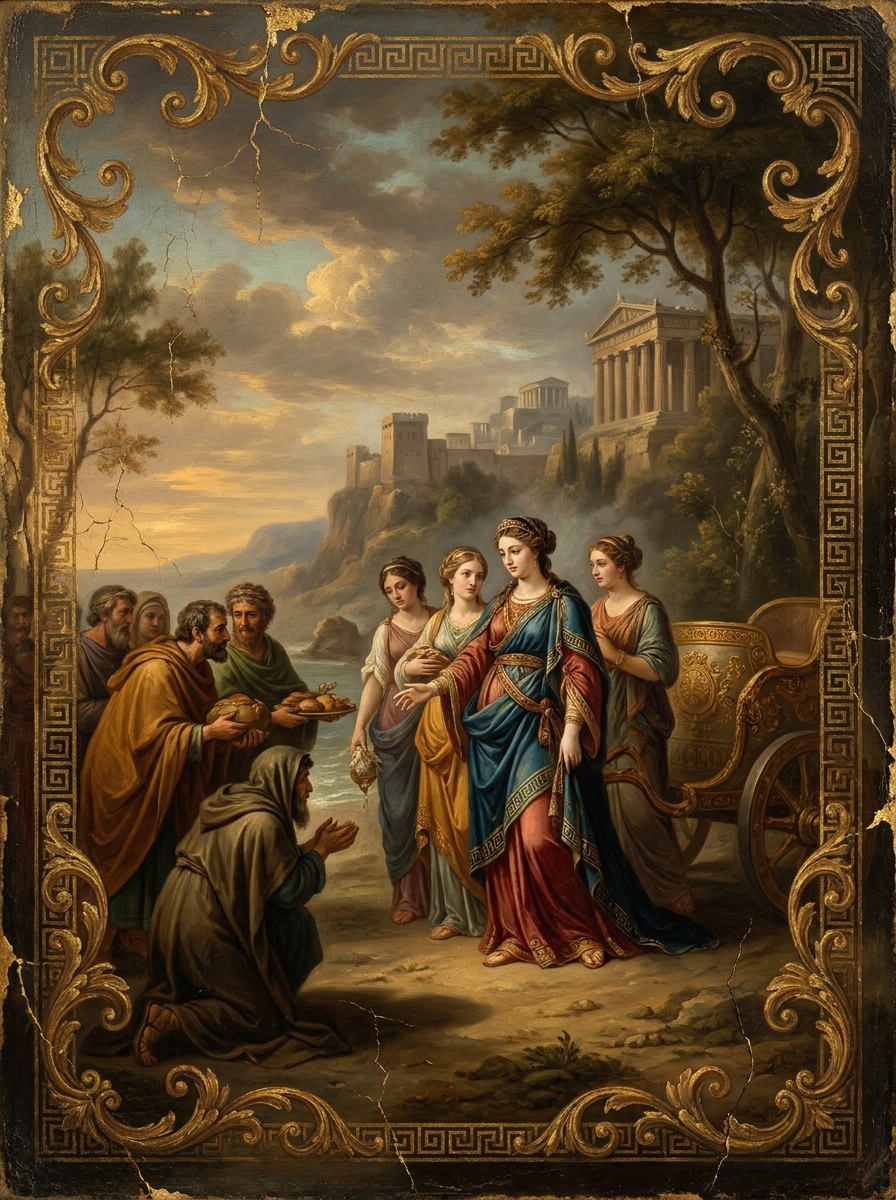
As soon as the maidens saw him, they screamed and scattered. Some ran toward the river; others hid behind the cart. Only Nausicaa did not retreat. Athena had placed courage in her heart. She stood where she was and watched the stranger approach.
The Suppliant Covered with a Branch
Odysseus did not dare come too close. He knew his appearance was frightening, and he knew that a helpless man must not behave roughly. He stopped at a respectful distance. He did not reach out to touch Nausicaa, but spoke to her where he stood.
First he praised her beauty, saying she was like a goddess. Then he told her he had suffered terribly at sea and been cast ashore by the waves. He did not know what land this was, nor whom he should seek. He begged her to show him the way to the city and to give him some cloth to cover himself. If the gods were willing, he said, may she one day have a good husband and a happy house; for among mortals there is no steadier blessing than a household living in harmony.
The words were reverent, and beneath them lay the low voice of a man who had endured much. As Nausicaa listened, much of her fear left her.
She answered, “Stranger, by your look you have indeed suffered greatly. Poverty and wandering are things Zeus assigns to men, and men must bear them. Since you have come among us, you shall not lack clothing, nor shall you be left without someone to show you the way. This is the land of the Phaeacians, and my father Alcinous is king here.”
Then she turned and called her companions back. “Stop. Do not be afraid. This man has not come to harm us. Strangers from afar and those who beg for help are under the care of Zeus. We must give him food and clothing.”
Slowly the maidens returned. They took garments from the cart and laid them beside Odysseus. They gave him the oil and withdrew. Odysseus went down into the river, washed the salt and mud from his shoulders and back, rubbed himself with oil, and put on the clothes. Athena made him seem taller and nobler, and his hair fell about his brow like clustered blossoms.
When he came back from the river, Nausicaa saw that he no longer looked as wretched as before, and wonder stirred quietly in her heart. She said to her companions, “A moment ago this man seemed a wanderer worn out by misery; now he looks like one of the gods. If I could one day marry such a man, and if he were willing to live here, that would be no bad thing.”
Yet she soon gathered her thoughts and began to arrange the return to the city.
Instructions Before the City
The clothes were dry. The maidens folded them and put them back on the cart. The mules were harnessed again, and Nausicaa took the whip, ready to go home. But she did not have Odysseus walk beside the cart at once. Instead, she gave him careful instructions.
“Stranger,” she said, “listen to me. We Phaeacians do not often receive men from abroad, and people in the city are quick with their tongues. If they see me bringing a young man into town, they will say ugly things. I do not want such talk to reach my father and mother.”
She told Odysseus to let her and her maidens go ahead. After they had entered the city, he should follow the road. Beside it he would find a grove of tall poplars, with a spring and a sacred place of Athena. There he should wait for a while. When he judged that they had reached the palace, then he could enter the city.
She also told him how to find the palace. The most splendid house in the city was the house of Alcinous. Once inside, he must not first entreat the king, but go to Queen Arete. She often sat beside the fire with yarn in her hands, leaning against a pillar, her serving-women nearby. If her heart took pity on him, then he would have hope of returning to his homeland.
Odysseus remembered every word. Nausicaa cracked the whip and urged on the mule-cart. The wheels rolled over the road, and her maidens followed until they disappeared toward the city. Odysseus remained behind, looking after them, and for the first time a steadier hope rose in him.
Light in the Palace
When enough time had passed, Odysseus rose and went toward the city. Athena wrapped him in mist, so that even if people on the road saw him, they would not stop him with questions. In the city there were harbors and long ships, and oars were set in rows along the walls. The Phaeacians loved ships; every household knew the sea wind.
He came to the palace and saw the threshold and walls gleaming in the firelight. In the courtyard grew fruit trees in rows: pear, pomegranate, apple, fig, and olive, their branches rarely bare. Vines hung from trellises; some were flowering, some bore green clusters, and some had already turned purple. Channels of water ran through the garden, feeding the roots, then flowing out beyond the court.
Odysseus stood for a little while before crossing the threshold. The hall was full of Phaeacian chiefs and nobles. They were pouring offerings to the gods and preparing to rest. Alcinous sat in the place of honor; Arete was by the fire with her weaving, and maidservants moved back and forth.
When the mist lifted, Odysseus had already reached the queen. He bent down, clasped Arete’s knees, and begged her and the king to pity a wanderer and send him home. When he had spoken, he sat down in the ashes beside the hearth, the humblest place for a suppliant.
For a moment the hall was silent. Everyone looked at this stranger who had appeared so suddenly. After a while, an elder among the Phaeacians reminded the king that it was not fitting to leave a guest sitting in the ashes. He should be raised up, given a seat, and offered food.
Alcinous rose at once, lifted Odysseus by the hand, seated him beside himself, and ordered the maids to bring water for washing, bread, and meat. Odysseus ate, and his hunger eased a little. The king poured wine for the company and asked them to pray for the suppliant. Late in the night the guests departed, and the palace grew quiet.
Only then did Arete ask about the clothes he wore, for she recognized them as garments washed by her own daughter and servants. Odysseus did not hide the truth. He told how the waves had thrown him ashore, how he had met Nausicaa by the river, and how the princess had given him clothing and directions. But he spoke carefully of her concern that bringing a strange man into the city might invite gossip, and so he gave no cause for blame to fall upon her.
When Alcinous heard this, he was still more willing to help. He said that if this guest wished to remain, he would even gladly give him his daughter in marriage; but if he longed for home, the Phaeacians would not hold him back. The next day they would summon the sailors, prepare a ship, and carry him to his native land.
Tears at the Song
The next day Alcinous called together the chiefs and sailors of the Phaeacians in the assembly place and announced that they would send the stranger home. They chose a ship and selected skilled rowers. Afterward, the king held a feast in the palace to honor his guest.
To the banquet came a blind bard named Demodocus. A servant led him to his seat and placed the lyre beside his hand. While the company ate and drank, he touched the strings and sang the old deeds of heroes: the strife beneath the walls of Troy, and the hard fighting of the Achaeans.
When Odysseus heard the song, it was as if a knife had opened his heart. He remembered dead companions, burning ships, and all those men of the ten-year war who would never return home. He drew his cloak over his face, and tears slipped from his eyes, for he did not want the others to see him weep.
Alcinous noticed. He did not press him in front of everyone, but stopped the song and ordered games for the young men. The Phaeacians were skilled at running, wrestling, jumping, and throwing the discus. The youths competed in the field, and laughter and cheers rose again.
One man, seeing Odysseus silent, spoke slightingly of him, thinking him only a merchant sailor with no knowledge of heroic skill. Odysseus heard and was angered. He took up a discus heavier than the others had used, planted his feet, and hurled it with all his strength. It flew beyond the marks of all the competitors and landed far away. Then the Phaeacians knew that this guest, though worn by suffering, was no ordinary man.
Later the feast was set out again. Demodocus sang once more, this time of the Wooden Horse and the fall of Troy. Odysseus could no longer restrain himself, and tears fell again. Alcinous saw that his grief was deeply bound to these songs, and gently asked him: Who are you? Where is your city? Why do you grieve so bitterly when you hear the songs of Troy?
This time Odysseus told them his name.
He said he was Odysseus of Ithaca, that he had fought at Troy, and that on the journey home he had endured disaster after disaster. The people in the hall listened in silence. The stranger cast up by the sea was no longer a nameless suppliant. He had a home, a father, a wife, a son, and a road home as long and dark as night.
The Ship of the Phaeacians
Odysseus told the story of his wanderings, and when he had finished, the night was far advanced. The Phaeacians had listened in wonder, and their pity for him grew. Alcinous did not withdraw his promise. Instead, he ordered the people to prepare still more gifts: bronze, gold, garments, and finely made chests. Arete herself told the maidservants to fold the clothes carefully and fasten the lids of the chests.
When the hour of departure came, the ship was already waiting by the sea. The Phaeacian vessel floated steady on the water, the rowers seated along both sides, ready for the command. In the palace, Odysseus took leave of his hosts. He thanked them for their welcome, and he thanked the princess who had not fled from him by the river.
Nausicaa stood near the doorway and looked at him. On a morning by the river she had given him clothing; now he was leaving by ship. She told him that when he reached his homeland, he should remember her, for she had been the first to save his life.
Odysseus answered that if he returned home alive, he would remember her as one remembers a god. She had shown him the road home again when he had stood at the edge of ruin.
In the night, the Phaeacians led him aboard. The ship left the shore of Scheria; the oars dipped in even strokes, and foam shimmered faintly beside the hull. Odysseus lay down on the blankets prepared for him, and sleep soon came over him. This time he was not sinking into leaves in a thicket, nor struggling on a broken plank. He slept aboard a ship whose people meant to bring him home.
The coast of the Phaeacians faded behind him. Nausicaa, Arete, Alcinous, and the bright palace were left astern. Yet the clothing, gifts, and ship they gave him carried him back from the edge of wandering and set him once more upon the path to Ithaca.