Greek Mythology
Menelaus, Helen, and Polyxena — Greek Mythology
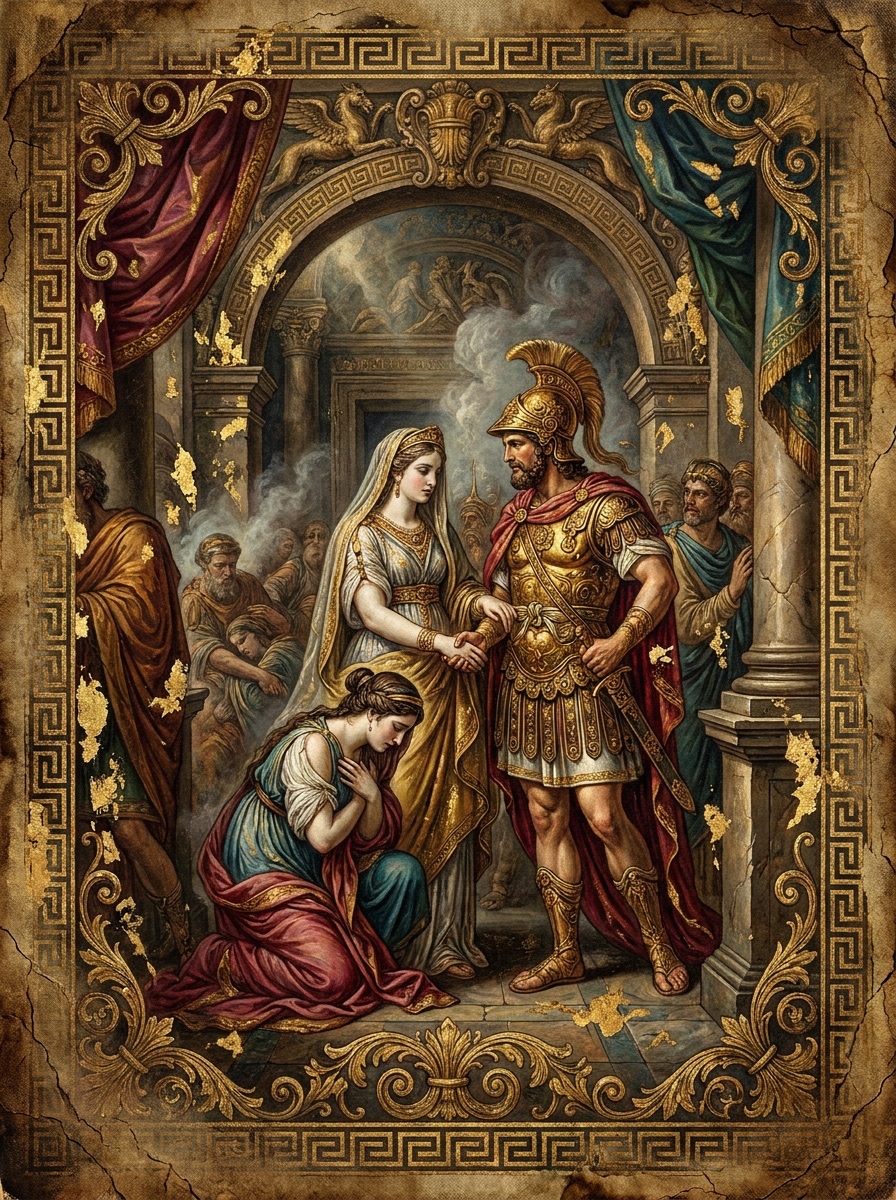
After Troy fell, Menelaus at last found Helen. He meant to end ten years of shame with his sword, but the moment he saw her, his heart failed him. Meanwhile, the Greeks led Polyxena, the young daughter of Priam, to Achilles’ tomb as a sacrifice, and the last brightness of the Trojan royal house was drowned in blood.
Article
Summary
On the night Troy fell, the Greeks climbed out of the Wooden Horse, opened the gates, and the city sank into fire. Menelaus went through the streets with his sword, carrying ten years of anger into that one hour, determined to kill with his own hand the wife whose departure had brought the war. He found Helen in the house of Deiphobus. She stood amid smoke and blood, with nowhere left to flee. Menelaus raised his sword, but when he saw her face, old love and beauty overcame his rage. In the end he did not strike her down, but ordered that she be taken back to the ships. At dawn, the women of the Trojan royal house were gathered and allotted to the victors. Hecuba, Andromache, Cassandra, and Polyxena all became captives. Just as the Greeks prepared to sail home, the ghost of Achilles demanded an offering, and young Polyxena was chosen to be sacrificed at his tomb. Polyxena was led to the burial mound by the sea. She did not cry out or beg for her life, but asked to die as a free person. Neoptolemus lifted the knife before Achilles’ grave, and the girl’s blood ran into the earth while Hecuba could only weep nearby. In the end, Menelaus took Helen aboard his ship, and the Greeks carried their captives away. Helen lived and returned to her husband’s side, but Polyxena remained forever on the Trojan shore before the tomb, and the grief after the city’s fall settled most heavily upon these women.
Fire Reaches the Palace
On the night the Wooden Horse was dragged into Troy, the Trojans believed the long struggle had finally ended.
They opened their gates and hauled the great horse near the temple. Men gathered around it singing; women lit lamps beneath the eaves. Ten years of siege had worn the city down. No longer did Achilles’ chariot thunder beneath the walls, and the Greek camp by the shore seemed abandoned. People drank wine, offered sacrifice, embraced their families, and thought that with morning they might mend their roofs again and return to the fields.
But deep in the night, when the city had fallen quiet, the Greek warriors hidden inside the horse pushed open the secret hatch. One by one they slipped down ropes from the high belly of the beast. They crept to the city gates and drew back the bars. The Greek fleet had already returned under cover of darkness; when the signal fires flared, the men lying in wait outside poured in like a tide.
By the time Troy woke, ruin had come to the bedside.
The streets rang with the clash of weapons. Flames climbed across rooftops, and beams cracked in the heat. Old men fled with their hands against the walls. Children cried in their mothers’ arms. Some snatched up swords and rushed to the doors, only to fall beneath spears coming straight at them. Others hid in temples and clung to the knees of the gods’ images, but even there they were dragged away. The high city that ten years of war had failed to take became, in a single night, a heap of fire.
Menelaus was among those who stormed into the city.
He was king of Sparta, and Helen’s husband. Because Helen had been taken by Paris to Troy, the kings of Greece had gathered their fleets and crossed the sea. For ten years, countless men had died on the plain outside the walls. Menelaus had watched comrades fall and funeral pyres rise one after another in the camp, and through it all one thought had lain heavy in his heart: when the city fell, he would kill Helen with his own hand.
That thought carried him through blood and fire.
Menelaus Searches for Helen
Paris was already dead. Afterward Helen had been forced to marry his brother Deiphobus. On the night Troy fell, the house of Deiphobus too was broken into by the Greeks. Bronze vessels had been knocked over, bed hangings torn down; there was blood on the threshold, and firelight made the walls flicker in and out of darkness.
Menelaus entered with his sword.
Ancient traditions do not all tell that moment in the same way. Some say Helen, amid the confusion, had already signaled to the Greeks and helped them find Deiphobus. Others say only that she hid in the house, listening as the footsteps outside drew nearer, knowing that there was no escape left for her. Yet all the stories remember the same thing: when Menelaus found Helen, his sword was in his hand, and his anger had not cooled.
He saw Deiphobus fallen. Then he saw the woman in the corner.
Helen came out of the shadow. Her clothing was stained with ash; her hair no longer shone as it had in palace halls. She was not the girl who had left Sparta ten years before, nor the royal wife praised in Trojan songs. She stood in a shattered house, hearing the cries outside, and knew that the Greek victory was also her judgment.
Menelaus raised his sword.
Ten years of rage tightened in his arm. He thought of the empty palace, of the fleet that had crossed the heavy sea, of the warriors who had died because of her. He could have struck then and ended the tale in blood.
But Helen lifted her face.
Firelight fell across it. Time, fear, and shame had not wholly covered her beauty. It was no longer the bright laughter of a feast, nor the dazzling charm Paris had first seen, but something like a last glow still unquenched after disaster. Menelaus’ hand halted in the air. He held the sword, yet suddenly seemed to have lost his strength.
The Greeks around him waited for the blow. Some urged him to kill her, lest she bewitch him again once they reached the ships. Others said that so much blood had been shed for this woman that she should not be allowed to return alive to Greece.
Menelaus did not answer at once.
He looked at Helen, and Helen looked back at him. She had nowhere to run. Splintered wood and blood lay at her feet; behind her the city burned. Her life rested only on the sword in his hand.
At last Menelaus lowered the blade.
He did not kill Helen in the fires of Troy. He ordered that she be taken away, back to the Greek ships. Some said he was conquered by beauty; others said that in that instant he remembered the marriage bed and the home they once had shared. Whatever the reason, Helen lived. She did not fall in the streets like the princes of Troy, nor was she offered on the spot to the dead. She was brought back to the Greek camp to await the voyage with Menelaus.
The Trojan Women Divided
When dawn came, Troy no longer seemed a city.
The walls still stood, and the gates were still there, but within them everything was ash. Old King Priam was dead. Hector had long since been buried. Paris and Deiphobus had left no life behind them. The women of the royal house were driven together and made to sit on the ground, waiting for their fate.
Hecuba had once been queen of Troy. Now she wore torn clothing, and her hair hung loose. Around her were daughters, daughters-in-law, and women of the palace. Whenever they saw Greek commanders approaching, they knew another of them was about to be led away.
Andromache, Hector’s wife, was given to Neoptolemus, the son of Achilles. Cassandra, the princess who had foretold disaster in the temple though no one believed her, was taken by Agamemnon. The old queen’s eyes moved again and again through the crowd, searching for her children, as if one more look might somehow keep them beside her.
Polyxena was among the captives too.
She was the daughter of Priam and Hecuba, and she was still young. When the war began, perhaps she had been only a sheltered girl inside the palace; by the time it ended, she was a princess of a destroyed city. She had no army, no walls, no father or brothers left to protect her. As the Greeks counted their spoils, they counted these living captives too and divided them among different masters.
But Polyxena was not allotted like an ordinary captive woman.
A terrible demand spread through the Greek camp: the ghost of Achilles required a sacrifice.
Achilles had been the strongest warrior in the Greek army. He had died outside the walls of Troy; his body had been won back by his comrades, and his ashes laid in a mound beside the sea. Now that the city had fallen and the Greeks were preparing to sail home, they did not dare ignore the will of the dead hero. Tradition says his shade appeared above the tomb, or else made his demand known through omens: Polyxena, the young daughter of Priam, was to be offered to him.
When this news reached the captives, Hecuba could hardly stand.
She had lost her husband, her sons, and her city. Now even her daughter was to be taken to a grave. She stretched out her hands and clutched Polyxena as if holding the last plank in a storm. But the Greek soldiers had already come. At their commanders’ order, they were to bring the girl to the tomb of Achilles.
The Girl Before Achilles’ Tomb
The wind by the sea was cold.
The tomb of Achilles stood near the Greek camp, a high mound facing the Trojan plain and the smoke-darkened city. The instruments of sacrifice had been set beside it, and the knife flashed in the morning light. Greek commanders stood around; soldiers formed a ring. Neoptolemus was there too, son of Achilles, heir to his father’s armor and name, and now the one appointed to complete this blood offering for him.
Polyxena was led before the tomb.
She wore no rich clothing from the palace. She was only a girl who had lost her country and her house. Yet the old stories say that when she came there, she did not scream or beg for mercy. She saw the altar, saw the knife, and saw the silent Greeks. She understood that she would never return to her mother’s side.
Behind her Hecuba cried out and tried to rush forward, but men held her back. Her voice broke in the sea wind, now calling her daughter, now cursing the victors. Polyxena heard her, but did not turn and run. She would not be thrown down like an animal, nor have her hands bound and be dragged to the grave.
She stood upright and told the Greeks to let her die freely.
For a moment the soldiers were quiet. This conquered girl had no weapon, yet before death she kept the last thing that was hers: her dignity. Some lowered their eyes, unwilling to watch. Some tightened their grip on their spears, as though afraid their hearts might soften. Neoptolemus stepped forward with the sacrificial knife in his hand.
Polyxena arranged her garments and uncovered the place where the blade must fall. She would not be held, and she would not be supported. She stood before the tomb of Achilles, facing the man who would kill her, as if she still remembered that she was a daughter of the Trojan royal house.
When the knife came down, Hecuba’s cry tore through the stillness by the sea.
Blood ran onto the earth before the tomb. The Greeks believed that the ghost of Achilles had received the honor due to him. But for the Trojans, it was only another royal life taken from them. The city had burned, the king was dead, and now a young princess had fallen beside the grave of an enemy.
Helen Boards the Ship
After Polyxena’s death, the Greeks continued preparing for home.
They carried gold and silver, bronze vessels, woven cloth, horses, and captives down to the ships. The vessels that had once sailed here for war were now loaded with plunder. Waves struck against the hulls; masts creaked in the wind. There was little laughter of victory in the camp, only weariness and the silence of men eager to leave.
Menelaus also brought Helen to the shore.
Many Greeks still could not believe he had spared her. As she passed, some looked at her and remembered dead brothers and friends, and their eyes were full of hatred. Helen kept her head lowered and made no defense before them. She knew her name had become bound to the war. Whether she had once been enticed away, compelled to remain, or had wavered in her heart at certain moments, none of the dead would return.
Menelaus did not hand her over to the soldiers, nor did he have her executed in public. He brought her onto the ship and kept her beside him. The sword that should have killed her was never stained with her blood.
The women of Troy were driven, one after another, onto different ships. Looking back, they saw smoke still rising from the city and knew they would never return to those colonnades, wells, and looms. Hecuba had lost her daughter and was now to be carried into a foreign land. Andromache bore her grief away from Hector’s tomb. Cassandra’s prophecies had all come true at last, and still no one could change her fate.
Helen left alive, while Polyxena remained before the tomb of Achilles.
One woman, believed to have brought the war, was led out of the fire by her husband. One girl, who had had no power to turn the war one way or another, paid with her life for a dead hero. When the Greek sails rose, the shore of Troy was left with ashes, burial mounds, and weeping. After that night, the story of the fallen city belonged not only to the victors, but also to those who were carried away and those who were left behind.