Greek Mythology
Memnon at Troy — Greek Mythology
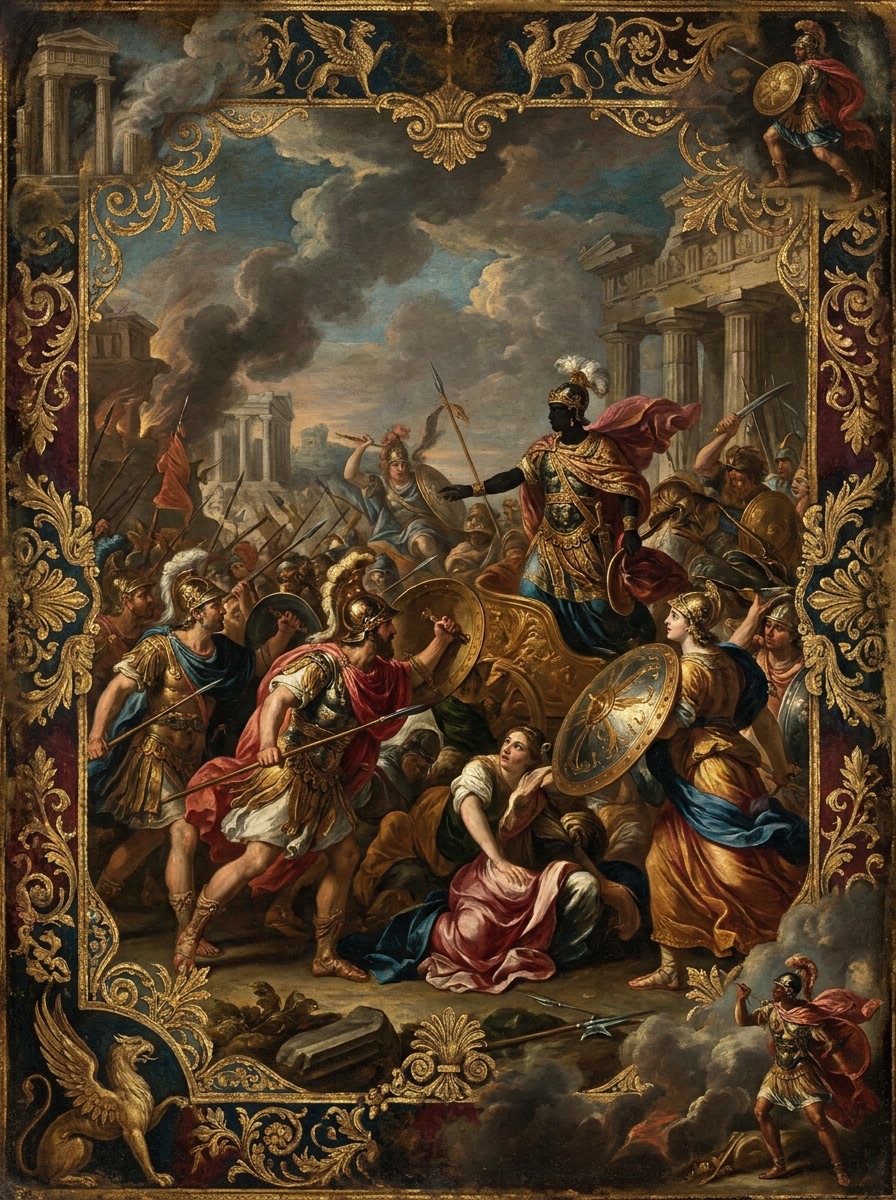
After Hector’s death, Troy still would not fall. Then Memnon, son of the dawn goddess, came from the east with an army to aid the city. He killed Antilochus and later met Achilles outside the walls, where he fell beneath the spear of Greece’s greatest hero.
Article
Summary
After Hector and Penthesilea had both fallen, Troy sank once more into despair. At dawn, a distant army appeared on the eastern road, led by Memnon, son of Eos, the goddess of dawn. Wearing armor forged by Hephaestus and leading Ethiopian warriors, he came to Troy and gave Priam and the city a new glimpse of hope. When Memnon entered the battle, Trojan courage rose with him. He struck the Greek line on the plain, killed many enemies, and drove toward aged Nestor. Antilochus, Nestor’s son, stepped in to save his father, but Memnon killed him, bringing fresh grief to the Greek camp. Achilles heard that Antilochus had fallen, remembered the young friend he had lost, and listened to Nestor’s plea for vengeance. He mounted his chariot again and rushed toward Memnon. The confidence that had just returned to the Trojans wavered at the sight of Achilles, and warriors on both sides drew back to watch the sons of two goddesses fight. Memnon was the son of Eos, while Achilles was the son of Thetis, and their clash seemed like dawn from the east meeting a storm from the sea. Tradition says Zeus weighed their fates on a balance, and Memnon’s death-lot sank. Achilles found his opening and drove his spear through Memnon’s armor, avenging Antilochus. When Memnon fell, Eos mourned her son, and people later said the dew on morning grass was made from her tears. His followers were remembered as Memnonides, birds that cried and fought around his tomb, while Nestor held funeral rites for Antilochus. Troy had lost another mighty ally, and the hope brought from the east shone only briefly, like dawn, before vanishing into battlefield dust.
Reinforcements in the Dawn
After Hector’s death, Troy seemed to have lost its backbone.
The walls still stood, the gates were still shut, and the watchmen on the towers still looked out toward the Greek camp by the sea. Yet everyone inside the city understood what had happened: the champion who had so often driven the Greeks back to their ships would not be returning.
Priam had grown old. He sat in his palace listening to the women weep for their dead sons, listening to the rumble of chariots across the plain, and it felt to him as though a stone of cold weight had been laid upon his chest. The Trojans were still resisting, but each day their courage seemed thinner. The name of Achilles alone was enough to make even a young warrior tighten his grip on his spear.
Then, in those days, dust rose along the road from the east.
At dawn, just as the sky began to flush pale red, the watchers saw a host approaching from far away. First there was the flash of spearheads in the morning light, then shields, manes, wheels, and ranks of foreign warriors. They had not come from the Greek ships, nor from any city nearby. Their banners opened in the wind like clouds lifted from a hot and distant land.
At their head rode a hero of great stature, his skin darkened by the sun. He wore brilliant armor, bronze newly polished by fire, with a cloak over his shoulders and a spear in his hand. His horses snorted white breath as they crossed the dust of the Trojan plain.
He was Memnon, son of Eos the dawn goddess and kingly child of Tithonus. He had come from far-off Ethiopia with troops to aid Priam at Troy.
When the gates were opened, the Trojans crowded the roadside to see him. The old men whispered that the gods had not wholly abandoned Troy. The younger warriors stared at his armor, and hope began to move again in their faces. Priam himself came out to receive him and led him into the palace. The old king looked upon this hero from afar and thought of his own dead sons. Tears rose in his eyes, though he forced himself to stand straight.
Memnon did not waste words in boasting. He listened to the story of Troy’s troubles and promised to fight the next day. He said he had not come to sit and drink in a palace, but to speak with his spear on the plain.
That night, the Trojans slept more peacefully than they had in a long time. The Greek fires still burned outside the walls, and the sea still beat against the ships, but inside the city people began to hope for morning.
Memnon Goes to War
The next day, when Eos rose from the edge of the sea, the sky was red as flame. Some said it was because a mother was watching her son ride out to battle, and the heavens had taken on her color.
Memnon armed himself and climbed into his chariot. His armor, it was said, had been made by Hephaestus. His breastplate fitted him closely, his shield shone hard and bright, and the plume on his helmet swayed in the wind. Behind him, the Ethiopian warriors stood in formation, spears angled upward like a moving forest.
The Trojans threw open their gates and followed them out onto the plain.
The Greeks saw at once that a new force had arrived. They had already fought so many battles that they had begun to think Troy’s strength was nearly spent. But on this day the defenders poured from the gate with greater fury than before. Memnon’s chariot came first, its wheels tearing up dust, and his spear struck down one Greek warrior after another. Those he hit tumbled from their chariots, their shields rolled aside, and blood sank into the hard earth.
Unease spread through the Greek ranks. Men cried out, “Who is this? Hector is dead—where has Troy found another hero like him?”
Memnon did not slow. He drove his chariot toward the thickest part of the fighting, turning the spear in his hand so that the bronze point kept searching for openings. The Trojans, seeing his strength, shouted and followed after him. From the walls the women looked down and saw the Greeks being forced back across the plain, and they prayed to the gods that this eastern hero might truly save Troy.
Among the Greeks, old Nestor had also taken to the field. Though age had bent him, he still sat in his chariot and directed his men. He knew battle well, and his voice was steady. Many young warriors, hearing his calls, rallied themselves again.
Memnon saw the old king’s chariot and drove straight toward him.
Nestor knew well that in his youth he had been strong, but now his arms were no longer what they had once been. His horses shied, and his chariot lurched among the dead and the fallen weapons strewn across the field, unable for a moment to turn away. Memnon’s spear drew closer and closer, and the Trojan cries came nearer too.
At that moment, a young hero rushed to his father’s side.
It was Antilochus, Nestor’s son and the beloved friend of Achilles. Seeing his father in danger, he did not pause to think. He stepped in at once, raised his shield, and called for Nestor to fall back as he hurled his spear at Memnon.
Memnon avoided the blow.
Then his own spear came thrusting in. Antilochus blocked the first strike with his shield, bronze ringing against bronze like stone splitting apart. But Memnon’s force was too great, and the second attack came fast and hard. The spearpoint slipped past the shield’s edge and pierced the young man.
As Antilochus fell, he still seemed to turn, as though to see whether his father had escaped. His fingers loosened on the spear, and his body dropped into the dust.
Nestor cried out in grief and tried to leap down from his chariot to recover his son’s body. The Greeks around him fought desperately to protect him and pulled him away from the front. The old man looked back toward the place where Antilochus had fallen, and tears ran down his dust-covered face.
He knew his son had died to save him.
Achilles Hears the News
The tidings of Antilochus’ death soon reached Achilles.
At that time Achilles was near the camp, setting his weapons in order. Since killing Hector, his fury had not truly gone out. Patroclus’ tomb was still there, and the corpses of the fallen still lay by the ships. War remained like a thorn driven into the flesh: impossible to pull out, impossible not to touch.
A messenger came running breathless to tell him that Memnon had killed Antilochus.
Achilles was silent for a while.
He remembered the young man. Antilochus had been quick in movement and quick in speech, often running errands for Nestor; and at the funeral games for Patroclus, he had stood among the heroes with all the sharp wit and daring of youth. Now he lay under Memnon’s spear, dead because he had tried to save his father.
Achilles took up his shield. It was heavy in his hands, like a cold moon. He set his helmet on his head, and the horsehair crest trembled above him. Those near him, seeing his face, said little.
Nestor also came.
The old man did not speak at length as he usually might have done. He stood before Achilles with a voice broken by grief and begged him to avenge Antilochus and bring his son’s body back from the battlefield.
Achilles agreed.
He climbed into his chariot, and his horses surged forward. As soon as the wheels turned, dust billowed up behind him. When the Greeks saw him ride out, their spirits rose again; when the Trojans saw him approaching, their shouting slowly faded. They knew Achilles was no ordinary enemy. Hector had once faced him on this very plain and had been killed; now Memnon would have to meet the same man.
The Sons of Two Goddesses
Memnon did not retreat.
Seeing Achilles’ chariot burst from the Greek ranks, he raised his spear and rode out to meet him. On both sides the warriors drew back to leave a space between the two heroes. Dust rolled beneath their feet, and broken shields, snapped spear-shafts, and the reins of dead horses lay scattered around them. On the walls of Troy, men and women held their breath; before the Greek ships, the warriors stopped their own fighting and watched this duel unfold.
It was the meeting of two sons of goddesses.
Achilles was the son of Thetis, the sea goddess. Memnon was the son of Eos, goddess of dawn. One had come from the sea, the other from the east; one fought for revenge for a friend, the other for Troy. Both were young, both were fierce, and both walked beneath the shadow of death.
They threw their spears first.
Memnon’s spear glanced off Achilles’ shield, ringing it like a struck bell, but it did not pierce. Achilles’ spear was also dodged, and it buried itself in the earth behind Memnon, still trembling in the ground.
They drew swords and came together in close combat. Blades struck shield rims and threw off sparks. The dust underfoot had already turned dark with so much blood that it was beginning to slick beneath their sandals. Memnon swung at Achilles’ shoulder; Achilles twisted aside and drove his shield forward. Memnon stepped back, then rushed in again at once. His strength was astonishing, and more than once he forced Achilles to turn and give ground.
Far away, the gods watched too.
Eos feared for her son. Every day she rises from the horizon and gives light to the world, but on this day her brightness seemed veiled in tears. Thetis feared for Achilles. She knew her son was fated to die young, and that glory often walks very close to the grave. Both mothers wanted their children to live, but the battlefield does not stop for a mother’s tears.
Zeus held the final balance. In the tale, it was he who weighed the fate of the two men. When the scale dipped, Memnon’s hour had come.
Achilles saw an opening.
Memnon had just struck down with his sword and his shield shifted slightly aside, leaving a narrow gap at the chest. Achilles’ spear flashed out like lightning and drove through the opening in the armor. Memnon’s body shook, and his sword fell from his hand. He tried to stand his ground, but the earth would not hold him any longer.
The hero who had come from the east fell on the Trojan plain.
The Trojans let out a cry of lamentation. The Ethiopian warriors rushed in to shield his body, and the Greeks surged forward as well, fighting for possession of the fallen hero. Achilles stood beside Memnon, blood still dripping from the spear’s point. He had avenged Antilochus, yet he did not rejoice. For the man lying before him was no coward, but a hero worthy to meet him face to face.
The Tears of Dawn
After Memnon’s death, Eos descended into grief.
She could not rush into the battle like a mortal mother and clasp her son to her breast, nor could she turn back the fate that had already fallen. But her sorrow spread across the sky. The light of morning dimmed, and fine drops of moisture settled on grass and weapons. Later people said that the dew of dawn was Eos’ tears for Memnon.
Memnon’s body was carried away. And there is an old tale about his followers: those who mourned him became birds and flew in circles above his tomb. At certain times they gathered there, as if still fighting for their master, beating their wings and striking one another until feathers fell into the dust. People called them the Memnonides, the birds of Memnon.
The Greeks recovered Antilochus’ body. Nestor held funeral rites for his son, and the old man stood beside the pyre watching the flames consume the young body, knowing that no wisdom of battle could console him now. Achilles also grieved for his friend. He had killed Memnon, but Antilochus would not rise because of it.
Inside Troy, the hope that had just begun to rise sank once more. Priam had lost Hector, and now he had lost the great ally who had come from afar. The walls still towered and the gates were still closed, but the dust of the plain had already buried too many of those who had tried to defend them.
Memnon’s name remained in the story of the Trojan War. He came from the east like the dawn, and at the very hour of brightness he fell. So when morning dew settles on the grass, people remember Eos’ son and the hero who wore god-made armor and fought for Troy to the end.