Greek Mythology
The Lernaean Hydra — Greek Mythology
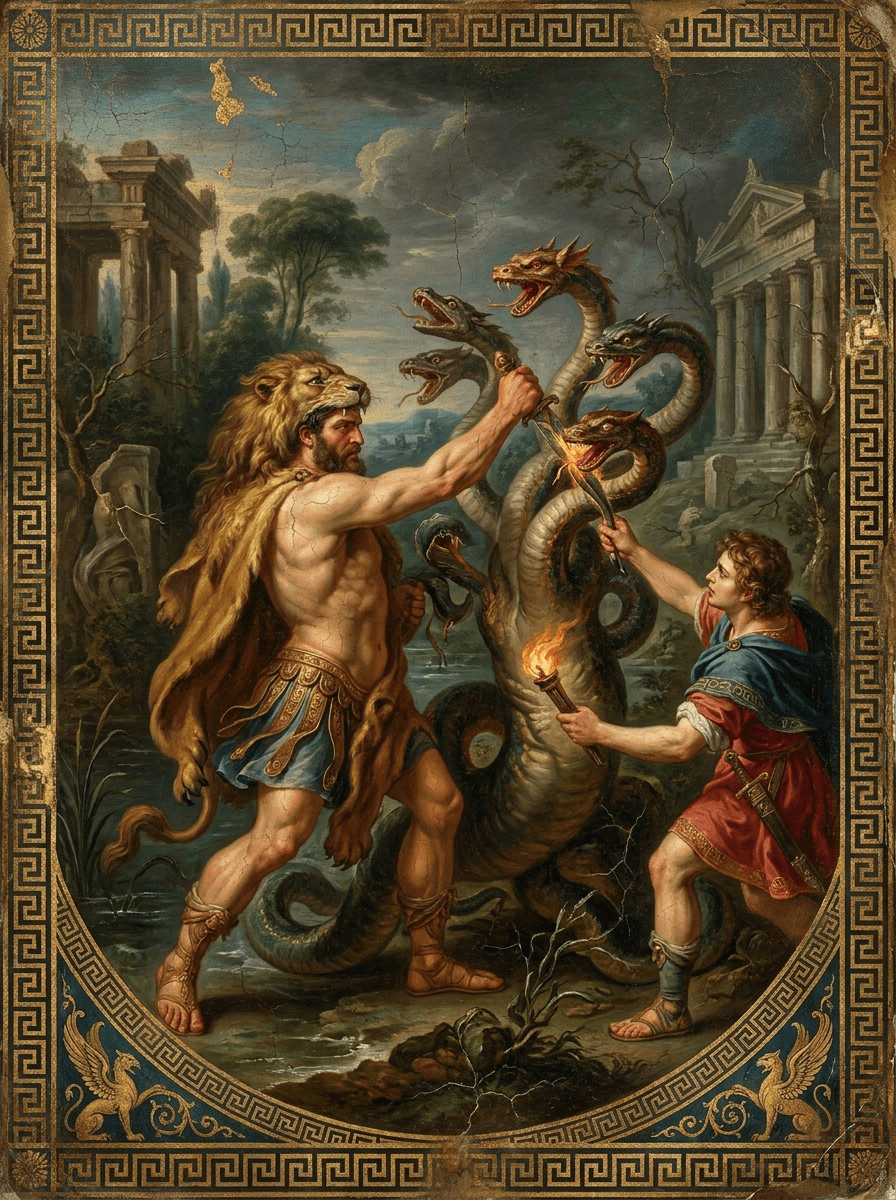
At Eurystheus’ command, Heracles went to the marshes of Lerna to kill the venom-breathing many-headed serpent, the Lernaean Hydra. Each head he cut away grew back in greater number, and Hera sent a giant crab to hinder him. In the end, with Iolaus’ help, Heracles seared the severed necks with fire and destroyed the monster.
Article
Summary
After the Lernaean Hydra was dead, Heracles cut open its body and dipped his arrowheads in its poisonous blood. From that day on, his arrows became dreadful weapons: even the slightest wound from them could bring death. Yet Eurystheus later refused to count the deed, saying that Heracles had not accomplished it alone, since Iolaus had helped him.
The Command beside the Marsh
After Heracles carried the Nemean Lion back to Mycenae, Eurystheus feared him more than ever. The king no longer dared to wait for him at the palace gates. Sometimes, when he heard that Heracles had returned, he hid inside a bronze jar and sent heralds out to speak in his place.
But fear did not make Eurystheus set him free. Hera still hated this son of Zeus, and she meant to wear him down through one deadly task after another. Soon the second command came: Heracles was to go to Lerna and kill the serpent that lived there, the Lernaean Hydra.
Lerna lay in the region of Argos, a low, wet place where reeds and black water ran together. Even by day the surface of the marsh seemed shadowed; at night the croaking of frogs, the rasp of insects, and the far-off cries of wild beasts mingled into a sound that chilled the blood. Deep in the swamp there was a cave, and there the Hydra made its lair.
This creature was no common snake. Ancient tales said it was born of Typhon and Echidna, of the same monstrous line as Cerberus and the fire-breathing Chimera. Its body was huge, its scales gleaming against the wet mud, and from its long necks rose many serpent heads. One head, the most terrible of all, was said to be deathless. Its breath was poisonous; plants near the cave withered, and cattle that drank from the marsh water fell dead.
When Eurystheus sent Heracles there, it was not only to have a monster slain. It was as though he were sending him into a place from which no man should return.
The Burning Arrows
Heracles did not set out alone. He took Iolaus with him. Iolaus was his nephew, young and quick-witted, and steady with the reins. They loaded the chariot with bow and arrows, club, sword, and fire-making gear, then left Mycenae behind. The wheels rolled first over dry earth, then gradually toward the damp lowlands.
When they reached Lerna, the horses refused to go farther. The air stank of rotting mud and poison, and the nearer they came to the marsh, the heavier it seemed to press against the chest. Heracles told Iolaus to halt the chariot on higher ground. Then he took up his weapons and went on toward the cave.
He did not foolishly thrust his head into the darkness. The Hydra lay hidden in the damp gloom, its many heads drawn together like a breathing mass of shadow. Heracles took out his arrows, wrapped burning tow around their tips, and shot them one after another into the mouth of the cave. Flame pierced the darkness. Smoke rolled inward. The monster stirred within, and the walls echoed with the scrape of scales against stone.
Before long, the Lernaean Hydra was driven out.
First several heads slid into view, forked tongues flickering, hissing in the foul air. Then the whole body came gliding from the cave, forcing muddy water up around it. Its necks rose one after another, like a living thicket of venomous vines. Heracles lifted his great club and struck at the foremost head.
The blow landed hard, and one head sagged into the mud. Heracles then swung his sword and cut off another. Poisonous blood spurted out, hissing where it struck the water.
But just as he was about to step forward, the severed neck began to swell. Flesh budded from the stump, split open, and from the place where one head had fallen, two new heads sprang forth. Both opened their jaws at once and lunged at him.
Heracles struck and cut again. Yet whenever he lopped off a head, two more grew in its place. The heads multiplied under his blows, their hissing piled upon itself until the whole edge of the marsh seemed filled with the voices of serpents.
The Crab Sent by Hera
The Hydra’s long body took its chance and coiled around Heracles’ legs. Its cold, wet coils tightened in the mud, trying to drag him down. Heracles braced himself, his feet sinking deep, while his club continued to fall.
At that moment Hera sent a giant crab against him. It crawled out from the marsh, hard-shelled and huge-clawed, and clamped one great pincer onto Heracles’ foot. Pain shot up from his instep. Looking down, he saw the monstrous crab gripping him fast, as if to nail him to the ground.
With a roar, he lifted his foot and stamped down. The crab’s shell cracked, and he crushed it into the mud.
But that brief delay had given the Hydra time to grow still more heads. Heracles understood then that strength alone would not defeat this creature. Holding off the striking heads, he shouted toward the chariot, “Iolaus! Bring fire!”
Iolaus had already seen that the fight was going badly. He leapt down, gathered dry branches and torches, and built up the flames. The fire wavered in the damp wind; shielding it with his cloak, he ran to Heracles’ side.
Heracles swung his sword again and cut off a serpent head. At once Iolaus pressed a torch to the severed neck. The smell of burned flesh rose sharply, and the wound was sealed by fire. No new heads grew from it.
They had found the way.
Heracles cut, head after head, and Iolaus burned, wound after wound. Firelight flickered across the muddy water; serpent blood, smoke, poison fumes, and heat mingled in the air. The Hydra writhed in agony. Its remaining heads snapped wildly—some at Heracles’ shoulder, some at the torch in Iolaus’ hand. Iolaus did not dare retreat too far. He watched for each severed neck, clenched his teeth, and thrust the fire against it.
Little by little, the Hydra’s heads grew fewer. The necks that had once multiplied under the sword became blackened stumps, and from them no new heads could rise.
The Deathless Head beneath the Stone
At last only the central, deathless head remained.
It was more dreadful than all the others, with cold eyes and venom hanging from its teeth. As Heracles came near, it lunged at him and nearly caught his face. He twisted aside, pinned its neck with his great club, then raised his sword and struck with all his force.
The head fell to the ground, but even then it was not wholly dead. Its mouth still gaped; its poisonous fangs still trembled, as though it would bite again if anyone came close.
Heracles did not leave it lying beside the marsh. He dug into the earth by the road, buried the deathless head, and rolled a heavy stone over it. The stone pressed down the soil and held fast the venomous thing beneath. Anyone passing that way would see only a quiet rock, never knowing what lay hidden below.
The Hydra’s body lay collapsed at the marsh’s edge, its poisonous blood still flowing slowly out. Heracles cut open the carcass and dipped his arrows into the venom one by one. The arrowheads took on a dark, gleaming poison, and from then on they became fearsome weapons. In later days, anyone struck by such an arrow would rarely escape death.
Iolaus put away the torches. The chariot and horses still waited at a distance. Smoke drifted slowly from the marsh, a patch of reeds stood blackened, and ash floated on the water. Heracles left Lerna with his poisoned arrows and returned to report the deed to Eurystheus.
But when Eurystheus had heard the whole account, he would not freely acknowledge the labor. He seized on a single point: Heracles had not done it alone. Iolaus had helped him burn the serpent’s necks, and so, Eurystheus said, this labor could not be counted among his achievements.
That judgment did not bring the Lernaean Hydra back to life. The marsh at Lerna was rid of the poison-breathing monster. The roadside stone still held down the deathless head beneath it. And in Heracles’ quiver there now lay arrows so deadly that enemies would tremble even to hear of them.