Greek Mythology
The Judgement of Paris — Greek Mythology
At the wedding feast of Peleus and Thetis, a golden apple inscribed “for the fairest” set three goddesses at odds. Zeus would not judge between them, and so the choice fell to Paris, a prince of Troy. Paris chose Aphrodite—and in doing so, turned Troy toward the great disaster to come.
Article
Summary
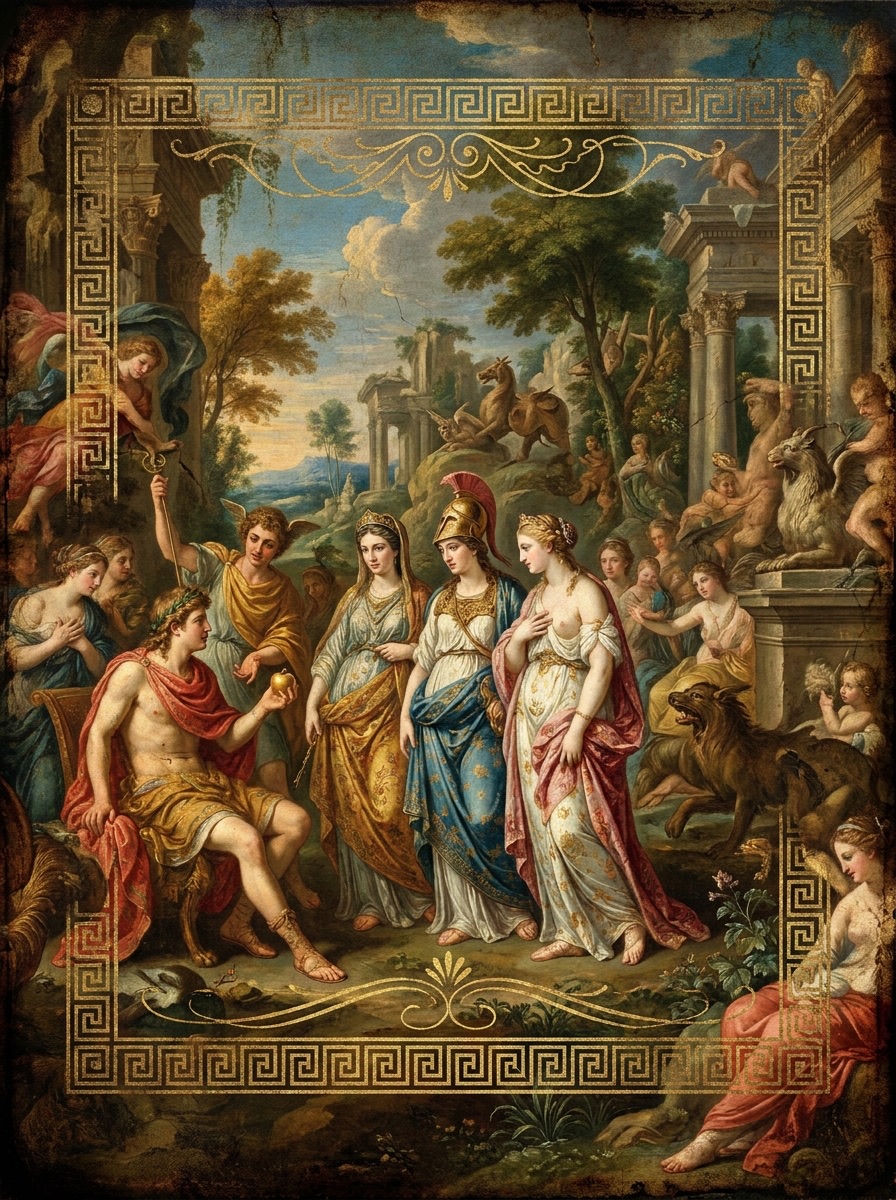
When the sea-goddess Thetis married the mortal hero Peleus, all the gods came to the feast. Only Eris, goddess of strife, had not been invited. Angered by the slight, she came near the banquet and threw down a golden apple inscribed “for the fairest.” Hera, Athena, and Aphrodite each claimed it, and before long the quarrel was brought before Zeus. Zeus knew this was no easy matter to settle. One goddess was his wife, one his daughter, and one possessed the power to bewilder gods and mortals alike. Refusing to speak the judgement himself, he sent Hermes to lead the three goddesses to Mount Ida, where a young shepherd named Paris was to decide. Paris was in truth the son of Priam, king of Troy, but because dark omens had attended his birth, he had been sent away to be raised in the mountains. That day he was watching his flocks on the hillside when Hermes suddenly appeared before him with the three goddesses. Hera promised him lordship over wide lands; Athena promised victory and wisdom in war; Aphrodite promised him the most beautiful woman in the world. Paris gave the golden apple to Aphrodite. From that moment Hera and Athena held resentment against him and against Troy, while Aphrodite remembered the promise she had made. What seemed a small judgement on a mountain pasture would one day draw in Helen, Sparta, Troy, and the fates of countless heroes.
The Goddess Who Was Not Invited
When Peleus and Thetis were married, the feast was magnificent.
Peleus was a hero among mortals, but Thetis was a goddess of the sea. Her father, Nereus, dwelt beneath the waters, surrounded by daughters as swift and bright as waves. Such a wedding was rare among men, and even the gods wished to see it. The immortals came down from Olympus; wine filled the cups, music and song passed through the hall, and blessings were spoken over the bride and groom.
But one goddess had not been invited.
Her name was Eris, the goddess of strife. Wherever people quarreled, wherever a single word or a small possession could make eyes burn with anger, she was glad to stand nearby. No host would willingly admit her to a wedding feast. Yet the more deliberately she was shut out, the less likely she was to go quietly away.
Eris came near the banquet. She did not shout abuse, nor did she overturn the tables. She simply took out a golden apple and tossed it among the gods. It rolled across the floor, gleaming in the lamplight. Someone bent down to look, and saw words written upon it:
“For the fairest.”
Those few words cut faster than a blade.
Hera saw them. She was the wife of Zeus, accustomed to sitting beside the throne and receiving the honor of the gods. Such an apple, she thought, plainly belonged to her.
Athena saw them too. Born from the head of Zeus, armed with helm and spear, bright-eyed and skilled in war, craft, and counsel, she did not think she should yield to anyone.
Aphrodite was no more willing to step aside. She ruled over love and beauty, and if she so much as brushed the heart of god or mortal, ordinary judgement might vanish. She looked at the apple as though the words upon it had been written for her from the beginning.
The three goddesses each reached for it, and none would let the others take it. The wedding, so joyful a moment before, changed at once. Cups halted in midair; the singing fell low. All the gods knew this was no quarrel into which one should speak carelessly.
At last the goddesses brought the matter before Zeus and demanded his judgement.
Zeus Sends the Judgement to a Shepherd in the Hills
Zeus sat in his high place and looked upon the three goddesses before him.
If he declared Hera the fairest, Athena and Aphrodite would not be content. If he chose Athena, Hera would remember it. If he named Aphrodite, the other two would not easily forget. A golden apple looked like a small thing, but inside it lay trouble enough to raise a storm.
Zeus had no wish to take the judgement upon himself. He summoned Hermes. Hermes wore winged sandals upon his feet and often carried the herald’s staff in his hand; messages, roads, mountain paths, city gates—these were all his province.
Zeus told him to lead the three goddesses to Mount Ida near Troy. There, he said, lived a young man named Paris. Let him decide who should receive the golden apple.
At that time Paris was not yet a prince honored in the city. He lived in the mountains and watched his flocks among shadows of trees and grassy slopes. In the morning he drove the sheep to dew-wet pasture; in the afternoon he sat on a stone, watching them graze and listening to the wind in the pines. At night he returned to his rough dwelling and counted the flock to see whether any had strayed.
Yet his birth was not ordinary.
He was the son of Priam, king of Troy, and of Queen Hecuba. It was said that before his birth Hecuba had a terrible dream: she bore not a child, but a mass of fire, and that fire consumed all Troy. Those who understood omens declared that the child would one day bring ruin upon the city. So when he was born, he was sent into the mountains. He should have died in the wild, but he was saved, and later grew up among shepherds.
He did not know that the palace of Troy lay so near to him. Still less did he know that on this day the gods would place in his hands a choice too heavy for any mortal to bear.
The Three Goddesses Come to Mount Ida
That day Paris was on the slopes of Mount Ida.
The sheep were scattered across the grass, their bells sounding now and then. In the distance lay the direction of Troy, its walls in the sunlight like a silent line. Paris held his shepherd’s staff and watched the flock, when suddenly he saw an unfamiliar god approaching with a light, quick step.
It was Hermes.
Behind him came the three goddesses. When they arrived, the hillside itself seemed to grow brighter. For a moment the wind in the trees stilled, and even the flock seemed to fall quiet. Paris had never seen such visitors in his pasture. He rose to his feet, uncertain whom he should greet first.
Hermes placed the golden apple in his hands and explained why they had come: all three goddesses claimed the apple, and Zeus had commanded Paris to judge the matter and give it to the one he considered fairest.
Paris was startled.
For a shepherd to judge between goddesses was no light thing. And these were no ordinary women standing before him, but Hera, Athena, and Aphrodite. No matter to whom he gave the apple, the other two might hate him for it.
But Hermes had already set the golden apple in his hands. It was heavy, smooth, and cold. Paris looked down at it and knew he could not simply run away.
The three goddesses understood as well that argument alone might not win the day. Each began to make promises to the young judge.
Hera Promises Kingship
Hera spoke first.
She stood before Paris with a solemn majesty, like a queen emerging from the depths of a great hall. If he awarded the golden apple to her, she said, she would give him power over broad lands. Many cities, many peoples, and great wealth could fall under his command. He need not remain a shepherd in the hills; he could sit on a high seat, issue commands, and see others obey.
Paris listened, and of course his heart stirred.
Though he had grown up in the mountains, he had not been blind to the splendor of cities. He had seen the walls of Troy from afar, and had watched merchants leading their animals along the roads. Kingship meant golden cups, chariots, palaces, soldiers; it meant men bowing their heads in respect. For a young man, such a promise was not easy to dismiss.
Yet he did not reach out at once.
Then Athena stepped forward.
Athena Promises Victory
Athena did not press him with queenly splendor as Hera had done. Her eyes were clear and bright, and the air around her carried the breath of the battlefield. Paris seemed to glimpse beside her the flash of shields, the points of spears, the dust churned up by chariot wheels.
If he gave the golden apple to her, she said, she would make him wise and brave. He would win in war and not be deceived in counsel. Enemies would retreat before him, and heroes would acknowledge his prowess.
This too was a great temptation.
Paris was a shepherd, but he knew that a man’s fame in battle could travel farther than the sound of sheep bells. Victory brought glory; wisdom could preserve one’s life. A man who could both fight and read the turn of events would no longer be a youth blown about by every wind.
Paris held the golden apple and remained silent.
Then Aphrodite drew near.
Aphrodite Speaks the Name of Helen
Aphrodite’s voice was neither command nor argument. When she spoke, it was as though she were laying a secret softly beside Paris’s ear.
She did not offer him wide kingdoms. She did not promise victory on the battlefield. She said she would give him the most beautiful woman in the world.
Her name was Helen.
Helen lived in Sparta. She was called the daughter of Tyndareus, though many traditions named Zeus as her father. She was already married to Menelaus, king of Sparta. In her youth many heroes had sought her hand, and her beauty was famous throughout the Greek lands. People said that anyone who saw her would remember her face, and anyone who heard her name would long to see her with his own eyes.
At this, something deeper moved in Paris.
Power was far away. Victory too was far away. But what Aphrodite promised seemed near as fire, clinging as a song. He looked at the goddess before him, and she herself shone with the radiance that confuses the heart. Helen had not yet appeared, yet her name already seemed to reach toward him from across the sea.
So Paris made his choice.
He gave the golden apple to Aphrodite.
Into Whose Hands the Apple Fell
Aphrodite took the golden apple, and triumph showed upon her face.
Hera did not cry out in rage, and Athena did not at once draw a weapon. But some resentments need not break forth in the moment. They can hide in the heart, waiting until the hour comes to become a storm. The two goddesses looked at Paris and remembered the young man from the mountain; they remembered Troy as well.
Perhaps Paris did not yet understand that what he had handed over was no ordinary apple. He thought he had only made a choice between three goddesses. He did not know that this choice would reach distant Sparta, disturb Helen’s marriage, and draw many Greek kings across the sea with their armies.
Hermes had completed the task Zeus had given him. The three goddesses left Mount Ida, and the hillside returned to its former quiet. The sheep lowered their heads to graze again; the wind moved once more through the pines. Paris still stood upon the grass, but his hands were empty now.
Later, Paris returned to Troy and was recognized as the lost son of Priam. He passed from shepherd to prince, entered the city gates, and came nearer to the fate Aphrodite had promised him.
So the judgement of the golden apple ended. But Hera and Athena did not forget the insult, and Aphrodite did not forget her pledge. One choice on Mount Ida was like a spark falling into dry grass: at first it flashed only for a moment, but in time it would burn toward all of Troy.