Greek Mythology
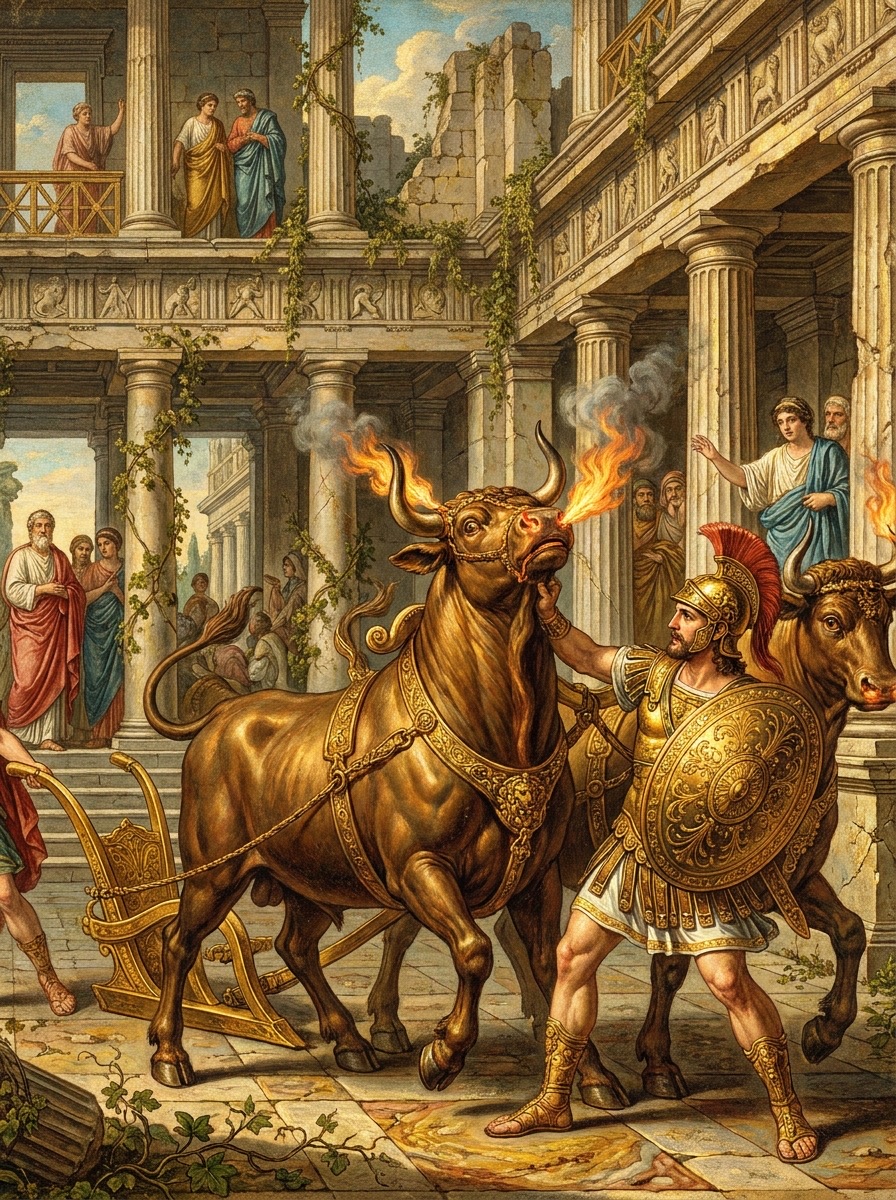
Jason Yokes the Fire-Breathing Bulls — Greek Mythology
Jason arrives in Colchis and asks Aeetes for the Golden Fleece. The king forces him to yoke two bronze-hoofed bulls that breathe fire and then sow dragon’s teeth in the earth. Only Medea’s secret help enables him to survive a trial that should have meant certain death.
Article
Summary
After a long voyage, the Argo reaches the mouth of the river Phasis. Jason goes into the city with his companions and tells Aeetes, king of Colchis, why he has come: he has been sent to claim the Golden Fleece. The king appears to consent, but he has no wish to surrender the treasure. Instead he sets a terrible condition. Jason must do as Aeetes himself is said to do: yoke two bronze-hoofed bulls whose mouths and nostrils pour out flame, plow the field of Ares, and sow dragon’s teeth in the furrows. In the palace, Medea, daughter of Aeetes, sees Jason and is overcome. She knows the power of herbs and incantations and serves at the altar of Hecate. That night she cannot sleep. If she does nothing, Jason will be burned to ash; if she helps him, she will betray her father and her country. At last pity and love overcome fear. Before dawn she meets Jason beside Hecate’s shrine and gives him an ointment of wondrous power. He must smear it over his body, his shield, and his spear, and when the armed men spring from the earth, he must throw a stone among them so that they turn on one another. The next day, before the people of Colchis, Jason enters the field. The bulls rush out with coppery hooves, iron horns, and breath like a furnace. Their fire breaks over his shield but does not harm him. He seizes their horns, forces the yoke onto their necks, and drives them over the field until the dark soil is torn open in furrows. Then he scatters the dragon’s teeth. Armed warriors rise from the newly turned earth, ready to kill him. Remembering Medea’s counsel, Jason hurls a great stone into their midst. The earthborn men suspect one another, fall into battle, and cut each other down. When their ranks are broken, Jason attacks and finishes the survivors. Jason has fulfilled Aeetes’ demand, and the Argonauts rejoice. But the king remains silent and grim. He has promised the Fleece, yet he is more afraid than ever. The Golden Fleece still hangs in the sacred grove, the sleepless serpent still guards it, and Aeetes’ heart has not yielded.
A Strange Ship at the River Mouth
For a long time the Argo had crossed the waters of the Black Sea. At last she came into the mouth of the river Phasis. The river flowed down from the land of Colchis, carrying silt and a cold, damp smell. Tall trees rose along its banks, and far away the mountains flashed with snow. The heroes made the ship fast and looked out at the unfamiliar country. They knew they were now close to the Golden Fleece; they also knew that the greatest danger lay just ahead.
Jason put on his armor and entered the city with several of his most trusted companions. They passed along broad roads and saw the palace of the Colchians standing on high ground, its bronze gates shining in the sun. There Aeetes ruled. He was no ordinary king: his father was Helios, and his halls held treasures such as men from distant lands had never seen. The Golden Fleece hung in the grove of Ares, guarded by a great serpent that never slept.
Jason came before the throne without drawing his sword and without threats. Observing the proper courtesy owed by a guest, he told the king his purpose. He was a prince by blood from Iolcus, sent by Pelias across the sea, and he asked only to carry away the Golden Fleece. If the king would grant him that treasure, the Argonauts would repay Colchis with friendship.
Aeetes sat high on his seat and listened. When Jason had finished, his face darkened. The Fleece was the glory of his kingdom, a sacred possession he had no desire to lose. As he looked at these Greeks who had come over the sea, murder already stirred in his heart. Yet he did not immediately order their deaths. To kill guests within his palace would invite trouble; but to send Jason to his death through a task that seemed fair—that would be much easier.
So he said, “If you truly have a hero’s courage, then do something that I myself can do. In the field of Ares there are two bulls, bronze-hoofed and iron-horned, with fire pouring from their mouths and nostrils. You must yoke them and force them to plow a field. Then you must sow dragon’s teeth in the earth. When armed warriors rise from the soil, you must still be standing at the end. If you can do this, I will give you the Golden Fleece.”
Silence fell over the hall. The Argonauts felt their hearts tighten. These were no ordinary bulls, and this was no ordinary plowing. Yet Jason could not shrink back before the king. He mastered the chill within him and agreed to face the trial the next day.
Medea’s Night
Medea, the daughter of Aeetes, was also in the palace. She knew the virtues of herbs and the force of spells, and she often made offerings before the altar of Hecate. When she first saw Jason, her heart was thrown into confusion. This young stranger stood before them all knowing he might die, and still he did not lower his head. Medea tried to look away, but again and again her eyes returned to him.
That night the palace sank into darkness. Medea lay on her bed, hearing the wind move through the colonnades outside, and sleep would not come. One moment she thought of her father’s command; the next, of the flames Jason would have to face at dawn. If she held back, the bronze bulls would burn him to ashes. If she helped him, she would be betraying her father and her land.
She paced her chamber, lifted her box of medicines, and set it down again; went to the door, then drew back. At last love and pity overcame fear. She sent a message to Jason, telling him to wait for her beside the temple of Hecate.
Before the sky had brightened, Jason came to the appointed place. The trees around the shrine cast deep shadows, and ash still lay upon the altar. Medea came wrapped in a light garment, carrying a small casket. Inside it was a dark ointment. In a low voice she said to Jason, “This salve is made from a divine herb and holds the power of Hecate. Tomorrow at dawn, pray first to the goddess. Then rub the ointment over your body, your shield, and your spear. For one day fire will not wound you, and bronze hooves will not crush you. But remember this as well: when the dragon’s teeth fall into the ground, armored men will spring up. Do not fight them one by one. Throw a stone into their midst. They will not know who cast it, and they will suspect and slaughter one another. When they are thrown into confusion, then rush in.”
Jason took the ointment and swore solemnly that if he lived to win the Golden Fleece, he would never forget what she had done for him, and he would take her away from Colchis. When Medea heard this, joy and fear rose together in her heart. She knew that from this moment onward she had set foot on a road from which there was no return.
The Fire-Breathing Bulls
The next day, the people of Colchis crowded beside the field of Ares. Aeetes sat in his chariot, dressed in splendid robes, with no smile on his face. He meant to see Jason die in the field with his own eyes. The Argonauts came too. They stood to one side with their weapons in their hands, but they could not go forward in Jason’s place.
At dawn Jason had done as Medea instructed. He had offered sacrifice to Hecate and carefully smeared the ointment over his body. It was as though an invisible armor covered his skin, and courage began to rise in his chest. He took up his shield, his spear, and the yoke, and walked into the field.
Soon the ground began to shake under a heavy tread. The two bulls burst out from behind the stone enclosure. Their hooves were like glowing bronze fresh from the fire, striking sparks from the earth. Their iron horns pointed low before them. When they opened their mouths and nostrils, flames rolled out with black smoke, and the air around them quivered with heat. The watching crowd drew back. Some cried aloud; others covered their faces.
Jason did not run. He raised his shield and met them. The first bull’s flame struck the shield like a wave breaking on rock and burst apart with a roar. Fire licked over his shoulders and the edges of his hair, but it did not burn him. The bull, maddened, lowered its head and charged. Jason sprang aside, seized its horns with both hands, and drove his heels deep into the mud. The bronze hooves tore up the ground beside him, flinging clods and sparks together.
The second bull came rushing from the side, and Jason was nearly trapped between them. He clenched his teeth, turned with the force of the first bull’s charge, slipped one end of the yoke over its neck, and then leapt toward the other. The hot breath of the beast burst in his face like the mouth of an opened furnace. His companions watched with their hearts in their throats. But the ointment still protected him. He stood firm against the fire, gripped the bull’s horns, and forced the second beast beneath the yoke as well.
The monstrous pair thrashed across the field, trying to fling off the wooden beam. Jason tightened the reins and drove them with the butt of his spear. Snorting flame, they dragged the plow forward. The heavy share cut into the earth; black soil rolled up behind it, and furrow after furrow opened across the field of Ares. At last the bronze bulls began to tire, and their flames no longer burned as fiercely as before. Jason drove them to the end, loosed the yoke, and sent them back into their enclosure.
A confused cry rose from the edge of the field. The Argonauts breathed again, while Aeetes’ face grew darker. He had not expected this stranger to come alive through the fire.
Dragon’s Teeth in the Earth
The trial was not over. Servants brought a helmet filled with dragon’s teeth. They were white and hard, each one like a little pointed stone, and they had once belonged to a slain dragon. Jason took the helmet, went into the newly plowed field, and scattered the teeth by handfuls into the fresh-turned soil.
At first the field was quiet. The wind passed over the earth as though nothing would happen. Then the surface of the ground began to swell. One iron helmet after another emerged, followed by shoulder-plates, shields, spears, and human faces. Armed warriors rose out of the soil. Wet clay still clung to them, but their eyes were already open and their weapons already raised. They had no parents and no childhood; they came from the earth knowing only how to kill.
They turned toward Jason, shields clashing, spears lifting in a line. If he let them close around him, he would quickly be pierced by a forest of weapons. Remembering Medea’s words, he bent down, lifted a great stone, and, while the warriors were still drawing together, hurled it into their midst.
The stone crashed among them with a heavy thud. One earthborn warrior was struck down, but the others did not know where the stone had come from. They glared at one another, each suspecting the man beside him of the blow. In an instant suspicion became battle. Spears punched through breastplates; short swords hacked at necks; shields split under blows; warriors who had only just risen from the mud fell back into it again.
Jason waited while they slaughtered one another. Then, when their order had broken, he raised his spear and rushed in. He avoided the shield-wall where it still held firm and struck at the places where confusion opened a path. One warrior had barely drawn his sword before Jason drove him down; another sprang at him from behind, and Jason turned and struck him. Dust rose across the field, and iron rang on iron. The warriors born from the dragon’s teeth grew fewer and fewer, until only a scattered handful remained, and Jason brought them down one by one.
When at last he stopped, the field of Ares was strewn with bodies. The newly turned black soil was wet with blood, and broken spears and shattered shields lay among the furrows. Jason stood in the middle of the field, his chest heaving, his spear still dripping. Sunlight flashed on his armor, and all who watched could see it plainly: he was alive.
The King’s Silence
The Argonauts burst into cheers. They ran forward to meet Jason, clapping him on the shoulder and taking him by the arm. Every one of them knew that without divine aid no mortal could have mastered those bronze bulls or walked out alive from the assault of the dragon-born warriors.
Aeetes did not join their rejoicing. He sat in his chariot with his fingers clenched tight around the rail, his face hard and shadowed. By his own promise, Jason had completed the task, and the Golden Fleece ought to be given to him. But the king felt no surrender in his heart; he was more afraid than before. If a man who could accomplish such a trial carried away the Fleece, the glory of Colchis would go with it. And for a moment the thought of Medea’s secret help passed like a shadow across his mind.
He did not break his word openly. He only said that the day was late and that the matter would be considered on the morrow. Jason heard the delay beneath the words, but he did not quarrel beside the field. He looked toward the distant palace and remembered Medea, who had given him the ointment in the night, and he knew that the true danger had not yet passed.
That day, with Medea’s ointment and counsel, Jason had yoked the fire-breathing bulls, plowed the field of Ares, and destroyed the warriors who sprang from the dragon’s teeth. The people of Colchis had seen him complete the trial the king had set. Yet the Golden Fleece still hung deep within the sacred grove, the serpent guarding it had not closed its eyes, and the heart of Aeetes had not softened.