Greek Mythology
Rebellion and Peace on Ithaca — Greek Mythology
After Odysseus killed the suitors, Ithaca did not at once fall quiet. The dead men’s kinsmen gathered to take revenge, and just as the island seemed ready to spill blood again, Athena, acting at Zeus’ command, stepped in and halted hatred at the final moment.
Article
Summary
When the suitors’ families learned that their sons and brothers had died in the palace, they gathered in the assembly place. Eupeithes, father of Antinous, called on them in grief and anger to take revenge. But the herald Medon and the aged seer Halitherses urged them not to shed more blood, reminding them that the suitors had indeed done wrong for many years and had brought this punishment upon themselves. Some of the Ithacans listened and went home. Others still took up their weapons and followed Eupeithes in pursuit of Odysseus. At that moment Odysseus had gone into the countryside with Telemachus to see his father, Laertes. The old man, worn down by years of sorrow, worked in his orchard in shabby clothes. Odysseus proved who he was by recalling the fruit trees his father had once given him, and father and son were at last reunited. The pursuers reached the farmstead, and Odysseus, Telemachus, and Laertes prepared to fight. Laertes cast his spear and killed Eupeithes, and the battle was on the verge of spreading. Then Athena, carrying out the will of Zeus, cried out and stopped both sides, while Zeus himself warned them with thunder. Odysseus obeyed the divine command and held back, and the Ithacans lowered their weapons. Athena established peace between the two sides. The deaths of the suitors did not lead to a new chain of vengeance, and at last the house of Odysseus and the island of Ithaca settled out of turmoil into peace.
The Hall Before the Blood Was Dry
On the day Odysseus returned to Ithaca, there was no song of feasting in the palace, only overturned tables, scattered cups, and blood across the floor.
The suitors who had sat day after day in his house, eating his food and pressing Penelope to marry again, lay dead in the hall. Odysseus had set down his bow, and Telemachus had put away his spear. The serving women were called to wash the floor and drag the bodies out one by one. Smoke rose; the sharp smell of sulfur filled the room, as though all the shame of those long years were being driven out with it.
Yet when one household’s vengeance had been taken, the vengeance of the whole island was just beginning to wake.
The suitors were not nameless raiders from over the sea. Most were sons of noble houses in Ithaca and the neighboring islands. They had fathers, brothers, and kin. When a son died in the palace and his body was carried home, his mother wailed and his father tore at his hair. By morning, the news blew over the hills, the harbor, and the fields like a cold wind: Odysseus had come back, and he had killed all the suitors.
Shades on the Road to the Underworld
While the living still did not know how to gather up the wreckage, the dead suitors had already set out on another road.
Hermes took up his golden wand and summoned the newly dead shades. They drifted after him, light and restless, like frightened bats in the night, making thin, faint cries in the gloom. They left Ithaca behind, crossed the waters and the dim paths beyond, and went down toward the depths of the Underworld.
There they met many heroes who had died long before. Achilles, Agamemnon, and the shades of men who had returned from Troy stood among the shadows. When Agamemnon saw so many young spirits arriving together, he asked why they had all died on the same day, like a troop overturned by a storm.
One of the suitors told what had happened: how they had feasted for years in the house of Odysseus, how they had pressed his queen, how the master had returned, shut them in the hall, and killed them with bow and spear. When Agamemnon heard it, he praised Odysseus instead, because Odysseus had been blessed with a faithful wife, unlike Agamemnon himself, who had come home only to be murdered by his wife and her lover.
The words spoken in the Underworld could not be heard by the living. The people of Ithaca saw only that bodies had appeared at their doors, and anger rose in their hearts.
Cries in the Assembly Place
Before long, the kinsmen of the dead gathered in the assembly place of Ithaca.
Some supported old men as they walked; some came wrapped in cloaks; some had hurried in from the fields with earth still on their hands. The square was filled with weeping. Eupeithes, the father of Antinous, stepped forward. Antinous had been the most arrogant of the suitors and the first to be shot down by Odysseus. But to Eupeithes, he was still his son.
The old man could hardly stand for grief, yet he lifted his hand and cried out to the crowd: “Men of Ithaca, how much ruin has this man brought upon us! Long ago he took many good men away to Troy. The ships came home, but the men did not. Now he has returned to his own house and slaughtered the best of our sons. If we do not pursue him at once, how shall we ever look anyone in the face again?”
His words fell like sparks into dry grass. Many, driven on by sorrow, answered him at once and called for Odysseus to pay with his life.
But not everyone had been blinded by anger. The herald Medon came forward. He had seen the slaughter in the palace with his own eyes, and Odysseus had spared him because he had not joined in the suitors’ crimes. Medon told the people that Odysseus had not won by his own strength alone; a god had stood beside him. The bard Phemius was alive as well, and he too knew how the suitors had behaved through all those years.
The old seer Halitherses also urged them to stop. He had long understood that the suitors’ deeds would bring disaster upon them. Now he said, “Do not lay everything at Odysseus’ feet. You did not restrain your own sons. They wasted another man’s wealth, dishonored the master of the house, and pressed his queen. Now ruin has fallen. Do not walk any deeper into it.”
His words brought some of the men back to themselves. They lowered their heads and left the assembly place, unwilling to be drawn into fresh bloodshed. But Eupeithes would not turn back. He tightened his cloak and called for weapons. Many others followed him, taking up shields, spears, and helmets, and marched out beyond the town.
They were going to find Odysseus.
The Old Father’s Farmstead
At that moment, Odysseus was not in the city. He had left the palace with Telemachus and two loyal servants and gone to the farmstead outside the town to see his aged father, Laertes.
For many years Laertes had lived in the countryside and no longer wore the robes of a king. His clothes were rough and worn; dust clung to him; he spent his days bent over in the orchard. His son had been gone so long, and news had failed for so many years, that the old man seemed like a tree aged by the wind, with only silence and sorrow left in him.
When Odysseus saw his father in such a state, his heart ached. Yet he had spent too many years wandering to cast caution aside. First he tested him. Pretending to be a stranger, he said he had once received Odysseus as a guest and asked whether the old man knew where that man was now.
At the sound of his son’s name, Laertes burst into tears. He scooped up dust and poured it over his white hair, saying that he had waited in grief for years and feared his son had long since died far away, with no one to gather his bones.
Odysseus could bear it no longer. He embraced his father and said, “Father, I am your son. I have come home, and I have punished the men who were destroying my house.”
For a moment the old man could not believe him. So Odysseus showed him the scar on his body and spoke of the fruit trees his father had given him when he was a child: how many pear trees, how many apple trees, how many fig trees, and the rows of vines besides. These were memories only father and son shared, and at last they carried the truth back into the old man’s heart.
Laertes reached out and clasped his son, but the strength seemed suddenly to leave his body, and he nearly fainted. Odysseus held him up and brought him into the house. The servants bathed the old man, rubbed him with oil, and dressed him in clean clothes. Athena, unseen, made him appear taller and stronger. When he stood again before his son, he no longer looked like the lonely old man who had been grieving in the orchard.
Food was set inside the house. Odysseus, Telemachus, Laertes, and the loyal servants had only just sat down when the sound of footsteps and weapons came from outside.
Enemies at the Door
Eupeithes had led the kinsmen of the dead to the farmstead.
They crossed the fields, their spearheads flashing cold in the sunlight. Grief would not let them stop, and wounded pride would not let them listen to counsel. To them, the bodies in the palace were not yet cold, and vengeance had to begin at once.
When Odysseus saw them approaching, he rose and put on his armor. He was not afraid, but he understood that if this battle began, Ithaca would sink into a new feud. Kill a father today, and tomorrow a son would grow old enough to answer. One house would fall, and another would lift the spear. The island was small, but hatred could pass from generation to generation.
Telemachus stood beside his father, no fear on his young face. Laertes too took up his weapons. The old man had only just recovered his son; he would not hide behind the house and wait for others to decide his fate.
Athena had now come to stand beside them. She had often aided Odysseus in the likeness of Mentor, and now she remained on the side of this household. She urged them to meet the enemy bravely and not let fear take hold before the fight began.
Battle was about to break out.
Laertes cast the first spear. It was as though he hurled with it all the grief he had stored through the years. The spear flew through the air, struck Eupeithes’ helmet, pierced the bronze, and brought down the old man who had called for revenge.
When Eupeithes fell, confusion seized those who followed him. Odysseus and Telemachus rushed forward, and spear and sword drove their enemies back. If the fighting had continued in that way, the assembly place of Ithaca would soon have had another heap of bodies to mourn.
Peace After the Thunder
Zeus in the sky saw everything.
Athena had asked him how this conflict should end. Zeus’ will was plain: Odysseus had avenged his house, and the suitors had paid for their crimes. Now Ithaca must be made to stop. If the gods did not hold back human anger, blood would keep flowing.
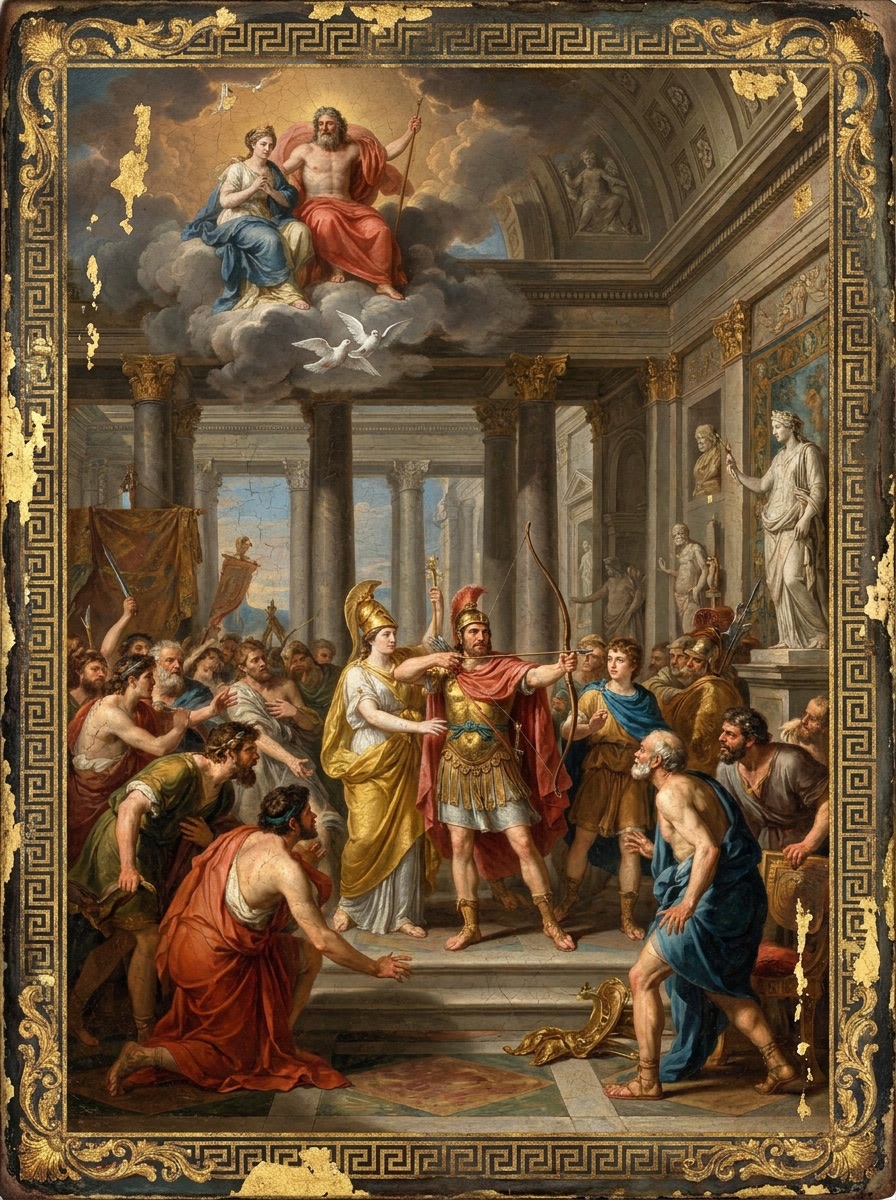
Then thunder suddenly rolled across the sky. Zeus hurled down a thunderbolt, and the fire struck the ground in front of Athena, chilling the hearts of all who saw it.
At once Athena cried out and stopped them. Her voice no longer sounded like that of an ordinary mortal, but like a god pressing down from the air: “Men of Ithaca, stop! Fight no more. If more blood is shed, you will bear the anger of Zeus.”
The kinsmen who had come in pursuit heard the voice, and their weapons grew heavy in their hands. Their feet halted. Fear rose first in their hearts, and then clear sense returned. They saw Eupeithes dead; they saw Odysseus still standing; they saw the earth smoking where the thunderbolt had struck. At last they dared go no farther.
Odysseus still wanted to pursue them. Years of suffering and the heat of battle had made it hard for him to stop. But Athena checked him again and commanded him to hold back. The thunder of Zeus had given its order, and no one could disobey.
Odysseus listened.
Weapons sank. The shouting died away. The men who had come for revenge withdrew, and the household of Odysseus did not chase them. Athena, in the likeness of Mentor, established a pact between the two sides and made them remember that day, so that the deaths of the suitors would not drive them on to further slaughter.
At last Ithaca was quiet.
Odysseus had endured storms at sea, the cave of the Cyclops, the islands of goddesses, the shadows of the Underworld, and then, in his own house, had bent the great bow and reclaimed his place. Yet his true return to his homeland did not begin when he stepped ashore, nor even when he killed the suitors. It began when this blood feud was stopped.
The palace could be cleansed, and the bloodstains in the hall wiped away. In the farmstead, the old father had embraced his son again. The people of Ithaca would still remember the young men who had died, but spears would no longer be raised for them. The house of Odysseus had survived its turmoil, and the small, mountainous island found peace again after the thunder.