Greek Mythology
Iphigenia among the Taurians — Greek Mythology
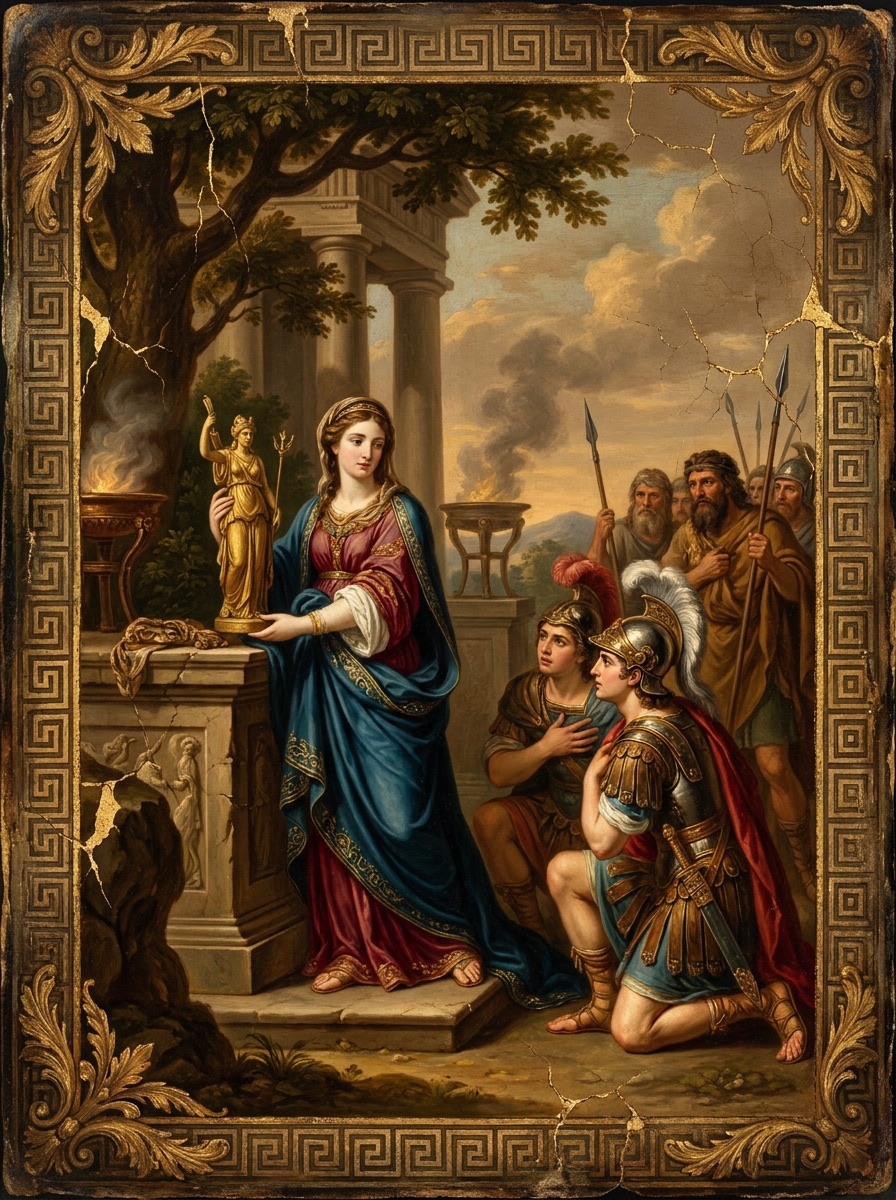
Iphigenia should have died on the altar at Aulis, but Artemis carried her away to distant Tauris, where she became the priestess who sacrificed foreign strangers to the goddess. Years later, Orestes and Pylades came there in their flight from the Furies. At the edge of the sacrificial knife, brother and sister recognized one another and escaped together, carrying the goddess’s image back to Greece.
Article
Summary
Iphigenia should have died on the altar at Aulis, but Artemis carried her away and placed her in distant Tauris. There, Greek strangers captured on the coast were sacrificed to the goddess, and Iphigenia became the priestess forced to preside over those rites. She lived for years beside the Black Sea, longing for home and believing the house of Agamemnon had become only a chain of distant nightmares. After avenging Agamemnon in Mycenae, Orestes is pursued by the Furies for the murder of his mother. Apollo tells him that release can come only if he goes to Tauris and brings back the image of Artemis. He crosses the sea with the faithful Pylades, but shepherds discover them on the shore; Orestes’ madness betrays him, and the two are bound and sent to the temple, nearly becoming victims at Iphigenia’s own altar. When Iphigenia hears the captives speak Greek, she questions them about Argos, Mycenae, and the house of Agamemnon. She learns that her father has been murdered and that Clytemnestra has been killed by Orestes, yet she still does not know that the young man before her is her brother. She offers to save one of the two if he will carry a letter to Greece, but Orestes and Pylades each tries to give the chance of life to the other. Fearing that the written message may be lost at sea, Iphigenia recites its contents aloud: it is meant for Orestes, son of Agamemnon, and says that his sister Iphigenia did not die at Aulis but lives captive in Tauris. Hearing his own name and hers, Orestes realizes who the priestess is. After proofs and shared memories, brother and sister recognize one another before the sacrificial knife, though Thoas, the temple, and the sacred image still stand between them and escape. Iphigenia then deceives Thoas by claiming that the two strangers carry the pollution of kin-murder and have defiled even the goddess’s image, so both captives and statue must be purified at the shore. The king believes her and allows her to lead them away. The three board the Greek ship; wind and waves nearly drive it back, but Athena appears and stops the pursuit. Thus Iphigenia, Orestes, and Pylades carry the image out of Tauris, turning an intended sacrifice into reunion and return.
The Priestess in the Temple by the Sea
In Greek memory, Iphigenia should long ago have died on the altar at Aulis.
At that time the Greek army was preparing to sail against Troy, but contrary winds held the ships trapped in the harbor. Her father, Agamemnon, obeyed what was said to be the will of the gods and lured his daughter from home, telling her she was to marry Achilles. But when she reached the camp, no wedding was waiting for her. Instead, there stood the altar of Artemis.
Many believed that when the knife fell, Iphigenia died. Yet in another and widely told version, the goddess rescued her at the final moment, set a deer upon the altar to bleed in her place, and carried the girl away to far-off Tauris.
Tauris lay by the Black Sea, where the wind rolled in from the water and made the flames before the temple flicker between brightness and shadow. The people there honored Artemis, but their custom was dreadful: whenever Greek strangers were driven ashore by storm or captured by the inhabitants, they were brought into the temple and offered to the goddess.
There Iphigenia served as priestess.
She did not return to Mycenae. She did not see her mother again, nor her brother, nor the roof of her own house. Day after day she guarded the altar, sprinkled the purifying water for others, and lifted the sacrificial knife. Whenever strangers were led in, her heart felt heavy as stone. They spoke the Greek tongue she knew so well; they looked at her and begged for pity. But she lived in a foreign land, under the rule of King Thoas, and she could only obey the law of that place.
One morning Iphigenia woke in terror from a dream. She had seen the house of her homeland fall in ruins. Its beams and pillars broke one after another, until only a single pillar remained standing. In the dream she poured water over that pillar and wept for it as though for the dead. When she woke, she thought that the last of her family must also have perished.
She did not know that the pillar still standing was even then crossing the sea, coming toward the land where she lived.
The Man Hunted by Vengeance
That man was Orestes, her brother.
After Agamemnon returned home from Troy, he was murdered by his wife Clytemnestra and Aegisthus. When Orestes grew to manhood, he came back to Mycenae and avenged his father by killing his own mother. The blood-debt was paid, but a new guilt fell upon him. The Furies pursued him and gave him no rest. At times he was clear-minded; at others terror tore through him, and he seemed to see the dark-clad goddesses rising out of the earth, their serpent hair stirring, their eyes fixed upon him.
At last, Apollo’s oracle told him that if he wished to be freed from these torments, he must go to Tauris and bring back the image of Artemis to Greece.
The command sounded almost like a sentence of death. The Taurians spared no foreigner, and the image stood in a temple watched over by the king. But Orestes had no road left behind him. He took with him his closest friend, Pylades, and sailed across the sea.
Their ship came to rest near the coast of Tauris. Before the night had fully lifted, the two men hid among the rocks and discussed what they must do. In the distance they could see the roof of the temple. Beside the altar were old marks of blood, and the sea wind blew ash across the sand.
Orestes looked toward the temple and said in a low voice that they must wait for darkness, then find some way to slip inside and carry off the image. Pylades nodded. He was never a man of many words, but whenever Orestes fell into danger, he stood beside him.
They never reached that chance.
Taurian herdsmen found them. Two young Greeks hiding by the shore were already suspicious enough, and then Orestes was suddenly seized by madness. As though he saw pursuers invisible to everyone else, he drew his sword and struck wildly, crying out about the Furies. The herdsmen were frightened and drew back at first; then they called more men, surrounded the strangers with clubs and ropes, and overpowered them. Pylades defended his friend, but the two were too few. In the end he and Orestes were bound together and taken to the king’s temple.
Strangers before the Knife
When Iphigenia heard that two more Greeks had been captured, her heart sank.
She came out before the temple and saw the young men under guard. Their clothes were stained with seawater and dust, and the ropes had marked their arms red. One looked exhausted, like a man newly awakened from a nightmare; the other stood more steadily and kept glancing toward his companion.
According to Taurian custom, she had to perform the rites of purification before the sacrifice. Yet these men spoke Greek. They came from the world she longed for day and night. Iphigenia could not keep herself from asking where they were from.
At first they were unwilling to say much. Orestes was full of pain and did not want a stranger to know his crime. So Iphigenia changed her questions. She asked about Argos, about Mycenae, about the fates of the princes after the Trojan War. She asked whether Agamemnon was still alive, asked about Clytemnestra, asked about Achilles, and asked whether anyone in the homeland remembered the girl who was once meant to be sacrificed.
When Orestes heard those names, it was as if needles pierced his heart. He told her that Agamemnon was dead, killed by his wife; that Clytemnestra too was dead, killed by her son; that Agamemnon’s house was filled with blood and weeping.
Hearing this, Iphigenia believed that her brother too must be dead. She forced down her grief, and then another thought came to her.
She told the two captives that she herself was Greek and had been carried into this foreign land many years before. She was willing to save one of them, if he would take a letter back to Argos and deliver it to her kin. The other, however, must remain and be sacrificed according to Taurian law.
When she finished speaking, both friends fell silent.
Orestes spoke first. He would not let Pylades die for him, and so he said that Pylades should carry the letter home while he himself stayed behind. Pylades immediately refused. Since he had come there with his friend, he said, he could not return home alone and leave Orestes beneath the knife. They argued back and forth, not over who should live, but over who could give the chance of life to the other.
Iphigenia watched them, and her heart grew heavier still. She did not know that fate had brought her own blood before her, and that only a name stood between them.
The Name in the Letter
Iphigenia ordered the letter to be brought. She feared that storms at sea might destroy the writing on the tablet, and feared as well that the messenger, once in Greece, might not find the right person. So she decided to speak the contents of the letter aloud to Pylades.
She said the message was to be delivered to Orestes, son of Agamemnon. It told him that his sister Iphigenia had not died at Aulis. Artemis had saved her and set her in Tauris. She begged her brother to bring her home, and not to let her spend her whole life in this temple stained with the blood of strangers.
When her voice ceased, the air seemed suddenly still.
Orestes lifted his head and stared at her. He had heard his own name, and he had heard his sister’s name. This was no rumor, no dream, but words spoken by the priestess standing before him.
He hurriedly asked whether she was truly Iphigenia, whether she remembered Aulis, remembered their father’s camp, remembered the day she had been deceived by the promise of a false wedding.
At first Iphigenia could not believe it. Years in a foreign land had taught her caution. She demanded proof. Orestes then spoke of things known only within their house: old matters of their grandfather’s line, the disasters of the house of Atreus, the patterns she had woven before she left home, and the objects she had left behind.
Memory after memory was set before her like old vessels lifted from the earth, still carrying the scent of home. At last Iphigenia believed.
She stretched out her arms and embraced her brother. The knife that had been waiting for slaughter still lay by the altar, and the Taurian guards were still not far away, but brother and sister forgot them for that moment. She had thought him dead; he had believed her long since a ghost of the altar. Now they had recognized each other before a foreign temple: she in the robes of a priestess, he carrying the anguish of a man who had killed his mother.
Beside them, Pylades at last breathed more freely. Yet the danger had not passed. King Thoas was still waiting for the sacrifice, the image of the goddess remained inside the temple, and unless they quickly found a way out, the reunion of brother and sister would end in their deaths together.
The Ruse of Purification
Iphigenia knew this land better than the two strangers who had only just been captured. She knew the Taurians feared the will of the gods, and that King Thoas himself would not dare treat the goddess lightly. So she devised a plan.
She went to Thoas with the grave face proper to a priestess. She told the king that the two Greeks were unclean, for one of them had killed his own mother and carried a terrible blood-pollution upon him. Once such a captive entered the temple, even the image of Artemis had been defiled. If the sacrifice was to proceed, the captives had first to be taken to the shore and washed clean in seawater; the image too must be carried out and cleansed of the stain that had touched it.
Thoas heard her and was afraid, just as she had hoped. He asked whether men should be sent with her. Iphigenia said that the rite must not be seen by others. If outsiders came too near, they would offend the goddess. She also ordered the guards to keep far away and not to look on.
The king believed her.
So Iphigenia took the image of the goddess and led Orestes and Pylades toward the shore as though they were still her captives. To those watching, she remained the priestess carrying out the required rite. Only the three of them knew that every step was taking them farther from death.
On the coast, the Greek ship lay hidden and waiting. When the sailors saw them hurrying toward the vessel with the image, they made ready to depart. The ropes were loosed, the oars dropped into the water, and waves struck the sides of the ship. Iphigenia climbed aboard with the goddess’s image in her arms; Orestes and Pylades followed after her.
But the affairs of the gods do not end so easily. The ship had barely left the shore when a wind suddenly rose over the sea. The waves tossed the vessel, and though the rowers strained with all their strength, the ship was driven for a time back toward land. The Taurians discovered the deception and came shouting in pursuit. Thoas, furious, prepared to lead his men forward, recover the image, and seize the fleeing Greeks.
At that moment Athena appeared in the air and barred Thoas’s way.
The goddess commanded him to stop the pursuit. She said that all this had happened by divine will: Orestes was meant to carry away the image of Artemis, and Iphigenia was meant to leave Tauris and return to Greece. However angry Thoas was, he did not dare disobey a goddess. He held back his men and let the ship depart.
At last the wind changed.
The sail filled, and the shore slowly receded. Iphigenia stood aboard the ship and watched the temple grow smaller and smaller behind her. She had spent many years there, raising the sacrificial knife over strangers and dreaming again and again of home. Now she was leaving with the image of the goddess, with her brother restored to her side, and with faithful Pylades beside them both.
The altar of Tauris remained behind. Brother and sister did not die beneath a foreign knife, but passed through the sea wind and sailed toward Greece.