Greek Mythology
The Disappearance of Hylas and Heracles Left Behind — Greek Mythology
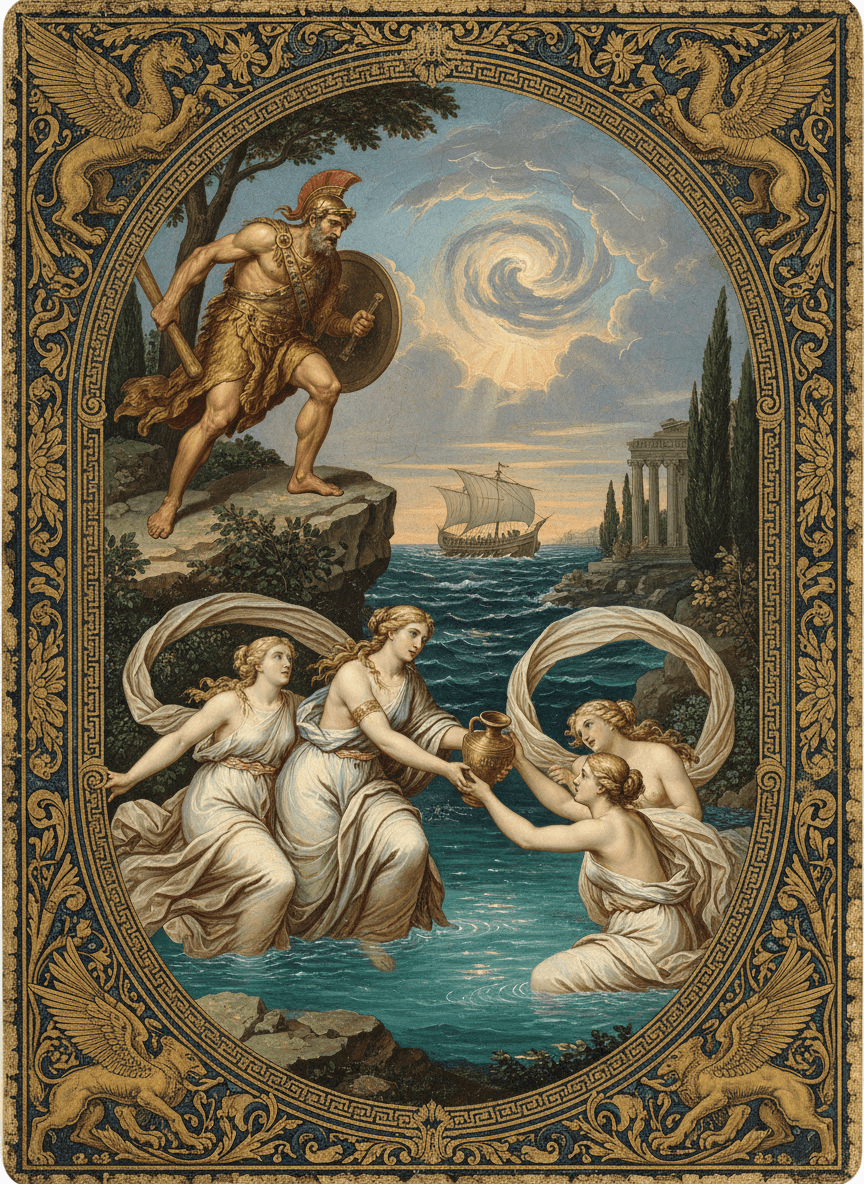
During the voyage of the Argo, Heracles breaks his oar off the Mysian coast. The young Hylas goes to a spring for water, but the nymphs of the pool draw him beneath the surface. Heracles searches everywhere, calling his name, while the Argo sails away in the night and leaves the strongest of the heroes behind.
Article
Summary
After leaving Lemnos, the Argonauts continued eastward. Many brave men were aboard, but none drew the eye like Heracles. His strength was astonishing; when he rowed, the whole ship seemed to shudder with the force of his stroke. At his side was Hylas, a beautiful young companion whom Heracles kept near him like a pupil and trusted attendant. When the Argo came near the coast of Mysia, the wind failed and the heroes had to row hard. Heracles strained so mightily that his oar snapped in his hands. The ship put in to shore so the men could rest, take on fresh water, and repair their gear. Heracles went into the woods to cut timber for a new oar, while Hylas took a bronze pitcher and went to look for a spring. Hylas found a clear pool in the forest, shining under the moon. But the spring was not empty water: nymphs lived there. When they saw the youth bend over the surface, they were seized with desire for him. As his pitcher touched the pool, pale arms rose from the water, wound around him, and pulled him down. His cry reached the hero Polyphemus, who came running, but by then only the overturned pitcher remained beside the spring. Heracles heard Polyphemus calling and rushed back through the woods. When he learned what had happened, he searched the spring, the stream, the thickets, and the dark hollows of the forest, shouting Hylas’ name until the night echoed. Meanwhile the wind turned fair. The Argonauts, confused and hurried, set sail in the dark, not realizing until too late that Heracles, Hylas, and Polyphemus were no longer aboard. A quarrel broke out on the ship, but the sea-god Glaucus rose from the waves and told them that Heracles’ departure had been ordained by Zeus. The hero had other labors to complete and could not go on with the Argonauts to Colchis. So the Argo sailed eastward without him, while Heracles remained on the Mysian shore, still searching for the boy who had vanished into the spring.
The Broken Oar
After the Argo left Lemnos, she pressed on toward the Black Sea. Sometimes the water lay calm beneath her hull; sometimes the wind rose, filling and slackening the sail by turns, while the ship climbed and fell upon the waves. Aboard her sat heroes from many parts of Greece: Jason held the honor of the expedition, Tiphys kept watch at the helm, the twin brothers Castor and Polydeuces bent over their oars, Orpheus carried his lyre, and many another man, palms blistered raw, still rowed in relays through day and night.
Among them all, Heracles stood out.
When he took his place at the oar, another man’s stroke might push aside a ridge of water, but his seemed almost to split the sea open. The wood groaned in his hands, and the side of the ship trembled under the force he put into it. At times the other heroes looked up at him with admiration, and also with a little unease. Such a man, standing on land, could face a wild beast alone; yet here he sat with them in the narrow belly of a ship, obeying the orders of captain and helmsman.
Beside Heracles was a youth named Hylas. He was of noble birth, still young, graceful in face and quick in movement. Heracles loved him and had brought him on the expedition, teaching him how to serve a hero and how to survive among dangers. Hylas would set his cloak in order, carry his quiver, bring him water, and often keep close beside him at night.
One day the Argo drew near the coast of Mysia. The wind was against them, and the heroes had to row with all their strength. Heracles pulled too hard. The great oar in his hands suddenly cracked and split in two. One broken half was swept away by the waves; the other remained in his grip.
Heracles frowned and threw the useless timber down into the ship. Without an oar, he felt as if his own hands had been bound. Just ahead lay a bay where they could put in. There were trees on the shore and slopes rising beyond them. The heroes decided to land, rest, take on water, and repair what needed mending. Heracles, too, meant to go ashore, cut a suitable tree, and make himself a new oar.
The Mysian Shore
By the time the Argo touched land, dusk was already deepening. Wet sand spread along the beach; the waves rolled in layer after layer, then slipped softly back. Farther off, dense trees gathered around the foot of the hills. In the grass insects were calling, and the air smelled of resin mixed with tidewater.
The heroes leapt down from the ship. Some carried gear ashore, some kindled fires near the beach, and some took jars and pitchers to search for fresh water. After the long voyage each man was tired, but all were glad to feel firm earth beneath their feet. One man laid out food; another spread wet clothes over stones to dry.
Heracles did not sit down. He shouldered an axe and went into the woods to look for timber strong enough for an oar. Branches brushed against him, and he pushed the undergrowth aside. He walked quickly, snapping dead twigs underfoot, the sound carrying far through the trees.
Hylas had been following him at first. Then, hearing that the men at camp needed fresh water, he picked up a bronze pitcher and turned away to look for a spring. He knew Heracles would soon return, and the task did not seem dangerous to him. The woods near the shore looked quiet. The moon had just risen, and the shadows of the trees lay across the grass like dark ribbons.
The boy followed a small path. Soft grass grew beside it, and the ground under his feet was damp. Before long he heard the sound of water and went toward it. Behind a screen of shrubs he found a spring. Water welled from a cleft in the rock and gathered in a clear little pool. Moonlight shone upon the surface, and wildflowers grew along the bank, their petals wet as if newly washed by mist.
Hylas set down the bronze pitcher and bent to draw water.
Arms in the Spring
This spring was not only a spring.
In the old woodlands, water had goddesses of its own. They dwelt in springs, streams, and clear pools; they heard the wind stir in the grass and saw the shadows of passersby. That night the nymphs of the spring were moving beneath the water. Through the clear pool they saw a strange youth approach. They saw him bend down, his arm reaching toward the surface.
Hylas’ face was reflected in the spring, every feature clear, like moonlight fallen into water. At the sight of him, the nymphs were seized by a fierce affection. They did not wish to let him return to the men on the shore. They did not wish him to go back to the powerful, stern hero who kept him near. So just as his bronze pitcher touched the water, the spring stirred softly.
Before Hylas could rise, several white arms reached out from the pool and wound around his wrists, his neck, and the folds of his clothing. He cried out once, a short cry that rang through the trees. The bronze pitcher rolled onto the bank and struck a stone with a hollow sound. In the next instant the water closed over him, and the boy was drawn below.
The pool soon became still again. The moon still shone upon the spring; the flowers still moved in the night wind. Only the one who had come for water was gone.
Hylas’ cry did not vanish altogether. Nearby was a hero named Polyphemus, passing along the edge of the woods. He heard that sudden cry and stopped, listening. But after it, there was only the thin sound of water flowing. Alarmed, he shouted at once:
“Hylas! Hylas!”
No answer came.
Polyphemus ran toward the spring, following the sound he had heard. He saw the bronze pitcher lying overturned beside the pool, and the grass trampled nearby. He bent over the water, but it was so clear it seemed nothing had happened there at all. Drawing his sword, he searched among the trees, running and calling the boy’s name.
Heracles Calling
Heracles had already felled a suitable tree in the forest. He was trimming away the branches when he suddenly heard someone in the distance shouting Hylas’ name in alarm. It was not the ordinary voice of a man calling to a companion; it carried fear.
At once Heracles dropped the timber, seized his bow and club, and ran toward the sound. Bushes stood in his way, and he crashed through them. Branches scraped his skin, but he took no notice. Soon he met Polyphemus.
“What has happened?” Heracles asked.
Breathless, Polyphemus told him that he had heard Hylas cry out. When he reached the spring, he found only the pitcher overturned on the ground. The boy himself was gone.
Heracles’ face changed at once. He rushed to the spring, bent low over the water, and searched the bank for tracks. Hylas had left no mark of a struggle, no blood, no sign that a beast had dragged him away. Only the empty bronze pitcher lay there.
Heracles shouted:
“Hylas!”
The forest carried his voice out and returned it to him. From far away came echoes, like faint replies, but they were not the boy’s voice. Heracles would not stop. He ran along the spring, along the stream, along the edge of the woods, calling again and again. Polyphemus searched with him. They pushed through grass, peered into hollows, crossed muddy banks, and listened for even the smallest sound in the night.
But Hylas did not appear.
The story says that the nymphs beneath the water kept him there, as one keeps a beloved treasure. No cry from the shore could call him back out of the cold, clear spring.
The Argo in the Night
Meanwhile, trouble was unfolding at the camp by the sea.
The heroes thought Heracles had merely gone to cut wood, and Hylas only to fetch water. Surely both would return before long. But as the night deepened, the wind suddenly shifted in their favor. It blew from the shore toward the open sea, exactly the wind the Argo needed. Tiphys the helmsman urged the men aboard, fearing they would lose it. The sail was raised, the cables were loosed, and the rowers returned to their places.
Someone asked whether they ought to wait, since Heracles had not come back. Others said that Heracles was strong and swift; if he meant to return, he would already have done so. Perhaps he had other plans. In the confusion of darkness, with the wind rising and voices crossing one another on the ship, Jason did not discover the truth. At last the Argo left the shore, her keel pushing through the black water as she slowly moved out of the bay.
Only after the ship had gone some distance from land did the men realize that Heracles, Hylas, and Polyphemus were all missing.
A great commotion broke out aboard. Many of the heroes blamed Jason, saying he had left their strongest companion behind. Telamon, blunt and fierce in temper, reproached him openly. He accused Jason of fearing that Heracles’ fame would eclipse his own, and of using the darkness as a chance to sail away without him. Jason heard him with shame and distress, but for the moment he had no answer.
The ship rocked on the sea, and the quarrel almost rose louder than the waves. Some argued that they must turn back at once. Others feared the wind would change again and trap them outside an unfamiliar bay. While they were still disputing, a divine voice suddenly came from the sea.
The sea-god Glaucus rose out of the waves. His hair and beard looked tangled with seaweed; half his body was in the water, half lifted with the swell. He told the heroes that Heracles’ departure from the Argo was not something they could undo. Zeus had made another plan. Heracles still had labors of his own to accomplish; he could not continue with the Argonauts all the way to Colchis. Hylas’ disappearance, too, had already become part of fate, and the crew should not turn back in search of him.
When they heard the god speak so, the heroes slowly grew quiet. Telamon, too, stopped accusing Jason. The Argo went on, her sail swelling in the night wind, while the dark sea carried the Mysian shore farther and farther behind.
Those Left on Shore
By daybreak, Heracles was still searching the woods for Hylas. His voice had grown hoarse, yet he would not cease. He examined every place where water ran and mistrusted every shadow under the trees. Polyphemus searched beside him for a long time. Later, when they returned to the shore, they found that the Argo was gone.
Only cold ashes and wave-washed footprints remained on the sand. The sea beyond lay empty; not even the shadow of a sail could be seen.
For Heracles, this was no ordinary misunderstanding. He had lost the young Hylas, and he had also lost his place in the voyage. He did not sit long on the beach lamenting. Throughout his life, sudden disasters often fell upon him; grief might weigh on his heart, but it never held him motionless forever. He continued to search for Hylas in Mysia, and afterward he went on to the road destiny had marked out for him.
Polyphemus, too, did not board the Argo again. Tradition says he remained in that region and later founded a city there, still remembering the cries beside the spring on that night.
The Argo, meanwhile, had lost her strongest oarsman. The heroes sailed eastward toward more distant straits, stranger peoples, and the Golden Fleece in Colchis. Yet from that time on, whenever they remembered the night in Mysia, they remembered the bronze pitcher lying overturned by the spring, Hylas’ brief cry, and Heracles calling the boy’s name again and again through the dark forest.
The story comes to rest beside that spring. The water lies calm; the woods go on growing; the tide fades the footprints on the shore. Hylas never returned to the ship, and Heracles never again sailed with the Argo.