Greek Mythology
Hermes Steals Apollo’s Cattle — Greek Mythology
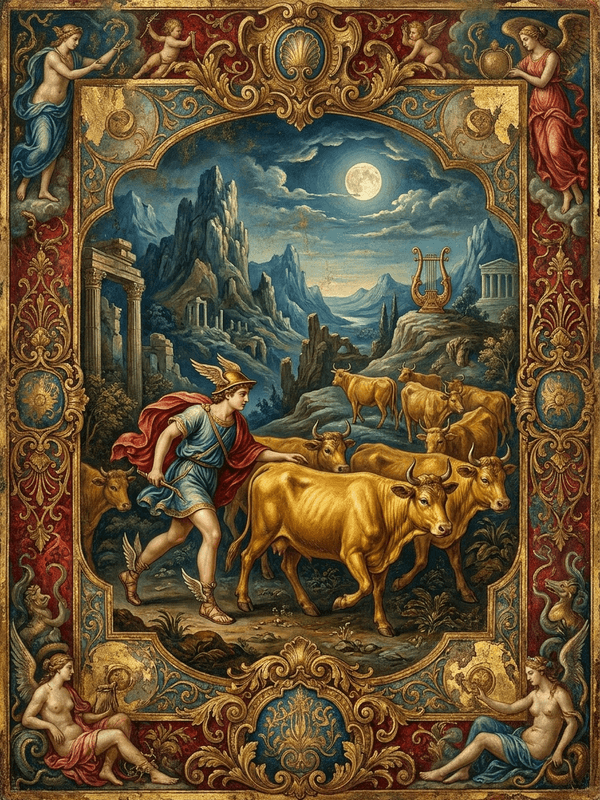
Not long after his birth, Hermes slipped out of his cave, stole Apollo’s cattle, and covered his trail by making the animals walk backward. Apollo tracked him to his mother’s cave, and in the end the two gods made peace before Zeus: Hermes traded the newly invented lyre for Apollo’s friendship.
Article
Summary
No sooner was Hermes born in Maia's cave in Arcadia than he slipped out of his swaddling bands and made the first lyre from a tortoise shell. By evening he had set his sights on Apollo's cattle, drove part of the herd away by night, and confused the trail by making the animals walk backward and hiding his own footprints. Apollo discovered the loss and followed the strange hoofprints and witness reports back to Maia's cave. Hermes had already returned to his cradle and played the innocent newborn, denying everything with perfect seriousness, but Apollo would not be fooled, so the quarrel went before Zeus. Zeus saw through Hermes's cleverness and ordered him to restore the herd. After Hermes led Apollo to the cattle, he played the new lyre, and Apollo's anger gave way to desire for the music; in the end, the brothers exchanged instrument, cattle, and golden staff, turning theft into friendship.
The Newborn in the Cave
In the hill country of Arcadia, hidden among trees and rocks, there was a cave where the goddess Maia lived. She did not love crowds, nor did she often go where the gods gathered. Only in the stillness of deep night did Zeus come to her. In time, she bore him a son, and that child was Hermes.
Soon after the baby was born, Maia wrapped him in swaddling bands and laid him in a cradle deep inside the cave. The air within was cool; outside, mountain wind moved through the pines. An ordinary infant, once fed, would have fallen asleep. But Hermes was no ordinary infant. His eyes were bright, his ears were open to every sound beyond the cave, and already some plan was stirring in his mind.
By daylight, while his mother was not watching, he slipped quietly out of his wrappings. His tiny feet crossed the dust at the cave mouth, and there he saw a tortoise crawling slowly along, carrying its round hard shell and stretching out its head to find the way. Hermes crouched down, picked it up, and smiled. Here, he thought, was a useful thing.
He carried the tortoise back into the cave, took out the shell, and gathered reeds, oxhide, and strings. Then he set to work with busy hands. Before long, he had made an instrument no one had ever seen before. When Hermes touched the strings with his fingers, a clear sound rang through the cave, like water striking stones in a brook, or wind passing through an empty valley. He played and sang as if he had always known how music should flow from the hand.
Yet this newborn was not content with a lyre. As the sun leaned westward, he hid the instrument away and thought of something bolder. Apollo had a herd of sleek, strong cattle grazing in a sacred pasture. Hermes had heard of those cattle, and he had heard how carefully Apollo kept watch over them. The more carefully they were guarded, the more eager Hermes was to test his own skill.
The Cattle That Walked Backward
When night came down, Hermes left the cave and made his way north. He moved swiftly, like a shadow skimming over slopes and valleys. When he reached the pasture, he saw Apollo’s cattle grazing in the grass. Their backs were broad, their horns pale in the moonlight, and warm breath steamed from their nostrils.
Hermes did not panic. He chose some of the cattle and drove them out from the herd. But he knew that if the animals walked in the ordinary way, their hoofprints would betray him. So he devised a cunning trick: he made the cattle walk backward. Then their tracks would seem to show that they had gone in the opposite direction.
Nor would he leave ordinary footprints of his own. He gathered branches and leaves, wove them into strange sandals, and tied them beneath his feet. Now the marks along the road were confused and shapeless, like neither a child’s feet nor a grown man’s. Under his guidance the cattle moved step by step through the night, their hooves falling heavily on the ground. Hermes darted ahead to turn them back, then circled behind to urge them on, as if he had been herding cattle all his life.
On the road he passed near a vineyard and met an old man. The old man saw the tiny cattle-driver, and saw the beasts walking backward in the middle of the night, and he was astonished. Hermes stopped and said to him, “Old man, whatever you have seen, act as if you did not see it. Whatever you have heard, act as if you did not hear it. That will be best for you.”
Then he drove the cattle on. The old man stood where he was, watching the herd vanish into the darkness, and for a long while he said nothing.
Hermes brought the cattle to a hidden place. He chose two of them, kindled a fire, and prepared the offering with wood and flame. For a child born only that day, such work should have come far too early, yet he did everything in proper order. He divided the meat into portions and arranged them carefully, as if making sacrifice to the gods. He did not feast greedily himself; he set everything in place and hid the traces as well as he could.
When the work was done, dawn had not yet come. Hermes hurried back to his mother’s cave, slipped into his swaddling bands, wrapped himself tight, and lay down in the cradle. If anyone had looked in then, they would have seen only a quiet newborn child, as if he had never left the cave all night.
Apollo Comes to the Cave
The next day, Apollo came to the pasture and soon discovered that some of his cattle were gone. Apollo was not easily deceived. He saw the hoofprints on the ground, but something about them troubled him: the tracks seemed to lead one way, while the theft itself seemed to have happened from another. He searched along the road, questioned those he met, and at last found the old man near the vineyard.
At first the old man hesitated and would not speak plainly. But Apollo pressed him, and at last he told what strange thing he had seen in the night: a little child driving cattle, while the cattle seemed to be walking backward, and the footprints on the road were stranger still.
Apollo heard this and understood enough. This was no common cattle thief’s work. He went to the cave in Arcadia and entered the place where Maia lived.
Inside, Hermes was lying in his swaddling clothes. His eyes were open, and he looked very small and very innocent. Apollo stood before him, his voice cold as a bowstring drawn tight. “You stole my cattle,” he said. “Where have you hidden them?”
Hermes blinked, as if he had heard the strangest accusation in the world. “I am only a newborn child,” he said. “I do not even know how to walk the road outside the door. How could I know where cattle are? How can someone as grown as you blame a baby for stealing cows?”
He spoke with perfect seriousness and even tucked himself farther into his wrappings. Maia, too, looked at Apollo in amazement, for the charge seemed absurd. But Apollo was not fooled. He had seen many tricks among gods and mortals, but seldom had he met a child so young who could lie to his face.
Apollo reached out to lift Hermes up. Hermes still pretended to be helpless, but Apollo now understood: this child could speak, steal cattle, and leave his work neat and hidden. The two could not settle the quarrel between themselves, and so they went to Zeus for judgment.
The Quarrel Before Zeus
On Mount Olympus, Zeus sat on high. Apollo brought Hermes before their father and told the story of the missing cattle. He said that he had followed every clue, and all of them led to this newborn younger brother.
Hermes stood before Zeus and still played the poor innocent. He said he had only just come into the world and knew nothing of cattle or theft. His words were clear, his arguments piled neatly one upon another, and the more innocent he sounded, the more amusing it became.
Zeus looked at his little son and could not help laughing. Of course he saw that Hermes was not telling the truth. He also saw in the child a gift for quickness, cleverness, and slippery invention that would be hard to grasp or hold. Still, theft was theft, and Apollo’s cattle could not simply disappear.
So Zeus ordered Hermes to lead Apollo to the cattle. Hermes knew there was no use arguing any longer. He dropped the helpless infant act and led Apollo down from the mountain toward the place where the cattle were hidden.
Apollo followed behind him, still angry. He had lost his cattle and been mocked by a child only one day old; naturally, he was not ready to let the matter go. Hermes, however, walked along without hurry, as if he were merely taking Apollo to see some curious toy.
They came to the hiding place, and there indeed were the cattle. When Apollo saw his herd, his anger eased a little, but he was still not willing to let the affair end so easily. Hermes noticed that his face had not fully softened, and so he brought out the lyre made from the tortoise shell.
The Sound from the Tortoise Shell
Hermes held the lyre in his arms and plucked the strings. A bright, clear music rose from the shell and the cords, and the valley itself seemed to grow still. It was not the sound of cattle bells, nor the sound of wind, yet it was lighter and more moving than either. Hermes played and sang of the gods and the world, with a skill that seemed entirely natural to him.
Apollo was lord of music and knew better than anyone the worth of a sound. When he heard the voice of this new instrument, the anger slowly left his face. He stepped nearer, his eyes fixed on the lyre, and asked Hermes where it had come from.
Hermes saw that Apollo desired it and handed the lyre to him. “If you like it,” he said, “I can give it to you.” Apollo took the instrument and plucked the strings. The sound was truly beautiful. He loved it at once, and his thoughts no longer rested only on the stolen cattle.
So the two gods made an exchange. Apollo received the lyre, and Hermes received the cattle and the authority of herding. Apollo also gave Hermes a golden staff as a token of friendship. From that time on, Hermes was no longer merely the newborn in the cave who knew how to lie. He became the clever messenger among the gods, and the protector of herdsmen, roads, and trade.
As for Apollo, he went away with the lyre. In later days, its music often accompanied him and became one of the instruments dearest to him.
So ended the theft of Apollo’s cattle. It did not close with harsh punishment, but with an exchange. A child’s slyness had cost Apollo dearly, yet it also showed the gods that Olympus had gained another power: elusive, quick-witted, and very useful indeed.