Greek Mythology
Heracles in Service to Omphale — Greek Mythology
After Heracles killed Iphitus, Apollo’s oracle condemned him to serve Omphale, queen of Lydia. He laid aside the lion skin and club of the hero, endured humiliation in a foreign court, and also rid the queen’s land of robbers and cruel men. At last he paid off his guilt and won back his freedom.
Article
Summary
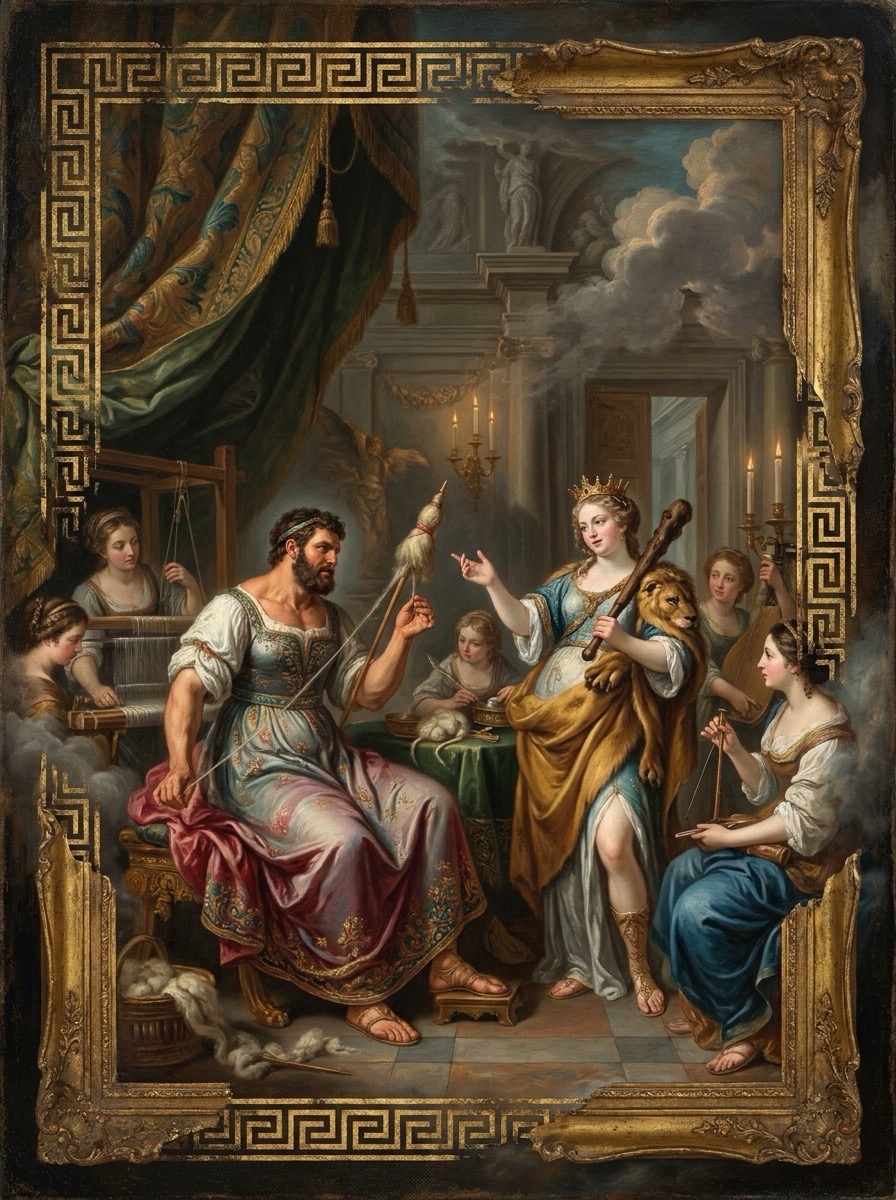
After completing many terrible labors, Heracles brought another calamity upon himself. Iphitus, son of Eurytus, came in search of missing horses, and Heracles should have received him as a guest. Instead, in a fit of madness, he hurled him from the city wall. Blood-guilt fell upon him. He sought purification, but pain still tormented him, and at last he went to Delphi to ask Apollo’s oracle what must be done. Apollo's oracle gave a hard sentence: Heracles had to be sold as a slave and serve for three years, with the price paid to Eurytus as compensation for Iphitus's death. For a hero who had killed monsters and reached the edge of the world, this was heavier than iron chains. Yet he could not escape his own guilt. Hermes led him away to be sold, and Omphale, queen of Lydia, bought him. In Omphale's palace, Heracles was no longer a free hero. The stories say that she sometimes dressed him in soft garments and set him among the women with wool and distaff, while she herself put on his lion skin and lifted his heavy club. Heracles did not lose his anger, but the oracle and the memory of Iphitus weighed on him. If he wanted release, he had to endure the humiliation and obey. Omphale soon understood that such strength could not be kept indoors forever. She sent Heracles against the robbers and cruel men troubling Lydia. He caught the mocking Cercopes, tied them upside down to a pole, and finally laughed at their jokes enough to let them go. He also punished Syleus, who forced passing strangers to labor in his vineyard, and destroyed the place where travelers had been abused. During those years, the palace remembered the strange sight of Heracles with the distaff and Omphale in the lion skin, while the countryside remembered safer roads and wicked men brought down. When the three years were complete, Heracles had paid for the death of Iphitus, and Omphale freed him. Some traditions even made the queen his wife, but the heart of the tale remains the same: the strongest of heroes once bowed under humiliation and worked off his blood-guilt through service.
Blood on the City Wall
Heracles had done many deeds that shook the earth, but that did not mean he could sit quietly at home for the rest of his life. His strength was too great, and his temper too fierce. When anger came over him, it was as if a dark cloud passed before his own eyes.
At that time Eurytus, king of Oechalia, had lost several horses. His son Iphitus went looking for them and, in the course of his search, came to the place where Heracles was staying. Iphitus had not come to seek revenge. He trusted Heracles and believed that so great a hero would never steal a few horses, so he entered his house and spoke with him as a guest.
But Heracles had long carried resentment in his heart. Eurytus had once promised that whoever could surpass him and his sons in archery would receive his daughter Iole as a bride. Heracles won the contest, but the bride was withheld. Eurytus feared the madness that had once seized him and dreaded giving his daughter into such a troubled household, so he broke his word. Heracles had buried the insult, but he had never forgotten it.
Iphitus, as a guest, should have been under his protection. When a guest crossed the threshold, the host gave him food and rest, and the gods themselves watched over that bond. But one day Heracles led Iphitus up to a high place, where they could look down from the city wall to the ground below. Perhaps some word touched the old wound; perhaps old anger and madness rose together in him. Suddenly he seized Iphitus and thrust the unsuspecting guest from the wall.
Iphitus fell and died on the stones below. Heracles soon came back to himself, but the blood had already been spilled. To kill an enemy was one thing; to murder a guest who had come under one’s roof was another. This was no victory or defeat on a battlefield. It was a violation of a law honored by both mortals and gods.
The Sentence at Delphi
Heracles tried to wash away the crime. First he sought someone to purify him, but not everyone was willing to take on so heavy a blood-guilt. In time the rites were performed for him: water was poured over his hands, and prayers were spoken. Yet the suffering did not leave him. Pain clung to his body like an unseen serpent biting into the bone. He understood then that the matter was not finished.
So he went to Delphi to ask the oracle of Apollo.
The mountain road wound upward, and smoke from sacrifices rose before the sanctuary. The priestess sat in the god’s place and delivered the answer. The oracle was clear: Heracles must be sold as a slave and serve for three years. The money from his sale was to be given to Eurytus, father of Iphitus, as payment for the blood that had been shed. Only then could he be released from the guilt.
To Heracles, those words were heavier than iron chains.
He had strangled the Nemean Lion, cut down the Hydra, chased the hind, subdued the boar, cleansed the stables, and journeyed to the edge of the world. Many kings stepped back at the sound of his name, and many monsters had died beneath his hands. Now the god commanded him to bow his head and let himself be sold like livestock, bronze goods, or a captive taken in war.
However angry Heracles was, he could not argue with the oracle. Hermes was ordered to take him away and sell him. The one who bought him was Omphale, queen of Lydia.
In the Queen’s Palace
Lydia lay far away, a wealthy land, and Omphale’s palace shone with bright woven cloth, gold ornaments, and sweet scents. The queen sat upon her throne and looked at Heracles when he was brought before her. His shoulders were as broad as doorposts; his hands were accustomed to the weight of a club; his whole body seemed still to carry the breath of wild mountains, beasts, and battlefields.
Yet from that moment on, he was no longer a hero free to come and go. He was a man the queen had purchased.
Omphale did not immediately send him out with weapons in his hands. In the stories told of her, she sometimes made Heracles remain in the palace, dress in soft garments, sit among the women, and learn to handle the distaff and wool. The hands that had once gripped a lion by the throat now had to draw out fine thread. The shoulders that had worn a lion’s skin were draped in delicate cloth. The maidservants laughed under their breath and stole glances at him. At times the queen would take up his lion skin and throw it over her own shoulders, then lift his heavy club, as though deliberately showing everyone that even the strongest of heroes could be made to bow in service.
Heracles endured it.
It was not that he felt no anger. Thread snapped between his fingers; the distaff rolled out of his clumsy hands and across the floor; his brows drew together, and his chest rose and fell. But the oracle hung over him, and the death of Iphitus weighed on his heart. If he wished to pay for his crime, he could not run away, nor could he rebel as he pleased.
Still, Omphale soon saw that such a man could not simply be shut inside palace rooms. If his strength was not put to use, it was like fire locked in a cage. Around Lydia there were robbers, cruel men who oppressed travelers, and monsters and violent offenders who troubled the countryside. So the queen sent him out to clear her land of these harms.
The Cercopes Hung Upside Down
Among those wicked troublemakers were two famous rascals called the Cercopes. They were quick in body and foul in speech, and they made a habit of stealing from travelers and mocking them. One man lost his purse on the road; another had his belt cut away just after he lay down to sleep; others were fooled and led in circles. Many people had tried to catch them, but the brothers always slipped away through bushes, between rocks, and along hidden paths.
When Heracles heard of them, he took up his club and went in search. He had little taste for roundabout tricks and no patience for banter with petty thieves. He searched along mountain tracks and through wooded ground until at last he caught the two brothers. The Cercopes tried to flee as they always did, but Heracles reached out, and his hands closed on them like iron clamps.
He cut a wooden pole, bound the two men to it head downward and feet upward, and slung it over his shoulder as a hunter might carry wild game.
The brothers hung there upside down, blood rushing to their heads while the road jolted before their eyes. They should have been terrified, but they had been born with mocking tongues, and even then they began to laugh. They saw Heracles’ back under the lion skin and his sun-darkened backside, remembered something their mother had once told them, and shouted jokes from midair. Heracles heard them. At first he was angry; then the strangeness of the scene made even him laugh.
He stopped and set the pole down. The two thieves were still gasping, their eyes rolling. Heracles decided that, though they were wretched fellows, they were not like those who slaughtered and tormented common people. So he let them go. The Cercopes had suffered enough to learn that this hero in bondage was not a man to be mocked lightly.
The Cruel Man in the Vineyard
There was also a man named Syleus, who held lands and vineyards and used them to abuse passersby. He seized strangers and dragged them into his fields, forcing them to swing mattocks and prune vines like slaves. Anyone who refused was beaten and punished; anyone who collapsed from exhaustion found no pity.
When Heracles came to that place, Syleus behaved with his usual reckless arrogance. Seeing a tall foreigner, he thought to seize him too and put him to work. Heracles did not flare up at once. He allowed Syleus to lead him into the vineyard.
The sun was bright over the rows of vines. The earth had been turned hard and dry, and the vines stretched away in long lines. Syleus threw him a tool and ordered him to bend down and work. Heracles took the mattock, looked at it for a moment, and suddenly drove it into the ground with all his strength. Earth flew up, roots snapped, and vines were torn apart. He did not look like a man tending a vineyard; he looked as though he meant to pull the whole place apart. Syleus shouted and rushed forward to stop him.
That was exactly what Heracles had been waiting for.
He threw aside the mattock and seized the cruel man. Only then did Syleus understand that the traveler he had captured was no helpless laborer, but Heracles, who had contended with beasts and giants. It was too late to beg. Heracles killed him and destroyed the place where he had tormented travelers. Those who had been forced to work there came out of the vineyard at last, their hands still stained with earth, but their backs straight for the first time.
The Lion Skin and the Distaff
The days passed one by one. In Omphale’s service Heracles suffered humiliation, but he also won honor through his deeds. In the palace, people still remembered the sight of him with a distaff in his hands, and the sight of the queen wearing the lion skin and carrying the club. In the countryside, people remembered other things: fewer robbers on the roads, safer paths for travelers, the doors of wicked men broken open, and the oppressed able to return home.
Omphale, too, gradually ceased to see him merely as a slave she had bought. She saw his patience when he was silent, and his power when he acted. Heracles was not a gentle man. He carried blood-guilt, anger, and the heavy burden laid on him by fate. Yet during those three years he did not flee the sentence. He served out the service required of him and did what had to be done.
When the appointed time was over, Heracles had paid for the death of Iphitus. Omphale set him free. Some traditions even say that the queen later became his wife and bore him a son. However that marriage was remembered, the most important part of the story had come to an end: Heracles walked out of bondage and took up his own road again.
When he left Lydia, the lion skin was still the lion skin, and the club was still the club. Yet those days remained in his story like a strange mark. The strongest hero in the world had once bowed his head in the palace of a queen; he had been mocked, and he had endured the judgment of the gods. Then, with his own hands, he paid his debt of guilt little by little until it was cleared.