Greek Mythology
Heracles and Eurytus — Greek Mythology
After reaching Oechalia, Heracles wins the archery contest set by Eurytus, only to be denied the hand of Iole. A quarrel over missing cattle then turns to bloodshed when Heracles, in a fit of rage, kills Iphitus and brings a new stain upon himself.
Article
Summary
Eurytus, king of Oechalia, was famed for his skill with the bow, and in younger days he had even taught Heracles archery. Proud of his talent, he announced that whoever could outshoot him and his sons would win his daughter Iole. Heracles heard the challenge and came to Oechalia to compete, and one shot after another carried him to victory over the king’s house. By Eurytus's own promise, Iole should have become Heracles' bride. Instead the king remembered how Hera's madness had once driven Heracles to kill his wife and children, and fear made him withdraw the prize. Most of Eurytus's sons supported their father, but Iphitus argued that a promise made in public ought to stand. Heracles left Oechalia in anger, with the insult burning under the surface. Soon afterward Eurytus's cattle vanished. The king immediately suspected Heracles, imagining revenge for the broken marriage promise, though another thief had actually taken the herd. Iphitus refused to believe the accusation. Hoping to find the cattle and clear the quarrel, he traveled to Tiryns and asked Heracles for help. Heracles received Iphitus as a guest, but old shame and suspicion rose together in him. The more honestly Iphitus spoke, the more Heracles remembered Eurytus's refusal and the charge of theft. He led Iphitus up to a wall or tower, and in a rush of rage hurled the unsuspecting young man down to his death. This killing was no victory in battle. It was the murder of a guest and left Heracles with a new blood-guilt. He sought purification and finally went to Delphi for Apollo's judgment. The oracle declared that he must once again serve another, and that the price of his sale should compensate Iphitus's father. The archery contest left no wedding songs behind, only hatred in Oechalia, Iole's unresolved shadow, and the road toward Heracles' servitude under Omphale.
The Contest at Oechalia
After Heracles had finished so many hard labors, his name had spread throughout Greece. Men spoke of him and remembered different deeds: the hide of the Nemean lion, the blood of the Hydra, the boar he had carried down from the mountain, the birds he had shot from the sky, the cattle he had driven back from far away. Yet the greater his fame grew, the less easily the shadows of his past left him. Hera’s madness, the slaughter of his wife and children, still trailed behind him. Though he had labored long in expiation, his heart had never truly found peace.
In Oechalia there was a king named Eurytus. He was a celebrated archer. In his youth Apollo had favored him, and he had passed his skill with the bow on to others. When Heracles was still a boy learning the bow, he had once received instruction from Eurytus. The king had several sons, all of them excellent archers, and a daughter named Iole, gentle of bearing and fine in character, whom many young men sought in marriage.
Proud of his skill, Eurytus made a public proclamation: whoever could defeat him and his sons in archery would win Iole as his bride.
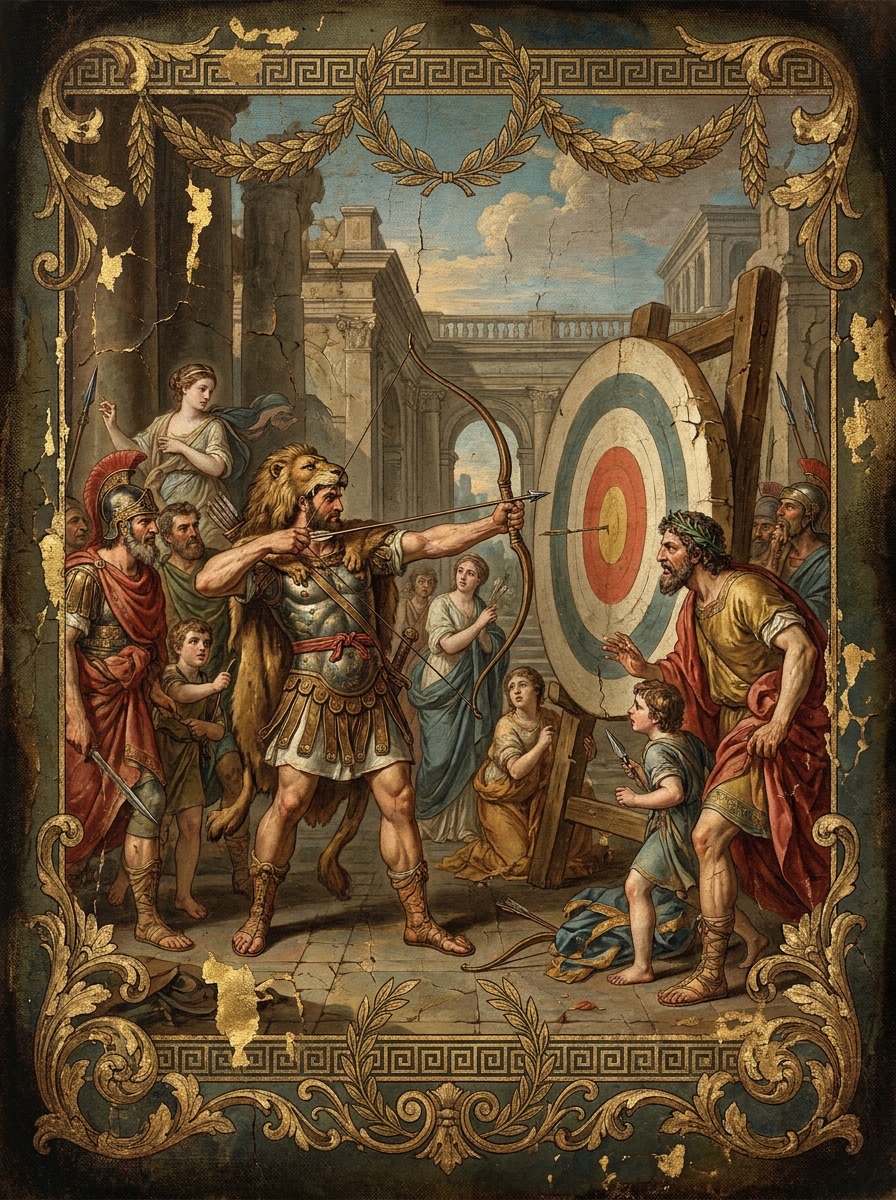
When Heracles heard this, he did not treat it as an idle boast. He took up his bow and went to Oechalia. On the day of the contest, many people gathered before the palace. The targets stood far off in the field, marked posts hung with tokens, and the wind came down from the hills, stirring the flags. Eurytus and his sons stood apart, with quivers and bows at their sides. As Heracles entered the ground, people whispered among themselves: there was the lion-slayer, there was the son of Zeus.
The shooting began. Eurytus went first. He drew the bow, loosed his arrow, and sent it near the mark. One by one his sons stepped forward, and each shot rang out cleanly, making the shafts tremble as they struck, while the onlookers cheered them on. When Heracles’s turn came, he said little. He simply took up his bow. In another man’s hands it might have seemed a weapon too heavy to master, but in his it bent like a supple branch. He set his feet, narrowed his eyes on the distant mark, and let fly. The arrow cut straight through the line of shafts already quivering there and buried itself in the very center.
Arrow followed arrow. No matter where the target was moved, no matter how the distance was stretched, his shots kept falling true. In the end even those who had been cheering for Eurytus fell silent. They could see for themselves that Heracles had won.
By the king’s own promise, Iole should have been given to him.
The Promise Withdrawn
But Eurytus’s face changed.
He remembered the disaster that had once overtaken Heracles. He thought of the madness that had driven him to kill his wife and children. Such a man might be unmatched in strength, but he was also terrible to behold. If he were given a daughter, who could say what would happen later? Fear rose in Eurytus’s heart, and he refused to hand Iole over.
His sons stood with him. Some said that although Heracles had won the contest, he was not fit to marry Iole; others said that a king must not give his daughter to a man once ruled by madness. Only one son did not join in. He was named Iphitus. He was more upright than the rest and believed that since his father had made the promise openly and Heracles had won according to the rules, it should not be broken.
When Heracles heard the refusal, anger surged through him. He had not lacked for insults in his life, but this was different. Eurytus had once been his teacher; now he was breaking his word before everyone and throwing Heracles’s darkest suffering back in his face. Heracles’s hand tightened on his bow, and his eyes flashed. Yet on that day he did not strike in Oechalia. He mastered himself and left the palace, while Iole remained in her father’s house and the marriage that had seemed so near was scattered like ash in the wind.
It looked, for a moment, as though the matter had passed. But in the stories of heroes, anger that is held down does not always disappear at once. It smolders beneath the surface like a fire under gray embers.
The Lost Cattle
Not long after, Eurytus’s cattle vanished.
It was not one or two strays, but an entire herd driven away, their hoofprints muddied and confused across the ground while the herdsmen searched in desperation. When Eurytus heard of the loss, he immediately suspected Heracles. In his mind the insult over the marriage must have bred resentment, and now Heracles had stolen the cattle in revenge.
But that was not what had happened. Another thief had taken them. The herd had not been stolen by Heracles at all. Yet Eurytus already had his mind made up, and so he laid the blame on him.
Iphitus, however, would not believe that Heracles had done such a thing. Though his father had refused the marriage and though ill will already stood between the two houses, he still thought Heracles was not the man to steal cattle. So, in order to recover the herd and uncover the truth, Iphitus set out from Oechalia and followed the road from place to place, questioning herdsmen, examining tracks, and pursuing every report until he reached Tiryns and found Heracles.
Heracles received him without open refusal. He welcomed the young man and let him come in and rest. Iphitus explained the loss of the cattle and said plainly that he did not share his father’s suspicion. He hoped Heracles would help search for the herd, for if they could discover the truth together, perhaps the old misunderstanding might yet be eased.
Heracles listened, but another storm was rising inside him. Eurytus’s broken promise, the shame before the crowd, the charge of theft, all of it came flooding back at once. The more earnestly Iphitus spoke, the more Heracles remembered how that house had treated him. His strength could bear mountains, but once his anger broke loose it could also crash down like a flood bursting through a dam.
Murder on the Wall
Heracles led Iphitus up to a high place. Some said it was the strong wall of Tiryns, others that it was the top of a tower. Below them lay the streets and rooftops of the city, and farther off the fields could be seen. Iphitus may still have believed they were only looking out for the path the cattle might have taken; he had no fear of the man beside him.
Then Heracles’s fury overtook his reason.
He seized Iphitus and hurled him from the height.
The young man fell heavily to the ground below. The cattle had not yet been found, and already Eurytus’s son lay dead by Heracles’s hand. Iphitus had spoken for him, had believed he was no thief, and in return became the victim of his hatred.
This was no battle between warriors, nor a defense against a monster. It left Heracles with a new pollution upon his hands. Once blood is spilled, it cannot be wiped away like water. Heracles soon understood that he had done a terrible thing. He sought purification wherever he could, hoping to rid himself of the stain of murder, but the guilt clung to him still.
At first he went from place to place seeking cleansing, and then he came to Delphi to ask Apollo’s oracle. But the gods do not lightly overlook such a crime. Heracles, still wild with anger, even came to struggle with divine will in the temple itself; the story says he once seized the sacred tripod in an attempt to force an answer. At last Zeus broke the quarrel with a thunderbolt, and Apollo gave his judgment: Heracles must once more enter another’s service to make recompense for the death of Iphitus.
For Heracles this was a bitter humiliation. He had already served a long term of labor and completed deeds that no other man could have endured, and now, because of his own hand, he was driven back into shame again.
A New Sentence
By the oracle’s command, Heracles was to be sold into slavery, and the money was to be paid as compensation for Iphitus’s death. He was taken far away and eventually came to Omphale, queen of Lydia, where he began another season of servitude.
The hatred in Oechalia did not truly end there. Eurytus had lost his son and now hated Heracles all the more. Heracles had lost the marriage that the contest had seemed to promise him, and in one burst of rage he had killed the man who had trusted him. Iole remained in her father’s house, yet her name was now tied to the quarrel, and in time it would help draw forth an even greater disaster.
This time Heracles had not conquered a monster, nor brought home a triumph. He had won the archery contest and lost the bride; he had not stolen the cattle, yet suspicion drove him to murder; he was the strongest of heroes, and still he could not master the fire in his own heart. After Iphitus died, Heracles once again left the road of freedom and went back toward slavery and atonement. In the palace of Oechalia, the contest of the bow left behind not wedding songs, but a chain of hatreds that could not be taken back.