Greek Mythology
Heracles and Admetus — Greek Mythology
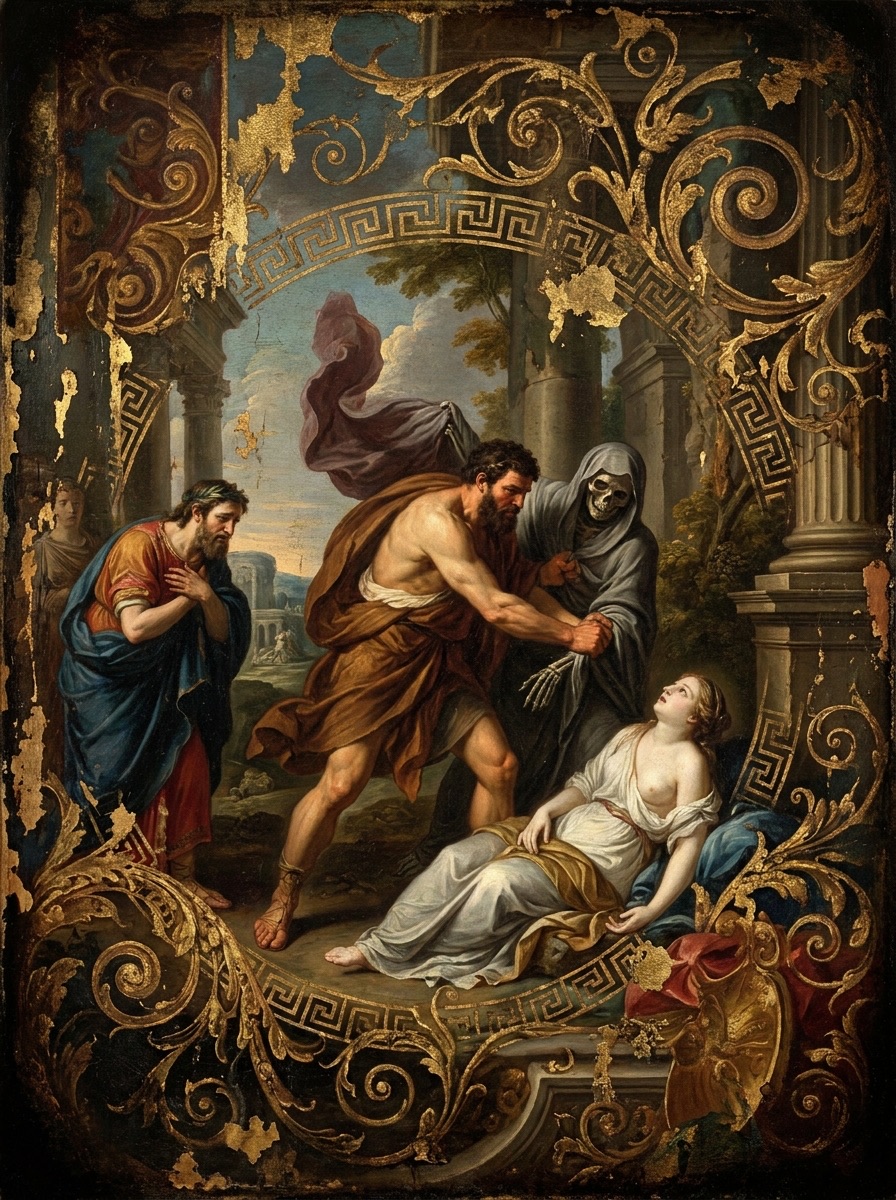
With Apollo’s help, Admetus won one chance to escape death—but only if someone else would go down to the underworld in his place. His wife Alcestis willingly gave her life for him. Later, when Heracles came to the palace and learned the truth, he went to her tomb and wrested her back from the hands of Thanatos.
Article
Summary
Admetus, king of Pherae, had once treated Apollo kindly when the god was punished and sent to serve among mortals. In gratitude, Apollo helped him win Alcestis as his wife, and later obtained from the Fates a strange favor: when Admetus’s appointed day of death arrived, he might live on if someone else freely chose to die in his stead. When that favor came into the house, it felt less like mercy than a cold blade. Admetus first asked his aged parents to die for him, but both clung to their own lives. At last his young wife Alcestis stepped forward. She gave her life so that her husband might keep his, said farewell to her children, asked Admetus not to bring home a cruel new wife to mistreat them, and died while the palace and city mourned. Before the grief had settled, Heracles arrived at the palace seeking shelter. Admetus, though broken by sorrow, would not fail in the duty owed to a guest. He did not tell Heracles that the dead woman was the queen, but said only that someone outside the close family had died. He had Heracles led to separate quarters with food and wine, while the true mourning continued inside the house. Heracles at first knew nothing and behaved with his usual rough cheer. When a servant finally revealed that Alcestis had died in place of the king, the hero sobered at once. He understood what Admetus had concealed in order to honor hospitality. Ashamed and moved, he took up his lion skin and club, asked where Alcestis had been buried, and went out alone toward the tomb. At night Heracles waited beside the new grave for Thanatos to come for the dead woman. When Death appeared, he seized him and wrestled until Thanatos was forced to release Alcestis. At dawn Heracles returned with a veiled woman and pressed Admetus to take her hand. When the veil was lifted, the king saw his wife restored from death. Alcestis could not yet speak until the proper rites were fulfilled, but she stood alive in her house, and Heracles had repaid his friend's hospitality with strength.
The God Who Came to Herd on Earth
Admetus of Pherae was a wealthy and gentle king in Thessaly. He had broad stables, fat cattle and sheep, and a household where servants and guests were always coming and going. Yet what people remembered most about him was not his wealth, but the way he once received a god in distress.
At that time Apollo had angered Zeus and was punished by being driven from Olympus to serve a mortal man. The pastures under the sun had no golden chairs and no music of the gods—only grass, dust, the smell of sheep, and the evening cries that called the herds back to their pens. Apollo came into the house of Admetus and became his herdsman.
Admetus did not know how great a being this herdsman truly was, but he did not treat him with contempt. He gave him lodging and food, and did not scold him as though he were a lowly servant. When Apollo played his pipe in the fields, the cattle grew quiet, and even wild beasts stopped at a distance as if they understood the music. Little by little, Admetus came to see that this herdsman was no ordinary man.
Apollo remembered his kindness. The gods can be stern, but sometimes they are also eager to repay a mortal’s good heart. Later, Admetus wished to marry Alcestis, the daughter of Pelias. She was beautiful and noble, and many princes wanted her for a bride. Her father, however, set a difficult condition: whoever wished to marry her must yoke a lion and a wild boar to the same chariot and drive it to the palace.
This was no trial for an ordinary man. A lion would spring and bite; a boar would smash the chariot pole with its tusks. To harness the two fierce beasts together was almost like tying ropes around the fury of the mountains. If Admetus had relied on himself alone, he could scarcely have come near them.
Apollo helped him in secret. On the appointed day, Admetus held the reins, and before his chariot stood a lion and a wild boar truly yoked together. The lion’s mane shook in the wind; the boar pawed the earth; the wheels rolled through the dust before the palace. Everyone stared in amazement, and Pelias could no longer take back his word. In this way Admetus won Alcestis as his wife.
A Strange Gift
For a time after the marriage, peace settled over the palace of Pherae. Alcestis was not a queen who merely sat in the inner chambers waiting to be served. She oversaw the household rites, cared for the servants, and honored her husband. People in the palace said that Admetus was generous to guests, Alcestis gentle to all, and that the two were well matched.
But no mortal happiness remains undisturbed forever. The day appointed for Admetus’s death drew near. However beloved a mortal may be by the gods, there is always a time when fate calls. Apollo could not bear to see the king who had once treated him kindly die in this way, so he went to plead with the Fates.
The Fates spin the thread of human life, and whether a life is long or short, they do not easily alter it. Apollo used every art he had, and at last won a condition for Admetus: when Thanatos came, if someone was willing to die in Admetus’s place, Admetus might be spared this death.
The gift sounded like salvation. But when it entered the house, it was colder than a knife.
Admetus first went to his aged father, and then to his mother. He thought that since they were old and had lived many years, perhaps they would be willing to give the few days left to them for their son. But when the old people heard his plea, both drew back their hands.
His father said that every living person loves his own life, and old age fears death as much as youth does. His mother, too, refused to walk into the dark. White hair does not mean one no longer clings to the sun, and the person who leans on a staff may still be unwilling to leave the familiar earth before the door.
When Admetus heard these words, shame and pain filled him. He had been given a chance to escape death, but he could find no one willing to die for him. Silence fell over the palace. The servants lowered their eyes, and his kin avoided his gaze.
Then Alcestis stepped forward.
She did not loudly accuse anyone, nor did she praise herself. She simply resolved to die in her husband’s place. She was still young; there were children in the house; the bed was still warm; in her chests were garments not yet worn threadbare. Yet she knew that if no one took Admetus’s place, Thanatos would carry him away. So she laid her own life before her husband, like handing a lamp to someone about to fall into night.
The Queen’s Last Hour
On the day death came, there was no singing in the palace. Branches of mourning were hung at the doors; servants moved about in hushed voices; even the horses in the stables seemed to sense what was happening and no longer neighed.
Alcestis lay upon her bed, her face growing paler little by little. Knowing that she was about to depart, she called Admetus to her side. She looked at him, and then at the children, and her voice grew softer and softer.
She asked for no gold or silver for herself, nor for a splendid funeral. She asked only that Admetus remember what she had done for the house, and that he not marry again and bring in a cruel new wife to mistreat the children. She called the children close and touched their faces with her hand. The little ones did not understand death; they only knew that their mother’s hand was cold, and that everyone in the room was weeping.
Admetus was torn with grief. He held his wife’s hand and promised that he would not marry again, promised that he would keep the house for her. He said that from then on there would be no feasting in the palace, no joyful songs; he would have a carved image of her beside his bed, as though she were still within the house.
Alcestis listened to these words, and the light in her eyes slowly faded. She looked one last time at her husband and children, and then life left her.
The crying carried from the inner rooms into the courtyard. Servants brought out clean water and prepared ointments and clothing. Admetus cut his hair and put on mourning garments. The people of Pherae mourned their queen as well, for they knew she had not died of sickness, nor fallen beneath sword or spear. She had walked toward death of her own will, and bought back the life of the king.
On that very day, Heracles came to Pherae.
A Guest Enters a House of Mourning
Heracles was on the road. He wore the lion skin over his shoulders, carried his bow and heavy club, and had the dust of travel on him. He was always going from one danger to another, and rarely found a truly peaceful place to rest. This time he came to the gates of Admetus’s palace, hoping to stay there for the night.
When Admetus saw him, astonishment and pain rose together in his heart. By Greek custom, a host must not slight a guest who comes to his door; and Heracles was a great hero, one who had freed many people from calamity. Yet his wife had just died. Her bier still stood within the house, and the crying had not yet faded. How could he lay out a feast for a guest?
Admetus hesitated for a moment, then mastered his grief and went out to welcome him. He did not tell Heracles the truth. He only said that someone outside the family had died, and that the mourning need not trouble his guest. He ordered the servants to lead Heracles to separate guest quarters, set out wine and food, and keep him from hearing the weeping in the inner rooms.
Heracles did not know the true sorrow of the palace. Tired from his journey, he sat down, drank wine, ate meat, and spoke with his usual hearty boldness. He called for the servants to pour more wine and urged those around him not to look so gloomy. He thought it was only the funeral of someone loosely connected with the household, not a grief that touched the king himself.
One servant could bear it no longer. His heart ached for the queen, and when he saw the guest drinking and making merry on such a day, resentment showed on his face. Heracles noticed his expression and asked what had truly happened.
At first the servant did not want to speak. But at last, unable to hold back his anger and sorrow, he said, “It is no stranger who has died. It is our queen, Alcestis. She died in the king’s place. Our master was afraid to fail in hospitality to you, so he hid his grief and let you eat and drink here.”
At these words, the wine seemed to leave Heracles at once. He fell silent, remembering Admetus’s pale face when he had welcomed him, and the weeping forced low throughout the house. He understood what a heavy day it was on which he had been received, and what pain Admetus had endured in order not to break the law of hospitality.
Heracles was not a man to let kindness pass lightly. He rose, drew the lion skin around him, took up his club, and asked where Alcestis had been buried. The servant stared at him in amazement. Heracles gave no long explanation. He strode out of the guest chamber and set off beyond the city.
The Struggle at the Tomb
After dusk, the road grew still. The mourners had already gone home, and beside the tomb remained the smell of offerings and the freshness of newly turned earth. Heracles came there and hid in the dark to wait. He knew that Thanatos would not leave empty-handed. Since Alcestis had only just been taken, the power that rules over death must still be lingering nearby.
Night deepened, and by the tomb there seemed to pass a cold wind. Thanatos came to the grave to take the dead woman who belonged to him down to the world below. Heracles sprang out of the shadows and seized him as he would have seized a wild beast.
It was no ordinary contest. One was the son of Zeus, whose arms could choke the life from a lion; the other was dark Thanatos, at whose footsteps mortals tremble. There were no spectators beside the grave—only cold earth, stone, and night wind. Heracles gripped Thanatos and would not let him go. Thanatos struggled, and a chill power wound itself around the hero’s arms, as if trying to drag the warmth of the living down beneath the earth.
Heracles clenched his teeth and tightened his hold. He did not argue at length with Thanatos; with his strength alone he demanded a life back. He forced Thanatos to release Alcestis. At last Thanatos could resist no longer, and let her go.
Before long, Heracles left the tomb with a veiled woman beside him and returned to the palace of Pherae.
The Veiled Woman
Admetus had come back from the burial. The house was empty, the bed was empty, and even the familiar sound of footsteps was gone. Only now did he truly understand that although he was alive, it was as though he had left half his life in the tomb. He had been granted a chance to escape death, but the cost of it stood behind every door and sat in every silence.
When Heracles returned, a veiled woman walked beside him. Admetus was troubled at the sight. He thought Heracles meant to entrust some new woman to him, and he refused at once. He said that he had just made a vow to his dead wife; he could not bring another woman into the house, and still less allow her to stand where Alcestis had once stood.
But Heracles insisted. He said that he had won this woman in a contest, and asked Admetus to keep her for a while until he returned to take her away. Admetus was torn. He did not wish to betray his dead wife, yet he did not wish to deny his guest’s request. Step by step, Heracles pressed him to stretch out his hand and take the woman himself.
Admetus turned his face away in pain. He said that the woman’s figure was too much like Alcestis, and that the sight of her would break his heart. Still Heracles placed the veiled hand into his.
At last Heracles lifted the woman’s veil.
The one standing before Admetus was Alcestis herself.
For a moment Admetus could not believe it. He looked at that face returned from death as though a lamp gone out in the house had suddenly been lit again. Heracles told him that he had kept watch at the tomb, wrestled with Thanatos, and won her back. Yet Alcestis could not speak for a while; only after the rites owed to the gods below had been completed, and the appointed days had passed, would she open her mouth again.
Admetus, overwhelmed with joy and wonder, reached out to support his wife, as though afraid she were only a shadow that would vanish at a touch. The mourning cries in the palace changed into shouts of disbelief and gladness. Servants came running, and when they saw that the queen had truly returned, they stood weeping at the doors.
Heracles did not stay to be praised again and again. He had done what he meant to do, and other roads were waiting for him. Admetus, even in his bitterest grief, had kept faith with the duties of hospitality; Heracles repaid that kindness with his own strength.
From then on, the people of Pherae long remembered how Alcestis had gone to death for her husband, and how Heracles had stopped Thanatos beside a new grave and brought a silent queen back among the living.