Greek Mythology
Helen and Paris — Greek Mythology
Paris, prince of Troy, won Aphrodite’s promise and came to Sparta, where he beheld Helen, the most beautiful woman in the world. While Menelaus was away from home, Paris carried Helen and rich treasures off with him, and that single flight stirred the old oaths of the Greek kings and brought the shadow of the Trojan War over both shores.
Article
Summary
Paris had once been a prince of Troy, but after a dire dream of a burning torch, he was sent to the hills and raised among shepherds. When he later returned to the royal house, he was drawn into the quarrel of three goddesses and gave the golden apple to Aphrodite, because she promised him the loveliest woman on earth. That woman was Helen. She lived in Sparta, daughter of Zeus and wife of Menelaus. Many heroes had once sought her hand, and in the end they were bound by a plan devised by Odysseus: whoever Helen married, the others were to honor the union and defend it if anyone tried to steal her away. Paris sailed to Sparta with fine clothes and Trojan gifts. Menelaus welcomed him as an honored guest, but soon left on family business. Once the host was gone, Aphrodite’s power moved quietly through the house. Paris persuaded Helen to leave with him, and he also carried off much of Menelaus’ wealth. When the ship left the coast of Laconia, Helen was no longer the queen of Sparta but the most dangerous guest in Troy. By the time Menelaus returned, the halls were empty and the old oaths still stood. He called upon the men who had once sworn to Helen’s marriage, and the elopement of Helen and Paris became the beginning of war between all Greece and Troy.
A prince raised in the hills
Before Troy was ever ringed by war, its palace still knew feasts, chariots, and the crying of children. King Priam had many sons and daughters, and before one of those children was born, Queen Hecuba had a terrible dream.
She dreamed that what she would bear was not a baby but a flaming torch. It rolled out from the palace, growing hotter and fiercer as it went, until it devoured the high walls, the wooden gates, the roofs, and the streets of Troy. When she woke, she was shaken with fear. The seers who heard the dream declared that the child would bring ruin on the city.
After the boy was born, Priam could not bring himself to kill him. Instead, he ordered that the infant be taken to Mount Ida. There among the cold mists, the pine trees, and the tracks of wild beasts, the child was left where he should not have survived. Yet the story says that someone found him and raised him. He did not grow up among gold pillars and woven hangings, but among shepherds. He learned to drive cattle and sheep, to watch the shifting shadows on the hillsides, and to strike at beasts with a staff.
They called him Paris, though later some named him Alexandros. He was handsome and quick in his movements, and on the mountain he often settled quarrels for others. If a man’s cattle were stolen or a sheep went missing, the shepherds came to him for judgment. At the time, he did not know that one day he would be asked to judge not a few straying animals, but the honor of three goddesses.
The golden apple comes to him
Later, when Thetis the sea goddess married the mortal hero Peleus, all the gods of Olympus came to the wedding feast. There was music, wine, and the hard look of immortals who did not yield to one another. The goddess of strife had not been invited, so she cast a golden apple among them. Upon it was written: To the fairest.
Hera, Athena, and Aphrodite all reached for it. None of the three would give way, and even Zeus did not care to decide the matter himself. So he handed the judgment over to Paris, the shepherd boy on Mount Ida.
That day Paris stood on the hillside while his flocks grazed far off and the wind moved through the trees. The three goddesses came before him, and each was beyond the beauty of any mortal woman. Hera promised him kingship, that he should rule over wide lands. Athena promised victory and wisdom, so that in war no man could defeat him. Aphrodite, speaking more softly than the others, promised him the most beautiful woman in the world.
Paris heard the last promise, and his heart moved. He gave the apple to Aphrodite. From that moment Hera and Athena hated him, and they hated Troy as well. Aphrodite, however, remembered her bargain, and she meant to lead him to that fairest woman of all.
Her name was Helen.
The queen of Sparta
Helen lived in Sparta. Zeus was said to be her father, and Leda her mother. From girlhood she had been famous for her beauty, and many Greek princes and heroes had come to Sparta to seek her hand. Tyndareus feared that if he chose one husband, he would offend all the rest, so he followed Odysseus’ counsel and made every suitor swear an oath: whichever man Helen married, the others would accept the match; and if anyone ever stole her away or wronged her husband, all would come to his aid.
The heroes swore before the altar. Blood fell to the ground, and the gods heard their words. Later, Helen married Menelaus of the house of Atreus and became queen of Sparta. The palace had looms, oil, gold cups, and broad halls. When guests arrived, servants washed their feet, poured the wine, and set out meat. Menelaus was not the strongest of kings, but he was wealthy and courteous, and Helen beside him was like a bright treasure, dazzling and dangerous, remembered by many men.
Aphrodite’s promise had not faded. Paris returned to the royal house at Troy, was recognized at last by his parents, and then sailed out as a prince in his own right. He brought companions, rich garments, and gifts from Troy. With his sails filled by the wind, he crossed the Aegean and made for Sparta.
A guest enters the hall
When Paris came to Sparta, he did not arrive as an enemy. He did not storm the gates with a spear in hand; he entered Menelaus’ house as a guest. By ancient custom, a man from afar was to be welcomed. Menelaus received him, set a feast before him, and ordered his servants to lay out food and wine.
Paris sat in the bright hall and saw Helen come forth from within. She was no chance encounter on a hillside now, but a queen, surrounded by maidservants and dressed in fine robes. Her beauty made even the firelight seem quiet. Paris remembered Aphrodite’s promise and knew he had not crossed the sea in vain.
Helen saw the Trojan prince as well. He was young, richly dressed, and gentle in speech, carrying the air of a foreign land. Aphrodite’s power did not need thunder to work. She often moved like a fragrance through a room, making men forget that beyond the doorway there were oaths, kinship, and ruin waiting ahead.
Soon Menelaus left Sparta because of a family death and sailed to Crete. Even as he departed, he still trusted his guest and left Paris in the palace, bidding his household treat him well. Once the master was gone, the great halls seemed empty at once. Paris and Helen had more chances to meet, and their quiet conversations grew longer.
The ship by night
What happened afterward is told differently in different traditions. Some say Helen was bewitched by Aphrodite and went of her own will; others say Paris carried her off. In any case, one night on the Spartan coast could not remain calm.
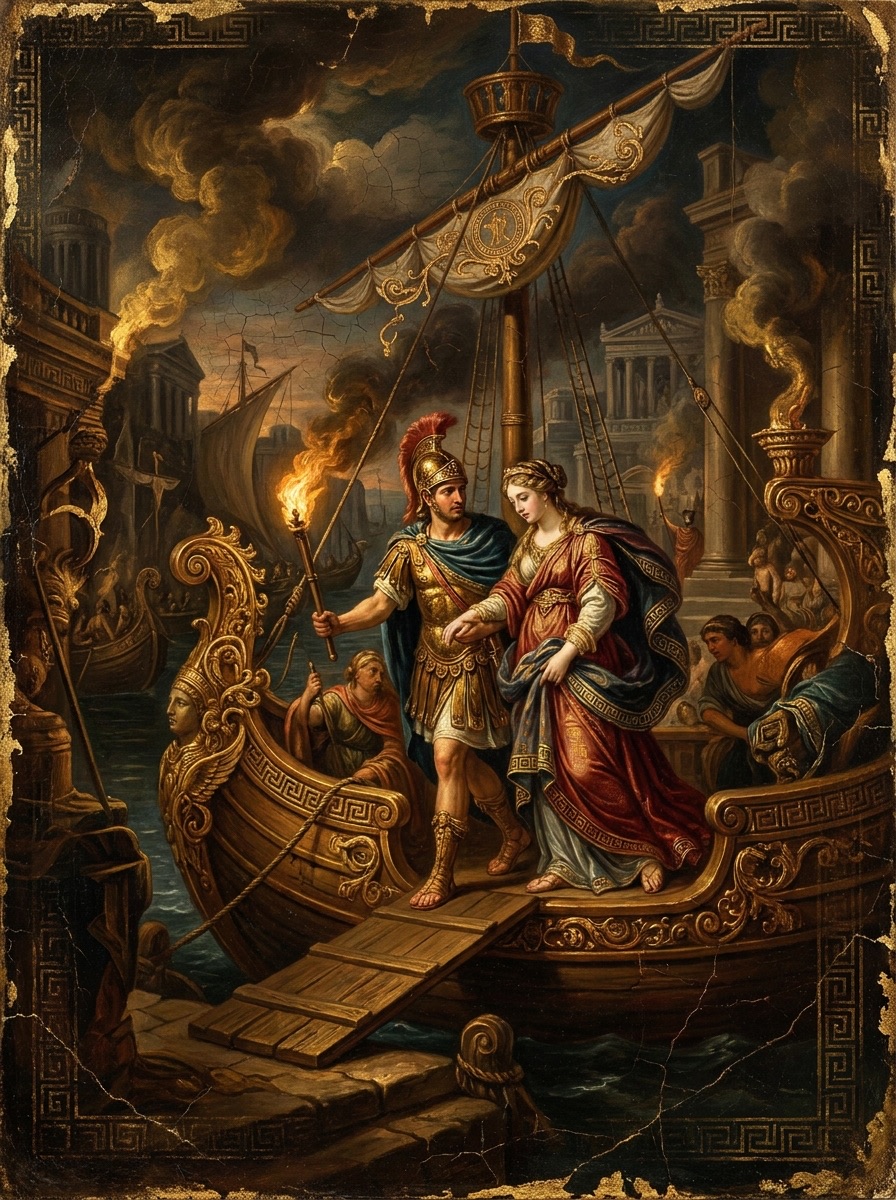
Paris ordered his men to load the treasures onto the ship. Gold vessels, clothing, perfumes, and precious things were packed into chests, weighing down the hold. When Helen left the palace, she may have looked back at the familiar colonnade, or perhaps she did not. Her maidservants followed her, and the night wind pulled at her robes while the sea beyond the shore beat blackly against the land.
The ropes were cast off, and the oars dipped into the water. The lights of Sparta slowly fell behind. Paris stood on the deck with the woman and the wealth he had won, and the ship turned eastward. The sea was not always kind; winds and waves drove them off course, and they put in elsewhere for a time. But in the end the walls of Troy rose ahead of them.
The city received the prince and saw the woman he had brought back. Helen’s beauty filled the people with wonder, but her arrival was not a simple joy. Priam and the Trojans may not yet have heard the footsteps of war, but Hera and Athena had not forgotten the golden apple, and the oath sworn at Sparta had not been broken.
The empty halls
When Menelaus returned to Sparta, the house had changed. The guest was gone, Helen was gone, and much of the wealth had vanished with them. The halls remained, the cups remained, the beds and looms remained, but the person most needed in the house had been taken, and the master’s honor had been trampled.
His anger was fierce, and so was his shame. Paris had not seized Helen in battle; he had left after being entertained under another man’s roof. That was harder to bear than an open blow. Menelaus went to his brother Agamemnon and told him what had happened. Agamemnon, king of mighty Mycenae, understood at once that this was no quarrel between two households.
The heroes who had once sought Helen’s hand had all sworn their oath. An oath is not a word that fades with the wind. It had been spoken before the altar, and the gods had heard it. So messengers were sent throughout the land to summon the men who had once raised their hands and pledged themselves. Some were on islands, some in the hills, some in their own halls. Many did not wish to leave home for war, yet the old oath drew them back to the same cause.
And in Troy, Paris had won the woman Aphrodite promised him. Helen lived in a foreign house, surrounded by Trojan women and by the attendants she had brought from Sparta. Her beauty had not dimmed, but wherever her name was spoken, sorrow and anger now followed it.
The meeting of Helen and Paris began as little more than a prince’s journey and a queen’s departure. Yet when they left together, the bed of Sparta was empty, the oaths of the Greek kings were awakened, and the sea wind before Troy changed its taste. Later, when ships came crowding in from every corner of Greece and their sails darkened the water, men understood that the little vessel which had slipped away from Sparta had already carried both lands into years of ruin.