Greek Mythology
Hector Returns to Troy — Greek Mythology
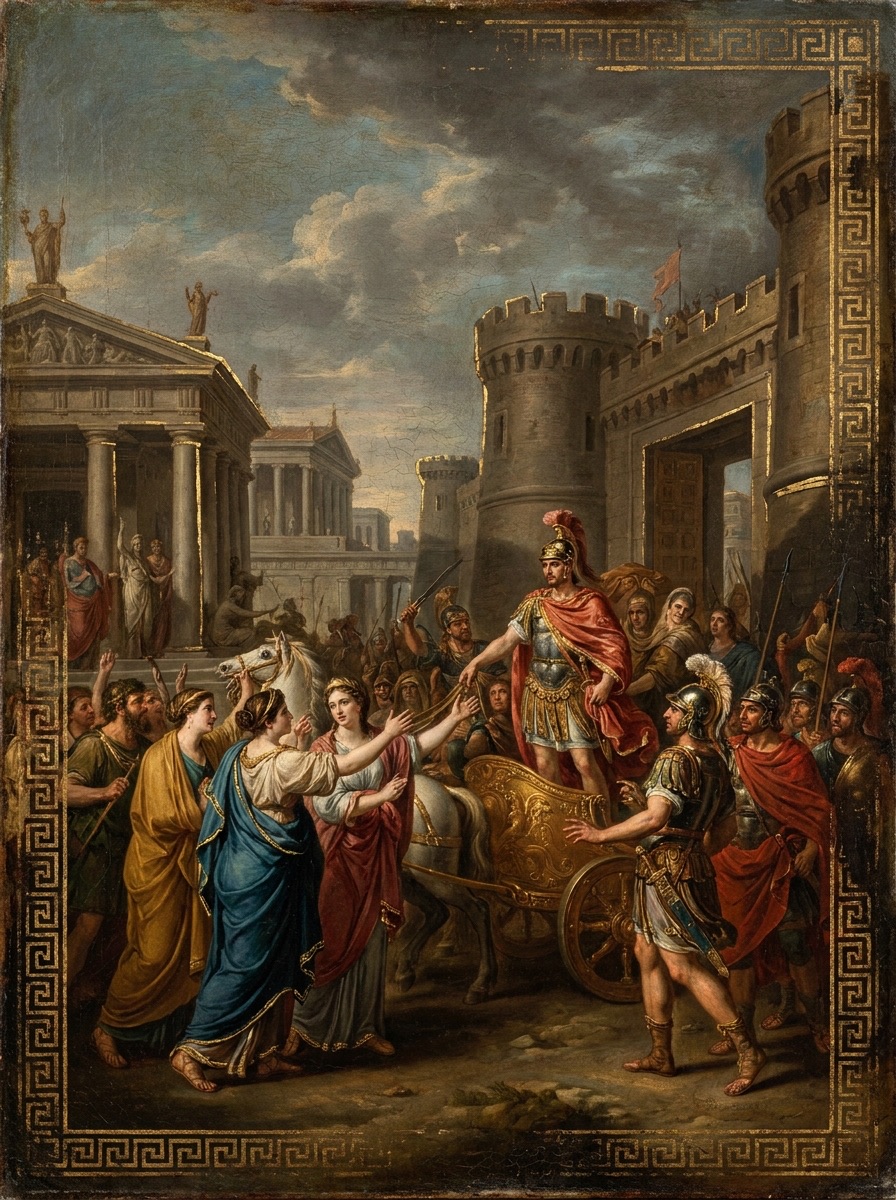
On the plain outside Troy, the battle rages fiercely, and Hector is sent back into the city on Helenus’s warning. There he urges Hecuba to lead the women in prayer to Athena, rebukes Paris for lingering indoors, and finds Andromache and little Astyanax at the Scaean Gate before donning his armor once more and returning to the field.
Article
Summary
Outside the walls of Troy, the Greek attack grows fiercer, and Diomedes drives through the battlefield with a force that pushes the Trojans steadily backward. Hector and Aeneas are still trying to steady the line when the seer Helenus reads the danger clearly. He urges Hector to leave the fight for a short time, return to the city, and ask his mother Hecuba to gather the elder women, bring the finest robe in the palace to Athena’s temple, and beg the goddess to pity Troy. When Hector enters the city, the women crowd around him asking whether their husbands, sons, and brothers still live. He can only tell them to pray. Hecuba thinks he has come home to rest and offers him wine, but Hector refuses it. He tells her to go at once to the temple with the women, dedicate the robe, and promise sacrifice. Hecuba obeys, yet Athena does not accept the prayer; the smoke in the shrine rises without mercy. After leaving his mother, Hector goes to find Paris. Outside the walls, Trojans are dying for Paris and Helen, while Paris himself is still in his chamber polishing splendid armor. Hector rebukes him for lingering away from battle, and Paris admits that shame has held him back, promising to arm himself and return. Helen also speaks with sorrow and invites Hector to sit, but he refuses to stay, because he still hopes to see his wife and child. Hector returns home and learns that Andromache has gone with their son to the Scaean Gate. There she meets him in tears and begs him not to rush back to the front, for her parents and brothers are dead and Hector is all that remains to her. Hector admits that he knows Troy will one day fall, and that the thought of Andromache being dragged into slavery hurts him most. Yet he cannot hide inside the city like a coward while others fight. When Hector reaches for his son, little Astyanax cries at the shining helmet and horsehair crest. Hector removes the helmet, kisses the child, and prays to Zeus that the boy may one day be braver and greater than his father. Then he gives the child back to Andromache, tells her to return to her weaving and household, and puts the helmet on again. Paris comes to join him, and the brothers pass through the gate together, leaving the tears of the house behind as Hector returns to dust and battle.
Dust Outside the Walls
On the plain before Troy, the dust rose high beneath hooves and wheels. Bronze shields crashed together, spearheads flashed in the sun, and the wounded fell beside the chariot tracks while cries of pain rolled again and again toward the city walls.
The Greeks pressed hard that day. Diomedes tore through the battle like a storm, charging back and forth with savage force. One Trojan after another went down before his spear, and his chariot rolled past the dead with dust and blood on the mane of his horses. The Trojans still fought desperately, but as their comrades kept falling, their line began to waver.
Hector stood among them. The horsehair on his helmet streamed in the wind, and his spear rose and fell without pause. He shouted the names of his countrymen, urging them to hold fast and never turn their backs to the enemy. Aeneas, too, called out to the soldiers, but the Greek assault kept rolling in like the tide.
Then Helenus, the Trojan seer, came up to Hector and Aeneas. He did not come to add a brave word to the shouting. He looked across the shattered field and already understood that voices and courage alone would not hold the line much longer.
He said to Hector, “You and Aeneas are the men Troy leans on most. Keep the soldiers steady wherever they stand and do not let them break back toward the gate. But I have one thing for you to do. Go into the city and tell our mother Hecuba to gather the elder women. Let them take the most beautiful and precious robe in the palace to Athena’s temple. They are to lay it across the goddess’s knees and promise sacrifice, and ask her to have mercy on the city and drive Diomedes away from the walls.”
Hector listened without asking more. He knew Helenus was not speaking empty words. Behind the walls were old men, women, and children; within the temple were incense and altar smoke; beyond the walls were spears, chariots, and chaos. He left the field to Aeneas and the other leaders and turned back toward the gate.
As he made his way through the fighting, Trojans called to him from all sides. He did not stop. He only cried out for them to wheel and defend themselves. By the time he reached the road to the gate, the women on the walls had already seen him. Thinking he must bring terrible news, they came out from houses, doorways, and porches, looking at him in anxious fear.
The Queen Brings Out the Robe
When Hector entered the city, his bronze armor was still gray with the dust of battle. Troy’s streets, which usually rang with carts, loom-beats, and children’s laughter, were now filled with low voices and hurried footsteps. The women crowded around him, asking whether their husbands, sons, and brothers still lived. Hector answered none of them one by one. He only told them to pray to the gods, for the danger on the plain was not yet over.
He came to the royal palace. It was broad and bright with columns, and within it lived the many children of Priam and their wives. Queen Hecuba came out to meet him. The moment she saw Hector, she hurried to him and took his hand. Seeing him covered in dust and weariness, she thought he had returned from the field only to catch his breath.
Hecuba ordered a servant to bring wine, meaning to have him pour a libation to Zeus and then drink himself to restore his strength. But Hector shook his head.
“Mother,” he said, “do not bring me sweet wine. If I drink now, my hands and feet will lose their strength and I will forget the force still in me. I am covered in blood and dust, and I cannot lift a cup to Zeus in such a state. What you must do now is something else. Gather the older women of the city and go to Athena’s temple. Choose from the palace a robe you love best and offer it to the goddess. Beg her to protect this city, to guard our wives and children, and to send Diomedes away from the field.”
At once Hecuba set about it. She went into the room where the garments were kept, where many splendid robes lay folded in order, woven with care by the women of Sidon and brought back across the sea by Paris. Among them she chose the finest robe of all. It shone with a soft light, broad and delicate, resting above the others like starlight laid across cloth.
With the elder women of the city she went to Athena’s temple. The doors were opened, and the priestess Theano came forth. The women lifted their hands and prayed through tears. Hecuba laid the robe before Athena, and she promised twelve unyoked heifers as sacrifice, asking only that the goddess break Diomedes’s spear and save Troy’s walls and children.
But Athena did not grant the prayer. The temple remained solemn and still, and the smoke before the altar rose slowly upward, as though it heard human grief or heard nothing at all.
Paris in His Chamber
After leaving his mother, Hector did not return at once to the battlefield. There was still one man he needed to find: Paris.
If Paris had not carried Helen away, this war would never have brought so many ships to Troy’s shore. Many of the city’s best fighters were already shedding blood for him, yet he himself often kept away from the front. Hector carried anger in his chest as he crossed the palace corridors and came to Paris’s room.
Paris was inside, arranging his splendid armor. Shields, breastplates, and his curved bow stood near him, all bronze-bright and beautifully made. Helen sat nearby with her women, working at her tasks. Outside, the noise of battle drifted in from afar, heavy as rolling thunder.
When Hector saw him there, he could not help but rebuke him. “So this is where you linger while other men die for you! The fight below the walls is blazing, and Troy burns for your sake. Are you not ashamed? Get up at once, before the enemy’s fire reaches the gate.”
Paris did not answer back. He admitted Hector was right, and said only that he was not without feeling, but had been held back by grief and shame, and was ready now to arm himself and go out.
Then Helen spoke as well. Her voice was heavy with weariness and remorse. She told Hector that she had brought disaster on Troy and burdened him, a good man, beyond measure. She asked him to sit for a moment, since he had borne so much labor for Paris and for her.
Hector did not sit. He said to Helen, “You have been kind to me, and I know it. But do not detain me. My heart is still outside, with the Trojans in battle. Tell Paris to come quickly. I must also go home and see my wife and little son. Who knows whether I shall ever see them again?”
With that, he turned and left. Paris stayed behind to finish arming himself, and Helen watched Hector’s back without saying more.
An Empty House and the Gate
Hector went home, but he did not find Andromache or his little son. Only the maidservants were there. He asked them, “Where has my wife gone? Is she with her sisters, or has she gone to the temple with the other women to pray?”
The servants answered, “She did not go to her kindred, and she did not go to the temple. When she heard that the Trojans were being driven back and the Greeks were gaining the upper hand, she rushed to the wall like one out of her senses. The nurse carried the child after her.”
Hector heard this and at once turned toward the gate. By the Scaean Gate, men were coming and going, and the wall rose high above the plain and the battlefield beyond. Andromache was indeed there. She stood near the tower, with the nurse holding the child beside her. The boy was still very small; his name was Astyanax, though the Trojans also called him the lord of the city’s child, because his father was Hector, the man who guarded the city.
When Andromache saw her husband, she hurried to him and seized his hand. Tears sprang to her eyes at once.
“You will kill yourself with this courage,” she said. “You have no pity for me, and none for this child. The Greeks will one day come against you together and kill you. Then I would rather die first. Achilles has already killed my father, and my mother is gone too; my brothers have all fallen in battle. Now I have only you. You are my husband, and you are also my father and mother and brother. Stay here by the wall. Do not keep charging to the very front. Place the troops near the fig tree, where the wall is weakest.”
Hector listened, and his heart was not unmoved. He looked at her, and then at the child in the nurse’s arms. But he could not agree.
“These things I have thought about as well,” he said. “Yet if I were to hide within the city like a coward, the men and the women in long robes would despise me. From boyhood I learned to stand in the foremost rank and win honor for my father and for myself. I know that one day sacred Ilium will fall, and Priam and his people will suffer. But what hurts me most in all that grief is not the fall of my father, nor my mother, nor even my brothers. It is that you will be carried off by the Greeks and forced to weave and draw water in a foreign land. Then someone will say, ‘This was the wife of Hector, who was once the bravest man in Troy.’ I would rather die before that day than hear your crying.”
The Child Feared the Helm
With that, Hector stretched out his hands for his son. But when the child saw the helmet, he shrank back in terror into the nurse’s arms. The horsehair crest towered above him, and the bronze gleamed in the sunlight; to such a small child, it was not his father’s face but a frightening thing that moved and shone.
Hector laughed, and Andromache laughed through her tears as well. Hector took off the helmet and set it on the ground. The bronze helm lay by the dust, the plume still trembling a little. Then he reached out again, and this time the child recognized his father and was lifted into his arms.
Hector kissed him, raised him high, and prayed to Zeus and the other gods: “Zeus, and all the gods, grant that this boy may one day stand out among the Trojans as I do, or even surpass me. May someone, when he returns from battle wearing the blood-stained armor of an enemy, say, ‘He is greater than his father.’ Then may his mother’s heart be glad.”
When he had said this, he gave the child back to Andromache. She held him tight against her breast, smiling still through fresh tears. Hector looked at her, touched her face gently with his hand, and urged her to go home.
“Do not let your heart be consumed by grief,” he said. “No man can send me down to Hades before my fate calls me there. When that day comes, the brave and the timid alike will not escape it. Go back now. Tend your loom and your spindle, and set the maidservants to their work. Leave the business of war to men, and most of all to me.”
It was not a cold thing to say. Hector only knew that battle was waiting beyond the wall, and that he could not lay down his spear.
Back to Battle
Andromache went home, turning to look back at him again and again. When she reached the house, the maidservants saw the grief on her face and gathered around her weeping. They already sounded as though they were mourning Hector, even though he was still alive and standing in the sunlight.
Hector set his shining helmet back on his head. The horsehair rose once more above the crest, and he took up his spear and turned toward the city gates. At that very moment Paris came hurrying from the palace. He wore his splendid armor like a stallion that, after feeding at the manger and regaining his strength, breaks loose from the rein and runs toward the plain. His delayed courage made his steps quick, and he caught up with Hector.
Paris said a few words to his brother, as if to excuse his delay and lighten the air between them. Hector did not scold him again. He only said that Paris was not lacking in bravery, only in the will to use it fully. The cry of battle was drawing near once more, and they had no time for more talk.
The two brothers passed through the gate and returned to the plain of Troy. The women on the walls were still watching them. No clear answer had come from the temple, and Athena still stood with the Greeks. But Hector had done all that could be done inside the city: his mother had gone to the shrine, Paris had armed himself again, and his wife and child had been seen.
So he gripped his spear and stepped back into dust and shouting. Behind him the gate stood high and still, while Andromache’s tears, the child’s cry at the sight of the helmet, and the robe laid before Athena all remained inside the city. And outside, Troy’s bravest defender went once more into battle.