Greek Mythology
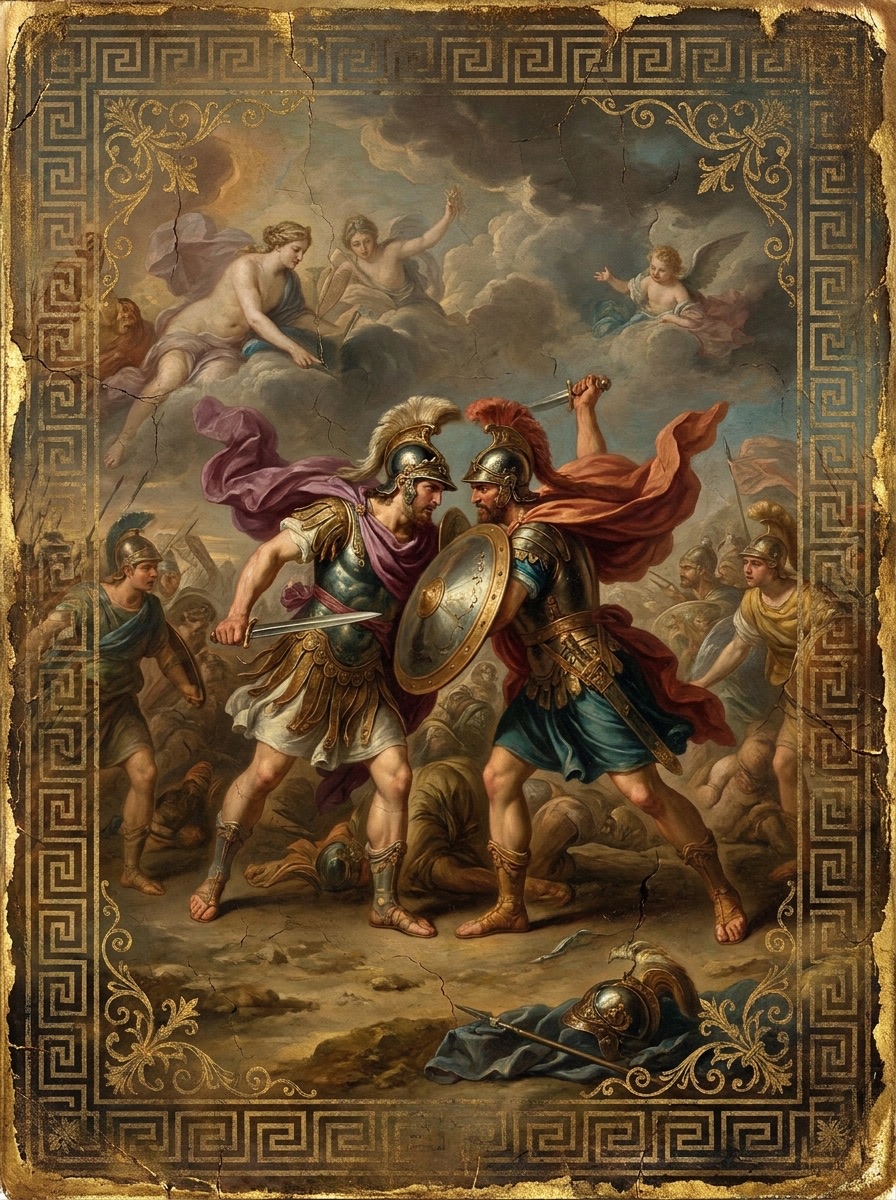
The Duel of Hector and Ajax the Greater — Greek Mythology
After Achilles withdrew from the fighting, Greeks and Trojans struggled on without rest. Hector challenged the Greek champions before the lines, Ajax the Greater was chosen by lot to meet him, and the two fought beneath the city walls until dusk, when they exchanged gifts and ended the combat for the night.
Article
Summary
After Achilles withdraws from the fighting, the war before Troy continues day after day, and both armies pay heavily. Apollo does not wish to watch the killing go on without end, and Athena also agrees that the battlefield should pause for a time. Divine purpose settles on Hector, and the seer Helenus urges him to stand between the armies and challenge the bravest Greek to single combat. Hector steps into the open ground and declares the terms: the victor may take the armor, but the defeated man's body must be returned to his own people for burial. The Greek ranks fall silent, for everyone knows Hector is Troy's strongest defender. Menelaus, stung by shame, wants to answer first, but Agamemnon and the other chiefs restrain him. Nestor rebukes the warriors for hesitation, and at last nine leaders offer themselves; the choice is made by lot. The lot falls to Ajax son of Telamon. Ajax comes forward like a moving tower, carrying his great shield into the space between the armies. Hector and Ajax acknowledge one another's courage, then begin with spears. Hector's spear bites into Ajax's shield but cannot pierce it, while Ajax's cast passes through Hector's shield and the edge of his breastplate, almost reaching the body beneath. When their spears are spent, the two draw swords and then seize huge stones from the ground. Hector's stone rings against Ajax's shield, but Ajax hurls a larger rock and knocks Hector down to one knee; without Apollo's help, Hector might have fallen there. As the two men prepare to continue with swords, night comes on, and the heralds step between them, urging both champions to obey the limit of darkness and stop. Hector praises Ajax as one of the strongest Greeks and proposes that they exchange gifts, so both armies will know they parted like true heroes though they fought as enemies. Hector gives Ajax his sword, and Ajax gives Hector a purple belt. Each man returns to his own camp, while both sides recover their dead and prepare funeral rites. The duel ends without a victor, but it briefly quiets the battlefield, and the sword and belt will later carry a darker weight.
Blood and Dust Beneath the Walls
After Achilles refused to fight any longer for the Greeks, the battlefield outside Troy grew more dangerous with every passing day.
At dawn, commands rang through the Greek camp by the sea. Soldiers lifted their shields and spears and poured out through the gates of the camp. From the city side the Trojans also came down in ranks, their chariots grinding over the dry earth, yellow dust rising behind the wheels. The two armies crashed together on the plain: spearheads struck bronze shields, blades rang against helmets, wounded men fell into the dust, and blood ran through the seams of their armor.
That day the fighting lasted from morning until the sun leaned westward. The Greeks tried to press nearer to the walls, while the Trojans fought desperately to drive them back. Hector, in shining armor, moved swiftly along the front and rear of his lines. The horsehair crest of his helmet tossed above him like a mane blown wild by the wind. Wherever men began to give ground, he hurried there; wherever the Greeks surged forward, he raised his spear to meet them.
On the walls, the old men, women, and children of Troy watched the plain below and hardly dared speak aloud. Through the dust they saw chariots flash into view, then fallen bodies; they saw Hector rushing again and again into the most perilous places. Everyone in the city knew that if he fell, the gates of Troy would seem to have lost an iron bar.
Yet the Greeks were not men easily frightened away. Menelaus, Diomedes, the two Ajaxes, Idomeneus, Odysseus—all fought in the battle line. Still, they knew in their hearts that without Achilles the sharpest spear in the Greek host had been laid aside.
Two Gods Halt the Battle
The din of battle grew heavier and heavier, like waves breaking one upon another.
Then Apollo looked down from the heights of Troy. He had long favored the city, and when he saw Trojans and Greeks falling in great numbers, he did not wish the bloodshed of that day to go on without end. Athena too came down from Olympus to the field. She guarded the Greeks, yet she also saw the plain strewn with bodies, dust mingling with blood.
The two gods met amid the battle. Apollo said that the armies should be made to pause, and that Hector should come forward to challenge the bravest man among the Greeks. Athena agreed.
So they set the thought in Hector’s heart, and they also made Helenus, the Trojan seer, understand the will of the gods.
Helenus found Hector and said to him, “Go and call the Trojans and the Greeks to stop fighting. Challenge the Greeks to single combat. This is not the day of your death; the gods will not let you fall in this duel.”
Hector heard him and at once sprang down from his chariot. He strode between the armies, holding his spear crosswise in his hand, and shouted for the Trojans to stop. At the sound of his voice, the Trojans checked their advance. On the Greek side too the attack gradually died away, until the field held only the groans of the wounded and the hot breathing of horses.
Hector stood in the open space, his bronze armor catching the evening light, and called out toward the Greek ranks: “Leaders of the Greeks, hear me! For Helen and her possessions you have shed too much blood here already. Now let both armies sit down, and let the bravest man among you come out to fight me. If he kills me, let him take my armor, but give my body back to the Trojans so that they may burn me in the city. If I kill him, I will take only his armor and give his body back to you, so that you may raise a mound for him by the sea. In days to come, when men sail past and see that tomb, they will say: here lies a warrior who once fought Hector.”
His words passed through the Greek army, and for a while all were silent.
It was not that there were no brave men among them. But Hector’s name carried great weight. He was the shield of Troy, the son on whom Priam most relied. Many had seen him charge in battle and knew that to meet him alone was no ordinary contest, but a wager made with one’s own life.
Menelaus Tries to Go First
When the silence had lasted too long, Menelaus could bear it no more.
This war had begun because of him. Helen had been taken to Troy by Paris, and the Greek kings had gathered from many lands and crossed the sea to this place. Now Hector had issued his challenge before them all, and no Greek had immediately risen to answer. Menelaus felt ashamed.
He stood, put on his armor, took up his spear, and said, “You all call yourselves warriors. Why do you sit still now? If no one else will go, I will.”
Many of the Greek leaders were startled when they heard him. Menelaus was brave, but he was no match for Hector. Agamemnon hurried to him and seized his arm.
“Brother,” Agamemnon said, “do not let a moment of anger carry you away. If you fall beneath Hector’s hand, the Greeks will suffer an even heavier blow. Let a stronger man go. That is no insult to you; it is the safety of us all.”
The other chiefs gathered around and urged him to yield. Menelaus clenched his teeth, unwilling in his heart, yet in the end he allowed himself to be persuaded. He took off the armor he had just put on and sat down again among the troops.
Then old Nestor rose.
He was already far advanced in years, his white hair falling over his shoulders, but his voice still carried strength. He rebuked the Greek warriors, saying that in his youth he too had faced mighty enemies and never shrunk from a challenge. Now, with so many chiefs in the Greek camp, it was shameful to let Hector’s voice silence them.
Nestor’s words fell like sparks into dry grass. Nine warriors among the Greeks rose one after another, willing to answer the challenge: Agamemnon, Diomedes, the two Ajaxes, Idomeneus, Meriones, Eurypylus, Thoas, and Odysseus.
None of them wished to be called a coward. But only one man could fight.
So Nestor had them cast lots. They placed the marked lots in a helmet, shook it, and the herald carried it before the companies. The Greek soldiers prayed to Zeus that the man chosen would be strong enough to withstand Hector.
The lot leapt from the helmet. The herald took it and showed it first to one chief; it was not his. He showed it to another; it was not his either. At last the lot was brought to Ajax the Greater.
Ajax looked and recognized his own mark at once. Gladly he rose, threw the lot down at his feet, and said, “Friends, this is mine. My heart is glad, for I trust that I can meet Hector in battle. Pray for me.”
Towering Ajax Steps Into the Open
Ajax the Greater, son of Telamon, was a man of immense stature, like a walking tower among the Greek army. He took up his great shield, made of many layers of oxhide and faced with bronze, so broad that it covered most of his body. He slung it over his shoulder, fastened his bronze helmet, gripped his spear, and strode toward the space between the armies.
His pace was steady, and with each step the dust lifted faintly beneath his feet. When the Greeks saw him go out, their hearts grew calmer. When the Trojans saw his shield, they could not help murmuring among themselves.
Hector waited for him in the open ground. When they had come near, Ajax spoke first: “Hector, now you will learn that among the Greeks there are warriors even besides Achilles. Strike first, or let me begin—it is all one to me.”
Hector answered, “Ajax, do not speak to me as though you were frightening a child. I too know how to wield a shield, how to cast a spear, how to charge into the press of chariots. But I will not strike you by stealth. Let us fight openly.”
With that, Hector raised his spear and hurled it at Ajax.
The spear flew with a whistling rush and struck Ajax’s great shield. The bronze point pierced the outer facing and bit into the thick oxhide, but it did not pass all the way through. Ajax braced the shield; his body trembled only slightly under the blow.
Then Ajax hurled his own spear. His strength was immense. The spearhead struck Hector’s round shield, drove through its face, tore the breastplate, and grazed past Hector’s side. Hector turned aside just in time and escaped the thrust.
A cry went up from both armies.
Hector drew another spear and cast again at Ajax. The point struck the great shield and bent against the bronze facing. Ajax then hurled his spear once more. This time it passed through Hector’s shield and struck near his neck, cutting the flesh so that blood ran down beside his throat.
Hector did not fall back. He tightened his grip on his weapon and pressed on.
Stones, Swords, and Dusk
When the spears were spent, the two men drew their long swords and searched for openings behind their shields. Bronze blades crashed against shield rims with a heavy clang. Ajax pushed forward behind his huge shield, while Hector moved with agility, circling away and striking back when he found a gap.
They were like two wild beasts meeting in a mountain valley—one vast in strength, the other fierce in courage—and neither would be the first to give ground.
Soon Hector bent and seized a black stone from the earth. It was rough and hard, so heavy that an ordinary man would have struggled even to lift it; yet he raised it with both hands and hurled it at Ajax. The stone struck Ajax’s shield. The bronze rang out, and the oxhide behind it shuddered from the force.
Ajax at once seized a still larger stone. Swinging it with both arms, he hurled it at Hector. The stone smashed against Hector’s shield and drove him backward until his knees struck the ground. Had Apollo not secretly aided him, Hector might then have been crushed down into the dust.
Hector rose again. The two drew their swords once more and rushed together, on the verge of closing in a hand-to-hand struggle.
But by then the light was failing. The sun had sunk toward the sea, and the shadows on the battlefield stretched long. The heralds of both sides hastened between the fighters: Idaeus for Troy, Talthybius for the Greeks. They lifted their staffs and stood between the two heroes.
Idaeus said, “Warriors, stop. Night has come, and night belongs to the gods and calls men to rest. Both of you are brave, and both armies have seen it. Do not go on fighting after dark.”
Ajax listened, then looked toward Hector and said, “Let Hector speak first. He was the one who challenged us; let him be the one to agree to the truce.”
So Hector said, “Ajax, the gods have given you height, strength, and skill in battle. Today you are the strongest of the Greeks. Let us stop for now and meet again some other time upon the field. And now let us exchange gifts, so that Trojans and Greeks alike may say: they fought one another in hatred, yet parted like honorable warriors.”
With that he unfastened his sword and gave it to Ajax, scabbard and sword belt together. Ajax in turn gave Hector his own purple belt.
Each man accepted the gift. There was no cheering on the field, and no mockery—only the night wind moving over the dust, stirring the scattered plumes and cloaks beside the dead.
Each Returns to His Camp
Hector went back to the Trojans. His kin and companions gathered around him, relieved to see him still alive. Some supported his arm; others looked at the wound beside his neck. If the news could reach the city at once, those inside would surely have let their anxious hearts rest for a little while.
When Ajax returned to the Greek camp, the Greek warriors came out to meet him. They saw the spear marks in his shield and the dents where the stones had struck the bronze, and they knew what kind of struggle he had just endured. Agamemnon honored him with a feast and gave him a rich portion of meat as a sign of respect.
That night the two armies did not fight again. Greeks and Trojans alike busied themselves with gathering the bodies and preparing to bury the dead. Men who had chased one another in the daylight now wished only to carry their friends and kinsmen out of the dust.
The duel between Hector and Ajax ended without a victor. One was the prince on whom Troy most depended; the other was the Greek warrior who stood like a wall. Before the eyes of both armies they had cast spears, lifted stones, and drawn swords, until dusk itself separated them.
In later days, people still remembered the two gifts: Hector gave Ajax a sword, and Ajax gave Hector a belt. On that day they seemed tokens of respect between warriors; yet in the farther reach of fate, both gifts would gather a heavy shadow. For that night, however, the battlefield at last grew quiet. Outside Troy there remained only firelight, the footsteps of watchmen, and the low wind beside the Greek ships by the sea.