Greek Mythology
The Greeks Mistakenly Attack Mysia — Greek Mythology
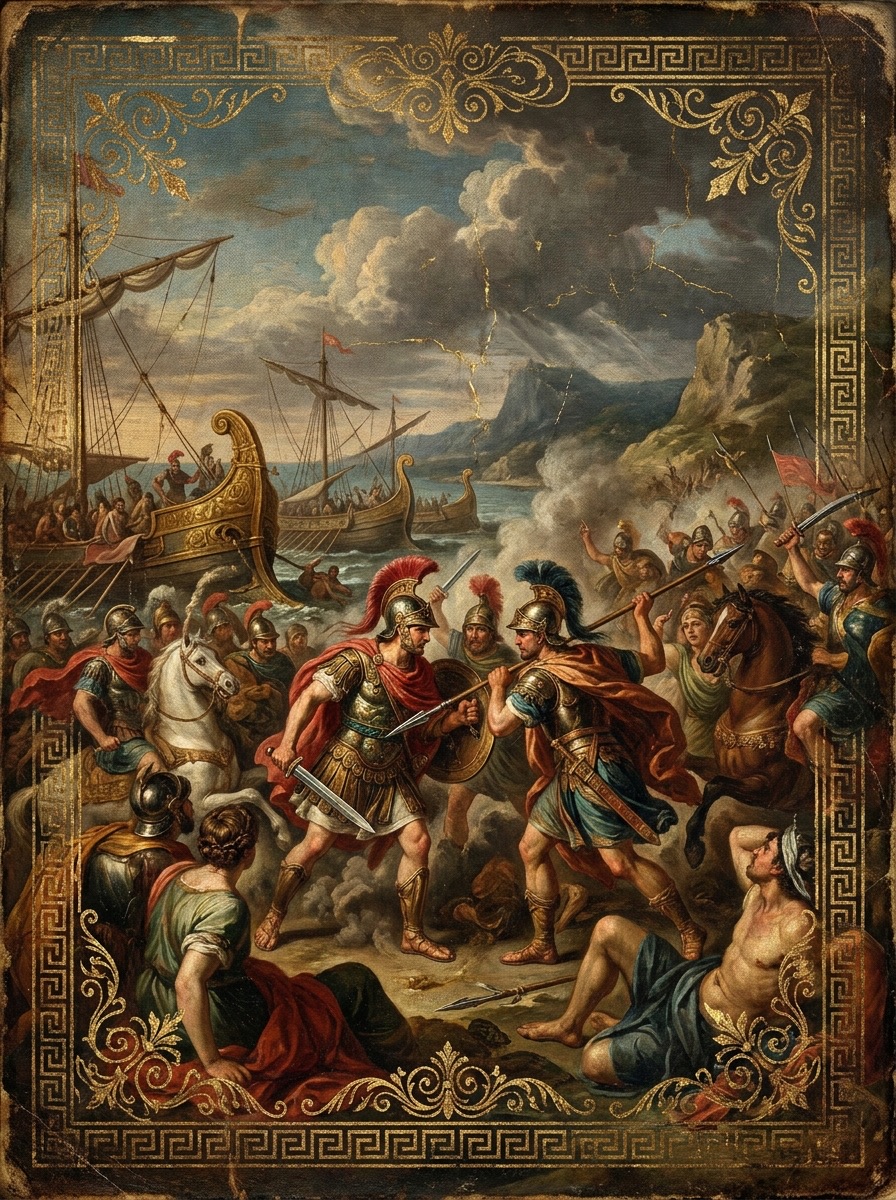
When the Greek army first sailed out to attack Troy, they mistook Mysia for enemy land. Telephus, king of Mysia, rose to defend his country and was wounded by Achilles; later, because that wound would not heal, he became the guide who showed the Greeks the way to Troy.
Article
Summary
When the Greek host first put to sea, they still did not know the true route to Troy. They landed in Mysia, took it for Trojan territory, and began burning fields and driving off cattle. Their attack brought Telephus, king of Mysia, out against them. Telephus was a son of Heracles and a man of extraordinary strength. He led the Mysians into battle, killed Thersander in the fighting, and drove many Greeks back toward their ships. Achilles stepped forward to stop him, and when Telephus was caught among trailing vines, Achilles struck him with his spear. Only afterward did the Greeks understand that they had attacked the wrong land, and they were forced to leave Mysia. Storms then scattered their fleet, and their first expedition ended in failure. But Telephus’ wound would not close. No herb and no physician could heal it. When he asked the oracle for help, the answer came: the one who wounded him would also cure him. So Telephus came among the Greeks and demanded that Achilles heal him. Achilles said he knew nothing of medicine, but Odysseus understood the riddle: the oracle meant the spear. Scrapings were taken from the point of Achilles’ spear and laid upon the wound, and at last Telephus recovered. In return, Telephus showed the Greeks the road to Troy. He would not fight against the Trojans himself, but when the Greek fleet sailed again, it no longer wandered blindly.
The Fleet Reaches an Unknown Shore
After Paris carried Helen away, the chieftains of Greece came one after another to Agamemnon’s side. Some brought long spears, some brought shields, some took their chariots apart and loaded them onto ships, and others led sacrificial beasts down to the shore, praying to the gods for a favorable wind.
The Greeks had already resolved to attack Troy, but in those days they did not yet know that sea-road as they would later. The waters were wide; islands and headlands rose one after another; and if the wind shifted, a fleet could easily be driven far from its intended course.
When the army sailed, the canvas bellied above the waves and the oars beat time against the sea. Many of the chiefs had only one thought in mind: once they saw the coast of Asia, Troy could not be far away. So when they came to land before a rich and fertile country, many believed that the land of the Trojans lay before them.
But the place was not Troy. It was Mysia.
Mysia had fields, pastures, and towns, and it had a king of its own. That king was named Telephus. He was no ordinary local ruler; tradition said he was the son of Heracles, and his mother was Auge. Fate had brought him to that country and made him lord over the Mysians.
The Greeks knew none of this. As soon as the ships touched shore, the soldiers leapt down into the shallows and dragged the prows up onto the beach. They lifted their shields, gripped their spears, and pressed inland. Some cut through fences, some drove off livestock, and some set fires, sending the smoke of burned cottages climbing into the sky.
To them, this was the first day of the assault on Troy.
Telephus Goes Out to Fight
News soon reached the palace of Mysia. The messengers came in covered with dust and reported that many foreign ships had appeared by the sea, that soldiers in bronze armor were already ravaging the fields and carrying off the cattle.
Telephus heard them out, and he did not mistake the attack for the work of a few raiders. He knew that such a fleet had not come merely to plunder a village or two. The Greek shields shone together in the sun, and their spears looked like a moving forest. If they were not stopped at once, the land of Mysia would be trampled into a battlefield.
He gathered his warriors, put on his armor, took up his spear, and went out from the city himself to meet the enemy.
The two armies met among the fields. The Greeks had expected only a frightened local guard, but the Mysians came quickly and stood their ground. Telephus charged at the front, tall in stature and fierce in movement. He swung his spear and forced the Greek front ranks steadily backward.
In the confusion of battle, Telephus came upon Thersander. Thersander was the son of Polynices, the Theban hero, and he too had joined the Greek expedition. Young and brave, he raised his weapon and faced the king of Mysia. Their shields crashed together, and spearpoints scraped harshly across bronze.
But Telephus was stronger and struck with greater force. He caught his chance and drove his spear into Thersander. Thersander fell to the ground, and his blood darkened the dust. When the Greeks saw one of their leaders dead, their line faltered.
Telephus pressed the advantage. He cut his way through the Greek ranks and drove many men back toward the ships. The waves were behind them, the vessels still lay on the beach, and the soldiers crowded together in panic. Some stumbled, some shouted for their companions, and some tried to shove the ships back into the water.
If no one had stopped Telephus then, the Greeks’ first expedition might have ended there in utter disaster.
The Vines and the Spear of Achilles
Achilles was also among the army.
He was still young then, yet already famous for the swiftness of his feet and the violence of his attack. When he saw the Greeks being driven toward the sea, he lifted his weapons and went to meet Telephus. Telephus was pursuing hard, but suddenly the ground under his feet became treacherous. One tradition says that Dionysus disliked the momentum Telephus had gained in battle and made grapevines rise from the earth to catch his feet, so that for a moment he could not move freely.
Other versions say only that, as he ran, he was tripped by vines. However the story is told, Telephus was slowed for that single instant.
Achilles seized the chance. He raised his spear and struck. The point passed through Telephus’ armor and left a deep wound in his body. When the Mysians saw their king wounded, they rushed in to shield him. The Greeks too drew back, dragging their dead and wounded toward the ships.
By then both sides had begun to understand that something was wrong.
The Greeks gradually realized that this land was not Troy. The men before them were not the sons of Priam, nor Trojans fighting over Helen, but Mysians who had been attacked by mistake. Yet the swords had already been drawn, the fields had already been ruined, and the dead lay on both sides.
Before long, the Greek fleet left Mysia. But this expedition brought them no victory. It left only confusion, corpses, and a strange wound.
Then storms rose at sea. Wind and waves scattered the ships, and many vessels made their separate ways back home. The Greeks had set out for Asia for the first time, but they never reached Troy. Instead, they had strayed into another country, and in the end they dispersed in shame and failure.
The Wound That Would Not Heal
Telephus remained in Mysia, but his wound would not mend.
Physicians came; herbs were applied; the wound was washed with wine; bandages were changed. Still the pain remained, as if fire burned inside the flesh. Day after day passed, but the skin would not close. Blood and matter continued to seep out. Telephus was a king and could endure the pain of battle, but he could not bear this torment without end.
He went to ask an oracle for help. The god’s answer was strange: the one who wounded him would also heal him.
The words sounded like a riddle. Achilles had wounded him, but Achilles was no physician. If Telephus wanted to be healed, he would have to go to the Greeks—the very men who had so recently burned his land and harmed his people.
But the wound drove him from home.
So Telephus left Mysia and came into the land of the Greeks. To keep himself from being recognized, he put on ragged clothes and entered the palace like a wandering beggar. There the Greek leaders were gathered, still discussing how they might make war again, for Troy had not yet been found, and Helen was still far away.
Telephus had to make them listen. According to the tale, following the counsel of Clytemnestra, he seized the young Orestes and held the child as a pledge while he begged for help. Agamemnon’s household was thrown into uproar. The mother cried out, servants ran to and fro, and the chiefs drew their swords, though none dared rush forward carelessly.
Then Telephus revealed who he was. He said that he was the king of Mysia, wounded by Achilles. He had not come to attack them, but to seek healing. Let them obey the oracle, he said, and let the one who had wounded him cure him.
Achilles answered that he knew only how to fight with a spear; he did not know how to heal a wound.
Then Odysseus saw the true meaning of the oracle. The god, he said, might not have meant the hand of Achilles, but the spear itself. Since the wound had been made by the spear, perhaps the spear must also undo it.
So they brought Achilles’ spear, scraped fine filings from the spearhead, and laid those bits of bronze upon Telephus’ wound. A wonder followed: the long-festering wound slowly ceased its pain, the flow of blood stopped, and the flesh began to close.
At last Telephus was saved.
The Road to Troy
Once he had been healed, Telephus did not forget the purpose that had brought him there. Nor did the Greeks forget that their first voyage had failed because they did not know the way.
They needed someone who knew the Asian coast—someone who could guide them past the wrong harbors and lead them to the true Troy. Telephus ruled Mysia and knew the shores, river mouths, and roads of that region. So he agreed to point out the route for the Greeks.
He would not, for that reason, become a warrior against Troy. He had ties of kinship and friendship with the Trojans, and he could not take up arms to kill them. But he could tell the Greeks where to sail and how to reach the city of Priam.
Thus the Greeks’ first expedition began in error and ended in failure, yet it left them with the one thing they would need when they sailed again: a road.
The fields of Mysia had been trampled because the Greeks mistook them for Troy, and Telephus had once pursued them across that same land. But in the end, it was this wounded king, injured in a mistaken war, who led them out of their wandering. When the Greeks gathered their ships and put to sea again, they no longer searched blindly. They followed the course that Telephus had shown them, sailing at last toward the true Troy.