Greek Mythology
The Greeks Gather and Send a Peace Embassy — Greek Mythology
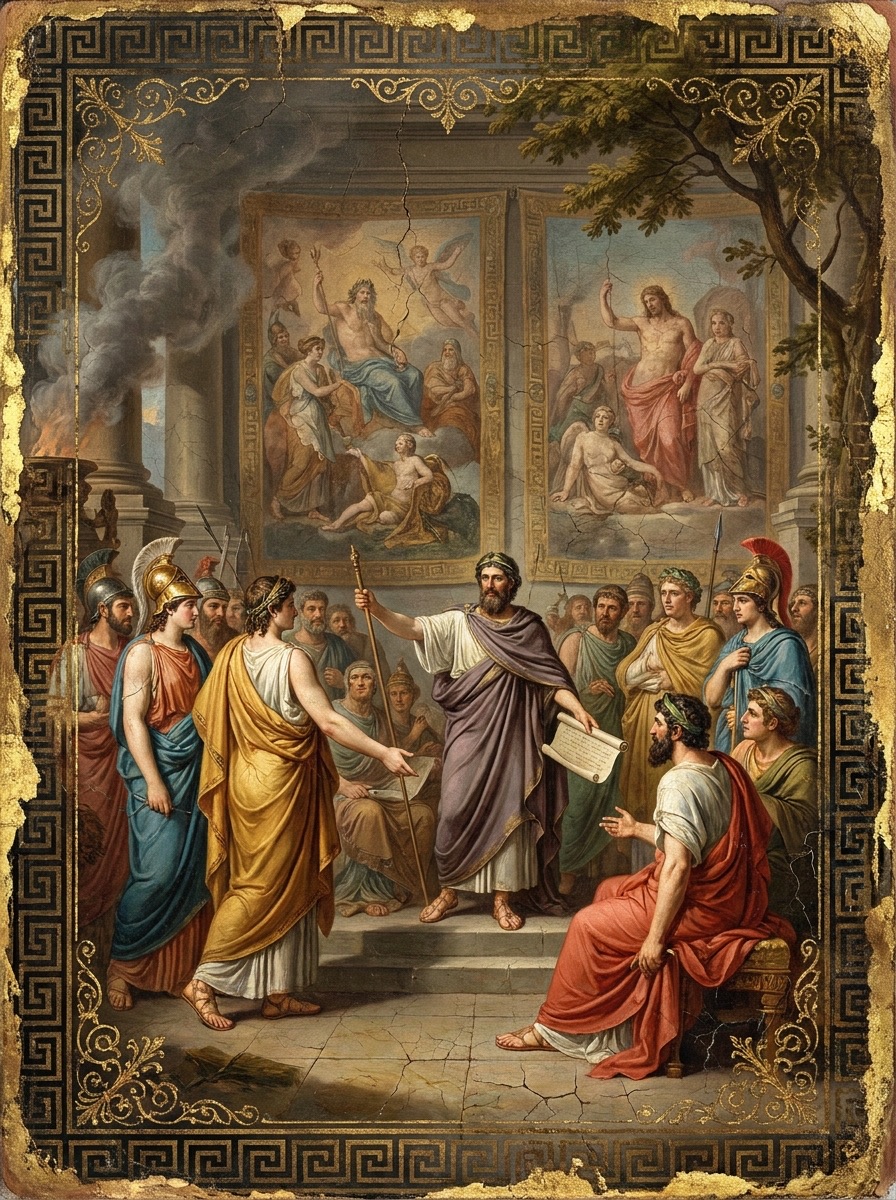
After Paris carried Helen off to Troy, Menelaus called upon the old suitors of Helen for aid, and the princes of Greece gathered at Aulis in obedience to the oath they had sworn long before. Before the fleet could sail, Menelaus and Odysseus went to Troy to demand Helen and the stolen treasures back. The Trojans refused, and the narrow road to peace closed.
Article
Summary
When Paris left Sparta, he carried away Helen, wife of Menelaus, and many treasures from the palace as well. Menelaus returned to an emptied house and understood that the insult was not his alone. Long ago, Helen's suitors had sworn before Tyndareus that if her marriage were ever broken, they would come to the aid of her husband. Menelaus first went to his brother Agamemnon, and then messengers left Mycenae carrying the old oath across Greece. Nestor, Ajax the Greater, Diomedes, Idomeneus, and other leaders answered the call; even Odysseus, though bound to Ithaca by home and child, could not escape the promise. As for Achilles, the stories say that Thetis hid him away and that Odysseus later drew him out by a trick. The ships finally gathered at Aulis, where the shore filled with masts, tents, altars, and weapons. Agamemnon was chosen as commander, while Menelaus looked over the growing fleet with both impatience and dread. He wanted Helen back, yet he knew that war would send many men to die far from home. So before the army sailed, the Greeks decided to send envoys to Troy and give peace one last chance. Menelaus and Odysseus entered Troy and were received by the elder Antenor. They demanded the return of Helen and the stolen goods, and they warned that the Greek kings had already gathered under oath. If Troy yielded, bloodshed might still be avoided. Their words stirred debate in the city: some urged that Helen be restored, while others stood with Paris, and a few even proposed killing the envoys. Antenor prevented that outrage, and Menelaus and Odysseus were allowed to depart. Yet the Trojans granted none of their demands. Helen remained in the city, and the treasures were not returned. When the envoys brought the answer back to Aulis, the Greeks understood that the road to peace had closed; the ships along the shore were no longer merely gathered vessels, but warships waiting for the wind.
The Empty Palace in Sparta
After Paris’s ship sailed from Sparta, only the fading shape of its mast remained on the sea.
When Menelaus returned to the palace, it was no longer the lively place he had left behind. Helen was gone. The serving women kept their heads bowed and did not dare speak loudly. In the storerooms, silver and gold had vanished, and many of the robes and treasures from the chests had gone with them. Paris had not merely carried off a woman; he had loaded his host’s honor and wealth onto his own ship as well.
Menelaus was both furious and distraught, but he did not remain in the palace to lament alone. He knew that this wrong could not be borne by him in isolation. When Helen had once been unmarried, many princes from across Greece had come courting. To prevent bitterness among the losers and envy among the rest, they had all sworn an oath: whichever man Helen finally chose, if anyone stole her away and broke the marriage, all the suitors would come to the aid of her husband.
Now the time had come to keep that oath.
Menelaus first went to his brother Agamemnon. Agamemnon, king of Mycenae, had a towering palace, rich stores, and more men than most could summon. The two brothers sat down together, and Menelaus told how Paris had been welcomed in his house and then, in his host’s absence, had carried Helen off. When Agamemnon heard the tale, his face darkened. He understood that if this insult went unanswered, every royal house in Greece would be despised from then on.
So the messengers went out. They crossed mountain roads and sea straits, knocking on the doors of the princes and laying the old oath before them once more.
Heroes Answer the Oath
The first to answer were the heroes whose names were already famous.
Nestor of Pylos was old now, with white hair falling to his shoulders, yet when he rose to speak in council his words still carried the calm weight of experience. Great Ajax of Salamis stood like a moving wall. Diomedes came from Argos, young and fierce. Idomeneus of Crete brought the island’s warriors with him. Lesser kings as well fitted out their ships and gathered grain and provisions, bringing bronze armor, spears, and shields up from the storerooms and onto the decks.
Not everyone was eager to leave home.
Odysseus of Ithaca had only recently become a father, and the island’s fields, flocks, and new-built house all held him back. He was shrewd enough to know that once he joined such a campaign, it might be many years before he saw his home again. But an oath is not dust that the wind can scatter. When the messengers came, he may have hesitated, but in the end he too had to go with the Greek host.
And then there was Achilles. The tales about him differed. Some said that his mother Thetis had hidden him on the island of Scyros, unwilling to let him be drawn into war too soon. Later, so the story goes, Odysseus exposed him by a trick and brought him out to take up arms and sail with the army. However the details were told, the Greeks were sure of one thing: without this young hero, the expedition against Troy would lack its sharpest spear.
One by one the ships came in from every direction until at last they lay in Aulis. There, where the shore was broad and the wind struck hard off the water, the fleet gathered. Oars and ropes creaked, waves beat against the hulls, and the men raised their tents on the sand. Cattle and sheep were led to the altars, smiths repaired the armor plates, young warriors practiced their casts, and the older men sat by the fire talking of far-off Troy.
Agamemnon was chosen as commander by common consent. People were always coming and going from his tent: one man reporting on the grain, another counting the ships, another arguing over the route. Menelaus was there as well, watching the rising forest of masts along the shore. He longed for the day of departure, yet he also knew that once the war began, many men would die on foreign ground.
So, though the army had already assembled, the Greeks did not immediately cut their anchors loose.
First they decided to send envoys to Troy.
The Last Words Before Departure
This time, the men who went to Troy were Menelaus and Odysseus.
Menelaus was the wronged husband, and he had to ask for Helen’s return in person. Odysseus was skilled in speech and knew how to move through an enemy’s hall without losing his footing. They did not take an army, only the attendants proper to envoys, and sailed across the sea to Troy.
The city stood on the plain, its walls high and strong, with wagon ruts and hoofprints before the gates. By the time Paris returned, Helen had already been settled in the royal palace. Everyone in the city knew what had happened. Some were uneasy in secret, some were dazzled by Helen’s beauty, and some thought the Greeks would never dare cross the sea and come against the city.
When the two Greek envoys entered Troy, no one laid hands on them at once. Antenor received them. He was an elder of Troy and knew that guests and envoys must not be killed. He brought them into his house, gave them seats, and allowed them to speak before the Trojans.
Long afterward, the Trojans still remembered the two men as they stood that day.
Menelaus rose first. He spoke little, but clearly. He asked for Helen to be returned, for the treasures taken with her to be restored, and for Paris to answer for breaking the bond of guest-friendship. He did not shout like a man in battle, but his voice held the force of restrained anger.
Odysseus at first seemed unimpressive. He stood there with his shoulders slightly drawn in and his eyes lowered, like nothing more than a quiet attendant. But once he began to speak, his words unfolded one layer at a time. He did not rush into abuse or wave his hands wildly. Instead, he set out the whole matter plainly for the Trojans: how Paris had been welcomed in Sparta, how he had carried off another man’s wife and wealth, how the kings of Greece had now gathered under the weight of the oath, and how the war might still be avoided if Troy would only return Helen.
Those words fell in the hall like nails driven into wood. Some were shaken by them; others murmured among themselves.
Inside Troy, the Debate Grows
Priam, old and seated on his throne, listened. He had many sons, and Paris was one of them. It is hard for a father to hand his own son over to public reproach; it is no easier for a king to ignore danger once it is already at the gate.
Hector was there too. He was steadier than Paris and understood that war was not a song sung at a banquet. If fighting began in earnest, it would be fathers, sons, and brothers in the city who would die. But just then the matter had not yet come to the point where he could settle it with a spear.
The Trojans argued.
Some believed Helen and the treasures should be returned. Men like Antenor understood very well that the envoys were not speaking idle threats. If the ships of Greece truly came, Troy might have strong walls, but it would not know peace for years.
Others refused to give way. Paris did not want to surrender Helen. There were also those who thought that since the Greek envoys had already entered the city, they might as well be killed, so they could not go home and rouse the army. As soon as such thoughts were spoken, the room seemed to grow colder. To murder envoys was a shameful thing, and it would leave peace with no path back.
Antenor opposed it. Since he himself had received the two Greeks as guests, he could not allow them to be harmed before his own eyes. In the end the Trojans did not kill Menelaus and Odysseus, but neither did they agree to the Greek demand.
Helen remained in the city, and the treasures were not restored.
The envoys’ final word of peace had failed.
The Envoys Return, and the Ships Wait for Wind
When Menelaus and Odysseus left Troy, the high city still stood behind them. In the sunlight the walls were pale, and men on the towers watched their ships recede. The sea was just as wide as when they had come, but the two men no longer carried the same thoughts in their hearts.
They brought Troy’s answer back to Aulis.
When the princes of Greece heard it in the camp, they knew there was no more delay to be had. Some struck their shields in anger; others went silently to check their weapons. Sailors took in the ropes, warriors polished their armor, and smoke rose from the altars beside the shore. The wind moved through the canvas of the tents as if urging them toward the sea.
Menelaus had not recovered Helen, and Agamemnon had not won Troy’s compliance. The narrow road toward peace had been blocked by the Trojans themselves.
From that moment on, the ships at Aulis were no longer merely gathered there. They had become warships waiting to cross the sea and besiege a city. The Greeks waited for a fitting wind, and for the sign that the gods permitted them to sail; far off, Troy still did not know how many spears, shields, and fates were slowly approaching over the water.