Greek Mythology
The Greeks Arrive at Troy — Greek Mythology
The Greek host sails from Aulis, crosses the straits, and reaches the shores near Troy, only to suffer ominous losses before and after landing. Philoctetes is bitten by a venomous snake and abandoned, while Protesilaus is the first to set foot on Trojan soil—and the first to fall in battle.
Article
Summary
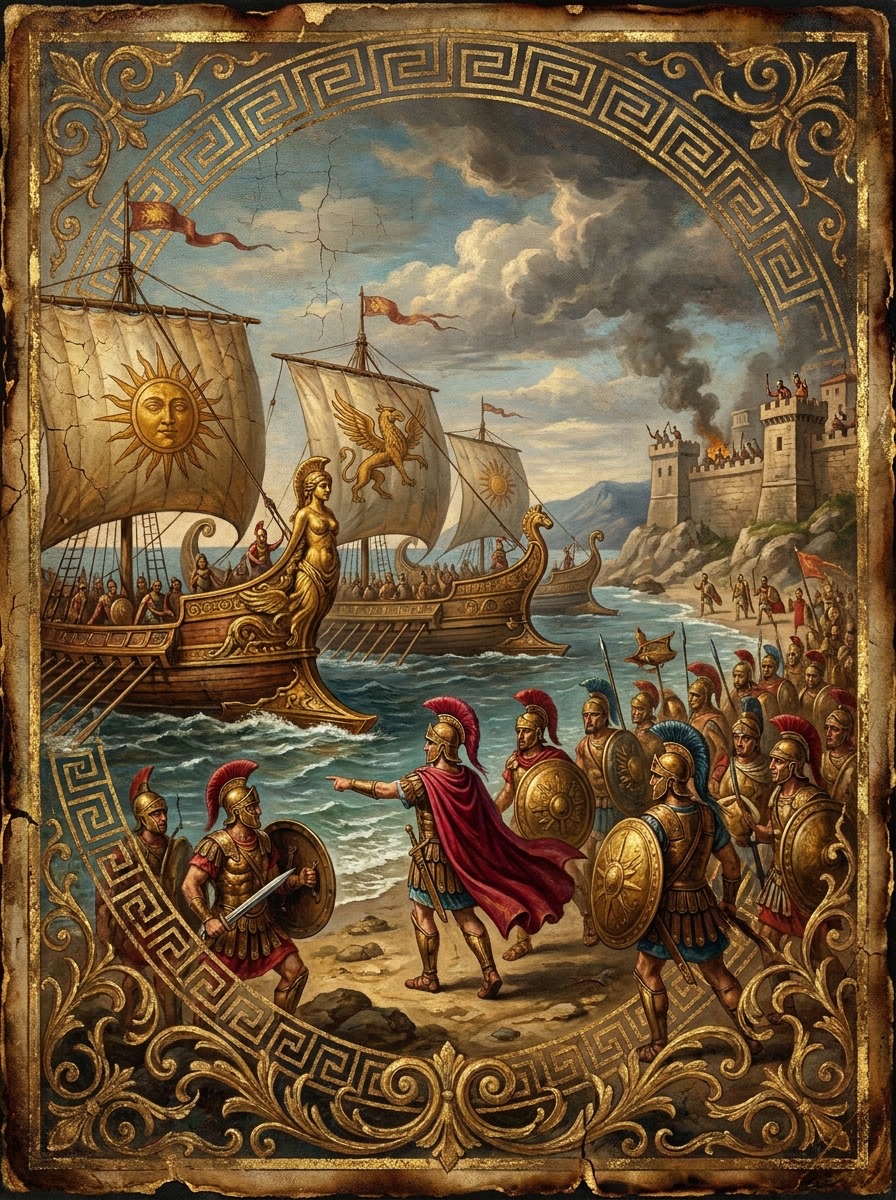
When the wind finally rises at Aulis, the Greek fleet leaves the bay and sails toward Troy. The ships carry kings, soldiers, and the hope of recovered honor from many lands. Everyone knows this is no brief raid, but a great expedition bound to Helen, old oaths, and the pride of many houses. Once the ships put out, the Greek princes can no longer treat the war as a rumor far away. On the voyage, Philoctetes travels with the bow and arrows inherited from Heracles. But while the fleet stops at an island and sacrifices to the gods, a venomous snake bites him. The wound darkens and festers, his cries last through the night, and the stench troubles the whole camp of ships. At last the commanders make a cruel decision: they leave him on Lemnos with his bow, his arrows, and a little food. The fleet sails on, while a bowman who will still matter later is trapped alone with pain. Before long the walls of Troy appear beyond the shore. As the ships move into the shallows, an ominous prophecy passes among the men: the first Greek to set foot on Trojan soil will die. The warriors can hear the enemy ahead, but no one wants to be the first to leap down. While hesitation spreads, Protesilaus steps forward, fastens his shield, jumps into the surf, and plants his feet on the sand of Troy. Protesilaus charges first, and his courage draws the other Greeks down from the ships. The Trojans have not hidden behind their walls; Hector leads their warriors to the shore, and the two armies clash among waves, sand, and blood. Protesilaus fights fiercely at the front, but the prophecy does not release him. Before long Hector strikes him down, and he becomes the first Greek hero to die on Trojan land. After Protesilaus falls, grief and anger drive the Greeks harder into the landing. Achilles and the other leaders join the battle, the Trojans are pushed back toward the city, and the Greeks drag their ships ashore to build a camp beside the sea. Philoctetes has been abandoned and Protesilaus has been killed before the siege has even settled. From that strip of sand, the ten-year Trojan War truly begins.
The Wind Turns Toward Troy
In the bay of Aulis, the sails had hung limp for a long time.
Warships from every corner of Greece lay in rows along the shore. Their hulls grew hot under the sun; oars rested against the gunwales; sailors could only stare across the still water and sigh. Agamemnon commanded the whole army, and beside him stood Menelaus, thinking only of Helen, far away in Troy. The heroes of many lands had already gathered there: swift Achilles, cunning Odysseus, huge Ajax the Greater, and many kings with the soldiers they had brought.
Then, at last, the wind rose.
First a cool breath passed over the sea. Then the ropes on the masts began to stir, and the sails swelled outward. Sailors shouted as they cast off the lines from the shore posts. Rowers took their places on the benches, and bronze-prowed ships cut into the water. The bay filled all at once with the creak and press of wooden hulls, the splash of oars, and the voices of men calling to one another.
The Greek army left Aulis and sailed east.
Their destination was Troy, the city of King Priam. It had high walls, strong gates, rivers running down from the hills, and warriors who would not easily bow their heads. The Greeks knew this would not be a brief raid. Yet the ships had left the shore, and no one could still treat the war as a rumor from far away.
The Man Left Behind
The fleet passed through the straits and drew near the islands off the Trojan coast. At times the sea lay calm; at times wind and waves beat against the sides of the ships. By night the soldiers slept on deck wrapped in their cloaks, and when they woke they smelled the salt dampness of the air and the timber of the hull beneath them.
Among the heroes was a man named Philoctetes. He was not the most conspicuous of the commanders, but he carried something of great worth: the bow and arrows left by Heracles. That bow had gone with the mighty hero into battle, and the arrows held a terrible power. Many believed that when the time came to take Troy, those weapons would prove indispensable.
But fate reached for Philoctetes first.
When the fleet stopped at an island, the Greeks made sacrifice to the gods, as was their custom. Around the altar, grass and brush grew thick, and the cracks between the stones were cool and damp. Philoctetes stepped near, and suddenly a venomous snake darted from the shadows and sank its fangs into his foot. He cried out and fell. By the time the others ran to him, the snake had slipped into the grass, leaving only his ankle swelling fast and the wound oozing foul-smelling pus.
At first, the men tried to save him. Some washed the wound with clean water; some bound his leg with strips of cloth; others prayed to the gods. But the poison went deep into flesh and bone, and Philoctetes writhed in pain through the night. One moment he bit down on the planks of the ship; the next he cried aloud, and his voice carried far over the dark sea. The stench of the wound grew worse and worse, until even the soldiers on the neighboring ships could hardly bear it.
The leaders gathered to discuss what must be done. All of them knew it was no honorable thing to abandon a comrade. Yet the army was on its way to war. Sacrifices and commands were constantly broken by his cries, and the soldiers were tormented and unsettled by the smell of the wound. In the end, Odysseus and several chiefs carried out the cruel decision: Philoctetes was to be left on the island of Lemnos.
They left him his bow and arrows, and a little food. Philoctetes lay on the shore and watched the ships depart one by one. He had thought he would attack Troy beside the other heroes. Now he heard only the sea striking the rocks, with pain, the lonely island, and the bow of Heracles beside him.
The Greek fleet sailed on toward Troy.
The Walls Appear by the Sea
Before long, land appeared ahead of the ships.
This was no ordinary shore. Far off, the hillsides shone in the sunlight; rivers wound across the plain; and high above, the city wall stretched like a pale gray line of stone. Soldiers rose to their feet and shaded their eyes with their hands. Some were seeing Troy for the first time, and one murmured, unable to keep silent, “There it is.”
Agamemnon ordered the men into formation. On every ship, warriors took down their shields and set their spears beside them. The rowers slowed their stroke, bringing the vessels in line by line toward the shallows. The water grew thin beneath them, and the bottoms of the ships scraped over sand and stone with a heavy sound.
But just then, a troubling prophecy began to pass through the ranks.
Some had heard it already: the first Greek to set foot on Trojan soil was doomed to die.
The words chilled the men like a splash of cold water. The ships had reached the shore, the enemy was ahead, yet no one wished to be the first to leap down. Soldiers gripped their shields and looked at the beach, then at the comrades beside them. The waves struck the prows again and again, as if urging them on.
On one of the ships, Protesilaus stepped forward.
He came from Phylace, young and brave, wearing his armor and holding his spear. He had heard the prophecy, and he understood the weight of it. But if the army hesitated aboard the ships, the Trojans would seize the chance to drive the Greeks back into the sea. Protesilaus waited no longer. He fitted the shield onto his arm, stepped to the prow, and sprang down into the shallow water.
The sea splashed up and soaked his greaves. With his next step, he stood on the sands of Troy.
The First Man to Fall
As soon as Protesilaus reached the shore, he raised his spear and rushed forward. When his followers saw their lord leap down, they too sprang over the sides of the ship. His courage stirred the Greeks on the other vessels. They began to shout, gangplanks dropped one after another from the prows, and warriors surged through the surf onto the beach.
The Trojans had not hidden inside the city.
They had already seen the sails on the sea and heard that a foreign army was drawing near. Hector led the warriors of Troy down to the shore, their spears and shields flashing in the sun. The people of the city knew this was no common raid. This war had come for Helen, and for the honor and shame of cities. If the enemy were allowed to camp at leisure, disaster would take root outside the walls.
The two armies crashed together on the beach.
Protesilaus fought in the front rank. He drove into the enemy line, his spear striking down the warriors who came against him, while the sand underfoot turned wet with seawater and blood. The Greeks saw him fighting and shouted as one; the Trojans refused to give way. Shields slammed against shields, spearpoints snapped, and wounded men fell at the water’s edge, where the waves washed over them again and again.
But the prophecy did not spare him.
Hector came to meet him. He was the bravest son of Priam, the firmest pillar of the Trojan army. In the confusion, the two men clashed. A spear flashed; shields rang. Protesilaus was brave, but he could not turn aside the death appointed for him. Before long, Hector struck him down on the shore, and he became the first Greek hero to die on Trojan soil.
When his companions saw him fall, they rushed forward in grief and anger to recover his body. A louder cry broke out among the Greeks. Achilles too entered the battle, racing over the sand like a storm wind and forcing the Trojans back step by step. Ajax the Greater held up his great shield to guard his comrades, while the other leaders drove their men forward from the ships.
That day, the Trojans failed to drive the Greeks into the sea.
They withdrew inside the city gates and left the shore to their enemies. The Greeks dragged their ships up onto the beach, fenced their camp with stakes and trenches, and raised tents beside the vessels. When night fell, fires sprang up one by one. Soldiers cleaned their weapons, bound their wounds, and wept for Protesilaus.
The Camp Beside the Sea
The walls of Troy still stood in the distance.
The cries of battle had ended with the day, and across the plain there was only the night wind moving through the grass. The Greek ships stood in rows by the sea, their sterns facing the water, their prows turned toward the land. Every man who had come down from the ships understood that they could not easily turn back. Behind them lay the wide sea; before them rose the high city and the enemies who guarded it.
The death of Protesilaus taught them the cost of this land. Philoctetes, left on his lonely island, had already been the first wound of the expedition; now the first man to set foot on Troy had also fallen. The Greeks had not yet reached the city gates, and already the war had taken their companions.
Yet the camp had been planted, the ships had been drawn ashore, and firelight gleamed on rows of shields and spears. Agamemnon summoned the chiefs and assigned the night watches and the duties of the coming day. Menelaus looked toward the city, where the woman he meant to recover was hidden—and with her, the root of the war.
From that day onward, the Greeks were no longer merely an army sailing toward Troy. They had reached Trojan ground. They had made their camp beside the sea, and across the plain the Trojans watched them from within the city. The long siege began there, on the sandy shore where Protesilaus fell.