Greek Mythology
The War of the Giants — Greek Mythology
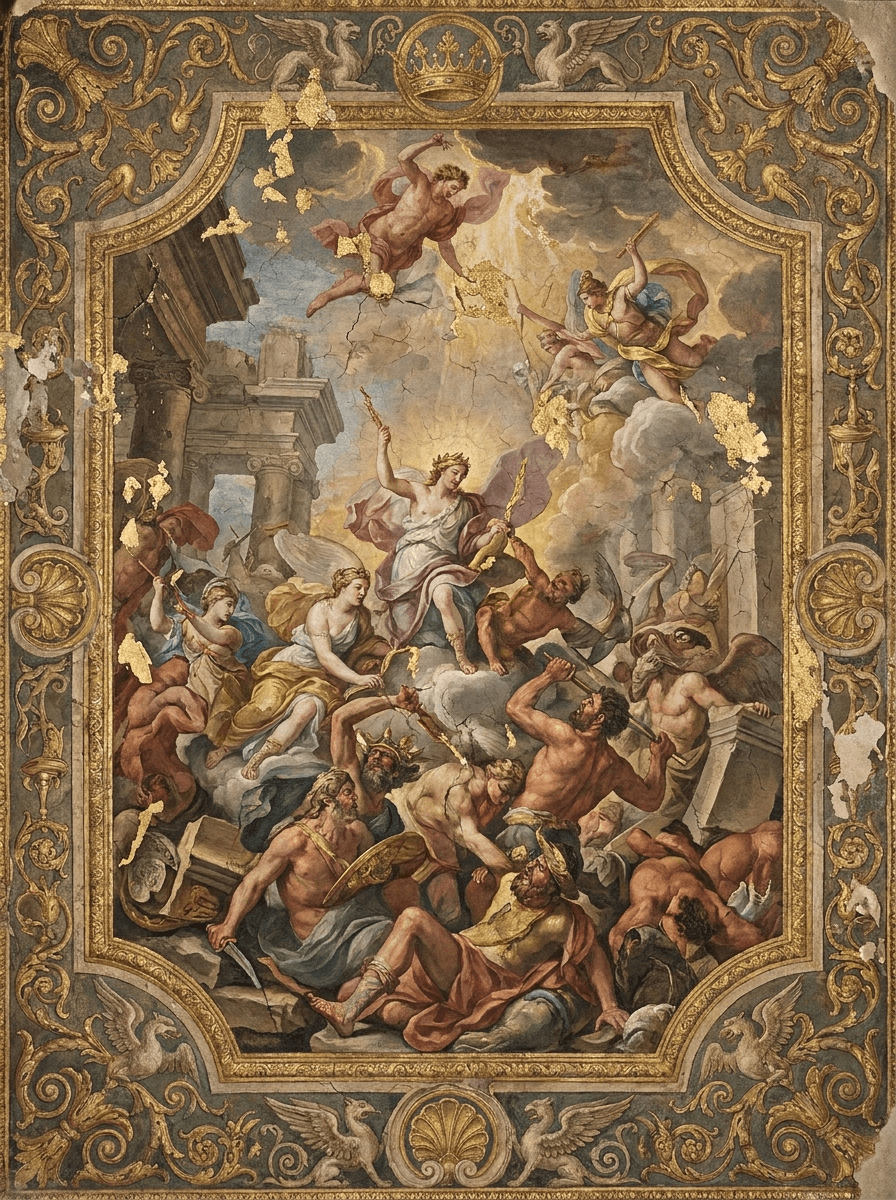
After the blood of Ouranos fell into the earth, Gaia gave birth to terrifying Giants. Years later, they launched an assault on Mount Olympus, and Zeus and the gods could save their heavenly throne only with the help of the mortal hero Heracles.
Article
Summary
In an earlier age, Kronos wounded his father Ouranos, and drops of blood fell upon Gaia, the Earth Mother. In time, the earth brought forth a race of huge and savage Giants. They carried tree trunks and boulders as weapons; some had serpent coils in place of feet; and in their hearts they nursed hatred for the gods above.
Enemies Awaken in the Earth
Long ago, when the sky god Ouranos was wounded by his son Kronos, his blood fell upon the earth. Gaia, the Earth Mother, received those drops deep within herself, as though burying restless seeds in the dark soil.
Ages passed. Then a low rumbling began in the valleys. Heat breathed from cracks in the stone; birds scattered in terror from the woods; rivers churned as if some hidden hand were stirring them from below. At last, from the depths of the earth, a company of dreadful Giants rose.
They were not like ordinary men, nor like the bright gods who dwelt on Olympus. Their bodies were enormous, their shoulders broad as cliffs, their hair and beards wild and matted, their eyes burning like brushfire. Some had no human feet beneath them, but twisting serpent coils, whose scales scraped harshly over the rock. They tore up pine trees for spears, broke cliffs into missiles, and roared among the ridges until the clouds seemed to roll and shudder.
The Giants had not appeared without cause. Gaia still carried anger against the Olympian gods. She had watched Zeus defeat the Titans and imprison many of her older children in the shadowed depths of Tartaros. So she had hidden her fury in the earth. Now that fury had bodies, arms, and the strength to batter down the gates of heaven.
The Giants gathered. They looked toward lofty Mount Olympus, where mist curled around the shining golden halls. Zeus, Hera, Athena, Apollo, Artemis, Poseidon, and the other gods lived there. The Giants would not bow their heads and gaze upward in reverence. Instead, they resolved to heave mountains into the sky and drag the thrones of the gods down to earth.
The Alarm on Olympus
The first to hear the approaching tumult were the gods who kept watch from the heights. Far away, whole ridgelines collapsed one after another; great stones rolled into the sea, and the waves rose higher than city walls. Forests were torn up by the roots, and dark masses of treetops flew toward the sky like hurled javelins.
Zeus stood among the clouds with thunderbolt in hand. He saw the Giants advancing across the plains like a moving range of mountains. They flung burning trunks toward the heavenly palace and cast broken peaks into the clouds. Some stones struck the cliffs below Olympus and burst into sparks and dust; others plunged into the sea, raising white foam and driving the creatures of the deep into hiding.
The gods quickly armed themselves. Athena put on her helmet and lifted her shield. Apollo drew his bowstring, the silver bow flashing at his shoulder. Artemis slung her quiver across her back and moved lightly as a wind through the trees. Hera mounted her chariot and glared at the oncoming enemy. Poseidon raised his trident, and the sea surged behind him.
But Zeus knew this battle was not merely a trial of gods against Giants. An ancient prophecy declared that the Giants could not be slain by divine power alone. If they were to be utterly defeated, a mortal must fight beside the gods.
The words chilled the hearts of the immortals. The Olympians were used to receiving sacrifice and prayer, and to sending blessings or punishments down among humankind. This time, however, they needed a hand from the mortal world: a hero who could bleed, grow weary, and die.
Zeus thought of his son Heracles.
The Hero Is Summoned
Heracles was still walking the earth in those days. He had already endured many hardships. A lion skin lay across his shoulders; a heavy club was often in his hand; and at his back hung his bow and quiver. His arrowheads had been dipped in the poisoned blood of the Hydra, and even a shallow wound from them could bring unbearable pain.
Zeus summoned him to the battlefield. Heracles looked up and saw the sky boiling, the mountains burning, and heard the Giants’ roars rolling from afar. He did not retreat. He only tightened the lion skin about him, tested his bowstring, and set a poisoned arrow to the string.
By the time Heracles reached the gods, the battle had already burned its way to the foot of Olympus.
A Giant named Alkyoneus charged at the front. His body was immense, and in his hand he clutched a boulder as though it were a lump of clay. As he strode forward, he hurled stones against the ranks of the gods. Whenever one struck the ground, the earth shook beneath it.
Heracles took aim. The bowstring sang, and the poisoned arrow flew, burying itself in Alkyoneus’s flesh. The Giant bellowed and staggered down. But then a strange thing happened: so long as his body touched the land where he had been born, strength flowed back into his limbs. Pressing his hands against the ground, as if drinking life anew from the earth, he rose again.
Heracles frowned. Athena understood the secret at once and rushed to him. “Drag him away from this land,” she said.
Heracles did not hesitate. He ran to the Giant, seized that massive body, and with all his strength began dragging him away. The Giant’s serpent coils lashed across the ground, scattering stones and clods of earth in every direction. At last Alkyoneus was hauled beyond his native soil, and he could no longer draw strength from the earth. Heracles shot again. The Giant fell, and this time he did not rise.
The Queen of Heaven Pursued
When Alkyoneus died, the Giants grew still more furious. Another Giant, Porphyrion, rushed toward the heart of the battle. He stood so tall he seemed almost to touch the low clouds, and when he swung his arms, it was as though he meant to tear open the sky itself. Seeing Hera in her chariot, he roared and ran at her.
Hera’s chariot lurched under the shaking ground, and the horses reared. Porphyrion stretched out his huge arms, trying to seize the queen of heaven and drag her down from the car. Hera turned pale, but she did not lower her head or beg for mercy. She gripped the rail of the chariot and cried out angrily to Zeus.
Zeus’s thunderbolt fell at once.
A white blaze split the clouds and struck Porphyrion full in the chest. The Giant reeled back from the blow, and before he could recover, Heracles’s poisoned arrow was already in flight. The arrowhead pierced the wounded place; the venom took hold; the Giant writhed in agony, his serpent coils thrashing, and then he crashed to the ground. Dust rose in a wall and covered half the battlefield.
Hera drew a long breath, and the horses slowly steadied. She looked toward Heracles with a complicated expression. She had long hated this mortal hero, yet in that moment he had truly saved one of the mistresses of Olympus.
The battle did not stop.
Each God Enters the Fight
The Giant Ephialtes charged forward with tremendous strength. Stone after stone flew from his hands against the gods. Apollo and Heracles lifted their bows at the same time. Apollo’s arrow struck one of the Giant’s eyes; Heracles’s arrow struck the other. Robbed of sight, the Giant clawed blindly at the air and finally collapsed among the broken rocks.
Another Giant, Eurytos, swung a tree trunk like a spear. Dionysos went to meet him, while his ecstatic followers shrieked around him. Dionysos raised his ivy-wreathed staff and struck the Giant down. In the god’s hand, that seemingly gentle wand became heavy and powerful; when Eurytos fell, he crushed a whole patch of woodland beneath him.
Klytios rushed at Hekate. The dark goddess lifted her torches, and the flames leapt high in her hands, wrapping the Giant like red serpents. Klytios struggled in the fire, his roaring grew weaker and weaker, and at last he burned and fell.
Enkelados escaped one assault and turned to flee into the distance. Athena did not let him go. She lifted the island of Sicily from the earth and pressed that vast land down upon him. The Giant was crushed into the depths and could never rise again. Later people said that when the earth trembled and volcanoes sent up smoke and fire, it was the buried Giant shifting beneath the weight, still breathing, still turning over below.
Pallas too rushed against Athena, shouting savage words and brandishing his weapon. Athena met him head-on, struck him down, and flayed off his skin, wearing it over herself like a mantle of victory. Her shield and helmet shone through the dust, and even the Giants could not help falling back at the sight.
Poseidon also fought without rest. He overtook one Giant, drove his trident into the earth, and pried up a great stretch of coastal land, hurling rock and shore alike down upon his enemy. The sea rose with it, white foam beating against the shattered stones.
Every part of the battlefield rang with shouting. Under every bank of cloud, fire flared. The weapons of the gods flashed; the stones of the Giants howled through the air. Thunderbolts, arrows, torches, tridents, clubs, and poisoned shafts crossed one another, and the foot of Olympus seemed to be torn open by day and night at once.
The Giants Pile Up Mountains
Though their comrades fell one after another, the Giants still refused to retreat. They lifted Mount Ossa, then Mount Pelion, meaning to pile peak upon peak until they reached heaven. Great rocks rolled; trees snapped; wild beasts fled in terror down the slopes. Mountain crashed against mountain with a deep, groaning thunder, as though the earth itself cried out in pain.
The Giants believed that if they stacked the mountains high enough, they could climb to Olympus, smash the palace of Zeus, and drive the gods down from the clouds.
When Zeus saw this, his anger could no longer be contained. He stood on the highest height while storm clouds gathered around him and thunder rolled through their dark bellies. Then he hurled his thunderbolts one after another. Lightning split the mountains the Giants had raised; peaks shattered in midair, and burning stones rained down.
Heracles followed in the wake of the lightning. He did not try to match the Giants’ brute force. Instead, he sought out every enemy whom the thunderbolt had wounded but not yet felled. Again and again the bowstring rang; again and again the poisoned arrows flew. Even Giants with bodies like the earth itself could not withstand the venom spreading through their veins.
Some fell to their knees, still trying to clutch at the rocks. Some lunged toward the clouds and dropped halfway through the air. Some crashed into the sea, turning the water dark, while the waves carried broken trees and shattered stones back to shore.
Deep within the earth, Gaia felt her children fall one by one. She had hoped to use them to shake Olympus, but however fierce the Giants were, they could not overcome gods and hero fighting together. Little by little the battlefield was left only with the fading echo of thunder and the low groans of the wounded.
The Earth After the Battle
When the last Giant fell, the sky beyond Olympus slowly grew quiet. The storm clouds parted, and sunlight returned to the golden halls and broken stones. The gods stood on the heights, dust and blood upon them. Some of their armor was cracked; some was blackened by smoke and fire.
Heracles lowered his bow. Many poisoned arrows were missing from his quiver. He was still mortal: his chest rose and fell, and his arms ached from the long fight. Yet it was this mortal hand that had completed what the gods could not do alone.
Zeus put away his thunderbolt. Of the defeated Giants, some were pressed into the depths of the earth, some buried beneath islands and mountain ranges, and some left as desolate reaches of stone. In later times, whenever volcanoes smoked or the ground shook, old people remembered that ancient war and said it was the Giants turning underground, their rage against heaven not yet forgotten.
Olympus had been saved. Zeus still sat in the seat of the king of gods, and the immortals still received offerings from humankind in their halls among the clouds. Yet from that day on, the gods remembered one thing: even those who dwell high in heaven may sometimes need mortal courage, and an arrow that knows where to strike.