Greek Mythology
The Argonauts Flee from Colchis — Greek Mythology
After Jason wins the Golden Fleece, he boards the Argo by night with Medea and flees Colchis. Aeetes sends ships in pursuit, and Medea, determined to keep the way of escape open, pays a bloody price before the Argonauts finally break free from the Colchians.
Article
Summary
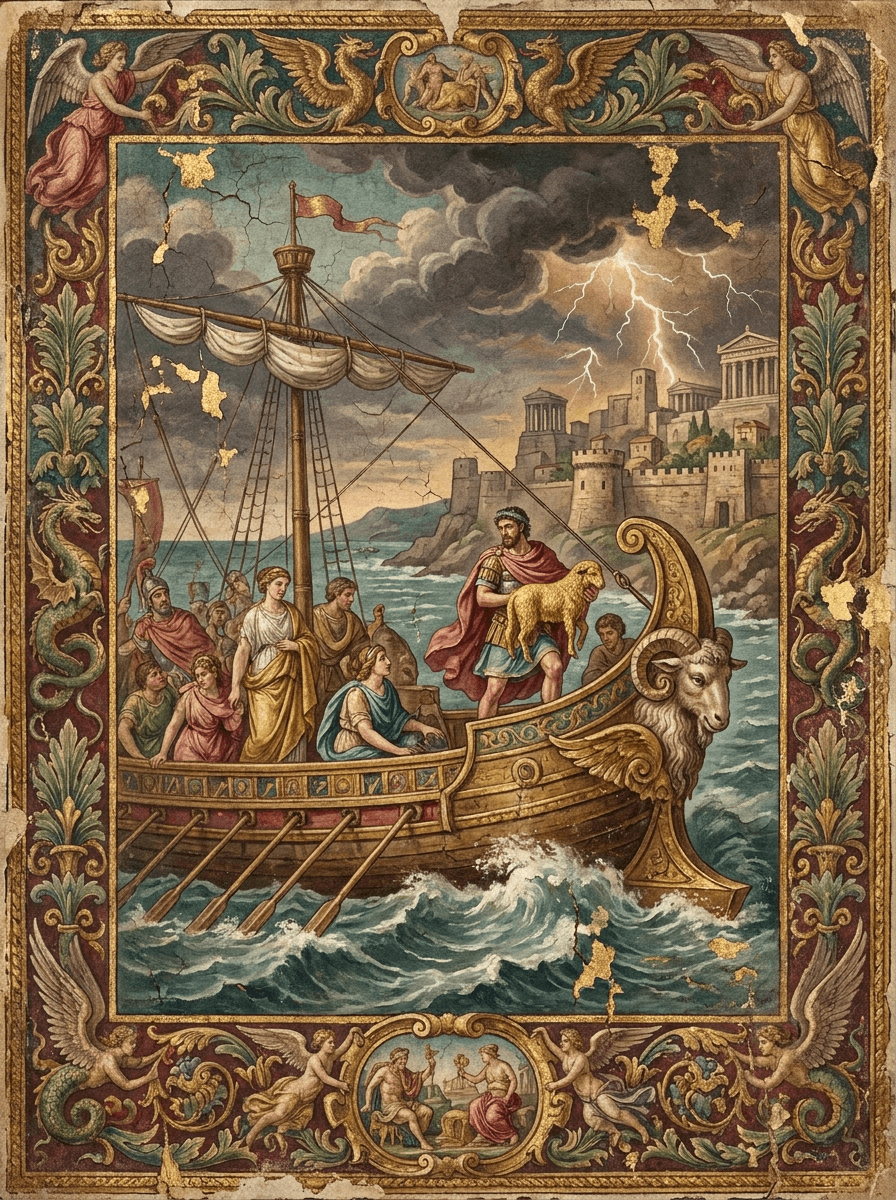
Jason and Medea steal the Golden Fleece from the sacred grove under cover of darkness and hurry to the bank of the Phasis, where the Argo is waiting. The heroes cut the mooring ropes, pull hard at the oars, and race toward the sea before King Aeetes of Colchis can discover what has happened. At dawn, Aeetes learns that the Fleece is gone and that his daughter has fled. He immediately sends a fleet after them. Though the Argo has already left the shore behind, the Colchian warships soon appear in her wake, drawing closer and closer. To delay the pursuit, the ancient story was told in two ways. In one version, Medea kills her young brother Absyrtus and casts his body into the sea, forcing their father to stop and gather the remains. In another, Absyrtus is a grown prince leading the pursuers; Medea deceives him into coming to a private meeting, where Jason kills him. After Absyrtus dies, the Colchian fleet loses its leader and falls into confusion. The pursuers no longer dare press on with the same force. The Argo seizes the chance to sail away, the Golden Fleece is saved, and Medea leaves her homeland forever. The Argonauts escape Colchis, but not the shadow that follows them. The Golden Fleece brings glory, yet it also brings kindred blood. Their ship sails onward toward Greece, leaving behind an enraged king and a deed that cannot be undone.
The Golden Fleece in the Night
Night lay deep over Colchis, and along the banks of the Phasis there was little to hear but the river’s murmur and the dip of hidden oars.
Jason came running from the sacred grove of Ares with the Golden Fleece in his arms. Even in the dark, the fleece seemed to hold a glow of fire, hanging heavy over his forearm. Medea walked beside him, her face paler than moonlight. She looked back once toward the distant palace. No alarm had risen there yet, but she knew that when morning came, her father Aeetes would discover everything.
There was no road back for her now.
She had used herbs and spells to help Jason master the fire-breathing bulls with bronze hooves. She had told him how to make the warriors sprung from the dragon’s teeth turn their weapons against one another. She, too, had lulled the great serpent that guarded the Fleece, until its heavy eyelids sank and it lay sleeping at the roots of the tree. Now that the Golden Fleece was in Jason’s hands, if she stayed behind she would have only her father’s wrath to await.
“Go quickly,” Medea said in a low voice. “Do not wait for dawn.”
Jason asked no more. He wrapped the Fleece close and ran with her toward the riverbank. The Argo waited there, her hull pressed against the black water like a great bird holding itself still. The heroes aboard already had their hands on the oars; they had only been waiting for Jason and Medea to return.
When they saw the Golden Fleece, for a moment no one spoke. Orpheus still had his hand upon his lyre. Castor and Polydeuces stood by the ship’s side. Heracles was no longer among them for this homeward voyage, yet those who remained were enough to make the vessel seem crowded, strong, and ready.
“On board!” Jason cried.
The mooring ropes were cut, and the oars struck the water together. The Argo shuddered lightly, pulled free from the shore, and glided down the Phasis toward the river mouth. The blades broke the dark water into flashing pieces. The night wind caught the sail. Hidden in the ship, the Golden Fleece still let a thread of brightness escape from beneath its fold.
Wrath in the Palace
At first light, a cry rang through the palace of Colchis.
Guards rushed in with the news: the dragon in the sacred grove lay in an unnatural sleep, the Golden Fleece was gone from the tree, and Princess Medea was nowhere to be found. When Aeetes heard it, he sprang to his feet. His face darkened with anger like a cloud before a storm.
He understood at once. The foreigner Jason had not passed the trials by his own strength. His daughter had betrayed him and delivered the dearest treasure of Colchis into Greek hands.
Aeetes summoned his men without delay. He ordered warships launched, soldiers armed with bows, spears, and shields, and the fleet sent down toward the river mouth in pursuit of the Argo. The bronze gates of the city opened, and the sound of hooves and shouting filled the streets. The Colchians knew their king’s temper; no one dared be slow.
The Argo had already passed out of the river and into the open sea. The heroes thought that the farther they drew from land, the safer they would be. But before long the lookout at the stern saw dark specks behind them. The specks multiplied and grew, like waterbirds rising from the line of the sea.
“The pursuers are coming!”
Tension swept the ship. The oarsmen quickened their stroke, and the slap of the blades came as close and sharp as rain. Jason stood at the stern, watching the Colchian warships gaining behind them. Medea saw them too. Her fingers closed around the rail until her knuckles whitened.
She knew better than anyone what would happen if her father caught them. Jason would die. The Argonauts would die. She herself would have no life left to return to.
Medea’s Ruthless Heart
Of this pursuit, the old stories preserve more than one account.
Some say that when Medea fled, she took with her her little brother Absyrtus. As the pursuers drew near, she did a terrible thing: she killed the child, cut his body apart, and threw the pieces one by one into the sea. When Aeetes saw his son’s remains drifting in the waves, grief overcame rage. He had no choice but to stop the ships, gather the body, and give the child burial. In that time, the Argo escaped far ahead. Later people said that certain places took their names from that dreadful deed.
Another tradition says that Absyrtus was no small child, but a prince old enough to lead men in war. He brought the Colchian fleet after the Argonauts and forced them near a cluster of islands in the sea. Neither side dared begin the fight lightly: the Colchians had more ships and men, while the Argonauts had the Golden Fleece and the hidden favor of the gods. Then Medea devised a colder plan.
She sent word to Absyrtus, saying that Jason had carried her away by force. If her brother would come to her in secret, she said, she would hand the Golden Fleece back to him and find a way to return to their father. Absyrtus believed her. After all, she was his sister. He knew she had been skilled from childhood in herbs and sacred arts, but he did not understand that she had already staked her fate on Jason.
By night, Absyrtus came to the appointed holy place. There were altars there, and images of the gods. The sea wind moved over the stone steps, and torchlight trembled along the walls. Medea stood in the shadows, her robe pressed close by the wind. When she saw her brother approaching, her heart did not remain untouched; but she did not turn back.
Jason was hidden nearby.
Absyrtus had scarcely begun to speak when Jason sprang out. The sword flashed. The prince fell beside the altar, and blood ran into the cracks of the stone. Medea could not bear to look long. She turned her face away. She knew that from that moment onward, she was no longer truly a daughter of Colchis.
The Pursuers Lose Their Leader
After Absyrtus died, the Colchian fleet fell into disorder.
They had come to recover the Golden Fleece, bring back the princess, and answer to Aeetes. Now the prince lay dead on a foreign shore, and no one knew whether to attack at once or tend first to his body. If they returned empty-handed, they feared Aeetes’ punishment. If they pressed on, the man who had commanded them was gone.
The Argonauts seized the moment and boarded their ship. The oarsmen pulled together, and the Argo left the island shore for more distant waters. White foam lifted behind the stern in the dark. Medea sat amidships, listening as the clamor behind them faded farther and farther away, and said nothing.
Jason placed the Golden Fleece safely aboard. It ought to have been a sign of triumph; now it seemed stained with blood. The heroes did not raise a loud cheer. Each of them understood that though they had escaped Colchis, they had not left it cleanly. The sea wind blew across the deck, carrying the taste of salt and also unease.
After the death of Absyrtus, some of the Colchians did not dare return to face Aeetes and settled in foreign lands. Others carried the dreadful news back to the palace. When Aeetes learned that one of his children had fled and the other was dead, grief and fury together crushed his heart. But the Argo had already crossed the waters beyond his reach.
Leaving Colchis Behind
The Argo sailed on toward the west.
By day, the heroes took turns at the oars, watching the surface of the sea and the shadowed outlines of distant coasts. By night, they brought the ship into safer bays, repaired ropes, and shared their dry provisions. Medea spoke seldom. The herbs and little chests she had brought with her lay close at hand, like the last remnants of her homeland. She had saved Jason, and she had destroyed one of her own blood. She had left her father’s country, but she had not found peace.
Sometimes Jason came to stand beside her, wanting to speak words of comfort, but the words failed before they left his mouth. To win the Golden Fleece, he had needed Medea’s help; in flight, he had needed her ruthlessness still more. Now the two of them were in the same ship, with the long sea road back to Greece ahead and Colchis behind them, a home to which she could never return.
The Golden Fleece still shone within the ship. It had allowed Jason to complete the hardest task set before him, yet it had also stained the expedition with the blood of kin. The Argonauts had at last shaken off their pursuers and sailed beyond the waters of Colchis. But they all knew that escaping one danger did not mean that guilt and disaster had come to an end.
The sea opened wider before them, and the mountain coast of Colchis vanished into mist. The Argo moved forward into the wind, leaving far behind the pursuing ships, the palace, the sacred grove, and the bloodshed of that night.