Greek Mythology
The Fall of Troy — Greek Mythology
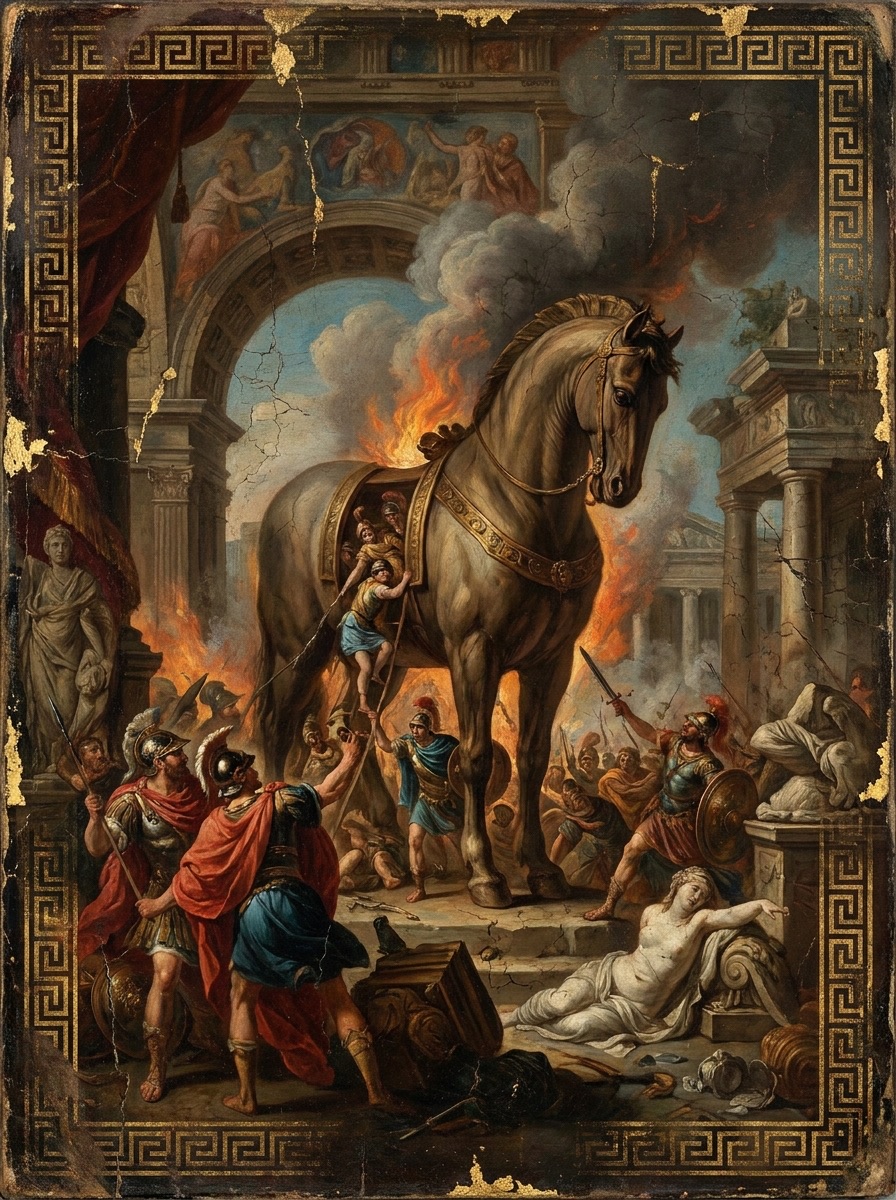
For ten years the Greeks besieged Troy, and in the end they won only by Odysseus’ stratagem of the Wooden Horse. At night the warriors hidden inside the horse burst out, fire spread through the city, Priam was slain, women and children were taken captive, and splendid Troy at last fell.
Article
Summary
After the Trojans dragged the horse into the city, all Troy believed the ten-year siege had finally ended. Deep in the night, wine and exhaustion overcame the guards, and the Greek warriors hidden in the horse slipped out and opened the gates. The fleet concealed behind Tenedos returned, and the Greek army poured into sleeping Troy. The city quickly filled with fire and screams. The Greeks drove through the streets, roofs were set alight, and temples, palaces, and houses were swallowed by war. Many Trojans were killed before they could take up weapons, while others fled with children or sacred images toward the altars, only to learn that the walls could no longer protect them. In the palace, aged Priam saw the city fall and still tried to take up arms, until Hecuba drew him back to the altar. Neoptolemus burst into the royal house, killed Priam’s son Polites before his eyes, and then dragged the old king to the altar and killed him there. The dignity and bloodline of the Trojan royal house were torn apart in that night. The temples and streets held their own tragedies. Cassandra clung to the image of Athena for protection, but Oilean Ajax dragged her away; Menelaus found Helen and at first meant to kill her, yet finally took her back to the ships; Hector’s little son Astyanax was thrown from the walls, while Andromache, Hecuba, and many Trojan women became captives. By dawn, Troy had become smoke, broken walls, and weeping. The Greeks divided treasure and prisoners and prepared to sail home with victory; Aeneas, meanwhile, escaped through the fire carrying his father and leading his young son, preserving a remnant of the Trojan line. But the slaughter in the city and the sacrilege in the temples boarded the ships with the victors, warning that the return would not be peaceful.
Weariness Beneath the Walls
The sea wind blew against Troy’s walls for ten long years.
The Greek ships had long since faded to a weathered white, and the stakes of the camp had been replaced again and again. Many of the bravest men had fallen beside the Scamander River and on the dusty ground before the gates. Achilles was dead. Ajax the Greater was dead. Hector had already been laid in his tomb. Yet Troy’s high walls still stood there, like a ring of pale cliffs, sheltering Priam’s palace, its temples, its streets, and the countless frightened people within.
The Greeks had not been without victories. They had seized many of the towns outside the city, taken rich spoils, and killed many of Troy’s allies. But as long as that wall remained unbroken, the war was not over.
One day the leaders gathered in the tents. Menelaus thought of Helen and darkened with anger; Agamemnon stared toward the walls, one hand on his sword; Diomedes said little. They all knew that if they kept rushing the city with spear and shield, they would only leave more bodies beneath the ramparts.
Then Odysseus spoke.
He was not the strongest man, nor the swiftest in the charge, but his mind curved and shifted like a hidden bay, never easy for others to read at a glance. He said that the Trojans had endured ten years of assault and had grown used to Greek attacks. Since the walls could not be forced from outside, the Trojans must be made to bring disaster into the city with their own hands.
The others looked at him. In a low voice Odysseus laid out the plan for the Wooden Horse.
The Giant Horse
Soon the sound of axes and chisels rang through the Greek camp.
Carpenters cut down great beams, trimmed away the branches, and fitted the planks together. Epeius was the man who made the horse; he understood timber and knew how to set hidden joints and mechanisms. He hollowed out the belly of the Wooden Horse so armed men could hide within it. Outside, however, it was made tall and solemn, like a gift offered to the goddess Athena. Its neck stretched forward, its ears stood erect, and its four legs planted themselves solidly on the ground. From a distance it did not look like a weapon at all, but like a vast votive offering.
The men chosen to hide inside the Wooden Horse were the boldest warriors in the Greek host. Menelaus went in. Odysseus went in. Diomedes and other champions went in as well. They carried short swords and crouched in the dark wooden chamber, speaking in hushed voices, packed tight in the gloom. Outside, the men shut the secret door, and only a faint thread of light entered through the cracks in the planks.
Then the Greeks burned part of the camp and launched their ships. Out on the water, oars beat and sails slowly receded. The Trojans watching from the walls could hardly believe their eyes.
The enemy who had besieged them for ten years was gone.
For a moment the city was silent. Then came a shout of joy. Men ran down from the towers and cried through the streets, “The Greeks have fled! They have fled!”
At last the gates were opened. The Trojans went out beyond the walls and stepped onto the battlefield they had not dared linger on for so many years. There were broken camps, ash, splintered timber, abandoned hearths—and there stood the great Wooden Horse.
People gathered around it and argued. Some said it should be dragged into the city as an offering to Athena, in thanks that the war was over. Some said it ought to be pushed into the sea. Others suspected a Greek trick.
The priest Laocoon came forward. He looked at the horse, too large to be harmless, and unease rose in him. Raising his spear, he thrust it into the horse’s belly. The point struck wood with a dull sound that echoed faintly inside. The Greek warriors hidden within held their breath and did not dare let even their armor ring.
Laocoon cried out and warned the people not to trust a Greek gift. But the Trojans had only just lifted their heads from years of fear, and they longed too deeply to believe the war was truly over. Most could not hear the warning.
Just as the argument reached its height, someone brought in a Greek captive from the shore.
Sinon’s Lie
His name was Sinon. His clothes were ragged, his hands bound behind him, his face full of terror, as though his companions had abandoned him to his fate.
The Trojans dragged him before Priam. The old king sat on a makeshift seat outside the city, his white hair trembling in the wind. He asked Sinon why the Greeks had withdrawn and what the Wooden Horse was meant to be.
At first Sinon pretended to refuse to speak. Then, as if forced to speak at last, he told the lie he had prepared long before. He said the Greeks had offended Athena and must offer a sacrifice to appease the goddess, and that he himself had been marked for death but had escaped. He went on to say that the horse was an offering to Athena, built so enormous that the Trojans would be unable to drag it into the city. As long as it remained outside, the Greeks would one day return. But if the Trojans welcomed it within their walls, the goddess would turn her favor toward Troy.
These words struck exactly where many hearts already leaned.
They were desperate to believe the gods had at last taken their side. Ten years of bloodshed, ten years of sons lost, ten years of guarding the walls—suddenly all of it seemed to have a clean ending: the enemy had fled, the sacred gift remained, and the goddess would protect the city.
Then something terrible happened as well. Two great serpents came gliding from the sea, their scales wet and cold in the light. They crawled ashore and coiled around Laocoon and his two sons. The children screamed and struggled; Laocoon rushed to save them, but the snakes wound themselves around him too. They tightened and tightened until father and sons lay dead on the ground. Afterward the serpents slid away toward Athena’s temple and vanished near the goddess’s image.
The Trojans saw this and were shaken even more. They believed Laocoon had struck the horse dedicated to the goddess and had been punished for it. The voices against the horse grew weaker, while those urging that it be brought into the city grew stronger.
So the people fastened ropes around the Wooden Horse. The young pulled, the old pushed, women and children stood by the streets watching. The wheels rolled over the earth outside the walls with a heavy creak. To make the huge horse pass through, they even tore down part of the gate and the obstacles beside the wall. Little by little, the Wooden Horse was dragged into Troy.
That day the city felt like a festival.
People offered sacrifices to the gods. Wine splashed to the ground from their cups, and flames licked the meat upon the altar. Some sang, some danced, and some wept while holding children who had not slept safely for years. Lamps were lit in Priam’s palace, and the streets were full of noise. Helen stood on high ground and looked at the horse, yet her heart was uneasy. More than most, she understood the Greeks’ cunning, and she knew Odysseus was not a man to abandon a plan easily.
Night slowly fell. Wine and exhaustion weighed upon the whole city. The Trojans believed disaster had gone away, and one by one they slept.
Night Inside the Wooden Horse
Inside the Wooden Horse the air was hot and close.
The Greek warriors crouched in the dark with their legs folded under them, sweat running down their faces. They heard the Trojans’ cheers from the day before, the creak of the wheels over stone, the closing of the gates behind them. As night deepened, the sounds outside grew faint, until only distant singing, drunken laughter, and the crackle of dying torches remained.
Odysseus pressed himself against the wood and listened for a long time.
At last the city grew still.
Out at sea, the Greek fleet had not truly gone home. It waited behind the island of Tenedos for the signal. Sinon, left on the shore, was waiting too. When he saw the city’s lights grow sparse, he quietly lit the agreed-upon beacon. Far out on the water, the Greek ships turned back, and in the darkness their oars cut into the sea as they headed once more for Troy’s shore.
Inside the Wooden Horse, the hidden door was opened.
One by one the warriors slid down on ropes. When their feet touched Trojan ground, they gave no shout. They only gripped their sword hilts and moved along the shadows. Odysseus led the way straight to the gates, where they killed the guards and drew back the bolts. The heavy gates opened in the night, and their hinges gave a low groan.
By then the Greek army from the ships had already arrived.
They poured into the city with torches and swords. Troy, still asleep, had not yet understood what was happening before the streets were filled with cries of slaughter.
Firelight on the Palace
The first people awakened burst from their doorways thinking there was a fire. Soon they saw armed Greeks rushing from the alleys and understood that the enemy had entered the city.
Some seized spears; some could only snatch up the clubs hanging by their doors. Fathers pushed children into the inner rooms and stood at the thresholds themselves. Women ran to the altars clutching the images of the gods. Old men knelt on the ground and cried out divine names. But the gates were open now, and more Greeks kept pouring in from the ships. The Trojans could no longer rely on their walls as they once had.
The palace itself fell into disorder.
Priam was old now, and his arms no longer had the strength they once had. Hearing the cries outside, he still strapped on his armor and took up his spear. Hecuba saw this and wept, begging him, “If you go out like this, you will save neither the city nor us.” She drew him toward the palace altar, where the family gods were kept. The old king sat by the altar like a tree bent by the wind.
But disaster had already broken into the palace.
Neoptolemus, Achilles’ son, stormed in. He was young and savage, and it seemed as though he carried his father’s fury in his veins. Priam saw his son Polites being hunted before the altar and cut down in a pool of blood. The old man, overwhelmed by grief and rage, lifted his spear and hurled it at Neoptolemus. The blow had little strength left in it and only glanced off the other’s shield.
Neoptolemus rushed forward and dragged the old king to the altar, where he killed him.
Priam had once ruled wealthy Troy, welcomed princes from distant lands, and knelt before Achilles after Hector’s death to beg for his son’s body. Now he lay dead beside the altar in his own palace, with shattered images, overturned vessels, and the cries of his kin all around him.
The royal house of Troy was torn apart in that one night.
A Cry in the Temple
Cassandra fled into Athena’s temple and clung to the statue. She had the gift of prophecy, yet no one ever believed her. Long before the Wooden Horse entered the city, she had cried out that ruin was hidden within it, but no one listened. Now her hair was loose about her shoulders, and her hands clutched the goddess’s image, but even so she could not escape her fate.
Oilean Ajax burst into the temple and dragged her away from the statue. The firelight trembled across the sanctuary, and the goddess’s image stood silent in the shadows. This sight troubled many of the Greeks themselves, for even in war, a temple should not be so defiled.
Menelaus was searching the city for Helen as well.
For her sake he had begun this war, and through ten years countless men had died in her name. Tradition says that when he found Helen, he had his sword in hand and meant to kill her. She stood in the lamplight, still so beautiful that it caught the breath. She pleaded her case and begged him, for the sake of their former marriage, to spare her. Menelaus’ fury wavered. In the end he did not kill her in Troy, but took her back to the ships.
There was also Astyanax, Hector’s little son.
The child was still very young; once, when Hector had held him in his arms and the horsehair crest on his helmet had frightened him, he had cried. Now Hector was dead and Andromache was a captive. The Greeks feared that when the boy grew up, he would seek vengeance for his father and for the city. They decided not to leave him alive. Little Astyanax was thrown from the walls. Andromache’s cries echoed among the ruins, but they could not bring her son back.
Hecuba, Andromache, Cassandra, and many other Trojan women were divided among the Greek leaders as slaves. They had once been queens, princesses, and noblewomen; now they stood on the shore, waiting to be taken onto the enemy’s ships.
Embers Behind the Walls
By dawn, Troy no longer looked like a city.
Roofs had collapsed, and the beams were still burning. Palace doors had been smashed open, storehouses emptied, and corpses lay across the streets. Along the broad roads where carts once passed, dirty water ran mixed with ash. There was smoke in the temples, blood beside the altars, and the bright towers of old had been blackened by fire.
The Greeks carried their spoils down to the shore. Gold cups, robes, weapons, bronze vessels, and the women and children taken captive were divided among the chiefs. Some rejoiced; others remained silent. The war of ten years had finally ended, yet its ending was not bright like the songs at a feast.
Amid the confusion, Aeneas fled the city with his father Anchises and his son. Tradition says he carried his aged father on his back and led his little son by the hand, while behind him his homeland burned. He did not save Troy, but he carried a small remnant of the Trojans out of the fire. As for Troy itself, there was no turning back.
When the sun rose, the sea turned a pale gold.
The Greek ships waited at the shore for the voyage home. But many of the men did not yet know that the road back would not be safe. The gods had seen the slaughter in the city, and they remembered the outrage in the temple. Storms, wandering, hatred, and revenge would still follow many of the victors.
But in that moment, Troy had fallen.
The wall that the Greeks had stared up at for ten years could not withstand the Wooden Horse that entered by night. Priam’s palace became ashes, Hector’s family was shattered, and Helen was carried away on the Greek ships. Beside the once-busy gates there remained only smoke, broken stone, and the waning firelight of dawn.