Greek Mythology
The Epigoni Attack Thebes — Greek Mythology
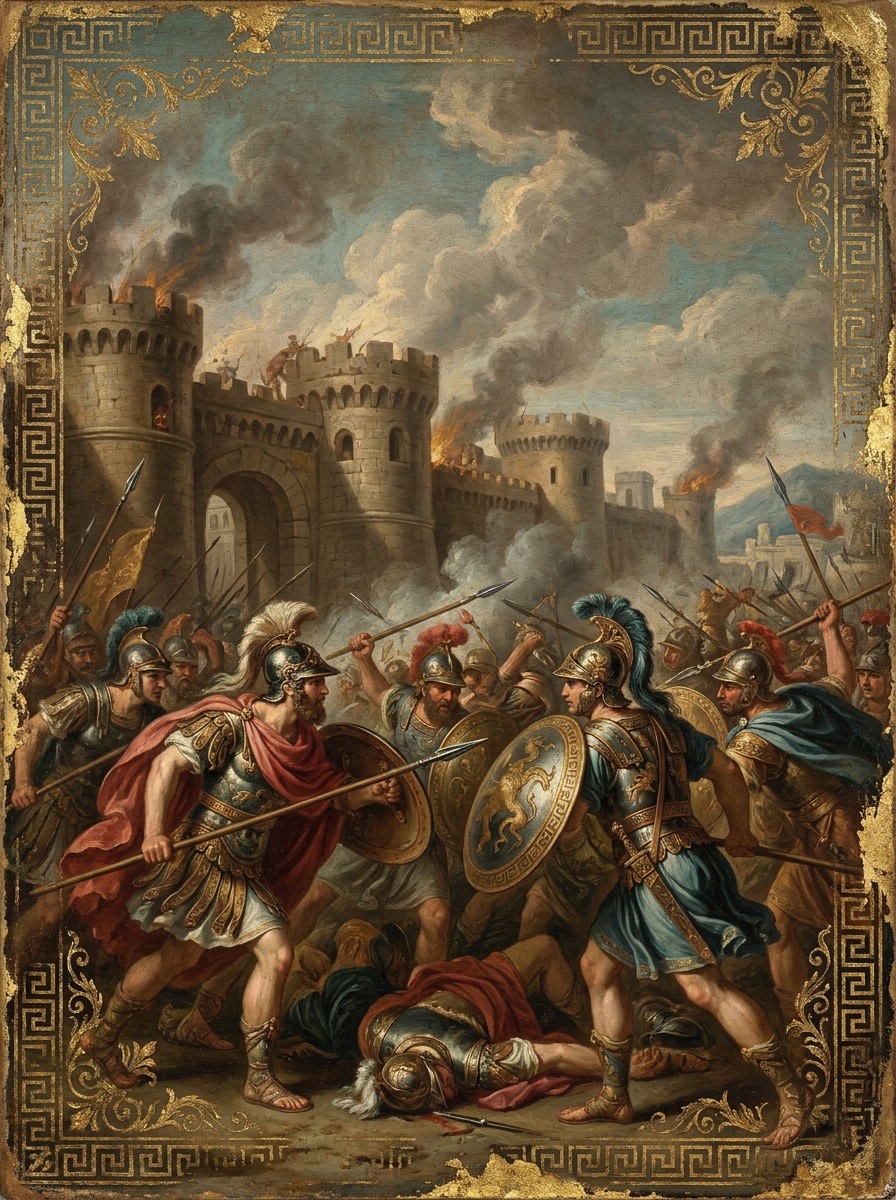
Ten years after the Seven against Thebes failed, their sons came of age and raised a new army beneath the seven-gated city. This time Alcmaeon led the Epigoni to victory, set Polynices’ son Thersander upon the throne, and found that triumph too could bring fresh death and blood-guilt.
Article
Summary
After the first war against Thebes failed, the bodies of the fathers and an unfinished feud lay before the seven gates. Polynices, Tydeus, Capaneus, Amphiaraus, and the others had fallen, and only Adrastus escaped back to Argos on the divine horse Arion. Ten years passed, and the sons of the dead heroes grew into men known as the Epigoni, the later-born. Adrastus gathered the young warriors for a second campaign: Diomedes, Sthenelus, Thersander, Euryalus, Aegialeus, and the sons of Amphiaraus, Alcmaeon and Amphilochus. An oracle declared that Thebes could be taken only if Alcmaeon led the army. Yet Alcmaeon carried a darker burden, for his dying father had ordered him to avenge Eriphyle's betrayal, and now Eriphyle was again moved by a gift, the robe of Harmonia, to urge him into war. The Epigoni marched from Argos and returned to seven-gated Thebes. The city was ruled by Laodamas, son of Eteocles, another child left behind by the former catastrophe. Battle broke out near Glisas: Laodamas killed Adrastus's son Aegialeus, but Alcmaeon then struck down Laodamas in return, shaking the courage of the Theban army. The Thebans turned to the aged Tiresias for counsel. The blind prophet told them that divine favor had passed to the attackers, and that stubborn defense would bring only more death. They should send envoys by day to gain time, then leave the city by night with their families and possessions. The people obeyed, and Tiresias departed with them, but near Tilphussa he failed from age and exhaustion and died on the road. At dawn the Epigoni found Thebes empty. They entered the city, seized its streets and palace, divided the spoils, and sent Manto, daughter of Tiresias, to Delphi as an offering to Apollo. Thersander was placed on the throne that Polynices had failed to recover for himself. Yet victory still demanded payment: Adrastus died of grief for Aegialeus, and Alcmaeon returned home to kill Eriphyle, turning vengeance into a new blood-guilt.
The Hatred Left before the Seven Gates
Before the seven gates of Thebes, some of the bravest men in Greece had once fallen.
Polynices had come there to win back the kingship that he claimed was his, and the heroes of Argos had marched beside him. Adrastus drove his divine horse Arion; with him came Tydeus, Capaneus, Hippomedon, Parthenopaeus, Amphiaraus, and the others. At every gate there were chariots and shields, and on every shield some dreadful image flashed in bronze. But that war did not bring them victory.
Polynices and his brother Eteocles struck each other down. Capaneus climbed the wall and was hurled from it by the thunderbolt of Zeus. Tydeus died on the field. Amphiaraus was swallowed when the earth split open beneath him. One after another the heroes perished. In the end, only Adrastus escaped back to Argos, carried by his miraculous horse.
He survived, but survival was no light gift. The dead heroes left behind wives, sons, and unavenged wrongs. Their children grew up hearing how their fathers had put on armor, gone to war, and never returned. Old shields still hung on the walls, and the weapons may already have darkened with rust, but the names of the fallen were not forgotten.
Ten years passed. Boys became young men strong enough to lift a spear and mount a horse. People called them the Epigoni, the “afterborn,” because they were not the first men who had attacked Thebes, but the sons of those who had died there.
Adrastus Gathers the Heroes Again
Adrastus had grown much older.
He had once led the Seven to war, and when he returned, almost no one was left at his side. Now he saw before him the sons of those dead companions: Diomedes, son of Tydeus; Sthenelus, son of Capaneus; Thersander, son of Polynices; Euryalus, son of Mecisteus; and Aegialeus, Adrastus’ own son.
Most remarkable of all were the two sons of Amphiaraus: Alcmaeon and Amphilochus.
Amphiaraus had been a seer as well as a hero. He had known before the first campaign that the attack on Thebes would end in death, and at first he refused to go. But his wife Eriphyle accepted the necklace of Harmonia from Polynices and persuaded her husband to join the war. Before he left, Amphiaraus understood that his wife had betrayed him. He charged his sons, when they were grown, to avenge their father.
Now a new war stood before them. The young heroes sought an oracle. The answer came: if Thebes was to be taken this time, Alcmaeon must command the army.
Alcmaeon was troubled when he heard it. He did not fear battle, but he knew that this path would lead him deeper into blood-guilt. His father’s command still echoed through the house, yet his mother Eriphyle still lived. To avenge his father, he would have to raise his hand against his own mother; to obey his mother, he would be driven toward war just as his father had been.
Then Thersander, son of Polynices, also wished to draw Alcmaeon into the campaign. He brought a precious gift: the robe of Harmonia. In the past, the necklace had persuaded Eriphyle to send her husband toward death. Now the robe came before her eyes. Its splendid fabric shimmered in the light, like an old temptation reaching out once more. Eriphyle accepted it and again urged her own son to take the field.
At last Alcmaeon consented.
The Epigoni gathered in Argos. Iron had not yet become the common weapon of men; warriors polished bronze spearheads, repaired chariot wheels, and yoked their horses. When the army set out, dust rose from the road, and the young men’s shields shone together in the sun. Adrastus went with them too, longing to see the old defeat repaid with his own eyes.
The Young Men’s Army Reaches the City
Word soon reached Thebes: the Argives were coming again.
The older people in the city still remembered the war of ten years before. Corpses had been heaped before the gates; wheels had thundered beneath the walls, and horses had screamed there. Now it was not the same seven men who approached, but their sons. The sons came bearing spears to the very places where their fathers had died, and fear moved through the Thebans.
At that time Thebes was ruled by Laodamas, son of Eteocles. He too was the child of a dead man, for his father had fallen in the quarrel between brothers. So on both sides stood, in a way, the children left behind by the former disaster.
The Epigoni did not wait long. They drew up their forces near Thebes, chariots in rank, foot soldiers advancing behind their shields. The Thebans came out to meet them. The armies clashed in the region of Glisas. Across the open ground rang the sound of bronze on bronze; long spears struck shield faces; horses reared and screamed under the reins; wheels crushed stone and mud.
Alcmaeon stood in the front line. He knew the oracle had placed the outcome upon him, and he knew that behind him stood his father’s unappeased anger. When he drove into the enemy ranks, the young heroes surged forward after him.
The battle quickly turned savage.
Aegialeus, son of Adrastus, fought among them. He was young and brave, one of the most beloved men in the army. But war does not spare a man because he is young. Laodamas met him in the fighting, and his spear struck Aegialeus down. The young man fell into the dust and did not rise.
When the news reached Adrastus, the old man seemed to be carried back ten years. In the first war he had lost sons-in-law, allies, and companions; now he had lost his own son. Yet the fighting was not over, and he could not let the army break apart in grief.
Alcmaeon saw Aegialeus fall, and his anger burned hotter. He rushed against Laodamas. The two met in the confusion of battle. A bronze spearpoint flashed, and Laodamas fell as well. When the Thebans saw their leader dead, their line began to waver.
The Counsel of Tiresias
Within Thebes there still lived an aged prophet named Tiresias.
He had seen too much: the death of Laius, the truth of Oedipus, the strife between the brothers, the first siege by the Seven. His eyes could not see the light of the world, yet he often knew before others where disaster was coming from. Now the Thebans gathered around him and asked whether the city could still be saved.
Tiresias offered them no pleasant comfort.
He told them that the will of the gods had turned toward the attackers. If they continued to defend the city by force, Thebes would only lose more lives. There was one thing left to do: send envoys to the enemy and delay them with talk, while the people of the city slipped away by night, taking with them whatever family and possessions they could.
When he said this, shame and fear filled the Thebans. It is no easy thing to abandon the walls of one’s ancestors. But they had just lost Laodamas in battle, and they had seen the force of the Epigoni. They knew Tiresias was not speaking falsely.
So they did as the prophet advised.
By day, Thebes sent messengers to the besieging army, saying that they wished to negotiate. The heroes outside thought the people within were still wavering, and for the moment they held back from a full assault. But when night came, the gates opened quietly. The Thebans led out the old, carried children in their arms, drove their animals before them, and shouldered whatever household goods they could bear. They went away through the darkness. Torches were kept low; wheels were wrapped in cloth so they would make as little sound as possible.
Tiresias left the city with the others. But he was very old, and the journey was hurried. When they came to the region of Tilphussa, his strength failed at last. Some said he drank from the spring there and then died. The old man who had witnessed so many Theban sorrows did not live to see the city fall, but neither did he ever return to it.
Thebes Falls
At dawn, the Epigoni discovered that Thebes was empty.
The walls still stood, and the gates were still in place, but the sound of the city had changed. No warriors shouted from the towers. No women drew water before their houses. No children ran through the streets. There were only abandoned objects, cold ashes on the hearths, and the signs of a hurried flight.
They entered Thebes.
This time, the seven gates did not keep the Argives out. The former generation had bled to death before them and still had not stepped within the city; the next generation at last passed through. The young heroes occupied the streets and palaces, seized the wealth inside, and divided the spoils among the army. They also sent Manto, the daughter of Tiresias, to Delphi as an offering to Apollo, for she too carried prophetic blood.
Thebes did not hold firm as it had before. It was taken and plundered, and its royal house and people were scattered in flight.
Afterward the Epigoni set Thersander upon the throne. Thersander was the son of Polynices, the heir of the line whose claim to kingship had once ended in death. Polynices had not won Thebes back with his own hands, but his son now sat upon the royal seat.
Yet the victory did not gladden everyone.
Adrastus saw Thebes fall at last, but he had lost his son Aegialeus. The old man’s heart could bear no more. The first war had taken his companions; the second had taken his own blood. Tradition says that he died of grief on the way home, as though fate had allowed him to live only long enough to see vengeance completed, and then at once set before him the price of that vengeance.
Blood-Guilt after Victory
After the Epigoni captured Thebes, they departed with honor and spoils. People could say they were more fortunate than their fathers, because they had won. They could also say they had not truly escaped their fathers’ shadow, because even this victory had been bought with the lives of kin.
Alcmaeon above all could find no peace.
He remembered the command Amphiaraus had left before he died. He remembered too that his mother Eriphyle had accepted gifts twice: first the necklace, to persuade her husband to go to war; then the robe, to persuade her son to do the same. Because of her counsel, his father had gone to his death. Because of her counsel, the son too had taken the road to battle.
When the war was over, Alcmaeon returned home and finally raised his hand against his mother. He killed Eriphyle and avenged his father. But a mother’s blood cannot simply be washed away. From then on, revenge became a new crime, and the new crime drove him into wandering.
So the story of Thebes left behind a heavy ending. The city the Seven could not take was taken by the Epigoni. The throne the father could not win was won by the son. But after the city fell, the dead did not rise again, and the living did not all find rest. The hatred left before the seven gates had been repaid, yet the blood kept flowing from one family to another, from one generation to the next.