Greek Mythology
Embassy to Achilles — Greek Mythology
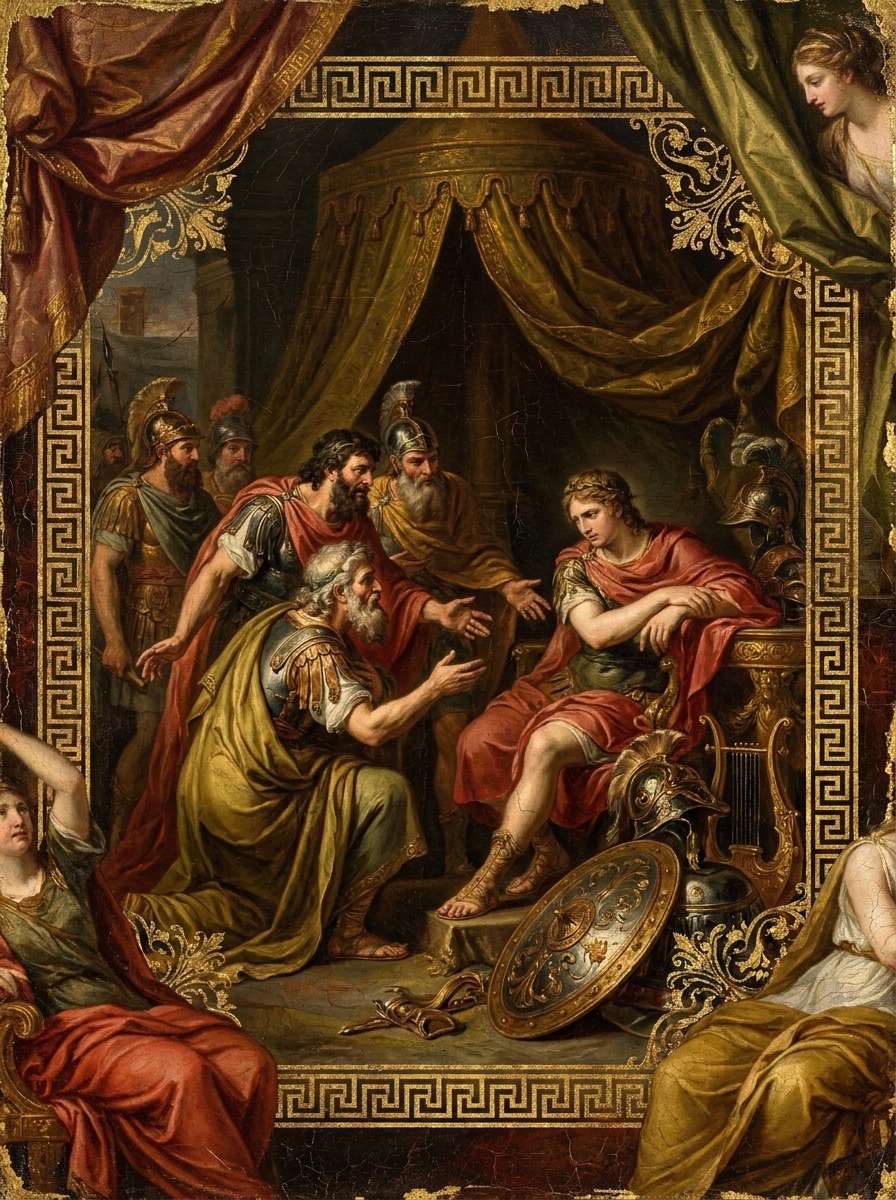
Driven back to their ships by Hector, the Greeks at last see Agamemnon ready to make amends to Achilles. He sends Odysseus, Ajax the Greater, and Phoenix to ask for peace. But Achilles’ anger has not cooled. He receives his friends with honor, yet refuses to return to battle, promising only that he will act when the fire reaches his own ships.
Article
Summary
In the tenth year of the Trojan War, Achilles, the strongest warrior among the Greeks, withdraws from the fighting after being publicly dishonored. Without him, the Greeks are driven back again and again. Hector leads the Trojans close to the Greek defenses, and by night they kindle fires across the plain, ready to burn the Greek fleet the next day. At the night council, Agamemnon first speaks of fleeing back to Greece. Diomedes and Nestor oppose him. Nestor urges him instead to make amends to Achilles, and Agamemnon promises gifts: Briseis, gold, tripods, swift horses, women, marriage, and rich cities. Odysseus, Ajax the Greater, and Phoenix are sent to persuade Achilles to relent. The envoys come to the ships of the Myrmidons and find Achilles playing the lyre and singing of the deeds of heroes, while Patroclus sits nearby. Achilles receives them as friends, roasting meat with his own hands and setting out wine. When the meal is over, Odysseus speaks of the Greeks’ peril and Agamemnon’s compensation, begging him to return to the battlefield. Achilles refuses. He says Agamemnon shamed him before all, and no heap of gifts can restore the honor taken from him. Phoenix pleads with tears and recalls the old story of Meleager, whose anger cost him dearly. Ajax the Greater speaks more bluntly and reproaches Achilles for his hard heart. Yet Achilles still will not fight. He promises only that when Hector reaches his own ships and fire comes to the vessels of the Myrmidons, then he will decide. Odysseus and Ajax return to the camp empty-handed, while Phoenix remains with Achilles for the night. When the Greek leaders hear the answer, they understand that at dawn they must face Hector without Achilles still.
The Greek Camp at Night
Over the plain outside Troy, night lay low and heavy. The shouting and slaughter of the day had fallen silent, but in the Greek camp few men could sleep.
Beyond their ditch, the Trojans had lit fire after fire. The flames shone on shields and spearheads like rows of red eyes watching the ships by the sea. Hector had not led his army back into the city as he usually did. He ordered his warriors to spend the night on the plain. The horses stood tethered beside the chariots, the wheels were still dust-stained, and soldiers rested against their spears, waiting for dawn and the next rush against the Greek ships.
In the Greek camp, Agamemnon’s heart sank deep. The day’s fighting had ended in bitter defeat. Many heroes were wounded, and the defenses had nearly been broken. Worst of all, Achilles still sat beside his own ships and would not enter the battle.
Agamemnon called the leaders together. Torches were fixed in the ground, their light wavering over weary faces. Agamemnon rose, his voice tight with fear. He admitted that Zeus no longer seemed to favor the Greeks, and said it would be better to drag the ships down to the sea under cover of darkness and sail home.
At those words, silence fell. The thought of flight passed over them like cold water.
Diomedes was the first who could not endure it. He was young, but he did not fear a king’s authority. He stood and said that if Agamemnon wished to leave, others need not follow him; he and Sthenelus would remain until Troy was taken. Old Nestor spoke next. He did not rebuke Agamemnon harshly, but his meaning was plain: the urgent task was not to flee, but to find a way to bring Achilles back.
Everyone knew where the disaster had begun. Agamemnon had taken Briseis, Achilles’ captive woman, and had wounded his honor before the whole army. In anger Achilles withdrew from battle and kept the Myrmidons beside the ships. Now Hector pressed ever nearer, and at last Agamemnon had to bend.
The King’s Promised Gifts
Before the assembled leaders, Agamemnon promised compensation. He would return Briseis to Achilles and swear that he had never touched her. Beyond that, he offered many gifts: shining gold, finely wrought tripods, swift horses, and women skilled in labor. When Troy was finally taken, Achilles might be first to load his ship with gold and bronze from the spoils, and he might choose Trojan women for himself.
Agamemnon said further that if they returned safely to Greece, he would give Achilles one of his daughters in marriage, asking no bride-price and granting rich cities besides. Those cities lay near the sea, with fertile fields, vineyards, and pastures, and their people would honor Achilles as they honored a king.
The offer was weighty, and the gifts were truly splendid. Yet all understood that Achilles might not want gifts alone. Wounded honor cannot be set on a table like a golden cup, nor led back like a horse by the bridle.
Nestor proposed that suitable men be sent. He chose Odysseus, master of counsel; Ajax the Greater, towering and steadfast; and old Phoenix. Phoenix was closest to Achilles, for he had been with him since youth and had cared for him almost like a father. Two heralds went with them to the ships of the Myrmidons.
Before they set out, the men lifted cups and prayed to the gods. A wind blew in from the sea and bent the flames low. The envoys walked along the shore, the sand cold and damp beneath their feet, the sound of waves striking the hulls of ships in their ears.
Farther and farther they went, until the noise of the Greek camp faded behind them. Ahead lay the camp of Achilles, strangely quiet.
The Lyre Beside the Ships
When the envoys came to Achilles’ shelter, they did not find a warrior standing armed for battle.
Achilles sat before his hut with a finely made lyre in his hands. It was a prize he had taken from a captured city, smooth across the frame, clear in its strings. He plucked it and sang of the deeds of heroes long ago. Patroclus sat opposite him, listening in silence and waiting for the song to end.
The battlefield was not far away, yet this place seemed another world. Out on the plain the Trojan fires were burning, and the Greek kings were sick with fear for the coming day; here there was music, wine, and an anger that would not fight.
When Achilles saw the three envoys approaching, he rose at once. He did not send them away. Instead he showed the courtesy owed to friends. He told Patroclus to prepare food and wine quickly, for the dearest of guests had come.
Patroclus set to work. He laid meat on the chopping block and cut it: mutton, fat goat, and pork. Achilles himself set the pieces on spits, sprinkled them with salt, and held them over the coals. Flames licked the fat, and the smell soon filled the shelter. He brought out bread and cups and invited his guests to sit and eat.
They did not speak of reconciliation the moment they arrived. First came food, then wine, then the settled order of guest and host. Only after the cups had passed several times, and the meat had been shared among them, did Odysseus look at Achilles and begin to speak.
The Plea of Odysseus
Odysseus never hurried his words. He began with the Greeks’ danger: Hector and the Trojans had pressed close to the ships; they had refused to withdraw to the city by night; tomorrow, he feared, they would set the fleet on fire. If Achilles did not act, the Greeks might suffer ruin beside the sea.
Then he recited Agamemnon’s offer. Briseis would be returned, and Agamemnon would swear he had never touched her. Gold, tripods, horses, women, cities, marriage—one by one, Odysseus laid them out in speech. He also reminded Achilles of his father, Peleus. When the old man sent his son to war, he had urged him to master his anger and win honor among his companions. Now was the time, Odysseus said, to heed a father’s counsel.
At last Odysseus said that if Achilles hated Agamemnon and would not fight for him, he should at least pity the other Greeks. If he returned now to battle, all men would honor him like a god. He could face Hector and win the greatest glory.
Silence settled over the shelter. Firelight moved across Achilles’ face. He listened to the end. He did not flare up at once, yet neither was he softened by the gifts.
At last he spoke, and his voice was hard and cold.
He said he would no longer be deceived by Agamemnon. Brave men and cowards alike must die in the end; the man who fights with all his strength and the man who hangs back do not always receive different rewards. He had stormed cities for the Greeks and brought back many spoils, yet when the prizes were divided, Agamemnon took the largest share. And when his own turn came, even beloved Briseis had been seized from him.
No gift, Achilles said, could buy back his heart. Agamemnon might pile up gold as high as sand, and still he could not wash away the insult. His mother Thetis, he said, had told him of two possible fates: if he stayed and fought at Troy, he would win undying fame but never return home alive; if he sailed back to his own land, his glory would be less, but he would live to old age. Now he would rather launch his ships at dawn and go back to Phthia.
Those words rose like a wall before every gift Odysseus had brought.
The Tears of Phoenix
Old Phoenix was grieved as he listened. He was aged now, and his voice trembled. He did not, like Odysseus, list the gifts one by one. Instead he spoke of former days.
He told Achilles how he had once left his father’s house and come to Peleus, and how Peleus had received him. Later, Peleus entrusted the young Achilles to him, asking him to teach the boy to speak, to eat, and to become a warrior. Phoenix said that when Achilles was small he often sat on his knees, eating meat and drinking wine, sometimes spilling the wine over his tunic. To see Achilles so unyielding now was like seeing his own son step onto a dangerous road.
Then Phoenix told the story of Meleager. That hero, too, had withdrawn from battle in anger and allowed enemies to press close upon his homeland. His kin and friends came to him with gifts, but he would not be moved. Only when disaster had reached the very doors, and his wife pleaded with him in tears, did he take up his arms again. By then, though he saved the city, he had missed the best moment and lost the rich gifts once promised to him.
Phoenix did not tell this as a distant tale merely for its own sake. He was begging Achilles not to wait until the ships were burning and his friends lay dead before he repented. If he returned now, the Greeks would be grateful, and Agamemnon’s gifts were still before him.
The old man spoke with such sorrow that tears nearly fell. He begged Achilles either to take him along if he sailed away, or else to listen and come back among his companions.
Achilles’ face softened a little. He respected Phoenix and did not wish to shame the old man. Yet he still would not agree to fight. He told Phoenix not to speak for Agamemnon, and not to wound his heart for that king’s sake. Phoenix could sleep there that night, and tomorrow decide whether to go home with him or return to the Greek camp.
The Blunt Words of Ajax
Odysseus had spoken, and Phoenix had pleaded, yet Achilles remained unmoved. At last the great Ajax could bear it no longer.
He did not turn words as Odysseus did, nor did he weep and entreat like Phoenix. He spoke plainly. They should leave, he said, because Achilles’ heart was too hard. A man whose own brother had been killed, or whose son had been killed, might still accept compensation and let hatred slowly subside. But Achilles, for the sake of one woman, showed no pity to his comrades. Those who had come were among his closest friends, and he would not even honor their friendship.
The words were heavy; and because they were heavy, they sounded like the truth only a friend could speak.
Achilles looked at Ajax and admitted that he had spoken boldly and in a way that suited his own heart. But still, he said, whenever he remembered how Agamemnon had shamed him before all the army, anger surged up within him. He would not put on armor at once for the sake of those gifts.
Yet at last he set one boundary. So long as Hector fought elsewhere, Achilles would not intervene. But when Hector came to the ships of the Myrmidons and set fire beside his own vessels, then Achilles would rise to stop him. At that moment, perhaps Hector would learn that drawing near the ships of Achilles was no easy thing.
It was not the answer the envoys had hoped for, but it was all they would receive that night.
Returning Empty-Handed
The night deepened. Achilles asked Phoenix to remain and had a bed made for him inside the shelter. Patroclus also arranged a place to sleep. Odysseus and Ajax the Greater left with the two heralds and made their way back to the Greek camp by the same road.
The sea wind was colder than before. Far away the Trojan fires still burned, like a line of flame that would not die. Odysseus said little, and Ajax was silent. Both men knew they were not bringing good news.
The leaders were still waiting. Wine had not comforted them, and firelight had not warmed them. When they saw the envoys return, they gathered around at once. Odysseus reported Achilles’ words exactly: the gifts had not moved him; Briseis had not changed his mind; he was even thinking of sailing home. He had promised only that he would fight when Hector brought fire to his own ships.
A hush fell over the camp. Every man heard the danger hidden in that answer: tomorrow they would still have to face Hector without Achilles.
Diomedes spoke last. Since Achilles would not come, he said, they should no longer humble themselves by begging him. Let Achilles remain or depart as his own heart commanded. As for the rest of them, tomorrow they must still eat, still put on their armor, and still take their stand before the ships against the enemy.
The others accepted his words. The night council broke up, and the leaders returned to their tents. By the shore the ships stood quiet, their masts rising in rows through the dark. Achilles’ anger had not been soothed, and the Greeks’ danger had not passed. The embassy had walked through the night and brought back one heavy result: the war would go on, and the next battle would be fought without Achilles.