Greek Mythology
Heracles' Education and the Choice of Path — Greek Mythology
Heracles was fierce even as a boy, and his strength brought him as much trouble as glory. After he left his teachers and the town, he grew up among the hills and one day stood before two roads, choosing a hard and dangerous life in exchange for true fame.
Article
Summary
When Heracles was still young, his foster father Amphitryon gathered many teachers around him. Some taught him to drive a chariot, others to wrestle, shoot arrows, and handle weapons, and still others to play the lyre and read. He learned quickly, but his strength often moved faster than his judgment. One day the music teacher Linus punished him, and Heracles seized the lyre and struck him dead. After that death, Amphitryon understood that the boy could no longer grow up safely under the same roof with tutors and servants. He did not imprison Heracles or seek another teacher. Instead he sent him out beyond Thebes to tend cattle on the slopes of Cithaeron. The rough mountain life gave Heracles room to move, but it also gave him long hours to think about the fire of strength inside him: it could guard a herd or frighten thieves, yet it could also destroy whatever stood too close. One day Heracles came alone to a fork in the road. Two women approached him there. The first was richly dressed and promised an easy life of wine, meat, songs, soft beds, and pleasures won without labor. The second was plain and steady. She promised no comfort at first: only training, hunger, cold watches, danger, and the hard work by which a man becomes worthy of trust and lasting honor. Heracles listened and remembered the broken lyre and Linus lying dead, and also Amphitryon's lesson that strength alone could not guide a chariot. The bright woman called herself Happiness, though the other named her Vice; the quiet woman called herself Virtue. Heracles understood that if he chose ease, his power would one day become another disaster. So he turned away from the broad, gentle road and chose the narrow, steep one. The choice did not turn his mountain life into legend at once. He still guarded cattle, kept watch at night, practiced with bow and stone, and learned discipline in ordinary labor. Then a fierce lion began to trouble Cithaeron, killing livestock and frightening the herdsmen. Heracles tracked it for many days, fought it by hand, killed it, and wore its hide over his shoulders. It was not yet the famous skin of the Nemean Lion, but it marked the lesson of his youth: strength had to be mastered, and true glory would be won only through hardship and danger.
A Boy of Too Much Strength
Before he became the hero everyone would sing of, Heracles was only a broad-shouldered boy in the palace at Thebes.
His foster father Amphitryon knew that this child was not ordinary. Other boys had to brace a bow against their knees and strain inch by inch before the string would give; Heracles took one in his hands and bent it as easily as a crescent moon. Other boys could lift a stone only to their chests before they blushed and panted; he could scoop one up as though it were no heavier than a jar full of water.
Amphitryon was both delighted and uneasy. It was a fine thing to have a child born with such strength in the house, yet he feared that if no one restrained that power, it would one day harm others and perhaps Heracles himself.
So he brought in many teachers.
Amphitryon himself taught him to drive. At dawn, when the horses in the stable still blew white breath and the wheels were wet with dew, he set Heracles on the chariot and told him to take the reins. Once the horses broke into a run, stones flew from beneath the wheels and the floor of the cart trembled under his feet. Amphitryon taught him that reins were not meant to be pulled by strength alone. A horse's mouth could be hurt, and a chariot could overturn; one had to watch the road, listen to the hooves, and know when to loosen the grip and when to hold fast.
Another teacher showed him wrestling. Barefoot in the sand, Heracles lowered his heavy body and waited for his opponent to rush him. He soon learned how to seize an arm, twist the waist, and turn another man's momentum against him until he was thrown to the ground. Clouds of dust often rose from the practice yard, and when they settled, Heracles was still standing while his opponent lay on his back, gasping.
Eurytus taught him archery. The quiver hung at the boy's shoulder, the bowstring bit into his fingers, and he learned to narrow his eyes and judge the sway of a branch far away, and the wind that moved through it. Once the arrow left the bow, it hissed through the air and buried itself in the target. Sometimes, before the fletching had stopped trembling, he was already reaching for another shaft.
Castor taught him how to wear armor and use weapons. The bronze shield was heavy on his arm, and the shaft of the spear rubbed against his palm. His teacher made him understand that on the battlefield courage was not enough. The shield had to guard the chest, the feet could not be allowed to wander, and once the spear thrust forward, it had to be drawn back again. Heracles learned quickly, though whenever he put too much force into the drill, he often broke the practice spear or whatever weapon he held.
He excelled at all these skills. Still, Amphitryon felt it was not enough. He did not want the boy to know only how to fight, so he asked the music teacher Linus to teach him letters and song as well.
The Broken Lyre
Linus came into the house with a lyre in his hands. The instrument was smooth and polished, its strings fine and taut. He sat before the boy and showed him how to press the strings, how to draw sound out of them in a line, neither as violently as a bowstring nor as abruptly as a club.
Heracles frowned, his thick fingers dropping awkwardly onto the strings. The notes came out too heavy, then broke apart, like water struck by a stone. Linus corrected him again and again. The boy could tame horses and strike a distant target, but he could not bear this slow, patient labor.
One day, when Linus heard him play wrongly once more, he could not help striking him. Perhaps the blow was not hard, but it fell on Heracles like a spark dropped into dry grass.
The boy sprang to his feet. He did not think of the teacher's age, nor of how hard the thing in his hands might be. He seized the lyre and brought it down on Linus.
The sound of splintering wood rang through the room. Linus fell and did not rise again.
People rushed in, crying out. Heracles stood there still holding the broken lyre, the anger on his face slowly draining away until only bewilderment remained. He had meant only to strike back, yet he had already committed a deed from which there could be no return.
Later, he was brought before others to defend himself. Some said there had once been a law allowing a man to strike back when he himself was struck. Heracles used that rule to plead his case. But no matter how he argued, Linus was dead, and Amphitryon at last understood that the boy could not remain beneath the roof any longer, growing up among teachers and servants.
He did not shut Heracles away, nor did he seek out another tutor. Instead, he sent the young man to the pastures outside the city, to watch over the cattle.
Days on the Mountain
Outside Thebes, the mountain wind was colder than the air within the city. Heracles left behind houses, lessons, and song and went up among the grassy slopes around Cithaeron. By day he trailed after the cattle across the stony tracks, watching them lower their heads to graze; by night he leaned against the rocks and listened to wolves howl far off in the dark.
The life there was rough, but it suited him. No one was always scolding him, and no narrow room could hem in his limbs. When he was hungry, he ate coarse bread and roast meat; when he was thirsty, he bent to the spring and drank. The sun browned his shoulders, and the wind whipped his hair into tangles. Day by day he grew taller, his chest broadened, and his arms hardened like tree trunks.
The herdsmen soon discovered that with Heracles nearby, wild beasts were less bold. If a wolf's shape flickered in the grass, he would pick up a stone and hurl it. If cattle thieves crept close at night, he would rise suddenly out of the darkness and send them fleeing in terror.
Yet the hills also gave him long hours to think alone.
People in the city often said that a noble-born boy ought to seek fame, and that a brave man ought to win glory. But where did fame come from? And what was glory worth? Heracles did not know. He only knew that strength lived in him like a fire that refused to go out. Left to burn as it pleased, it could drive away beasts, but it could also burn down houses. It could protect a friend, or kill a teacher.
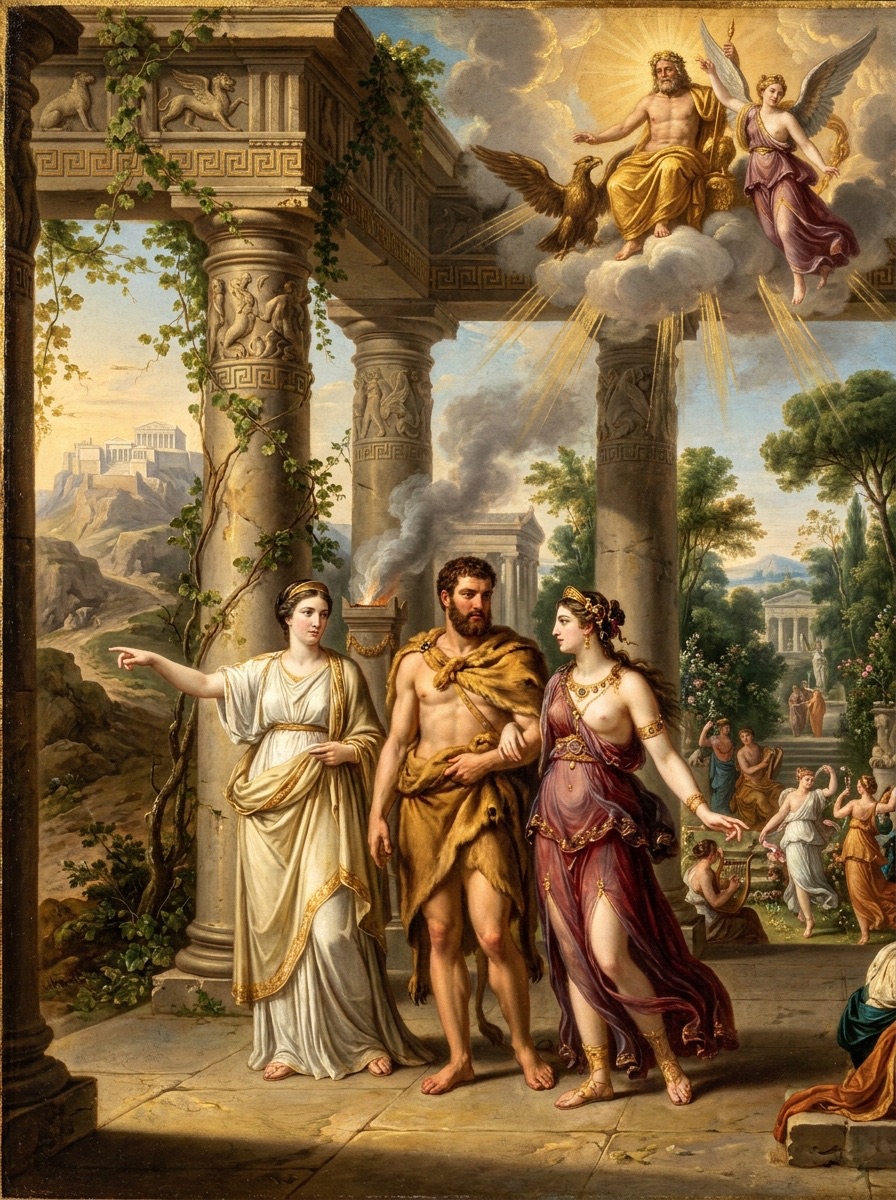
One day, Heracles left the cattle and walked alone to a lonely fork in the road. Before him, the way split in two: one path looked broad and level, its trees casting gentle shade, as though a man could walk it far without effort; the other was narrow and steep, with stones jutting from the earth and thorns pressing close to either side, its end impossible to see.
The boy stopped there.
Then two women came toward him.
The Two Women
The first woman to reach him was richly dressed and very lovely. She walked without haste, yet her eyes were fixed on Heracles, as if she had long known he would stand here and hesitate. Perfume clung to her, and her voice was bright and light.
"Heracles," she said, "you are still young. Why burden yourself with what lies ahead? Come with me, and I will lead you along an easy road. You will not have to suffer, or sweat, or risk yourself for others. There will be wine on the table, meat at every feast, and a soft bed waiting for you. If you want music, someone will sing for you; if you want rest, you need never rise again. What others win through toil will be placed before you."
Heracles looked at her and asked, "Who are you? And what will become of all these gifts you promise?"
She smiled, as if unwilling to hear the word "become."
"Men ought to enjoy the present," she said. "Why ask so far ahead? Those who follow me will spare themselves many hardships. With a body like yours, you should let it live in comfort."
Her words were sweet as honey. For a boy who had spent his days in wind and sun, wine, meat, song, and a soft bed could not help but sound tempting.
Then the other woman drew near.
She wore no splendid clothes. Her face was calm, her gaze clear. Her dress was plain, and when she came along the path she did not avoid the stones, nor fear the thorns that caught at her hem. She did not hurry to speak, but waited until Heracles turned toward her.
"I have come for you too, Heracles," she said. "But I will not promise you gifts won without labor. If you come with me, the road will be hard. If you would strengthen your body, you must train it. If you would win the trust of others, you must first help them. If you would be honored, you must do deeds worthy of honor. You will sweat, go hungry, keep watch through cold nights, and face enemies fiercer than yourself."
At once the richly dressed woman laughed.
"Listen to her!" she cried. "She calls toil a gift and danger a road. Follow me, and you may be happy now; follow her, and you will suffer first, with no promise that anything will come of it."
The plain woman did not grow angry. She only kept her eyes on Heracles.
"Pleasure that is handed to a man too easily soon turns stale," she said. "Without hunger, food is never truly sweet; without labor, sleep is never truly deep; without danger, fame never endures. The gods favor those who strive, the city remembers those who defend it, and friends keep faith with the one who stood by them in their need. If you are willing to use your strength for such things, the road will be hard, but it will not be empty."
Heracles was silent for a long time.
He thought of Linus lying broken beside the shattered lyre, and of what Amphitryon had told him while teaching him to drive: strength alone was not enough. He looked again at the two roads. One was smooth and inviting, as though it would lead a man gently into shade; the other was steep and rough, demanding that each step be set down with care.
He asked the plain woman, "What is your name?"
"Men call me Virtue," she answered.
The richly dressed woman quickly spoke as well. "And some call me Pleasure."
Virtue glanced at her and said, "Others call her Vice. She is fond of setting the easiest things before a man's eyes, and saying nothing of the price he will pay when he has had his fill."
Heracles asked no more. He already knew in his heart that if he chose ease, the strength born in him would one day become a disaster. If he meant to make it useful, he would have to give it to the hard road.
So he turned and took the narrow, steep path.
The Lion's Hide
Even after he made his choice, life in the hills did not at once turn into legend. The sun still rose each day, the cattle still scattered across the slopes, and Heracles still had to drive them, keep watch through the night, practice with bow and spear, and throw stones. Only now, he no longer regarded hardship as something to endure. It was as though he had set himself a promise: these hands were not meant to shatter lyres or seize easy pleasures, but to stand in front when danger came.
Not long after, a fierce lion appeared in the Cithaeron region. It leapt out of the forest, killed livestock, and threatened the people nearby. The herdsmen heard its low growl in the brush and dared not go near it; at night the cattle caught its scent and crowded together, horn against horn, pounding the earth with their hooves.
Heracles did not go back to the city. He took up his bow and his club and followed the lion's tracks into the mountains. The prints sank deep in the damp earth, and beside them the grass showed where something had been dragged through it. He pushed through the trees, brushed aside thorny branches, heard crows calling overhead, and saw tufts of fur caught among the stones.
He waited many days before he finally met the beast near a cave in the rocks.
The lion came out of the shadows with its body low, its mane dusted with dirt and its eyes yellow. It opened its mouth in a roar, and heat and stench poured from it. Heracles loosed an arrow, and it struck the beast, but it did not kill it at once. The lion roared in rage and sprang at him. He threw down the bow, gripped his club in both hands, and brought it down on the charging beast.
The valley rang with the sound of the blow. Stones rolled away, and the cattle scattered in panic at a distance. The lion raked at him with its claws, and he twisted aside, though blood was drawn from his shoulder. The pain only made him clearer in mind. He waited until the beast came at him again, then seized its neck and wrestled it to the ground. Dust covered his face, the claws tore at the earth, but he did not let go.
At last the struggle weakened.
When Heracles stood up again, he was covered in dust and bloodied at the shoulder. He flayed the lion and threw its skin across himself. It was not yet the famous Nemean hide that everyone would one day know, but it was the first lion skin his youth had won and worn. When the herdsmen saw him return along the mountain path with the lion's head hanging over his back and the cattle settling quietly around him, they understood that the boy sent out into the wilderness was no longer merely a child of extraordinary strength.
He had not yet reached the greatest labors of his life, nor the far places he would one day visit. But before that time, he had already learned two things: strength must be governed, and glory must be won through hardship.
From then on, Heracles did not return to the easy road. The way he had chosen was rough, long, and crowded with sweat, beasts, and enemies; but it was also the road on which he became, step by step, the hero the Greeks would remember for generations.