Greek Mythology
Dolon and Rhesus — Greek Mythology
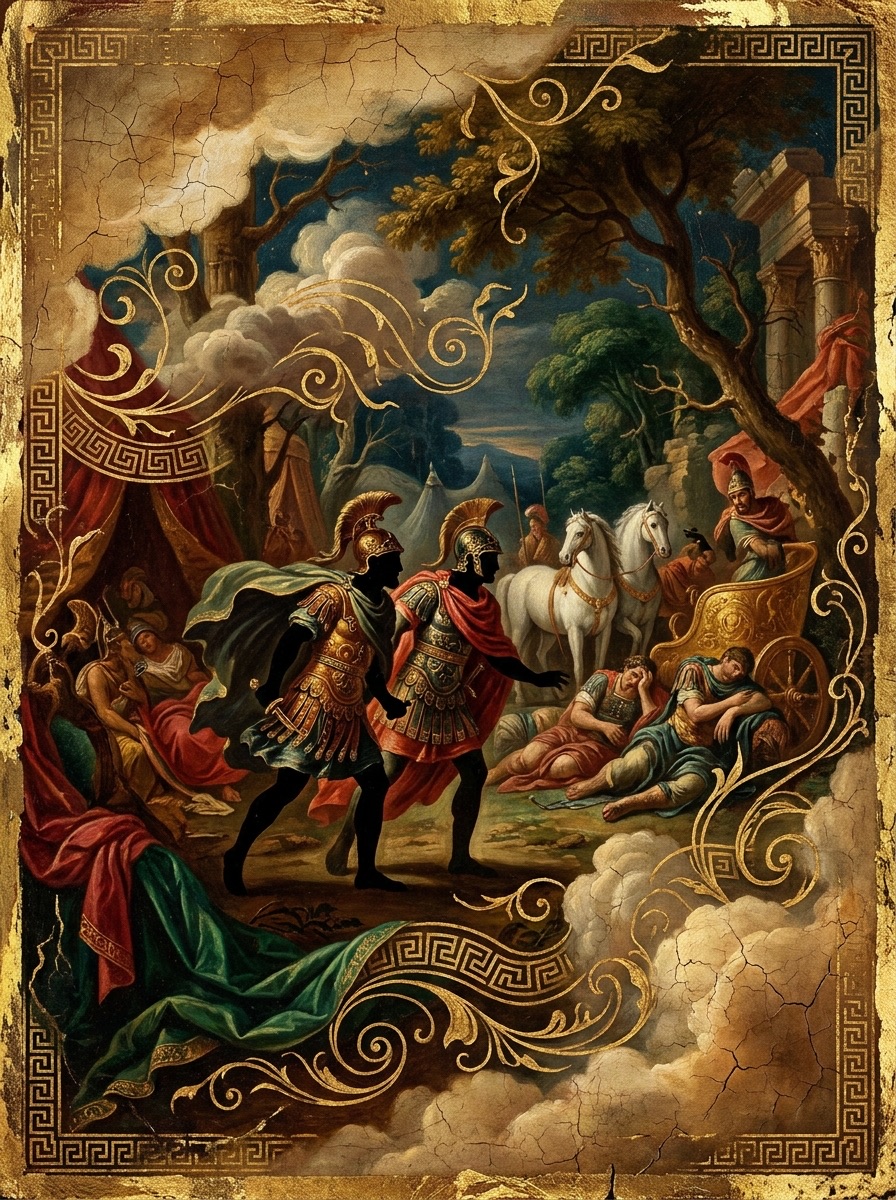
On a deep night beside Troy, both the Achaeans and the Trojans sent out spies. Dolon, tempted by the horses of Achilles, fell into the hands of Odysseus and Diomedes; following what he confessed, they slipped into the Thracian camp, killed Rhesus, and carried off his white horses.
Article
Summary
After forcing the Greeks back toward the ships during the day, the Trojans do not return to the city. They camp on the plain with fires burning, ready to attack again at dawn. In the Greek camp, Agamemnon fears the ships will be burned and summons Menelaus, Nestor, Odysseus, Diomedes, and the other leaders to council. Nestor advises sending a spy into the enemy camp, and Diomedes volunteers, choosing the cunning Odysseus to go with him. That same night, Hector also wants to know whether the Greeks plan to hold the ships or flee under cover of darkness. He offers a reward to any Trojan willing to scout the Greek camp. Dolon, wealthy and greedy, steps forward and asks Hector to swear that he will give him Achilles' horses and chariot. Hector needs information badly enough to accept. Dolon puts on a wolfskin and leather cap, takes his bow and javelin, and runs crouching toward the ships. Odysseus and Diomedes hear Dolon's steps in the dark. They let him pass, then chase him from behind until Diomedes' spear forces him to stop. Dolon begs for his life and promises ransom from his house. Odysseus questions him closely, and Dolon reveals Hector's reward, the arrangement of the Trojan allies, and the arrival of the Thracian king Rhesus with his bright white horses. Though Dolon hopes his answers will save him, Diomedes does not let him go. He kills Dolon and hangs the wolfskin, cap, bow, and spear by the roadside as a marker for their return. Then the two heroes follow Dolon's information into the Thracian camp. Rhesus and his men are asleep, the white horses tied beside the chariot; Diomedes strikes through the sleepers while Odysseus drags bodies aside and loosens the reins. At Athena's warning, Diomedes does not linger for more glory. He and Odysseus lead away Rhesus' white horses, recover Dolon's gear from the roadside marker, and return to the Greek ships before the enemy camp fully wakes. The Greeks gain intelligence, horses, and a sharp night victory; the Trojans lose their spy, and the newly arrived Thracians lose their king before they can win honor in daylight battle.
A Sleepless Night beside the Ships
That day, the Trojans had pressed the Achaeans hard.
The fighting had lasted until the sun went down. The Achaeans had fallen back to their ships and now guarded themselves behind the ditch and wooden palisade. Far out on the plain, the Trojans did not return to the city as they usually did. They made camp in the open, kindling fire after fire. The flames shone on the manes of horses and on the spears in soldiers’ hands. Some men roasted meat, some kept watch, and some dozed against their shields, waiting for morning, when they would drive the attack down toward the ships by the sea.
In the Achaean camp, no one found much rest.
Agamemnon could not remain lying down. He wrapped himself in a lion skin, took up his spear, and stepped out of his hut. The sea wind moved past the sterns of the ships. In the darkness he could hear only the wash of the waves and, far away, the voices from the enemy camp. He feared that the Trojans would burn the ships the next day; he feared that ten years of war would end in flight.
Before long, Menelaus, Nestor, Odysseus, Diomedes, and the other leaders were summoned. Old Nestor urged them not to sit helplessly in worry. Better, he said, to send someone near the Trojan camp to discover their plans. Had they resolved to stay out on the plain? Were they discussing a night attack? How would they advance at dawn?
It was no easy task. Night can hide a man, but it can also swallow him. If an enemy watchman discovered him, he might have no time even to cry out.
Diomedes was the first to rise. He said he was willing to go, provided someone went with him. The men looked toward several of the champions, and in the end Diomedes chose Odysseus, for Odysseus had a subtle mind, steady feet, and did not lose his nerve when danger came close. The two armed themselves for the venture. Meriones gave Odysseus a bow and quiver, and also a leather cap; Diomedes took his sword and settled his armor. Athena, too, favored them from the shadows, making their hearts firmer and their eyes keener.
They left the camp by the ships, passed among the bodies and scattered weapons, and moved across the battlefield toward the Trojans.
Hector’s Reward
Under that same darkness, Hector also remained awake.
He stood in the Trojan camp and looked toward the black mass of the Achaean ships in the distance. He did not know whether the Achaeans meant to defend them to the death, or whether they were already planning to drag them down into the water by night and flee. If he could learn this, the next day’s battle would be far more certain.
So he gathered the leaders of the Trojans and their allies and said, “Who will dare go to the Achaean ships and find out what they intend? If he returns and tells me whether they are keeping guard beside the ships or preparing to escape, I will give him a reward that others will envy.”
The men were silent. An enemy camp at night was more frightening than spears in daylight.
Then Dolon stepped forward.
Dolon was the son of Eumedes. His household was rich, with plenty of gold and bronze, though he himself was not handsome; he was, however, very swift of foot. He looked at Hector and asked for no ordinary prize. “If I go to learn their plans,” he said, “you must swear to give me Achilles’ horses and chariot.”
The horses of Achilles were famed through the army. They ran like the wind and were no common mortal team. Hector may well have known that Dolon’s desire was too great, but he needed information urgently. He raised his hand and swore that, if Dolon succeeded, the horses and chariot would be his.
Once he had the oath, Dolon made himself ready. He slung a curved bow over his shoulder, wrapped himself in a gray wolfskin, set on his head a cap made from weasel hide, and took a javelin in his hand. Bent low as he ran through the night, he looked from far off like a wild beast slipping close to the ground.
He left the Trojan fires and ran toward the Achaean ships. The glow behind him grew fainter and fainter, until there was nothing before him but darkness.
Footsteps in the Dark
Odysseus heard the sound first.
He and Diomedes were crouched at the edge of the battlefield when they suddenly heard someone coming quickly ahead of them: feet striking broken earth, hide and leather softly rustling. Odysseus whispered to Diomedes that someone was coming from the Trojan side—perhaps a spy, perhaps a man hoping to strip armor from the dead. They should not spring at him at once, he said. Better to let him pass, then cut him off from behind, so he could not flee back to the camp.
The two men sank lower, like black stones lying on the ground.
Dolon did not see them. His mind was fixed on Hector’s oath, on Achilles’ horses, on the glory he would win before all the men when he returned with news. He passed them and kept running toward the Achaean ships.
When he had gone some distance, Odysseus and Diomedes rose suddenly and ran after him.
Dolon heard footsteps break out behind him. He looked back, and terror nearly tore the spirit from him. At first he thought Hector had sent men to call him back, but soon he saw they were no friends. Two Achaean warriors were closing on him in the dark, their weapons glinting coldly.
Dolon turned and fled. He was indeed swift, running as desperately as a hare with hounds behind it, but Diomedes was swifter. As he ran, he lifted his spear. When Dolon was nearly close enough for the Trojan sentries to hear him, Diomedes shouted and hurled. The spearpoint did not pierce Dolon; it flew over his shoulder and stuck in the earth ahead of him.
Dolon stopped at once.
His teeth chattered with fear, his knees weakened, and he lifted both hands. In a trembling voice he begged for mercy. “Take me alive! There are goods in my house—bronze, gold, iron. If you spare me, my father will pay a rich ransom.”
Odysseus stepped forward, calm and unhurried. “Do not think of death yet,” he said. “Tell us why Hector sent you out. Where were you going? How are the Trojans keeping watch? Are they preparing to go back to the city, or will they stay here and attack our ships?”
Fear had broken Dolon. He dared hide nothing. He told them of Hector’s reward and confessed that he had accepted the task because he coveted Achilles’ horses. At that, Odysseus smiled with a touch of coldness and said those were not horses easily won—not even by many great warriors.
Then Dolon told them how the Trojans were arranged: where the Trojans themselves lay, where the allies were, who kept watch, and who slept carelessly. He also said that a new force had just arrived at the edge of the plain: the Thracians, led by their king, Rhesus.
When he spoke of Rhesus, Dolon gave even more detail. The man’s horses, he said, were astonishingly beautiful, white as snow and swift as the wind. His chariot was adorned with gold and silver, and his arms were splendid. Because the Thracians had only just arrived, they had not yet grown used to the battlefield. They were sleeping on the outer edge of the camp, not far from the others, but not as wary as seasoned soldiers.
With those words, Dolon had shown the two Achaean heroes the road.
The Wolfskin by the Road
When Dolon had finished speaking, he still begged them to let him return, or else take him to the ships and hold him for ransom.
But Diomedes would not agree.
“You have told us useful things,” he said, “but you cannot go back to Hector. If we let you live, another day you will come spying on our ships again, or stand against us in battle.”
Hearing this, Dolon reached out to touch Diomedes’ chin, pleading in the ancient way of suppliants. But Diomedes had already lifted his sword, and with it he took Dolon’s life.
Odysseus stripped the dead man of his gear: the wolfskin, the weasel-skin cap, the bow, and the spear. He raised these spoils and prayed to Athena, asking the goddess to keep guiding them. Then the two dragged Dolon’s body aside and hung his equipment on a tamarisk branch as a marker, so they would not lose their way when they returned.
The night was still deep. The Trojan fires trembled in the distance, and the Thracian camp lay in the direction Dolon had pointed out.
Odysseus and Diomedes did not go back to the ships. Bent low, they continued through the darkness.
The White Horses of Rhesus
The Thracians were sleeping heavily.
They had come from far away and had not yet taken part in the day’s great battle. Their horses were tied beside the chariots, while the men lay sprawled about with shields near their sides and spears planted in the ground. Rhesus slept among them, his splendid armor lying close by. Even in the night his chariot looked unlike the others, its gold and silver ornaments faintly shining. Most striking of all were the white horses. Their coats were clean and pale, as though moonlight had settled over them.
When Diomedes saw the camp unguarded, he drew his sword and rushed among the sleeping men.
Like a lion breaking into a sheepfold, he struck down the Thracians one after another. They had no time to lift their shields. Some had only just startled awake; some were still trapped in dreams when they fell into blood. Odysseus followed behind, dragging the bodies aside to clear a path for the horses. He did not shout wildly or linger; he did only what had to be done.
Diomedes came to Rhesus himself. The Thracian king had not fully awakened from sleep before the sword took his life. Some say that in that moment Athena urged Diomedes to act quickly, for if Rhesus and his divine horses had drunk the water of the Scamander and eaten the grass of the Trojan plain, the Achaeans would have found victory harder still. However it was, Rhesus never truly won his glory on the battlefield of Troy.
Odysseus untied the white horses. He had no whip, so he guided them lightly with the back of his bow. The horses were frightened, but well trained, and they followed him out. Diomedes wanted to kill still more of the enemy, but Athena warned him not to be greedy for glory. The night was passing, and the enemy camp might wake at any moment.
The two men led the horses back along the way they had come.
By the roadside they found the wolfskin and cap hanging where they had left them, and so knew they had returned to the place where Dolon died. Odysseus took down the spoils, and Diomedes drove the white horses on more quickly. Behind them, the Thracian camp at last stirred in confusion, and the Trojans heard the cries; but the two Achaean warriors had already crossed through the darkness and were hurrying toward the ships.
Back beside the Ships
In the Achaean camp, the watchmen heard hoofbeats from far off and were startled at first. But when they saw that the riders were Odysseus and Diomedes, the men gathered around them.
They had brought back more than ordinary news. They had brought blood from the enemy camp, and horses. The white horses were led down beside the ships, still carrying the scent of a strange camp. Dolon’s wolfskin, cap, bow, and spear were laid out as proof of the night’s venture.
Nestor and the others asked what had happened. Odysseus told how Dolon had been captured and how he had revealed the camp of Rhesus; Diomedes handed the horses over to his companions to be tended. Then the two men washed the sweat and blood from their bodies and gave thanks to Athena.
Across the plain, meanwhile, the Trojans had lost a spy; and the newly arrived Thracians, before they had ever raised their spears in daylight battle, had lost their king and their finest horses.
That night did not decide the whole war, but it gave the Achaeans a breath of relief in their hardest hour. When dawn came again, wheels, shields, and spears would still clash on the Trojan plain. But Dolon would never return to stand before Hector and claim his reward, and the white horses of Rhesus were already standing beside the Achaean ships.