Greek Mythology
The Division of the World and the Order of Olympus — Greek Mythology
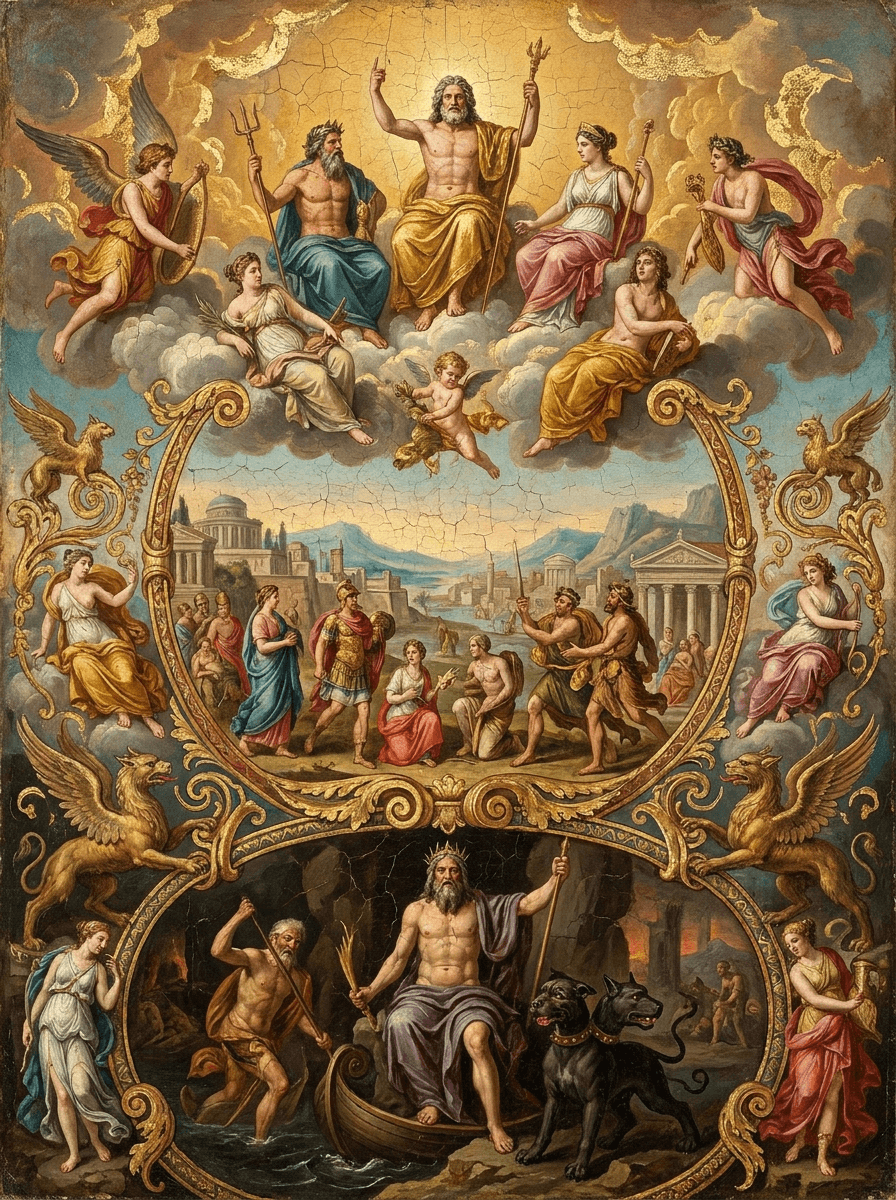
After the Titan War ended, Zeus and his brothers divided the powers of the world among themselves: Zeus received the sky, Poseidon the sea, and Hades the realm below. The new king of the gods then settled the immortals upon Mount Olympus, so that the old chaos of struggle gave way, for a time, to a new order in which each god had a place and the world had new masters.
Article
Summary
When the Titans had been defeated, heaven and earth were not yet truly at peace. Cronus had lost his throne, but someone still had to rule the sky, the sea, and the dark places beneath the ground. In the world left behind by victory, Zeus, Poseidon, and Hades chose to divide their domains by lot.
The War Was Over, but the World Was Not Yet Still
At last, the Titan War came to an end.
It had raged for a long time. Mountains trembled under the crash of thunder; storms heaved the sea into towering swells; even the depths below the earth seemed to shake as if stirred by some enormous hand. Cronus and the Titans had once stood high above all others, pressing the younger gods beneath their rule. But after Zeus grew to strength in Crete, he freed the brothers and sisters his father had swallowed, released the Cyclopes and the Hundred-Handed Ones from their prison, and in the end overthrew the old king.
The defeated Titans were driven down into darkness. Tartarus lay far beneath the earth, as distant as a night no traveler could ever cross. There were heavy gates there, and walls of bronze, and the Hundred-Handed Ones stood guard. Cronus and his kin were shut within, unable any longer to reach up and seize the sky as they once had done.
Yet the fall of the old king did not make everything calm at once.
The world still lay open before the victors. Overhead stretched the wide sky, where clouds rolled and lightning hid behind their folds. Far away spread the endless sea, its waves striking the rocks, its white foam torn like fleece. Beneath their feet lay the earth, home to gods, mortals, beasts, and forests. Below the earth waited the cold dark, the place where the shades of the dead would one day go.
Such places could not remain without rulers. Nor could the victorious gods live forever by battle. And so Zeus and his two brothers, Poseidon and Hades, stood before the newly won world.
The Three Brothers Cast Lots
Zeus was not the eldest, but he was the one who had brought Cronus down. In his hand he held the thunderbolt—not ordinary fire, nor the coal of a mortal hearth, but the divine weapon the Cyclopes had forged for him. When he hurled it, white light split the sky and mountain peaks were shattered.
Poseidon stood beside him. His nature was fierce, like the sea he would later rule: quiet and unfathomable in calm, but in anger able to overturn ships. In his hand would be the trident; when its points struck, rock would crack open and the waters would surge.
Hades was there as well. He did not shine like Zeus, nor did he reveal his anger in storm and spray like Poseidon. He was silent, shadowed in face, as though listening to a voice rising from the deep earth. Roads below the ground, gates of the dead, palaces untouched by sunlight—all these waited for a master.
The three brothers did not tear at one another as the Titans had done. They chose instead to cast lots.
The lots were drawn, and with them destiny fell into place. Zeus received the sky. Clouds, thunder, rain, and the high places where eagles fly came under his power. From then on he sat above the clouds and gave commands, and the thunderbolt became the voice in his hand.
Poseidon received the sea. The broad waters, the hidden currents below, the sea floor where monsters moved, and the waves over which sailors prayed for fair winds all belonged to him. When he was gentle, the sea might gleam like polished bronze. When he was enraged, black waves would rise one upon another, masts would snap, and hulls would groan.
Hades received the underworld. It was no ordinary cave, no valley merely darkened by night, but the place to which the dead must finally go. Few living people could ever look upon it, and the sun did not shine there. Hades became king of the shadowed realm, keeping watch over the shades of the dead, the wealth beneath the earth, and the road from which no one easily turned back.
Sky, sea, and underworld each had their lord. The earth still stretched beneath the feet of gods and all living things. Mortals would plow, sacrifice, fight, and grow old there; the gods, too, would appear there, fall in love, grow angry, punish, and reveal their power. But the highest judgment gradually came to rest in the hands of Zeus.
The New King on Mount Olympus
After Zeus received the sky, the gods needed a place where they could gather.
They chose Mount Olympus. The mountain rose so high it seemed to hold up the roof of heaven. Clouds wound around its slopes, and clear light often shone upon its summit. Mortal feet could scarcely reach it. Wind and snow howled below, while above there seemed to be another, brighter dwelling place. There the gods built their halls, gold shining on the pillars, cloud drifting to and fro beside the steps.
Zeus took the high seat not only because the lot had given him the sky, but because in wartime he had led the younger gods against Cronus. After the war, the immortals acknowledged his rank and made him king of the gods.
But a king of gods does not hold every power in his own fist.
Zeus began to assign to each deity a proper honor. Who would rule what, who would receive which offerings, and in what matters mortals would call upon each god—all this had to be set in order. The gods were not passionless shadows. They quarreled, grew angry, remembered insults, and could bring disaster when their honors were slighted. If Zeus wanted the new world to stand firm, he could not govern by terrifying them with thunder alone. Each immortal had to know his or her place among the gods.
Hera became his queen and sat in honor upon Olympus. She guarded marriage and cared deeply for her dignity. Her eyes often watched the movements of Zeus, and when she was offended, her anger could pursue its target down into the mortal world.
Demeter cared for earth and grain. When she passed through the fields, the ears of wheat grew full; when she grieved, the earth turned cold, and seeds drew back into the soil and would not sprout. If mortals wanted harvests, they could not forget the rites owed to her.
Hestia kept the fire of the household. She did not roam and contend like many of the gods, yet she had her place beside every home and every altar. As long as the fire did not go out, the household endured; when sacrificial flame rose, the gods could hear mortal prayers.
The younger gods, too, came one by one into the light of Olympus. Athena received from Zeus wisdom and the calm of the battle line; she did not merely wield the spear, but taught mortals how to defend their cities with craft and counsel. Apollo brought the bow, the lyre, and divine prophecy; his arrows could bring disease, yet he could also drive away pollution. Artemis moved through the mountains and forests, protecting wild creatures and young girls, and under the moon one might hear the footfalls of her hunting dogs. Ares loved the shouting of the battlefield. Hephaestus hammered metal beside the furnace. Aphrodite drew both gods and mortals under the power of desire.
Each of these gods had a temper, an emblem in the hand, favored offerings, and beloved places. Olympus was not a silent, empty palace. It was a radiant and dangerous dwelling of immortals.
The Measure Beneath the Thunder
Zeus sat on high, holding the thunderbolt. He could summon black clouds and send rain down upon the fields. He sent messengers to carry his commands into distant places. He watched over mortal oaths and punished those who broke them. If anyone crossed the proper boundary, thinking himself equal to the gods, thunder might soon sound overhead.
Yet even Zeus’s power had limits.
Poseidon did not forget that he ruled the sea simply because Zeus was king. When ships passed over the crests of waves, sailors prayed to him. Cities that lived by the coast feared his trident. If he grew angry, the earth itself could shake, springs could burst forth, and horses could rear and cry out.
Hades came even less often to the feasts of Olympus. He lived in his palace beneath the earth, where dim rivers flowed, where a dreadful hound guarded the gate, and where the dead could not lightly return along the road they had taken. People disliked speaking his name, but they knew that no one could escape his kingdom. Kings, shepherds, warriors, women at the loom—when life ended, all had to go down to him.
So the new arrangement did not hand the whole world to one god. It divided the vast universe into separate realms. The sky had its king, the sea its master, and the underworld its keeper. The gods of Olympus acknowledged Zeus as the highest ruler, but each great deity retained a proper share of honor.
From then on, mortals living upon the earth thought of Zeus when they looked upward, of Poseidon when they sailed, and of Hades when they buried their dead. Demeter was in the fields, Hestia by the hearth, Athena on the city walls, Artemis in the woodland hills. The gods no longer struggled for everything in the confusion that had reigned before the war. Each showed power in a proper place.
When the Gods Had Taken Their Seats
On Mount Olympus, the feasts began.
The gods drank immortal nectar, while music rang through the halls. Clouds moved along the mountain’s flanks, and the light at the summit fell upon their seats. Zeus sat highest, his thunderbolt beside him. Hera sat at his side, stately and grave. The other gods took their places according to rank and honor.
This did not mean there would never again be quarrels. The gods had loves and hatreds, jealousies and rages; they would contend with one another over mortal cities and heroes. But the days when Cronus devoured his children, and when the Titans pressed the new gods down beneath them, were over. The old king was imprisoned in the deep. The new king sat among the clouds. Sky, sea, and underworld each had a ruler.
The world had taken on a new shape.
When thunder sounded, people knew that Zeus was raging or commanding in heaven. When the sea suddenly darkened, they knew Poseidon’s mood was not to be treated lightly. When the grave earth closed, they knew the dead had begun the road of Hades. The Olympian gods kept their appointed honors, and each received the gifts of mortals.
After the three brothers divided the world, the age of the gods truly settled into place. High above stood Olympus; above the clouds was the throne of Zeus. And on the earth below, the smoke of sacrifice rose slowly from the altars, drifting toward the immortals who had taken their seats.