Greek Mythology
Dionysus and Pallene — Greek Mythology
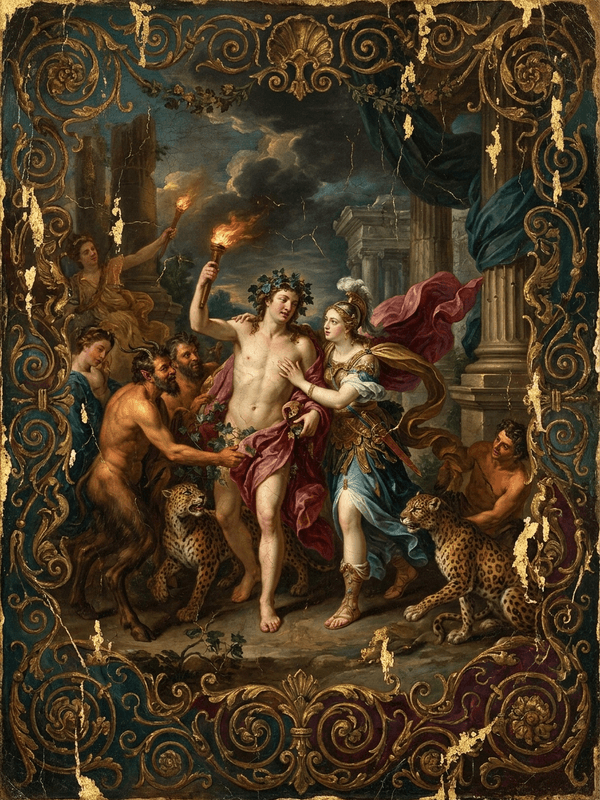
Dionysus came to Pallene in the Thracian lands and found there the savage king Sithon and his daughter Pallene. The king offered his daughter as a prize and forced every suitor to wrestle him. At last Dionysus himself entered the contest, overthrew Sithon, and left Pallene’s name upon the land.
Article
Summary
Beside the Thracian sea, King Sithon made a cruel rule around his daughter Pallene's marriage: any man who wished to wed her had to defeat him in single combat, and whoever failed would lose his life as well as the bride. Many young men came because of Pallene's beauty, only to be thrown down by Sithon, until the palace gates and bloodstained steps were heavy with fear. Dionysus came to the land with his followers and heard how Sithon had turned his daughter into a prize and killed suitors by his own law. He did not send his frenzied women or wild beasts against the palace. Instead, like a guest from far away, he asked to be announced, entered Sithon's hall, and accepted the king's challenge. Pallene stood nearby, frightened after seeing too many men go to the same death, yet faintly hoping this stranger might be different. When the wrestling began, Sithon rushed Dionysus like a beast, trying to crush him as he had crushed the others. Dionysus first slipped aside and let the king think he was nearly winning. Then, when Sithon had spent his strength, the god put forth his own power, hurled the cruel king into the dust, and told him that the rule by which he had killed so many men had now returned upon himself. After Sithon fell, fear began to lift from the palace. Dionysus poured wine for the dead, had the grim trophies removed from the gates, and let the bloodstained steps be washed clean. Pallene later became beloved by Dionysus, and songs, vines, feasting, and dance returned to the seashore. People remembered the day she walked out of that palace, and the land became joined to her name: Pallene.
The Palace by the Sea
On the seaward edge of Thrace, where the mountain wind came down through the woods carrying the scent of pine resin and salt, there was a stretch of land that later generations would call Pallene. In those early days it was simply the realm of King Sithon.
Sithon lived in a palace near the shore. He was no gentle ruler. Trophies of combat often hung outside his gates, and the stone steps bore dark stains of blood, dried and wetted and dried again. Travelers who saw those marks lowered their voices and hurried on, for they knew that many young men had come there filled with hope and had never returned.
All this was because Sithon had a daughter, and her name was Pallene.
Pallene grew up between the sea wind and the shadow of the hills. Her hair was dark as a vine heavy with grapes, and when she passed between the columns of the palace, the hem of her robe brushed softly over the white stone floor. Princes and warriors heard of her beauty and came with chariots, gold, and attendants to ask Sithon for her hand. But Sithon was proud and cruel. He would not settle his daughter’s marriage with ordinary gifts. Instead he set down a dreadful condition: any man who wanted Pallene must first wrestle him. If the suitor won, he might take the bride away; if he lost, he would leave his life behind.
At first the young men thought Sithon was only trying to frighten cowards away. But when the first suitor fell in the dust, and the second was dragged from the ring, and the third man’s shield was hung beside the palace gate, everyone understood that this was no jest.
From behind a high railing Pallene watched the young men enter the arena one after another, and one after another be carried out. She could not speak for them. Sithon’s eyes were as cold as stone, and whenever anyone mentioned marriage, he ordered his servants to bring straps, oil, and the gear of the wrestling ground, welcoming death as if he were preparing for a feast.
The Stranger Crowned with Ivy
In time Dionysus came to that land.
By then he was no longer the child hidden in a cave, nor the boy who had only learned to flee Hera’s anger. He traveled with his followers through many countries, teaching people to plant vines and press wine from the grapes, and teaching the arrogant that gods were not to be slighted. From a distance his company did not look like an ordinary army. Some carried wands wrapped in ivy; some beat bronze drums and little cymbals. The god’s mountain women wore skins, their hair loose upon their shoulders, and panthers and lynxes moved slowly beside the procession, as though drawn onward by song.
They reached the borders of Sithon’s kingdom, and the sound of drums echoed through the valleys. The local people peered from behind their doors and dared not speak loudly. When Dionysus asked why the place was so silent, someone told him, “In the palace lives King Sithon. He has a daughter named Pallene, beautiful as spring; but every man who tries to marry her dies by the king’s hand. Sithon says that only the man who can defeat him in wrestling is worthy to become his son-in-law.”
Dionysus did not flare into anger at once. He lifted his eyes toward the palace and saw banners snapping in the wind above the walls, and broken shields hanging by the gate like a row of silent warnings. He smiled, and the leaves of his ivy crown trembled faintly in the sun.
“If he has made his daughter a prize,” Dionysus said, “then let me go and see this contest.”
His followers cried out, and the cymbals rang. But Dionysus raised his hand and quieted them. He did not send the frenzied women rushing through the palace gates, nor did he order the beasts to leap upon the guards. Like a guest newly arrived from a distant land, he climbed the stone steps with only a few companions and asked to be announced.
When Sithon heard that a stranger crowned with ivy had come, he laughed scornfully. He thought this was only another young man lured by Pallene’s beauty. Yet when Dionysus entered the hall, Sithon saw the flush of wine upon his face, and eyes bright as fire; he smelled upon him the mingled fragrance of grape juice, wild woods, and sacred incense, and for a moment something stirred in his heart.
But Sithon never yielded before others. Seated high on his throne, he asked, “Stranger, what do you want here?”
Dionysus looked toward the far end of the hall. Pallene stood there with one hand on a pillar, her face pale. She had heard too many exchanges like this, and had seen too many endings.
“I have heard,” said Dionysus, “that a king here gives his daughter to the man who can defeat him. I have come to accept your terms.”
Sithon burst into laughter so loud that dust shook down from the beams. He ordered the ground to be prepared, the oil brought out, and everyone in the palace summoned to watch. He meant to make this stranger fall before Pallene’s eyes, just as the others had fallen.
Pallene’s Fear
Before the contest began, servants rubbed oil over Sithon’s arms, shoulders, and back. He was no longer young, but he was still powerful; his chest was like a rugged tree trunk, and when his fingers closed, they could leave deep marks in a leather strap. With those hands he had thrown suitor after suitor to the ground, until killing had become a habit.
Pallene sat nearby in fear. She looked at Dionysus and saw that he was not like the princes who had come in armor. He did not hurry to display his strength, nor boast before the crowd. He simply gathered up his robe, letting the ivy leaves fall over his shoulder. One of his attendants handed him a cup; he drank a mouthful of wine, then poured the rest upon the earth, as though making an offering to the ground and to the gods.
Pallene did not know who he was. Yet when she saw this stranger standing calmly on the bloodstained ground, a small hope rose in her heart—light as the first glimmer upon the sea, and just as easily scattered by the wind.
Sithon stepped into the center of the ring and reached out his hands toward Dionysus. The wrestling began.
At first Sithon charged like a wild beast. He meant to lock both arms around Dionysus’ waist, lift him, and dash him to the ground. Many young men had died that way, their backs striking the hard earth, the breath breaking in their chests. But Dionysus turned aside, moving like a vine that slips around a tree trunk, and lightly escaped the king’s strength.
Sithon rushed a second time, stamping dust from the ground. He caught Dionysus by the wrist and pressed down with all his force. Dionysus did not answer at once. He let Sithon think he was beginning to gain the better of him. The king clenched his teeth, sweat running to the corners of his eyes. The onlookers held their breath, and Pallene’s fingers tightened on the edge of her robe.
Then, just as Sithon believed he was about to force his opponent down, Dionysus put forth his strength. His arm was no longer like a pliant vine, but like iron hidden beneath the vine. Sithon felt the ground vanish beneath him; his body was twisted sideways, and he crashed heavily to his knees.
A low cry rose from the crowd.
Shamed and furious, Sithon sprang up and lunged again. But Dionysus’ gaze had changed. It was not the look of an ordinary young man, but the coldness of a god who has watched cruelty too long. Drums sounded outside the ring, and ivy-wrapped wands struck the earth like thunder in the hills. Sithon swung his fist; Dionysus stepped aside, seized his arm, drew him close, and with one blow of his shoulder hurled the savage king into the dust.
Sithon struggled to rise. Dionysus stepped forward and held him down, so that he could move no more.
“Enough,” Dionysus said. “With this rule you have killed many men. Now your own rule has returned upon you.”
Sithon’s face lay against the dust, and at last he had no words left. The king who had made suitors fall one after another was defeated in the very ground he had chosen.
The Land Receives Its Name
After Sithon fell, the palace was so still that the sea wind could be heard. The servants who had once dragged away the dead did not dare come forward, and the guards lowered their spears. Pallene rose and slowly walked to the edge of the ring. She saw dust settling at Dionysus’ feet, and she saw that Sithon could no longer command with those cold eyes.
Dionysus turned to her. Behind him his followers had already begun to sing, and the drums no longer sounded as sharp as they had before the fight; now they were like the joyful noise of grape harvest on a hillside. Someone brought wine. Someone hung ivy from the doorposts. The grim trophies before the palace gate were taken down, and water was poured over the bloodstained steps.
Pallene did not smile at once. First she looked at the empty spaces on the walls, as though bidding farewell to the dead. Those young men had come because of her and had died by her father’s hand. Though she had held no blade, her heart carried a heavy shadow. Dionysus did not hurry her. He only had wine poured upon the ground, an offering to the spirits below.
Afterward Pallene became a woman beloved by Dionysus. His company stayed for a time in that land; songs sounded among the hills, and people began to dress their eaves with grapevines. The fear that had once hung over the palace gradually lifted, and feasting and dancing returned to the seashore.
People remembered Sithon’s cruelty, and they remembered the day Pallene walked out of that palace. So the land became joined to her name, and was called Pallene.
From then on, when travelers passed through that country and heard the songs of the grape harvest, they thought of the god crowned with ivy: he brought not only drunkenness and festivity, but could also enter a field where the blood had not yet dried and make the proud and brutal fall by the rule they had made themselves.