Greek Mythology
Diomedes' Aristeia — Greek Mythology
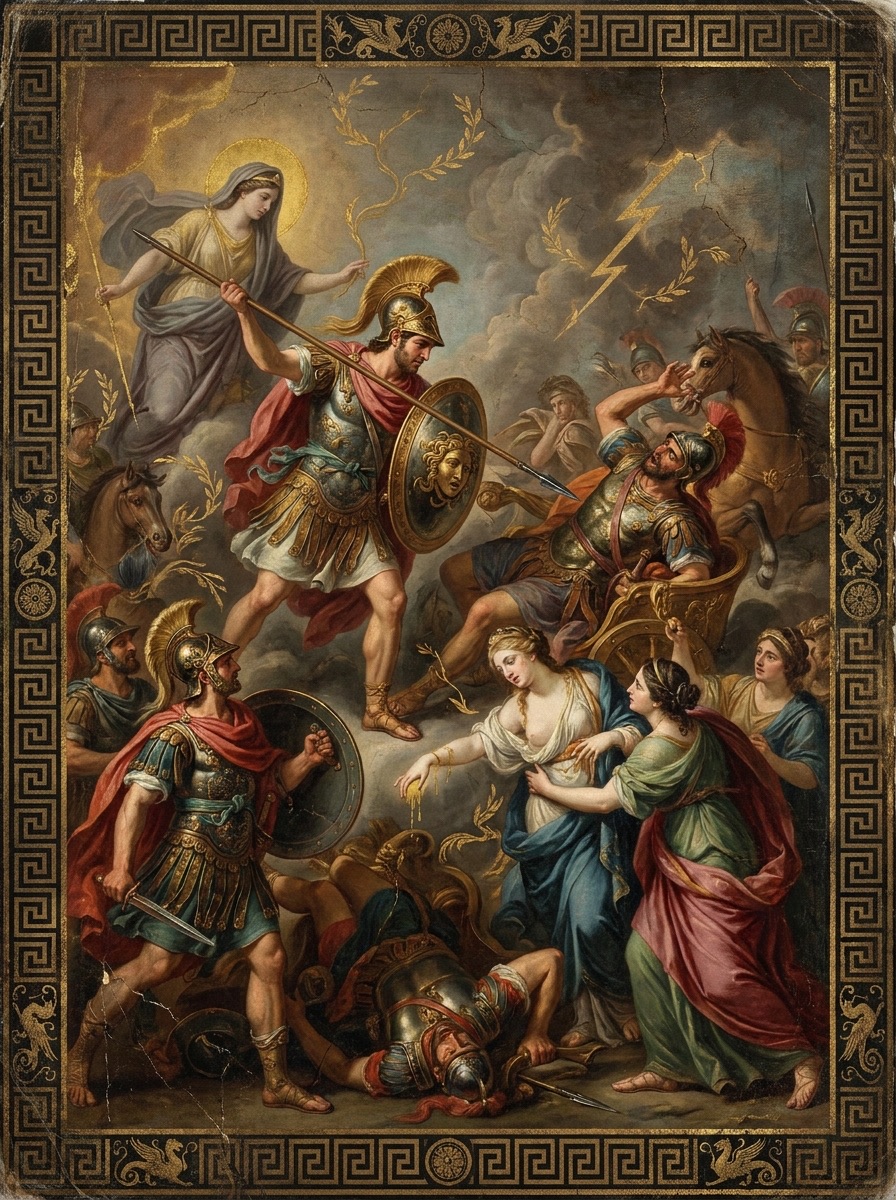
With Athena's help on the Trojan battlefield, Diomedes drives into the enemy lines like a blaze of fire, wounding even the goddess Aphrodite and Ares, the god of war. Yet Apollo stops him and teaches him that a boundary still stands between mortals and the gods.
Article
Summary
When the Trojan War had grown fierce, Greeks and Trojans clashed across the plain before the city. Diomedes, the young king of Argos, was already a formidable warrior, but on this day Athena poured greater strength into him, until his helmet and shield seemed to flicker with fire. He plunged into the enemy ranks and drove the Trojans back in confusion. The archer Pandarus, hidden behind the press of men, struck Diomedes in the shoulder and thought he had at last checked him. But Diomedes pulled out the arrow and prayed to Athena to let him find the man who had shot him. Athena came to his side, healed his wound, and lifted the mist from his eyes, so that he could tell mortals from gods on the battlefield. She warned him not to attack the immortals recklessly, with one exception: Aphrodite. Later Pandarus climbed into Aeneas' chariot, and the two charged Diomedes together. Diomedes killed Pandarus face to face, then hurled a great stone that wounded Aeneas. Aphrodite hurried in to carry off her son, but Diomedes pursued her and pierced her wrist, forcing her to drop Aeneas and flee. Apollo then protected Aeneas and drove Diomedes back again and again. The battle did not end there. Ares himself fought for the Trojans, and for a time the Greeks were hard pressed. Athena mounted Diomedes' chariot and guided him against the war god, helping his spear strike Ares. With a roar of pain, Ares left the field and flew back to Olympus. Diomedes' fame spread through both armies, yet before Apollo he had learned one thing: a hero may come close to the shadow of divinity, but he cannot truly cross the boundary that belongs to the gods.
Fire on the Shield
On the plain outside Troy, dust had been churned gray by chariot wheels and horses' hooves. Far off by the shore stood the ships of the Greeks; at the other end rose the high walls of Troy. Between them the two armies were locked together. Spears struck shields, bronze armor rang against bronze armor, and wounded men fell to the ground, sometimes before they could cry out, only to be swept under the next rushing chariot.
That day the brightest figure in the Greek army was not Agamemnon, nor Achilles. Achilles still sat in his camp and refused to fight, and many Greek hearts were heavy. But amid the disorder, Diomedes stepped forward.
He was the son of Tydeus and king of Argos, not the oldest of the warriors, but fierce with a stubborn courage that would not give way. Athena saw him moving along the front and poured bravery into his breast. She made his helmet and shield flare as though fire had risen from them. From a distance he looked like the brightest star of an autumn night, newly risen from the sea, its light sharp enough to sting the eyes.
Diomedes gripped his spear and rushed among the Trojans. Whoever stood before him felt his attack. One Trojan had just leaned out from his chariot to cast a spear when Diomedes' weapon pierced his breastplate; another tried to seize the reins and flee, but Diomedes overtook him and struck him down. A tremor ran through the Trojan ranks. Like sheep suddenly catching the scent of a wolf, they began to lose their order.
Pandarus' Arrow
Behind the crowd of warriors, the archer Pandarus saw Diomedes.
Pandarus had already wounded Menelaus during the truce, causing Greeks and Trojans to take up the war again. His aim was sure, and he trusted his bow to change the course of battle from afar. Now he hid behind shields and chariots, bent his bow, set an arrow to the string, and took aim at the burning shape that drove ahead of all the rest.
The bowstring snapped. The arrow flew over the crowd and struck Diomedes near the right shoulder, passing through the plates of his armor. Blood flowed at once. Pandarus shouted aloud, sure he had hit the most dangerous of his enemies and that he would soon see him fall.
Diomedes withdrew beside his chariot. His charioteer, Sthenelus, saw the shaft still lodged in him, sprang down, and pulled it out. Blood welled from the wound and reddened the strap across his shoulder.
But Diomedes did not fall. He lifted his head and prayed to Athena: "Goddess, if ever you helped my father, help me now. Let me find the man who shot me, so that he may not boast any longer on the battlefield."
Athena heard him. She came to Diomedes' side like a wind close against his ear. She stilled the pain of his wound and brushed away the mist that lay before his eyes. Then Diomedes could see more clearly than other men: who on the field were merely mortals in armor, and who were gods moving among the fighting.
The goddess warned him: "You may fight bravely, but do not raise your hand at random against the deathless gods. One alone is excepted. If Aphrodite comes into battle, you may wound her. She was not born for spear and sword."
When Diomedes had heard her, he climbed back into his chariot. His gaze had changed; it was like a spear point newly whetted. He paid no heed to the blood on his shoulder, urged on the horses, and charged the Trojans once more.
Two Enemies in One Chariot
When Pandarus saw that Diomedes had not fallen, but fought all the more fiercely, unease entered his heart. Just then Aeneas came up.
Aeneas was the son of Anchises and Aphrodite, a man of high honor among the Trojans. He drove fine horses and urged Pandarus to mount his chariot, so that together they might stop Diomedes. Pandarus had a powerful bow, but no chariot of his own, and in the confusion of battle he could not move easily in and out of danger. Aeneas had horses and a car, and could carry him close to the enemy.
Pandarus leapt aboard and took up a long spear. He was still thinking of the arrow he had shot, and said that he had struck Diomedes already, yet the man must be guarded by some god, since he had not died. Aeneas too knew that Diomedes was no ordinary opponent at that moment, but on the battlefield a warrior could not always give ground. They turned the horses, the wheels ground through the dust, and the chariot rushed straight toward Diomedes.
Sthenelus saw Aeneas and Pandarus coming in the same car and urged Diomedes to draw back for a while. These two, he said, were no common fighters: one was deadly with the bow, the other had a goddess' blood. If they attacked together, they might not be easy to withstand.
Diomedes would not retreat. He ordered his charioteer to hold the horses steady, then stood at the front of the car and waited for the enemy chariot to close.
Pandarus cast first. The spear point struck Diomedes' shield and pierced its surface, but did not reach the man within. Pandarus cried out, thinking the spear had gone home. Diomedes answered coldly and then hurled his own spear.
This time the cast did not fail. The spear struck Pandarus in the face, driving through tongue and teeth. The archer toppled from the chariot, and his bronze armor rang heavily against the ground. His bow would never be drawn again.
Aeneas at once leapt down and stood over Pandarus' body with his shield. He would not let the Greeks strip the armor from his comrade, nor would he retreat before all eyes. When Diomedes saw him on foot, he seized a great stone from the ground. It was so heavy that two ordinary men would have struggled to lift it, but he raised it in both hands and hurled it at Aeneas.
The stone struck Aeneas on the hip, crushing bone and sinew. Aeneas sank to his knees, and darkness swam before his eyes. If no god had saved him, he would soon have died on the Trojan plain.
The Wounded Goddess
When Aphrodite saw her son fall, she forgot the danger of the battlefield. She rushed into the dust and flashing bronze, wrapped her white arms around Aeneas, and spread her robe over him, hoping to carry him away from the Greeks.
Diomedes recognized her at once. Athena's words still sounded in his ears: if Aphrodite came into battle, he might wound her.
He pursued her. The goddess held her son and could not defend herself like a warrior; she could only retreat. Diomedes thrust with his spear, and the point tore her delicate wrist. Divine blood flowed out, not the red blood of mortals, but the clear ichor that runs in the veins of the immortal gods.
Aphrodite cried out in pain and let go. Aeneas fell from her arms. Pale with fear and almost weeping, she drew back. Iris caught her and led her from the field. Ares lent her his chariot, and she drove back to Olympus, where she complained to her mother Dione. When the gods saw the goddess of love and beauty return wounded, some pitied her, while others smiled in secret. Zeus too advised her not to meddle in the work of battle; war, he said, was not her business.
But Aeneas did not die. Apollo came and shielded him with divine power, hiding him from Diomedes' reach.
Diomedes still would not give up so important an enemy. He rushed forward again and again, trying to seize Aeneas. Apollo stood before him, his presence blocking the way like a heavy cloud. When Diomedes charged close for the third time, Apollo cried out in a terrible voice: "Draw back, son of Tydeus! Do not think yourself the equal of the gods. The men who walk the earth and the deathless gods are not of one kind."
The words stood like a wall. At last Diomedes stopped. Though battle fury had taken hold of him, he did not go on insulting Apollo, but withdrew. Apollo carried Aeneas to a holy place in Troy, where Leto and Artemis healed him. Then he fashioned a phantom like Aeneas and set it on the battlefield, so that the two armies kept fighting around that image as though the real man still lay there.
Ares Enters the Battle
Aphrodite had fled, and Apollo had rescued Aeneas, but the battlefield did not grow quiet. Apollo urged Ares, the god of war, to help the Trojans. Ares belonged to battle; when he heard the clash of weapons and the shouting of men, he was like a wild beast scenting blood. He took the likeness of a mortal and moved among the Trojans, stirring them to turn and strike back.
The Trojans gathered themselves again. Hector shouted at the front, and chariot after chariot pressed toward the Greeks. The Greek army, which had just been lifted by Diomedes' courage, now felt the weight of Ares fighting among the enemy ranks.
Diomedes saw clearly. He knew this was no ordinary warrior, but Ares himself. Remembering Athena's command, he did not dare rush forward rashly. Instead he called to the Greeks to fall back little by little and not throw their lives away before a god.
Then Athena refused to let Ares keep troubling the field. She went to Hera, and the two goddesses yoked their divine chariot and came down from Olympus to the plain of Troy. Hera roused the Greeks with her great voice, while Athena went straight to Diomedes.
Diomedes was standing beside his chariot, letting his shoulder rest for a moment. Athena came before him and reproached him for hanging back, saying that his father Tydeus had possessed great daring and had never bowed his head before an enemy. Diomedes answered steadily: "Goddess, I am not afraid of the Trojans. I recognized Ares, and so I remembered your words. I dared not fight with a deathless god."
When Athena heard this, she told him that this time was different. She herself would stand beside him, and he must drive his horses against Ares.
She pushed Sthenelus down from the chariot, climbed onto the car herself, and took the reins. The axle groaned beneath the goddess' weight, the horses screamed, and the chariot rushed toward the place where the war god stood.
The War God's Cry
Ares was busy killing. He had just taken the life from a Greek warrior, and the blood around him had not yet dried. When he saw Diomedes' chariot coming, he lifted his spear, meaning to kill the mortal first.
Athena put on the cap that made her unseen, so that Ares could not perceive her. Ares thrust his spear, but Athena reached out and turned the point aside, and it did not wound Diomedes. In that instant Diomedes raised his own spear and drove it forward with all his strength. Athena too pressed upon the shaft, adding divine power to the blow.
The spear point struck Ares in the belly. The war god gave a dreadful cry of pain, a sound like nine thousand, even ten thousand warriors shouting together in battle. Greeks and Trojans alike were stunned by it, and for a moment the spears and shields in their hands faltered.
Ares became a dark cloud and left the field, hurrying straight to Olympus. He sat beside Zeus, uncovered the wound, and complained that Athena had allowed a mortal to injure a god. Zeus did not show him much pity. He said that Ares loved strife more than anything and was always stirring up the fires of war; if he was wounded now, he had brought the suffering on himself. Even so, Zeus ordered the healer of the gods to tend him. Divine medicine was laid upon the wound, and it quickly closed. Ares recovered his immortal form, though his anger had not yet faded.
On the battlefield, once Ares was gone, the Trojan attack lost force. Diomedes still stood in his chariot, holding the spear that had tasted divine blood. That day he slew many enemies, struck down Aeneas, wounded Aphrodite, and, with Athena's help, injured Ares himself.
Yet he also remembered Apollo's command. A hero's courage may carry him up to the very face of a god, and in one moment may even let him wound an immortal. But when a god truly stands across the path, a mortal must know where he belongs. From that day on, Diomedes' fame spread through both armies. When the Trojans heard his name, they remembered the fire upon his shield; when the Greeks saw him return to the ranks, they knew the field had not yet fallen into Trojan hands.