Greek Mythology
Deianira and Nessus — Greek Mythology
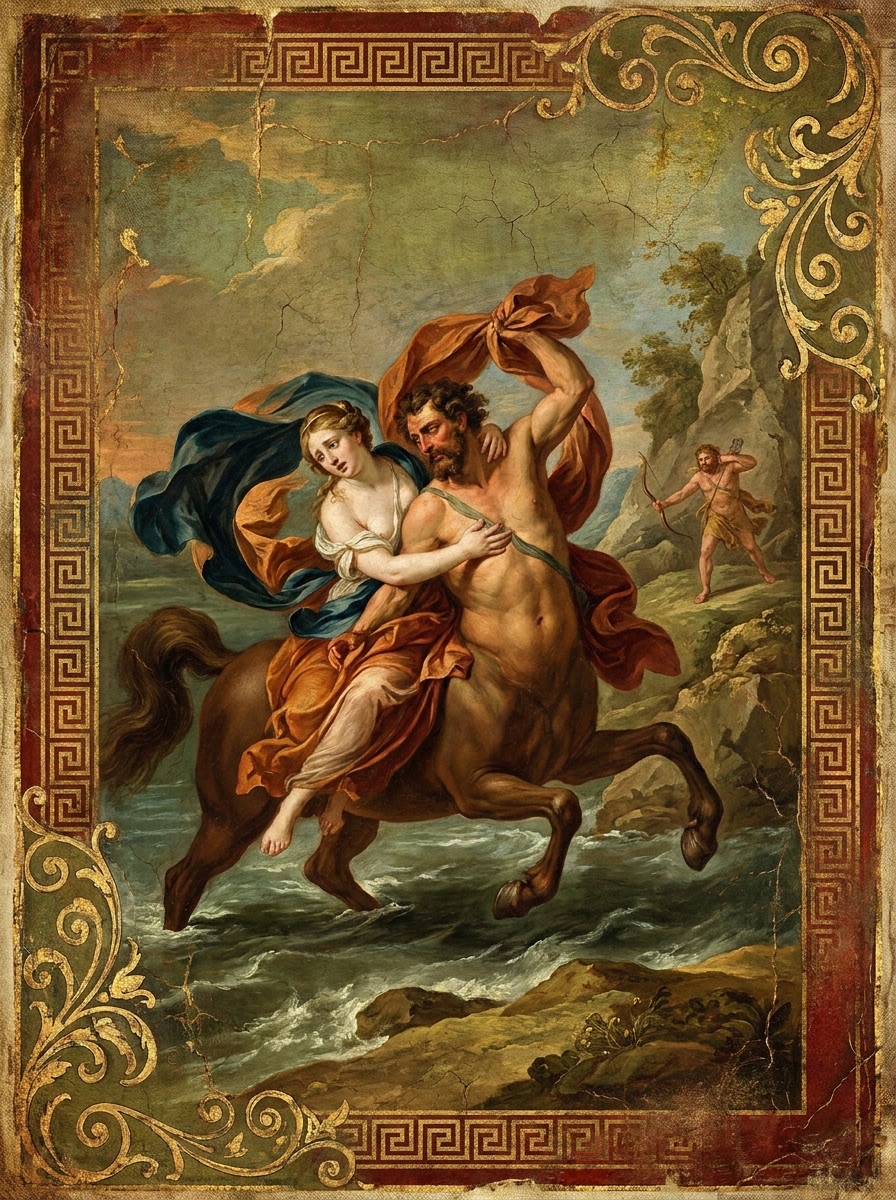
After Deianira marries Heracles, a centaur named Nessus tries to help her cross the Euenus River, then turns treacherous. As he dies, he leaves her with a fatal gift: his poisoned blood, which she mistakes for a charm to keep her husband faithful.
Article
Summary
Deianira was the daughter of Oeneus, king of Calydon, and many men sought her hand. The most frightening of them was Achelous, the river god, who could change his shape at will. He came first as a man, then as a snake, then as a bull, and his wild power made Deianira fear the marriage she could not escape. Heracles came to Calydon as another suitor, and Achelous had to face him openly. The river god wrestled first in human shape, then changed into a snake to coil and slip away, and finally became a charging bull. Heracles seized the horn, held against the force of the beast, and broke it off. Achelous withdrew in pain, and Oeneus gave Deianira to Heracles. She thought the most frightening suitor had been defeated, but another danger waited on the road. After the wedding, Heracles and Deianira reached the Euenus River. The water ran high and rough. Heracles could cross by his own strength, but Deianira could not easily wade through with her clothing and belongings. Nessus the centaur stood at the ford and offered to carry her across on his back. Heracles trusted him as a ferryman, let Deianira mount, and prepared to cross the river himself. In midstream Nessus betrayed them. He turned away from the proper crossing, hurried toward the far bank, and tried to seize Deianira for himself. She cried out, and Heracles heard her from across the water. He snatched up his bow and loosed an arrow dipped in the poison of the Lernaean Hydra. The shaft flew through the mist and struck the fleeing centaur. Nessus knew he was dying, but he thought only of revenge. With his last words he deceived Deianira, telling her to keep his blood and use it on Heracles' clothing if she ever feared losing his love. Shaken by the attack and not seeing the trap, Deianira hid the supposed charm away. Nessus died beside the river, but his malice remained sealed in the blood, waiting to become a later tragedy.
A River God Comes to Court
In the palace of Oeneus, king of Calydon, there lived a daughter named Deianira. She was not the kind of girl who had spent her whole life shut away in a women’s room, knowing nothing beyond the orders of others. She could drive a chariot, and she had heard the clash of weapons. Yet when the time came for her marriage, one fear still followed her.
Many men came to court her, but the one who frightened her most was Achelous, the river god.
Achelous was no ordinary mortal. He came from the water with a cold, damp breath about him, and when he spoke, his voice sounded like a stream forcing its way over stone. At one moment he appeared as a man; at another he became a coiling snake; and at another he took the form of a powerful bull, lowering his head and planting his horns in the earth. When such a suitor stood before the palace gate, no one dared turn him away lightly.
Deianira looked at him as if she were watching a flood rise. If she went with him, she knew she might never live as an ordinary woman again. King Oeneus was troubled as well. To refuse a river god might bring down the river’s wrath; to accept him was to hand his daughter over to something wild and inhuman.
Then Heracles came to Calydon.
By then he had already done many astonishing deeds. He was broad-shouldered, immensely strong, and still wore the lion skin over his back. When he saw Deianira, he too asked for her hand. At once Achelous could no longer win the bride by fear alone. He had to meet Heracles and settle the matter by force.
The Broken Horn
The two men fought before all the people.
At first Achelous grappled with Heracles in human form. His body was slick as wet clay, and his strength pressed down like the whole river was driving behind him. Heracles set his feet, seized the god’s arm, and hurled him aside.
Achelous would not yield. Suddenly he became a snake, winding himself forward and trying to slip from Heracles’ grasp while also coiling around his legs. But Heracles had faced fiercer beasts than that. He caught the serpent and pinned it to the ground.
Then Achelous changed again into a bull. Snorting, pawing at the dust, he charged with his head low. Heracles sprang aside, seized the horns, and threw his whole weight against the beast. The bull thrashed, flinging up dirt and stones as the onlookers scattered backward. Yet Heracles did not let go. He twisted with all his strength, and with a sharp crack one of Achelous’ horns snapped free.
The river god, beaten and in pain, withdrew to the water and no longer contested the bride.
Heracles had won. King Oeneus gave Deianira to him in marriage. After the wedding, she left her father’s house and followed her husband on the road ahead. She believed the most terrible suitor had been driven off at last, and that she had escaped the shadow hanging over her. She did not know that another danger was waiting for her at a riverbank.
By the Euenus River
Later, Heracles and Deianira came to the Euenus River.
The water was running fast then, brown and rough, striking the stones along the bank. Heracles, with his strength, could cross on his own, but Deianira could not easily force her way through the current with her clothes and belongings.
Near the crossing stood a centaur named Nessus. He had the upper body of a man and the lower body of a horse, with heavy hooves sinking into the mud and a broad back ready for labor. He was accustomed to carrying travelers or their baggage across the river. Seeing the couple arrive, he stepped forward and offered to bear Deianira over to the other side.
Heracles heard him and took care of his own bow and heavy gear, preparing to go through the water himself. He thought Nessus was only a ferryman of the riverbank, and so he let Deianira climb onto the centaur’s back.
Deianira grasped Nessus by the mane and shoulders. Nessus entered the river, searching for footing among the stones with his four hooves. Water splashed against Deianira’s dress, and she looked back to see Heracles still on the bank, ready to wade in after them.
At first all seemed well. But when they reached midstream, Nessus suddenly quickened his pace. He no longer moved toward the opposite shore in the proper way, but angled instead toward a farther bank. His arm reached back, and he tried to seize Deianira. At once she understood: this was no kindness.
She struggled on the centaur’s back and cried out to Heracles.
The Arrow Across the Water
Heracles heard his wife’s shout and looked up to see Nessus carrying her away toward the far bank. The centaur’s hooves splashed through the water, and it seemed he might break from the riverbank and escape.
Heracles had no time to pursue him. He drew his bow at once and set an arrow to the string.
It was no ordinary arrow. After killing the Lernaean Hydra long before, Heracles had dipped his arrowheads in the monster’s poisonous blood. Any wound made by such a shaft would be hard to heal.
Standing on the near bank, he pulled the bow taut. The string sang under the strain, and he aimed at Nessus. In the next instant the arrow flew through the river wind and mist and struck the centaur.
Nessus fell. Deianira tore herself free from his back and staggered away in terror. By the time Heracles crossed the river, Nessus already knew he would not survive.
Yet even in death the centaur felt no remorse, only hatred. Since he could no longer fight Heracles openly, he chose another way to take revenge.
The Centaur’s Last Gift
Writhing in the poison’s pain, Nessus called Deianira close. He pretended to speak kindly, his voice growing faint, and told her, “You are the wife of Heracles. Men who wander far from home do not always keep their hearts steady. If you ever want to hold his love fast, keep my blood. Hide it well. And if one day you fear he has grown cold, smear it on his clothing, and he will think of you again.”
Deianira had only just escaped danger, and her mind was still in confusion. She saw that Nessus was dying, and because he spoke as if he were making a final gift, she did not guess at the trap hidden in his words.
So she took the blood and stored it away. It was mixed with his own life and with the poison that had come from the Hydra’s arrow, but Deianira did not know that. She believed only that she had received a secret charm that could keep her husband’s love.
Heracles came up, rescued her, and killed Nessus. The river kept moving as rivers do, and on the bank there remained only the centaur’s corpse and the muddy ground trampled by hooves. Deianira went on with her husband, carrying the “gift” hidden with her.
From that day on, though Nessus was dead, his hatred did not vanish. It was sealed inside the blood, carried away by Deianira, and left waiting in silence for the greater ruin that would come later.