Greek Mythology
The Death of Theseus — Greek Mythology
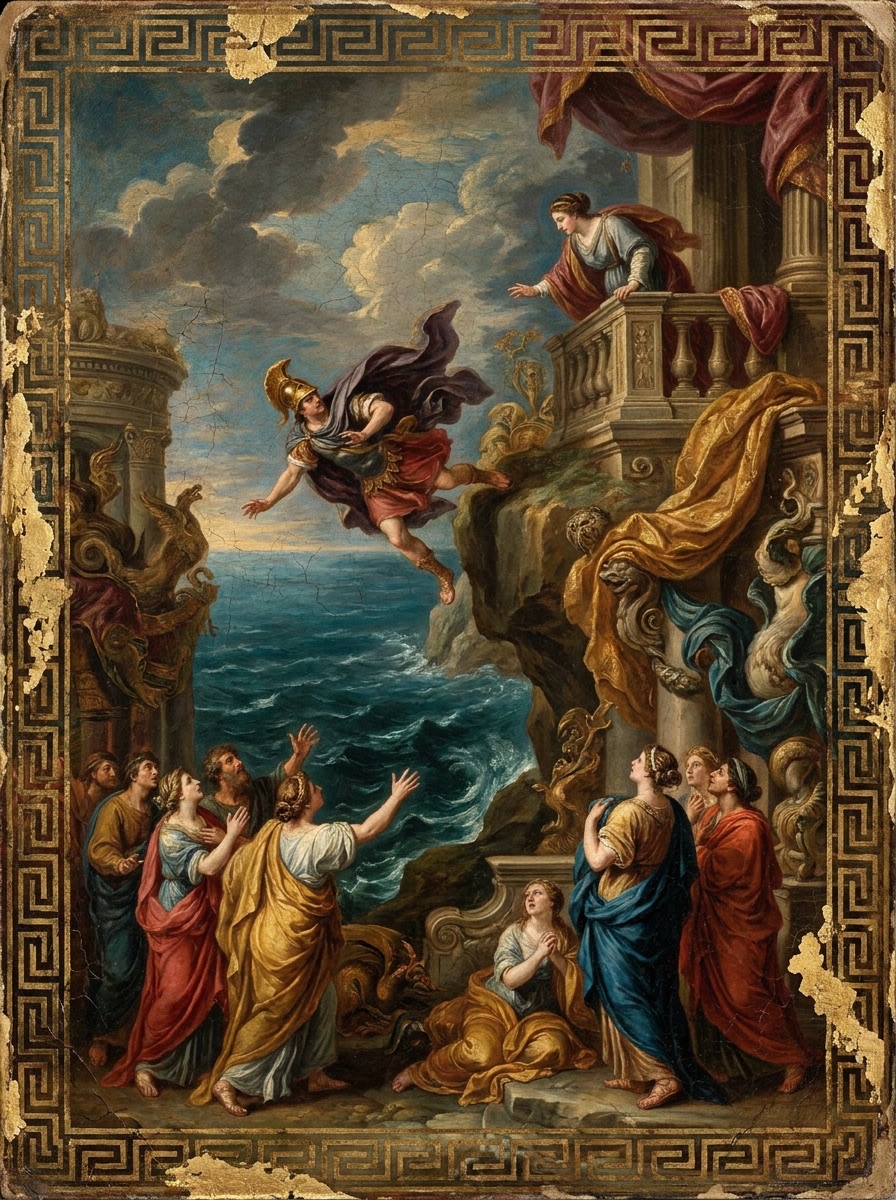
In his old age, Theseus lost both his family and the love of his people. After leaving Athens on a reckless venture with Pirithous, he returned from the Underworld to find his throne taken from him. At last he wandered to the island of Skyros, where Lycomedes pushed him from a cliff to his death.
Article
Summary
In his youth, Theseus had been one of the most honored heroes of Athens. He cleared the road to the city of robbers, killed the Minotaur, and brought home the young Athenians sent to Crete. Yet his later house was darkened by trouble: the deaths of Phaedra and Hippolytus chilled his home, and the Athenians no longer loved him as they once had. His friendship with Pirithous brought further disaster into the city. Together they carried off the young Helen and hid her at Aphidna; then, in even greater arrogance, they descended to the Underworld to seize Persephone. While Theseus was trapped on the stone seat of Hades, Athens lacked its king, and Menestheus used the people’s resentment to gather power. Helen’s brothers, Castor and Polydeuces, invaded Attica, rescued Helen, and carried away Theseus’s mother, Aethra. Later Heracles freed Theseus from the Underworld, but when he returned to the upper world, Athens had changed. Menestheus held authority, the people no longer trusted him, and Theseus could not win everything back by one heroic deed. He left Attica and crossed to Skyros, hoping to recover ancestral property and find one last place to stand. King Lycomedes of Skyros received him outwardly as a guest, but feared that this fallen hero might still bring danger. One day he led Theseus up to a high place on the island and, when the old hero was unguarded, pushed him from the cliff. The man who had freed Athens from the black-sailed tribute did not die in battle or in the Labyrinth, but beneath the rocks of an island far from home. Long afterward, the Athenians sought out his bones and established a hero-shrine for him. Yet Theseus’s own ending remains fixed in the wind of Skyros, a reminder of old age, rashness, and the changing hearts of a city.
The Palace Grown Cold
When Theseus was young, the people of Athens could not hear his name without remembering deeds full of brightness.
He had walked the dangerous road from Troezen to Athens and struck down the wicked men who haunted it one by one. He had entered the Labyrinth of Crete, killed the Minotaur in its darkness, and sailed home with the youths and maidens of Athens. In those days, when the people saw the ship appear in the harbor, they first wept at the sight of the black sail; then, learning that the hero had triumphed, their mourning turned to shouts of joy.
But no human life remains forever at its brightest hour.
Theseus became king of Athens. The scattered towns and villages of Attica were gathered into one city, and the altars and assemblies took on a new order. Yet within the royal house there was no peace. He married Phaedra, the princess of Crete, and later, deceived by Phaedra’s accusation against Hippolytus, he called upon Poseidon himself to curse his son. On the road by the sea, the horses bolted in terror, the chariot shattered, and young Hippolytus was dragged until his body was torn. By the time the truth came to light, Phaedra was dead, and Hippolytus could not be brought back.
After that, the palace of Athens seemed as if a corner of it had been hollowed out by the sea wind. Theseus still sat upon the throne. He still climbed the stone steps to offer sacrifice at the altars. But those closest to him were gone, and a deeper shadow lay across his face. The people remembered his services, but they remembered his disasters too. The hero’s fame did not fall in a single day; it flaked away little by little, like whitewash from an old wall.
In those years, Theseus still could not sit quietly in his palace. His friend Pirithous often came to him. Pirithous was king of the Lapiths, fierce in temper and bold in spirit. In youth the two men had formed a strong friendship. They had feasted together, fought together, and done many things that others would never have dared even to imagine.
One day they began speaking again of marriage and women. Though both heroes were no longer young, a reckless thought seized them. They agreed that each would take a daughter of Zeus as his wife. Such an oath might have sounded like drunken boasting at a banquet, but Theseus and Pirithous were not men who stopped at words. They kept the vow in their hearts and set out to make it real.
Helen Carried Away
At that time Helen of Sparta was still very young, not yet the woman whose name would one day be known throughout the world. She was dancing at the sanctuary of Artemis, with companions around her and family watching nearby. Sunlight fell on the sacred grove and the altar; the girls moved lightly in the dance, and no one imagined that two heroes were already approaching from afar.
Theseus and Pirithous came to Laconia. Taking advantage of a moment when no one was ready, they seized Helen and carried her away. They did not remain long in Sparta, but took her northward with them. Helen was still a child; once she had been taken from home, she could only follow where they led, leaving behind the hills, rivers, and temples she knew.
When they reached Attica, Theseus knew he could not openly keep Helen in the city of Athens. The Spartans would not swallow such an outrage, and the people of the city might not be willing to suffer for his private desire. So he sent Helen to Aphidna and placed her in the care of his mother, Aethra. It was a place some distance from Athens, with low walls and simple houses, quieter than the royal palace.
Aethra was old by then. When she saw her son bring back a young girl, she may well have had doubts in her heart. But she was Theseus’ mother, and she took Helen in. Thus Helen was hidden at Aphidna, like a young deer caught in a southern wood and shut for a time in a strange courtyard.
After doing this, Theseus did not stay in Attica. He and Pirithous cast lots and agreed that first they had helped Theseus bring back Helen; now they would help Pirithous seek his own bride. But the woman Pirithous desired was no mortal. He wanted Persephone, the wife of Hades.
This thought was more dreadful than the abduction of Helen. Human walls could be climbed, and guards on the road could be struck down; but the Underworld was no place for the living. There was no sunlight there. Its rivers were cold, its dead had no color in their faces, and the palace of the Lord of the Dead lay deep beneath the earth. Yet Pirithous had spoken, and Theseus would not break the promise he had made to his friend.
So the two men left Athens and went toward the road that led below.
The Stone Chair of Hades
When they came to the Underworld, the air was like damp ash. Rivers flowed through the darkness, and shadows passed back and forth near the ferrying place. The footsteps of living men sounded strange there, as if each tread disturbed the sleeping earth.
Hades knew well enough why they had come. The Lord of the Dead sat in his palace, with Persephone beside him, the queen he had brought below. Theseus and Pirithous meant to steal her away. Even in the tales of gods and heroes, such a deed was an insolence beyond measure.
Hades did not burst into anger at once, nor did he command the monsters in the shadows to spring upon them. He invited the two heroes to sit, as though receiving guests from far away. The chair appeared to be made only of stone, cold and heavy, standing in the hall of the dead. Tired from their journey and seeing their host gesture to them, the two men sat down.
But as soon as they were seated, their bodies were fastened there. The stone chair seemed to grow invisible hands, gripping their legs and waists. They tried to rise, but the stone did not move. They tried to reach for their weapons, but their arms grew heavy. The courage of Pirithous was useless here, and the strength of Theseus could not help him. The palace of Hades fell silent, leaving two living men trapped in a place that did not belong to them.
Time in the Underworld is not clear as it is among the living. In Athens, the sun rose and set day after day; ships came into harbor and put out again; in the palace, Theseus’ seat stood empty, and those who waited for him passed from anxiety to disappointment, and from disappointment to anger.
Some said Theseus should never have carried off the Spartan princess for his own desire. Others said that, as king, he had abandoned the city and gone storming into the realm of the dead, showing contempt for Athens itself. Once he had faced danger for the city; now the city was being forced to bear danger because of his adventure.
At this moment a man named Menestheus stepped forward.
The City Taken from Him
Menestheus came from the royal line of Athens. He knew how to speak, and he knew which way the hearts of men could be turned. He did not at once draw a sword and rush into the palace. Instead he went among the people and stirred up the grievances of the old nobles and village leaders.
He told them that Theseus had forced the people of many places into Athens and stripped old families of the authority they once possessed. Now, he said, Theseus had brought foreign danger upon them through his own mad conduct and had cast the city aside. Such words traveled quickly. One man spoke them in the marketplace, another repeated them at a feast, and a third added a little more among his kinsmen. Before long, Theseus’ former achievements still stood, but his faults seemed nearer and heavier.
The Spartan trouble soon arrived as well.
Helen’s brothers, Castor and Polydeuces, heard that their sister had been taken and led an army into Attica. They had not come to plead. Spears and shields came with them. Aphidna was captured, and Helen was found. Aethra, the mother of Theseus, fell into their hands too, and was carried away to serve Helen.
When the Athenians saw the Spartans pressing near, their anger grew stronger. They would not suffer more fire and steel for a king who was not even in the city. Menestheus seized the moment and pushed himself to the front, becoming the new ruler of Athens. The old authority Theseus had won was drowned beneath wave after wave of complaint.
And Theseus was still trapped in the Underworld.
Later, Heracles descended below to fetch Cerberus, the watchdog of Hades. Passing through the hall of the Lord of the Dead, that great hero saw Theseus seated on the stone chair, his face pale, as if the shadows of many years lay upon him. Theseus begged him for help. Heracles stretched out his mighty hand, seized him, and dragged him hard from the seat.
The stone chair did not wish to release its prisoner; Theseus’ body seemed to be bitten fast by the earth itself. Heracles strained with all his power and at last tore him free. But Pirithous was not saved. His offense in entering the Underworld was heavier, and he remained in that dark place. Theseus looked back at his friend, but he could do nothing except follow Heracles away.
When he returned to the world above, the light struck his body, and he could scarcely open his eyes. Yet that light did not bring back the old cries of welcome. What awaited him was not an empty throne, but a city that no longer obeyed him.
Athens Lost
When Theseus came back to Attica, he learned how much had changed.
Helen had been taken away, and his mother Aethra was gone too. Aphidna had suffered war. When the Athenians spoke his name, their voices carried blame. Menestheus held power now and refused to return the kingship. Theseus tried to gather those who had once supported him, but many avoided him; some were respectful in speech, yet their feet stood firmly on the side of the new ruler.
Theseus had once united Athens and brought the scattered towns and villages together. Now, in the very city he had built, he seemed unnecessary. The streets were the same streets, the temples the same temples, but the eyes of the people had changed. The young knew only tales of his former deeds and were not eager to draw swords for a fallen old man. The elders remembered his hardness from earlier days and were not necessarily eager to see him return.
He was angry, and he was ashamed. A hero can wrestle with robbers and fight the Minotaur to the death, but it is far harder to contend with the coldness of an entire city. He could not kill every man in the streets of Athens who opposed him, and he could not make trust, once dead, come suddenly back to life.
In the end, he took what possessions and followers remained to him and left Attica, crossing the sea to the island of Skyros.
Skyros was an island of cliffs above the deep blue sea, where the wind blew among the rocks. Theseus had inherited property there from his ancestors, and he thought he might at least recover that land and settle the last part of his life. The king of the island was named Lycomedes. He received the old hero and showed him no open discourtesy, but in his heart he was making other calculations.
Lycomedes feared Theseus. If such a guest came only to stay a few days, he could be entertained with food and wine. But if he meant to reclaim land, gather men, and perhaps use the power of the island to return to Athens, then he would become a danger. Moreover, the new ruler in Athens would hardly be pleased with anyone who helped Theseus. A hero who has lost power can still stir up storms.
Theseus did not at once sense the danger. He was too weary. The shadow of the Underworld, the betrayal of Athens, and the news that his mother had been carried off all weighed upon his heart. He had come to Skyros only in search of one last place to stand.
The King at the Cliff
One day Lycomedes invited Theseus to climb with him to a high place on the island.
They went up along a rough mountain path. Low trees and broken stones lined the way, and seabirds wheeled in the wind. When they reached the edge of the cliff, the sound of white waves striking the rocks rose from below. Lycomedes pointed toward the lands in the distance, as though showing his guest the boundaries, or speaking with him about the estate.
Theseus stood at the cliff’s edge and looked out over the island’s slopes and bays. Perhaps he remembered the road on which he had set out from Troezen in his youth; perhaps he remembered the gates of Athens, or the sails on the Cretan sea. In those days he had always moved forward, and before him there had been enemies, but glory too. Now he stood on a height in a foreign place, with only a suspicious island king behind him.
Lycomedes waited until he was unguarded. Then he struck from behind and pushed him over the cliff.
Theseus fell, his body striking the rocks before plunging toward the depths by the sea. The sound of the waves covered his cry. The hero who had killed the monster in the Labyrinth, cleared the roads of robbers, and freed the Athenians from their tribute did not die on a battlefield or in a palace. He died beneath the cliff of an island far from home.
No great funeral was held for him at once on the island. Athens did not immediately bring his body back. Menestheus continued to rule, and life in the city went on as before. People might speak beside the altars of the hero of former days, but few knew that, in his last moment, he had seen only the sea wind of Skyros and the steep wall of stone.
Many years later, the Athenians remembered Theseus again. Some said that his figure had appeared on the battlefield, armed with spear and shield, as if he had returned out of ancient time to help his city. Later the Athenians found his bones, brought them home, and buried them in the city, raising a hero-shrine in his honor. By then the old anger had faded, and his former services were remembered once more.
But the end of Theseus himself remained fixed at the cliff of Skyros.
He had walked many dangerous roads in his life and overcome many enemies. In the end, he was defeated by age, recklessness, and the changing hearts of men. Athens did not receive him while he lived, and he did not close his eyes in his own city. The waves beat against the rocks, as if repeating, for a vanished king, words to which no one would ever answer.