Greek Mythology
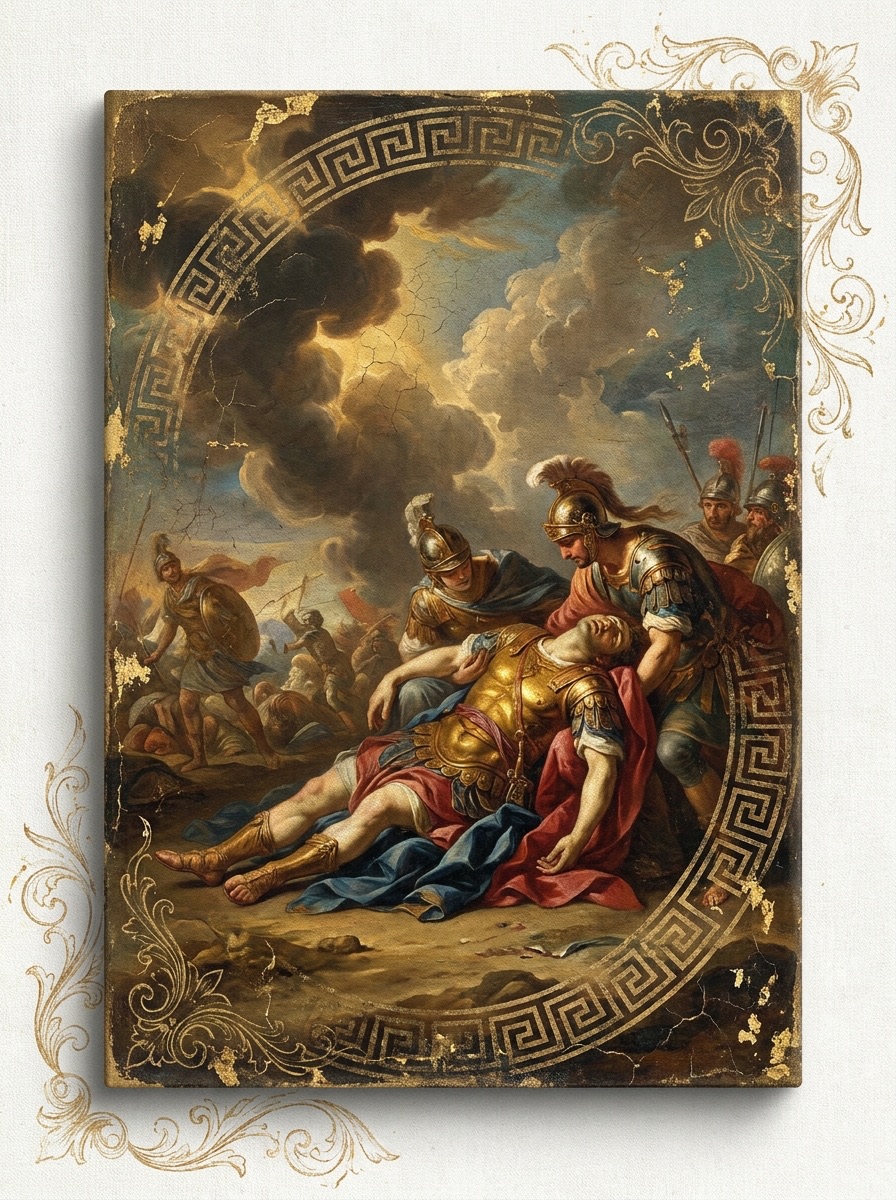
The Death of Patroclus — Greek Mythology
When Patroclus saw the Greek ships burning, he begged Achilles to lend him his armor and let him lead the Myrmidons into battle. He drove the Trojans back, but he forgot Achilles’ warning, pressed on to the walls of Troy, and was struck down in turn by Apollo, Euphorbus, and Hector.
Article
Summary
After Agamemnon had humiliated him, Achilles refused to fight, and the war turned against the Greeks. The Trojans pressed all the way to the ships, and Hector even set fire to the sterns. Patroclus watched the wounded come stumbling back from the field, one after another, and his heart broke for them. He went to Achilles and begged him that if he would not fight himself, he might at least lend him his armor so that the Myrmidons could charge out under Achilles’ name and frighten the Trojans into thinking their greatest foe had returned. Achilles agreed, but he warned Patroclus to drive the enemy back from the ships and then return at once. Patroclus put on the armor and rushed into battle. The Trojans indeed faltered and fell back. He killed many men, and among them Sarpedon, son of Zeus. Victory carried Patroclus farther than he should have gone. He chased the Trojans up to the walls of Troy. There Apollo struck him from the shadows and scattered his armor; Euphorbus wounded him first, and Hector came after to drive his spear into his body. As he died, Patroclus foretold Hector’s own death, and then he fell into the dust. Around his body, Greeks and Trojans fought a savage struggle.
The Fire by the Ships
Achilles had not fought for a long time.
After his quarrel with Agamemnon, he had withdrawn to his tents with the Myrmidons. Day after day the battle roar rolled across the plain, bronze struck bronze, chariots thundered over the dust, and the wounded were carried back by their companions. Yet he sat by his ships and listened to the sea beating against the hulls.
The Trojans did not wait for his anger to cool.
Hector led them again and again against the Greek wall. At first the Greeks still held behind their ditch and palisade, but little by little their line was torn open. Trojan chariots broke into the camp, and the warriors were driven back toward the ships. There was nowhere left to retreat. The sterns were hard against the sea, the planks bleached by the sun, ropes coiled around the posts, oars and rigging piled nearby. If the ships burned, the Greeks would lose even the road home.
That day the fighting reached its darkest point.
Hector stood beside the ships and shouted for the Trojans to bring fire. Men ran forward with blazing torches; black smoke and sparks whirled up and fell upon the wood at the sterns. The Greeks tried to hold them off with spears and whatever came to hand, beating at the flames as they rose. Firelight flashed over helmets and shields, as though daylight itself had split open and bled red.
Patroclus stood near Achilles’ tents and saw the smoke rising in the distance. He could bear it no longer.
He and Achilles had grown up together. Achilles was fierce, like a fire that would not bend; Patroclus was the one who felt other men’s pain. He had seen Eurypylus come back wounded, an arrow still lodged in his thigh. He had seen the healers unable to keep pace, the shore crowded with groans. He had seen the kings who once stood tall in battle now returning, one by one, broken and bleeding.
He went into Achilles’ tent with tears in his eyes.
Achilles saw him and asked, “Why are you weeping like a little girl clutching her mother’s robe and begging to be picked up? Has something happened to the Myrmidons, or has bad news come from home?”
Patroclus did not hide the truth. The Greeks, he said, had been driven back to the ships. Their bravest men lay wounded, and Hector’s fire was about to take the fleet. If Achilles would not fight, then at least let him wear Achilles’ armor and lead the Myrmidons into battle. The Trojans, seeing that shining armor from afar, might think Achilles had returned; their hearts would fail, and the Greeks would breathe again.
The Borrowed Armor
Achilles listened, and his heart was moved.
He still hated Agamemnon. He still would not march back into battle for that man’s sake. But the fire by the ships already blazed before his eyes, and he could not watch his companions die there without stirring.
So he gave Patroclus his consent.
The Myrmidons were gathered quickly. They had been pent up too long, like wolves locked behind a fence. At the command to fight, they snatched up shields, spears, and helmets, and drew themselves into rank beside the ships. Achilles fitted the armor onto Patroclus with his own hands: the greaves fastened around his legs, the breastplate closed over his chest, the silver-hilted sword hung at his side, and the great shield was lifted into his grasp. At last Patroclus set on Achilles’ gleaming helmet, with its horsehair crest nodding above him.
Only Achilles’ own spear he did not take.
It was a huge, heavy spear, cut from the ash of Mount Pelion, and no man but Achilles could wield it. So Patroclus took another spear, climbed into the chariot, and stood ready. Automedon held the reins, with Achilles’ swift horses harnessed before him.
Then Achilles stepped close and gave his warning in earnest: Patroclus was to save the ships, drive the Trojans away from them, and come back. He was not to chase the enemy farther, not to press on to Troy’s walls. If he won too much glory, some god or some Trojan would set their eyes on him. His task was only to save the ships.
Patroclus heard, and he agreed.
But on a battlefield, promises are often swept away by the noise of drums, the pounding of hooves, and the cry of victory.
The Myrmidons Charge
The Trojans were still fighting by the ships when they saw a new force pouring out from the Greek camp.
At their head came a man in Achilles’ armor, bright helmet flashing, broad shield raised, chariot flying like the wind. Behind him came the Myrmidons, spearpoints rising in ranks like the stalks of a ripe field swaying as the wind moves through it.
The Trojans saw that armor and their hearts broke first.
They thought Achilles had finally come. That name had long hung over them like a storm cloud. Many did not even wait to see the man’s face before they began to fall back. Patroclus seized the moment and drove in hard. He pushed the fire away from the ships and saved those that were already burning. The Greeks, seeing the Myrmidons at last, found their courage again and fought back from the shoreline.
Patroclus cut into the Trojan ranks. His spear brought down one man after another, and the chariot rolled past bodies as blood and mud splashed from the wheels. The Trojans were driven away from the ships, back across the plain, and then toward the trench. Many chariots overturned by the ditch; horses screamed, drivers were thrown clear, shields tumbled into the dust.
Even Hector was forced back.
He had led the assault like a living flame, but now he saw the turn in the battle and had to yield ground. The Trojan line broke apart. Some ran for the gates, others fled across the plain. Patroclus fought with ever greater fury, feeling as if the Greeks’ suffering were finally being washed away.
Then he came upon Sarpedon, king of the Lycians.
Sarpedon, son of Zeus, had brought his men from far Lycia to help the Trojans. Seeing his warriors scattered, he leaped down from his chariot and advanced with spear raised against Patroclus. The two men met over the bodies and the dust, and neither gave way.
The first spearcast missed its mark, and then they closed again. Patroclus drove his spear through Sarpedon and struck him down hard. As he fell, Sarpedon reached for a companion as an oak tree falls, its branches pressing to the ground. With his last breath he called to Glaucus and begged him to guard his body, so that the Greeks should not strip off his armor.
Sarpedon died on the field, and the Lycians raised a cry of grief. The Trojans too were shaken. But Patroclus did not stop.
He kept pursuing.
The Shadow at the Wall
Achilles’ warning should have called him back then.
The ships were saved, the fire had been beaten out, and the Trojans had been driven from the camp. If Patroclus had turned his chariot at once and returned to Achilles, he would have come back crowned with glory and greeted by the cheers of his comrades.
But victory on the battlefield is a treacherous thing.
Patroclus saw the enemy retreat, saw Troy’s walls drawing near, saw confusion spreading before the gate. He thought that one more charge might force the Trojans back into the city; one more charge might end the long struggle for the Greeks.
So he went on.
Three times he rushed toward Troy’s wall and tried to climb it, and three times Apollo drove him back. The god would not let him storm the city. Still Patroclus refused to withdraw. When he pressed forward a fourth time, Apollo let out a dreadful cry and warned him away. It was no mortal shout. It rose as though from stone, cloud, and earth all at once.
Patroclus shuddered and had to pull back.
Then Apollo came up behind him. The field was chaos, the dust thick, and no mortal eye could see a god’s feet. Apollo struck him on the back and shoulder, and the blow left him stunned. The light before his eyes shattered.
Achilles’ helmet rolled from his head, its horsehair crest dragging through the dust. The breastplate loosened, the shield slipped from his grasp, and the spear broke. The borrowed armor that had made him terrible a moment before no longer protected him. He stood in the middle of battle like a tree split by lightning, still upright for a breath, but doomed.
Euphorbus, a Trojan warrior, saw his chance. He rushed in and struck Patroclus from behind with a spear. The wound was not mortal at once, but it was deep enough to weaken him. Euphorbus did not linger; after the blow he withdrew into the crowd.
Wounded now, Patroclus tried to make his way back toward his allies. His strength was leaving him, and every step had grown heavy. But Hector had already seen him.
Hector’s Spear
Hector leaped down from his chariot and moved in on Patroclus.
He saw the armor scattered, saw that the man before him was not Achilles but Patroclus. The terrible warrior the Trojans had feared was only Achilles’ dearest companion. Courage rose in Hector, and with it the hunger for victory.
He raised his spear and drove it into Patroclus’ belly.
Patroclus fell to the ground, and dust clung to his face and hair. The sounds of battle still rushed around him: horses screaming, shields clashing, men shouting, wheels grinding over the earth. Hector stood over him and taunted him for trying to sack Troy, for hoping to make Trojan women slaves, and now dying here where even Achilles could not save him.
Patroclus answered with the last strength left in him.
He said Hector must not claim all the glory for himself. Zeus and Apollo had first brought him low, and Euphorbus had wounded him; Hector had only finished the work. Then he foretold that Hector’s own day was near, and that Achilles would soon come to the field and avenge him.
When he had spoken, Patroclus’ life left his body.
Hector pulled out his spear, kicked the corpse aside, and turned to chase Automedon, hoping to seize Achilles’ horses. But the horses would not bear an enemy away. Dust rose all around them on the battlefield, and they cried out in grief, as though they too knew that their master’s dearest companion was dead.
The Fight Over the Body
After Patroclus fell, the battle did not stop. It grew even fiercer.
Hector stripped off Achilles’ armor. That armor had been worn by Achilles, then lent to Patroclus, and now it lay in Hector’s hands. The Trojans shouted in triumph. The Greeks, seeing Patroclus’ body exposed in the dust, were gripped by anguish.
Menelaus reached the body first. He set his shield over Patroclus and kept the enemy from closing in. Euphorbus came to seize the corpse, and Menelaus warned him away, but the young ally of Troy would not yield. He came on with his spear, and Menelaus killed him. Blood ran through his curly hair.
But Hector and more Trojans pressed forward again. Menelaus could not hold them alone and called for Ajax the Greater. Ajax arrived with a shield broad as a wall and stood before Patroclus’ body. The Greeks gathered around the corpse; the Trojans tried to drag it away. They shoved, stabbed, and grappled, while the dead man lay in the middle like a prize fought over by two packs of wolves.
Dust rose high into the sky, and even the sun seemed dim. Inch by inch the Greeks dragged Patroclus back toward the ships; inch by inch the Trojans fought to drag him forward. Everyone knew this was more than the body of a dead warrior. If the Trojans seized him, they would shame Achilles. If the Greeks kept him, at least they could bring him back to his friend.
At last the Greeks held fast, and Patroclus’ body was saved from the battlefield. But Achilles’ armor was lost, and Patroclus would never open his eyes again.
When the news reached Achilles, his world seemed to collapse at once.
The man who had stood beside him, who had seen the suffering of the army for him, who had gone out in his armor, now lay by the ships covered in dust and blood. Achilles flung ashes over his head and threw himself to the ground with a cry of agony. The camp by the sea heard him, and even the slave women in the distance joined their mourning.
Patroclus’ death turned Achilles’ long-smoldering anger into another fire altogether.
That day the blaze by the ships was put out. But a more terrible fire had begun to burn inside Achilles himself.