Greek Mythology
The Death of Paris — Greek Mythology
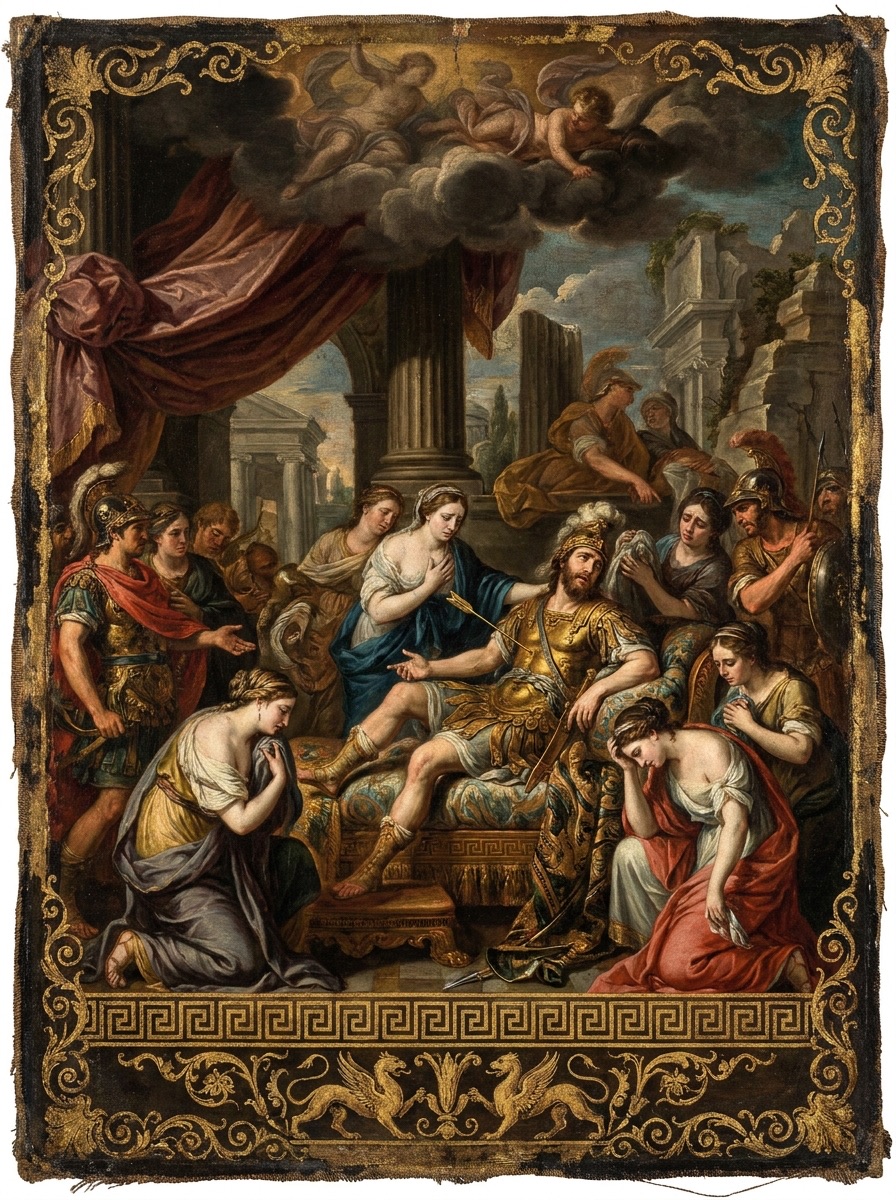
Philoctetes returns to the Greek army with the divine bow of Heracles, and Paris is struck on the battlefield by a poisoned arrow. Near death, he seeks help from Oenone, the wife he once abandoned, but she refuses him for his old betrayal, and he dies beneath Mount Ida.
Article
Summary
The Greeks knew that Troy would be hard to take without Philoctetes and the bow left behind by Heracles. After years of abandonment, Philoctetes was finally brought back to the camp. The physicians healed his poisoned wound, and he set aside his old anger enough to take up the bow and return to battle. The Trojans would not retreat inside their walls, but formed ranks outside the city once more. In the fighting, Neoptolemus charged with his spear, Aeneas fought fiercely to hold him back, and Paris too shot down Greek warriors with his bow. But when Paris faced Philoctetes, one of Heracles’ poisoned arrows flew toward him and pierced his body. Paris fled back to Troy in agony, but no one could cure the wound. Then he remembered Oenone on Mount Ida, the nymph he had once abandoned. She knew the healing herbs, and she had once told him that only she could save him from such a wound. So Paris was helped up the mountain and begged her in a failing voice to save his life. Oenone looked at the dying man before her and remembered how he had left her long ago and carried Helen away. Pain and hatred rose together in her heart, and she refused him. Paris left with the poison still burning in him and soon died. When Oenone repented and ran after him, it was too late. She threw herself upon his body and, overwhelmed by grief, ended her own life.
The Archer Brought Back
The war outside Troy had dragged on for many years. After Hector’s death, the city had lost one of the pillars of its courage, yet its walls still stood high, and the Greek ships still lay along the shore. No one could see the end.
At that time the Greeks began to hear one name more and more often: Philoctetes.
He had sailed with the Greek army at the beginning of the war, carrying the bow and arrows left to him by Heracles. That bow was no ordinary weapon. When its string was drawn, its arrows seemed to fly with the anger of the old hero himself. But on the voyage to Troy, Philoctetes had been bitten by a venomous snake. The wound festered, its stench sickened those near him, and the pain made him cry out day and night. The Greek leaders, thinking him a burden to the army, abandoned him on Lemnos with only a little food and the bow.
Years passed. On that lonely island he survived by shooting birds and wild beasts, and his heart filled with bitterness. But later a prophecy reached the Greek camp: without Philoctetes and the bow of Heracles, Troy could not be taken. So the Greeks sent men to bring him back.
When the ship carrying Philoctetes drew near the coast of the Hellespont, the Greek camp stirred with excitement. Soldiers ran down to the shore and saw the hero, abandoned for so many years, standing on the deck. His body was still weak, and his steps were unsteady. They helped him down from the ship. His face was pale, and his clothes still carried the smell of sea wind and desolate island air.
Agamemnon came forward, took him by the hand, and admitted that the Greeks had wronged him when they left him behind. Philoctetes was silent for a while. He had suffered too long to forget easily. Yet Troy still stood before them, and the bow of Heracles was still in his hands. In the end, he accepted reconciliation.
The physicians brought their medicines and cleansed his wound. Slowly the poisoned sore closed; the pain eased. The man who had been ill for so long could at last straighten his back. Philoctetes ate, drank wine, and felt strength return little by little to his arms. By the next day, he was able to sling his quiver over his shoulder and walk toward the battlefield.
Fighting Outside the City
That day the Trojans were burying their dead outside the walls. In the dust lay broken spear shafts, split shields, and feathered arrows trampled into the mud by horses’ hooves. Then the Greeks poured from their camp, and their shouting rolled across the plain.
Among the Trojans was wise Polydamas. Seeing the Greeks advancing with fresh force, he urged the men to withdraw into the city, guard the gates, and not waste their lives on the open plain. But the warriors would not listen. Hector was dead, and they would not let the Greeks think Troy had learned only to hide. Aeneas stepped forward and heartened them, and many gripped their long spears and formed their lines outside the city once more.
The battle soon dissolved into confusion.
Neoptolemus, brandishing the spear left by his father Achilles, rushed among the Trojans like a young wild beast. Dust clung to the rim of his shield, and again and again his spearpoint struck out. Many Trojan warriors fell at his feet. Aeneas did not give ground. With his companions he drove against the Greek line, breaking open a path of blood for the Trojans behind him.
Paris was also on the field.
He did not fight as Hector had, meeting spear with spear in the press of men. He knew the bow better. Dodging the oncoming chariots, he took his place behind the turmoil, drew the string, and searched for gaps among the Greeks. His arrow flew and brought down a warrior on Menelaus’ side. Some recognized him and shouted his name. The Trojan prince who had carried Helen away and brought ten years of war upon the peoples was once again bending his bow outside the city.
But this time another bow was seeking him.
Philoctetes stood among the Greeks, still gaunt from his long sickness. He did not run like the younger fighters. He planted himself firmly and reached for an arrow. The shaft settled against the string, and the bow bent into a taut arc.
It was an arrow of Heracles. The old hero’s poison had once been smeared upon its head, and few who were bitten by that wound ever escaped.
Paris saw Philoctetes and shot first. His arrow swept over the heads of the men, but it did not take his enemy’s life. Philoctetes did not retreat. He narrowed his eyes, drew the string to its full length, and let go.
The sound of the arrow was light, like wind cutting past the ear.
Before Paris could turn away, the poisoned shaft struck his body. Pain rushed into the wound at once, like fire and ice together. His bow slipped from his hand, and his knees buckled; men beside him quickly caught him. Blood soaked his robe. The poison spread through his veins, and the color drained from his face.
The Trojans shielded him and carried him back into the city. The gates opened amid shouting, then closed heavily behind them.
The Wound No One Could Heal
When Paris was carried back to the palace, Helen too heard the news.
She hurried to him and found him lying on a bed, his lips dry, his forehead covered in cold sweat. The man who had once carried her from Sparta to Troy no longer had the proud bearing he had shown upon the prow of his ship. One moment he sank into unconsciousness; the next he woke and clutched the edge of the bed, as if he could tear the pain out of his own body.
Those in the palace who knew how to treat wounds were summoned. They washed the injury, laid herbs upon it, and bound it tightly with cloth. But the wound left by the poisoned arrow would not quiet. When the medicine touched it, Paris trembled from head to foot. The healers spoke in low voices, and in the end they all avoided his eyes.
Paris understood. No one in the city could save him.
As waves of pain swept over him, he remembered Mount Ida long ago. Then he had not yet been Helen’s husband, nor the cause of the Trojan War. He had tended flocks among the hills, with springs, pine trees, and sheep around him. In those mountains lived a woman named Oenone. She knew the healing herbs. She knew which leaves by the water could stop blood, and which roots could drive out the fire of poison. She had loved Paris once, and had once been his wife.
Then Paris left her.
He went to judge the goddesses and awarded the golden apple to Aphrodite, receiving in return the most beautiful woman in the world. Later he sailed to Sparta and brought Helen back, while Oenone remained abandoned among the old trees and caves of Ida.
But Paris remembered what Oenone had once said: if someday he were wounded by a poisoned arrow, only she could save him.
When death draws near, a person remembers many things he has cast aside. Paris had no thought left for pride, nor even for Helen beside him. He ordered men to help him rise. He would go to Mount Ida and beg Oenone for aid.
The Former Wife on Mount Ida
Outside Troy, the shadows lengthened on the mountain road at evening. The men supporting Paris moved slowly, each step like the dragging of a body already growing cold. The poisoned wound would not let him stand upright. He pressed his hand against it, and dark blood seeped between his fingers. Wind passed through the pines, and the branches made a low sound, like the night noises he had known in former days.
Oenone lived in the mountain.
When she saw Paris being helped toward her, she was startled at first; then her face hardened. Of course she knew him. Though years had passed, though pain had worn him almost beyond recognition, she could still see in his brow and eyes the man who had betrayed her.
Paris looked at her, and his voice was so faint it could scarcely be heard. He begged her to save him, begged her to use her herbs to drive out the poison. He said he was dying, and that only she knew the cure.
Oenone did not answer at once.
The man before her was not merely an injured stranger. He was the man she had loved, and the man who had brought shame upon her. When he left her, he had not been driven away by sword or spear. He had gone of his own will, toward Helen, toward the palace, toward war. Many who had died outside Troy, many who had wept beside the Greek ships, were bound in one way or another to the choice he had made.
Old love and long resentment struck against each other in her heart. She watched Paris gasp in pain, and at last she made herself hard.
She refused him.
When Paris heard her answer, the light in his eyes faded. He tried to speak again, but only broken sounds came from his throat. The men who had brought him dared not linger. They carried him away from Oenone.
The road down the mountain was colder than before. Paris could no longer keep his feet beneath him, and the poison had sunk deep into his body. He did not live to reach the city. Near Mount Ida he died. The prince who had once chosen among three goddesses, the man who had brought back Helen and set two peoples at war, did not die on the wall or in the palace, but beside the very mountain woods he had abandoned.
Repentance Too Late
After Paris had gone, Oenone remained alone in her dwelling.
At first she told herself that she had been right to refuse him. He had betrayed her, brought shame upon her, and brought ruin to countless others. But as the wind moved again and again through the trees and their shadows stirred outside, the anger she had held so tightly began to fall away, leaving behind a deeper pain.
She remembered Paris in his youth. She remembered him tending his flocks on Mount Ida, and the two of them walking together beside the springs. She remembered, too, the face she had just seen, pale as stone, and the plea of a man at the edge of death in his eyes.
Suddenly Oenone rose, gathered up her healing herbs, and ran down the mountain after him.
But it was already too late.
When she reached him, Paris had no breath left. Men were preparing his body for the funeral pyre. Wood had been piled beside the bier; the smoke had not yet risen, but evening already lay heavy over the valley. Oenone threw herself beside him and called his name, but the dead do not answer.
The herbs she had brought fell scattered on the ground, useless now.
Grief overcame her. The woman whom Paris had abandoned still could not, at the last moment, drive him wholly from her heart. Different traditions tell her death in different ways: some say she hanged herself in remorse; others say she threw herself onto Paris’ funeral pyre. In either telling, the end is the same. She followed him, and Mount Ida sank once more into silence.
After Paris died, Troy lost a prince, and the war lost the man who had first kindled its fire. Yet his death did not stop the weapons outside the city. The Greek campfires still burned by the sea, and the gates of Troy remained tightly shut. Only this had changed: the man who once struck Achilles in the heel with an arrow would never again stand behind the walls and draw his bow.