Greek Mythology
The Death of Palamedes — Greek Mythology
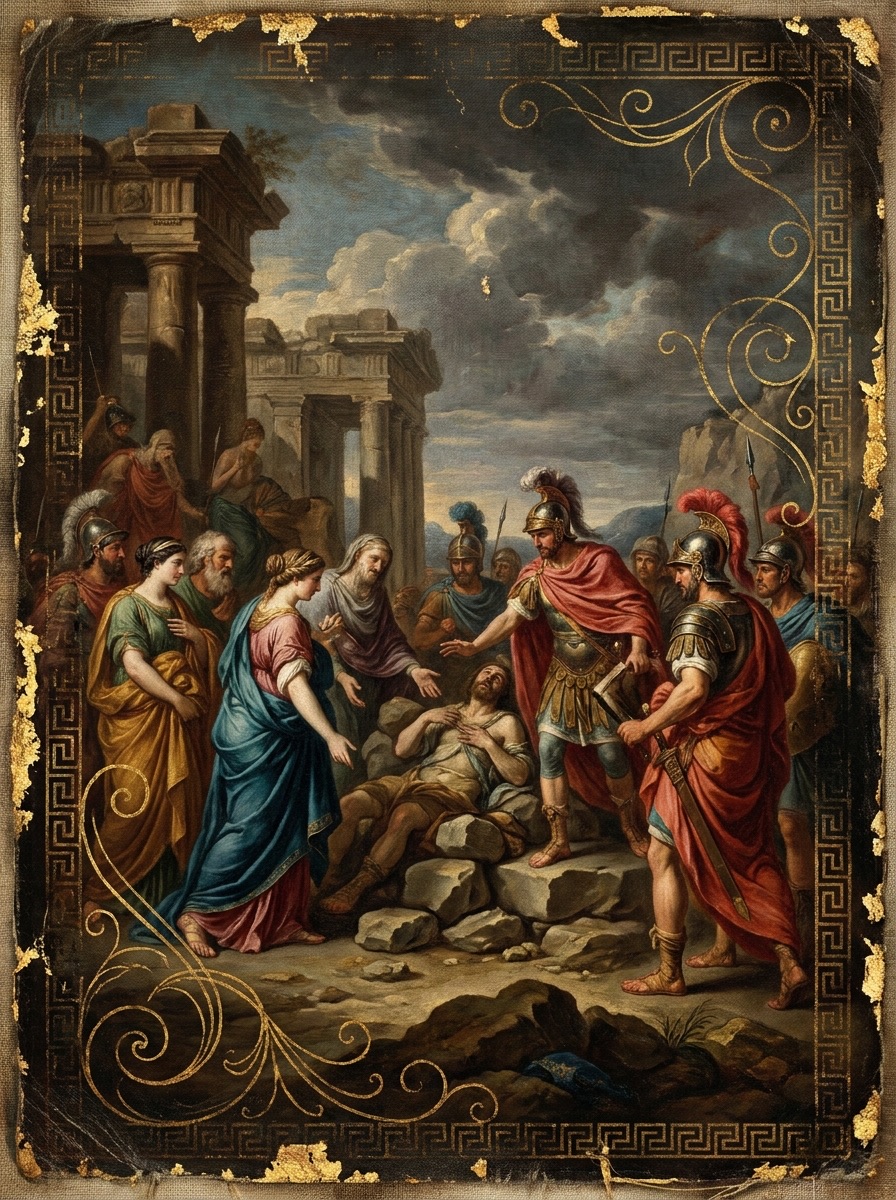
Palamedes was clever and upright, and he had once exposed Odysseus’ attempt to feign madness and escape the war. For that, he earned Odysseus’ hatred. Before Troy, Odysseus framed him with a forged letter and buried gold, making the Greeks believe he had betrayed them to the enemy. So the army put this wise hero to death.
Article
Summary
After the Trojan War begins, the Greek army remains for a long time beside the sea. In the camp Palamedes is known for intelligence, fairness, and useful invention, and many leaders respect him. But Odysseus keeps an old hatred hidden in his heart: when he once feigned madness to avoid the expedition, plowing a field with animals yoked before him, Palamedes placed the infant Telemachus in the furrow and exposed the trick. From that day, Odysseus remembers the humiliation. Palamedes continues to be trusted in the army and is even sent to offer a hundred animals to Apollo Smintheus. Outwardly, he is a valuable and honored man among the Greeks; in secret, Odysseus waits for a chance to bring him down for good. At last the chance comes. Odysseus buries gold inside Palamedes' tent and forges a letter in Priam's name, making it say that the gold is payment from the Trojans for betrayal. Then he arranges for a Phrygian captive to carry the letter, to be intercepted, and to die on the way, so that the whole affair looks like a secret act of treason discovered just in time. The Greek leaders read the forged letter and then search Palamedes' tent, where the buried gold is found. Palamedes defends himself, saying he has never betrayed his comrades and has taken nothing from Troy. But fear and suspicion in the camp overpower judgment. The evidence seems too complete, and many would rather believe the letter and the gold before their eyes than speak for a man accused of helping the enemy. Palamedes is condemned and stoned to death by the Greeks. He had once uncovered Odysseus' lie, but now he dies inside a deeper lie. Odysseus has his revenge, and the camp appears calm again, yet the army has lost a clever and upright voice. Palamedes' father Nauplius will not forget this innocent death, and that bitterness will later pursue many Greek heroes on their way home.
The Hatred a Clever Man Awoke
When the Greek fleet had anchored off the coast of Troy, smoke rose day after day above the camp. Wooden stakes enclosed the tents, weapons leaned beside shields, and horses stamped in the sand at the ends of their tethers. Princes from many cities gathered before Agamemnon’s great tent to debate the war. Some relied only on strength, some only knew how to rage; Palamedes was different.
He was the son of Nauplius, noble by birth, handsome in appearance, and clear and forceful in speech. When quarrels broke out in the army, he often found words that persuaded both sides. The dull labor of war—grain, scouts, sacrifices, the division of spoils—he could arrange with order and sense. Many said that without his urging, a number of the Greek princes might never have agreed to join the expedition against Troy.
Yet such a man easily makes enemies.
Odysseus hated him.
Before the expedition had truly begun, Odysseus had not wanted to leave Ithaca. He had only recently taken Penelope as his wife, and his son Telemachus was still a small child. So he pretended to be mad. He yoked an ox and a horse together to a plow, drove them crookedly through his fields, and scattered salt into the furrows, hoping the Greeks who came to summon him would believe his wits were gone. For a time they were uncertain. But Palamedes stepped forward, took little Telemachus, and laid him in front of the plow.
When Odysseus saw the blade about to reach his child, he could keep up the act no longer. At once he reined in the animals and turned the plow aside. Then everyone understood: he was not mad; he simply did not wish to go to war.
From that day on, Odysseus kept the shame hidden in his heart. Outwardly he still fought beside Palamedes, sat in the same councils, and obeyed the same commands. But whenever Palamedes was praised, his gaze grew cold.
Offerings for Smintheus
As the war dragged on, the Greeks in the camp often sought the will of the gods. Once an oracle of Apollo came to them, commanding that they offer him a hundred animals. In the region around Troy, Apollo was called Smintheus—Apollo of the Mouse.
The name was ancient. Long ago, it was said, a band of people had crossed the sea from Crete to the coast of Asia Minor. They received an oracle telling them to settle where “enemies came up from beneath the earth.” They searched from place to place until they reached the land near Hamaxitus. At night the camp fell quiet, and the soldiers slept beside their shields. But from under the ground came swarms of mice, which gnawed their leather gear and the straps of their shields. In the morning, when the men saw the scattered fragments, they believed the oracle had been fulfilled. They settled there and raised an image of Apollo, with a mouse crouching at the god’s feet.
Now the Greeks were to sacrifice to this Apollo, and the princes chose Palamedes to escort the offerings. He left the camp with a hundred sacred sheep and went to the temple. The flock was driven before the altar, their hooves raising fine dust. Chryses, the priest, received him beside the image of the god; hands were washed, prayers were spoken, barley was scattered, and then the flames rose. Fat hissed upon the fire, and the fragrance drifted beyond the temple doors.
When the sacrifice was completed, Palamedes honored the god in the proper way. Such a mission should have been an honor. But when news of it reached Odysseus, it pierced him like another thorn. The more Palamedes was trusted, the more Odysseus felt that he could wait no longer.
Gold in the Tent
Odysseus was not a man who knew only the sword. He knew how to wait in darkness, and how to draw other men’s eyes toward whatever he wished them to see.
One night, as the campfires burned low and the sentries wrapped their cloaks close against the sea wind, Odysseus crept toward the tent of Palamedes. He had already prepared a sum of gold. In a place where no one would notice, he hid it, burying it in the earth inside the tent. Gold cannot speak; but when it is dug up, it can condemn a man.
Then he wrote a letter, making it appear to come from Priam, king of Troy, to Palamedes. In it, Priam seemed to say that the Trojans had sent the promised gold and thanked Palamedes for betraying Greek military secrets. The words were arranged with venomous care, as though the two men had long been in secret contact and only waited for the Greeks to discover it.
Odysseus placed the letter in the hands of a Phrygian captive, then arranged for the man to be intercepted. Before the captive could explain anything, he was killed. A dead man cannot defend himself; the letter remained.
The next day the Greek princes were summoned to council. Agamemnon sat before them, with Menelaus, Diomedes, Ajax the Greater, and others present. Odysseus brought out the letter with a grave face, as if he himself could hardly bear to believe it.
The letter was read aloud. At once the tent stirred with anger. Some men muttered curses; others gripped their sword hilts. The walls of Troy still stood in the distance, and the Greeks had already spent many lives upon this war. If one among them had gone over to the enemy, he had handed his comrades’ blood to Troy.
When Palamedes was brought in, he did not yet know what had happened. He entered the council and saw the faces turned toward him; then he understood that something was terribly wrong.
Agamemnon asked him, “Does this letter concern you?”
Palamedes read it, and his expression changed. At once he said, “This is false. I have received no letter from Priam, and I have taken no gold from the Trojans. If someone means to destroy me, at least let me discover where this came from.”
But Odysseus had already prepared the next step. He proposed that Palamedes’ tent be searched. The others went together. Soldiers lifted the tent flap, turned over baggage, blankets, and weapons. At last, from the ground inside the tent, someone dug up the buried gold.
When the gold was carried out, sunlight flashed across it so sharply that it dazzled the eyes. Even those who had hesitated began to waver. The letter had spoken of gold, and gold had indeed been found in the tent. Together, the two pieces of evidence seemed like two hands closing around Palamedes’ throat.
Innocence No One Believed
Palamedes stood among them and looked at the heap of gold. He knew he had been caught in a trap, but he could not at once prove who had set it.
He defended himself before Agamemnon, saying that he had never left the Greek lines to meet the Trojans, nor sent anyone to carry military secrets. He reminded them how he had labored for this army, how he had persuaded princes from many lands to come, how he had overseen the affairs of the camp. If he had truly meant to betray them, why would he have thrust himself into the war from the beginning?
Some who listened showed pity on their faces. Palamedes truly had honor in the camp, and there were men who wished to believe his innocence. But war makes hearts impatient. Defeats, sickness, and long waiting had made both soldiers and princes fearful of treachery. Once they imagined that the Trojans might already know Greek plans, anger overpowered reason.
Odysseus spoke from the side, calm and measured. He did not need to shout. He only kept turning everyone’s eyes back to the letter and the gold. The proof lay before them, he said; if the gods had not brought the matter to light, how much longer would the Greeks have been deceived?
Palamedes looked at him, and at last understood who his true enemy was. But he understood too late. The judgment no longer listened to his explanation. The army wanted an answer, and a head that might quiet its fear.
In the end, Palamedes was condemned as a traitor.
When the Stones Fell
The Greeks led Palamedes out of the camp. Wind blew in from the shore, lifting sand and tugging at the edge of his cloak. Men who had once sat beside him in council now stood among the crowd; some turned their eyes away, others held stones in their hands.
Palamedes did not beg for mercy. He knew that begging would not save him. He only declared his innocence one final time, and sighed for the grief that would come upon his father, Nauplius. Some say that before he died he lamented truth and wisdom, because in the roar of an angry crowd they had no place to stand.
The first stone came and struck the ground. Then more flew after it. When Palamedes fell, the sand was stained red with blood. The man who had once advised the Greeks and exposed a lie died at last inside a deeper lie.
Odysseus had taken revenge for the old insult, and on the surface the Greek camp grew quiet again. But it was not a clean quiet. Many later remembered Palamedes with a shadow in their hearts; and when his father Nauplius heard of his son’s death, he would not easily forget it.
After Palamedes died, the tents still stood along the shore, the warships still lay moored beside the beach, and the walls of Troy still rose high in the distance. But among the Greeks one wise and upright voice was gone, and the gold that had been buried and dug up again became the sign of his unjust death.