Greek Mythology
The Death of Heracles and His Apotheosis — Greek Mythology
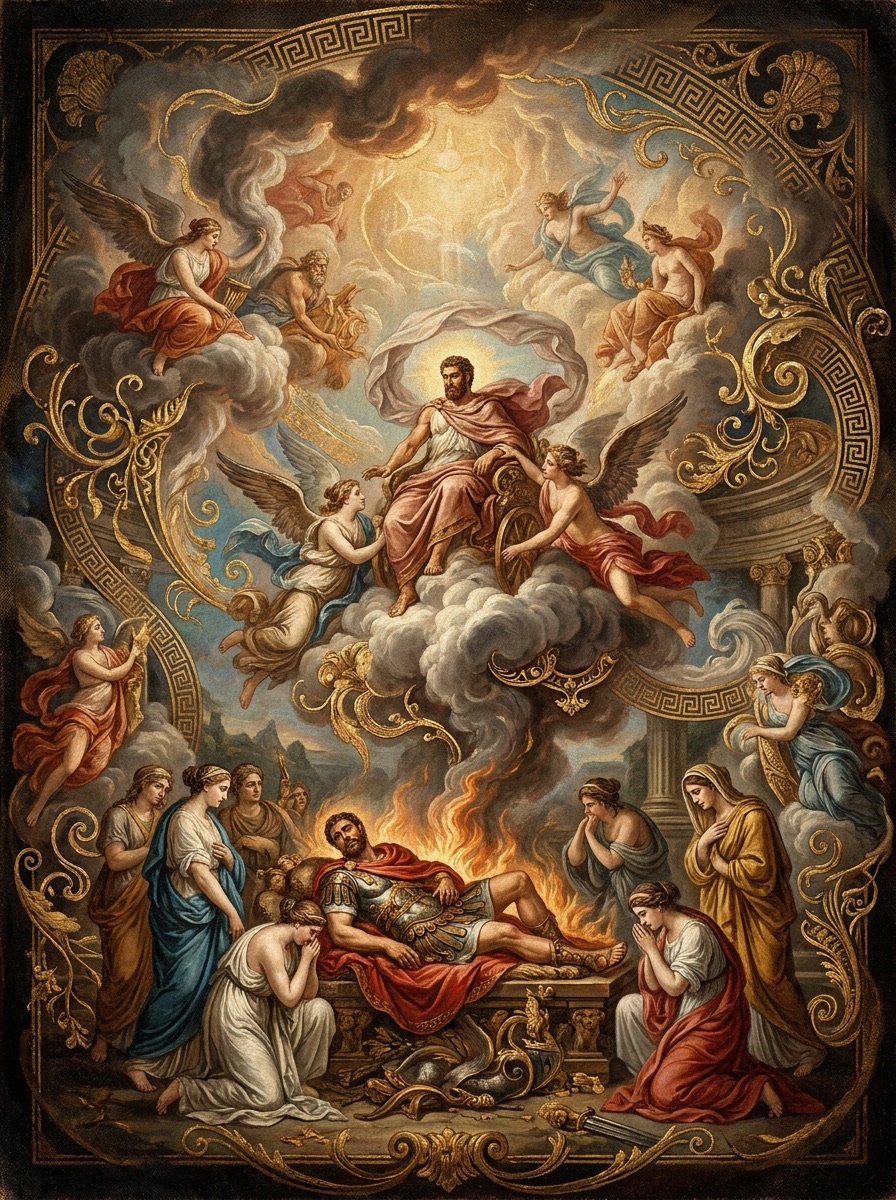
After Heracles captures Oechalia, his wife Deianira is deceived by the dying centaur Nessus into preserving his blood, believing it can hold her husband’s love. She sends a robe soaked with that poison to Heracles, and when he puts it on, the venom burns through his body. He dies in agony on Mount Oeta, and afterward the gods raise him to Olympus, where he becomes immortal.
Article
Summary
In his later years, Heracles married Deianira in Calydon. While they were crossing a river together, the centaur Nessus tried to seize her, and Heracles shot him dead. As he lay dying, Nessus concealed his malice and tricked Deianira into keeping his blood, telling her that it would preserve her husband’s love. Years later, Heracles attacked Oechalia, killed Eurytus, and carried off the beautiful Iole. When Deianira heard that her husband was bringing a young captive home, fear and sorrow overwhelmed her, and she remembered Nessus’s words. She smeared the old blood on a robe and sent it by the herald Lichas, hoping that when Heracles wore it, his heart would return to her. Heracles was offering sacrifice to Zeus by the sea. As soon as he threw on the robe and the fire warmed it, the poison awoke and fastened itself to his flesh. In unbearable pain, he tried to tear it off and hurled Lichas into the sea. Deianira learned the truth too late and took her own life in remorse. Knowing that his end had come, Heracles had himself carried to Mount Oeta. He gave his son Hyllus instructions, ordered a pyre to be built, and at last the fire was lit. When the flames had consumed his mortal body, the gods received him among the immortals. He was reconciled with Hera, married Hebe, and took his place on Olympus.
By the River
Heracles had wandered through many lands, fought many monsters, and suffered many labors before, in the end, he laid aside the perilous road and married Deianira in Calydon.
Deianira was no helpless maiden. Long before, she had been courted by the river god Achelous, who could change himself into a serpent or a bull. Heracles wrestled with him, broke off one of his horns, and won her hand. Deianira knew the strength of her husband and the force of his temper. She honored him and loved him, yet she also feared him in the quiet of her heart, for a man like that carried trouble wherever he went.
Once Heracles took Deianira with him on a journey, and they came to the bank of the Evenus River. The current ran swift and white with foam. There, waiting to help travelers across, was a centaur named Nessus. He had a man’s upper body and a horse’s body beneath, and he seemed powerful enough to carry anyone safely.
Nessus said to Heracles, “You may cross on your own, and I will carry your wife over for you.”
Heracles did not suspect deceit. He still wore his weapons and carried his bow, so he waded into the river and started toward the opposite bank. Nessus lifted Deianira onto his back. At first he moved as though he meant to help, but once he was out of Heracles’s sight, he suddenly quickened his pace and tried to carry her off.
Deianira cried out. The river roared too loudly to carry every sound, but Heracles heard enough. He turned in the water, drew his bow, and loosed an arrow. That shaft had been dipped in the poison of the Lernaean Hydra, and its dark point flew straight to the centaur.
Nessus fell with the arrow in him, and the poison began to pour from the wound. He knew he was dying, but even then he wanted vengeance on Heracles. So, with his last breath, he called Deianira close and spoke in a low, earnest voice.
“Do not be afraid,” he said. “I can give you a remedy. Keep some of the blood from my wound. Hide it away. If ever Heracles should turn his love toward another woman, smear this blood upon his robe, and his heart will come back to you.”
Deianira was still shaken and anxious, and she remembered that her husband was often away for long periods. So she believed him. She carefully took the blood and stored it in a vessel, never letting sunlight touch it again.
She did not know that she was not preserving love, but carrying the poison of Nessus’s revenge.
The Captive Brought Home
Many years passed, and Heracles was drawn into fresh conflict. He had once sought the hand of Iole, daughter of King Eurytus of Oechalia, and been insulted for it. Later he marched against Oechalia, the walls were breached, the gates were battered in, and Eurytus fell in blood, with his sons ruined beside him.
Iole was taken away.
She was young and beautiful, and she followed silently among the captives. She had not chosen her path, nor could she stop the men who led her toward a stranger’s house. Heracles sent the herald Lichas ahead to Trachis with some of the prisoners and word of what had happened.
In the house, Deianira saw the women. Among them stood Iole, dust from the fallen city still clinging to her dress. Her face was pale, but her youth shone through it. Deianira asked who she was, and Iole kept her head bowed and said nothing. No one else dared tell the truth plainly.
At first Lichas spoke vaguely, calling them spoils of war. But the story spread from mouth to mouth, and soon the matter stood revealed: Heracles had taken Oechalia not only to settle an old grievance, but because he had long desired Iole. Now this girl was to be brought into the house and placed at Heracles’s side.
Deianira felt as though cold water had been poured over her heart.
She did not rage at once, and she did not accuse Iole. She knew the girl was herself only one more victim dragged along by war. Yet Deianira thought of her own aging body, and of the possibility that her husband’s heart might drift from her, and her fear grew with every passing moment. The house was very still, save for the footsteps of the maidservants moving to and fro. Sitting alone, she suddenly remembered the little vessel she had kept for so many years.
Then Nessus’s dying words returned to her ears.
The Robe Sent to the Altar
Deianira brought out the vessel she had hidden for so long. She did not let it meet the sun, nor did she bring it near the fire. Obeying Nessus’s old instruction, she carefully smeared the blood upon a splendid robe.
She meant no harm to her husband. She only wanted Heracles to remember her and return to her side.
She folded the robe and gave it to Lichas, saying, “Take this garment to Heracles. Tell him that I have prepared it with my own hands. Let him wear it when he makes sacrifice, and do not let anyone else put it on before him.”
Lichas set out with the robe.
By then Heracles was by the sea, preparing to offer sacrifice to Zeus. The altar was piled with wood, the victims had already been brought, the sea wind stirred the flames, and smoke drifted slowly upward. Heracles received the robe from his wife and draped it over his shoulders.
At first, nothing happened.
He stood beside the altar and raised his hands in prayer, while the fire warmed the garment. Then suddenly the blood smeared into the cloth came alive. It seeped into his flesh. The poison burned through his shoulders, his chest, his ribs, like countless invisible teeth sinking into him. It was the venom of the Lernaean Hydra, hidden for years in Nessus’s blood, and now at last it had found Heracles’s body.
Heracles gave a terrible cry. He seized the robe and tried to tear it away, but the cloth had already clung to his skin; when he ripped free a strip of fabric, flesh came with it. In his agony he rolled on the ground, then lurched up and crashed against the stones, trying to scrape the dreadful garment away. The people around the altar scattered in fear, and none dared come near.
When he saw Lichas, Heracles thought the herald must be part of the plot. Fury and pain surged together. He snatched Lichas up and hurled him hard against the rocks by the sea. The poor man had no time to defend himself, and he was swept away into the waves.
Still the poison burned. Only then did Heracles understand that this was no ordinary human trick. Wounds from spear or sword he could endure; but this venom had come from the monster he himself had killed, and been hidden there by a centaur’s revenge. Even his strength could not withstand it.
Deianira Learns the Truth
Back in Trachis, Deianira waited for news. Her uneasiness grew, and at last she picked up a tuft of wool left from the robe. She had cast it aside in a corner, but in the sunlight it changed before her eyes. It began to bubble slowly, as though eaten up by fire, and turned into a heap of ash and froth, while a dreadful liquid seeped into the floor.
Deianira’s face changed when she saw it.
Only then did she understand that Nessus had deceived her. The centaur had not given her a potion of love, but a poison of revenge. She herself had sent the murderous robe to her husband.
Soon afterward the message came back: Heracles had put on the robe and suffered terribly, and Lichas was dead. Everyone had fled in terror.
Deianira could bear no more. She made no defense of herself and blamed no one else. She went into the house to the marriage bed, the place that had once held their shared life and now seemed only a cold sentence. She wept there for a while, and then she ended her own life with a sword.
She had only feared losing her husband, but in the end she had driven him toward death and herself into darkness.
Carried to Mount Oeta
The poison tormented Heracles so fiercely that he could barely breathe. He ordered that he be carried home. When Hyllus, his son by Deianira, came to his side, he saw only the hero who once strangled lions and lifted great stones now lying on a litter, his body burned and blistered by the robe.
At first Heracles believed that Deianira had meant to kill him. He cursed her in rage. Hyllus, weeping, told him the truth: his mother had been deceived by Nessus, and when she learned what had happened, she had already taken her own life.
As Heracles listened, his anger slowly sank away. The pain still gnawed at his flesh, but he understood that the arrow he had loosed at Nessus so many years before had at last returned to him in a long circle. He remembered the old prophecy: he would not die by a living man’s hand, but would be undone by an enemy who was already dead. Nessus had long since died, and it was the poison left behind by that dead foe that destroyed him. Fate had not missed its mark.
He told Hyllus, “Carry me to Mount Oeta. Build a pyre there, and let the fire consume this body that suffers so.”
Hyllus was afraid and would not agree at first. How could he set fire to his father’s funeral pyre with his own hands? But Heracles urged him on, and in the end Hyllus obeyed and had him borne up Mount Oeta.
The mountain wind moved through the trees. Pine and oak were cut down and stacked one upon another into a great pyre. Heracles lay upon it, spread the lion skin beneath him, and rested his head beside the heavy club that had accompanied him through so many dangers. That club, too, lay quietly by the fire.
He gave Hyllus his final command: in time, Hyllus was to marry Iole. Hyllus was heartbroken and unwilling to be joined to the woman who had brought such ruin into their house, but he could not disobey his father’s last words, and so he promised.
The pyre was ready, and the torches were waiting, yet all around stood men with lowered heads. No one dared light the fire. To set Heracles’s death in motion with one’s own hand was too heavy a burden.
At last someone came forward to strike the flame. Some traditions say it was Poeas; others name his son Philoctetes. Heracles, grateful to the one who would end his torment, gave him his bow and arrows. That bow and those arrows would later prove their power in other wars.
The torch touched the wood, and the dry branches burst into crackling flame. The fire devoured the timber first, then leaped up over the lion skin and the hero’s body. Smoke rolled over the mountain peak, and thunder muttered somewhere on the horizon.
The Throne Beyond the Flames
What mortals saw was only a great fire.
Yet when the blaze had done its work, no bones of Heracles were found in the ashes. The mortal body that had endured so much was gone, as though carried off by thunder and cloud together.
The gods received Heracles on Olympus. At last the hero who had wandered among men, slain monsters, borne labors, and suffered hatred and pain laid aside the body that could be wounded, could ache, and could die, and took his place among the immortals.
Long before, Hera had opposed him and filled his life from birth with sorrow. But now even that enmity came to an end. Hera was reconciled with him, and Zeus acknowledged his son among the gods. Heracles married Hebe, the goddess of youth, who served the gods with wine and remained forever young.
Among mortals, people remembered the fire on Mount Oeta and the robe that killed him. Heracles did not end like an ordinary hero in a tomb. He died in agony, but pain did not claim him in the end. The flames burned away his mortal part, and what remained was a name lifted up to Olympus.