Greek Mythology
The Death of Agamemnon — Greek Mythology
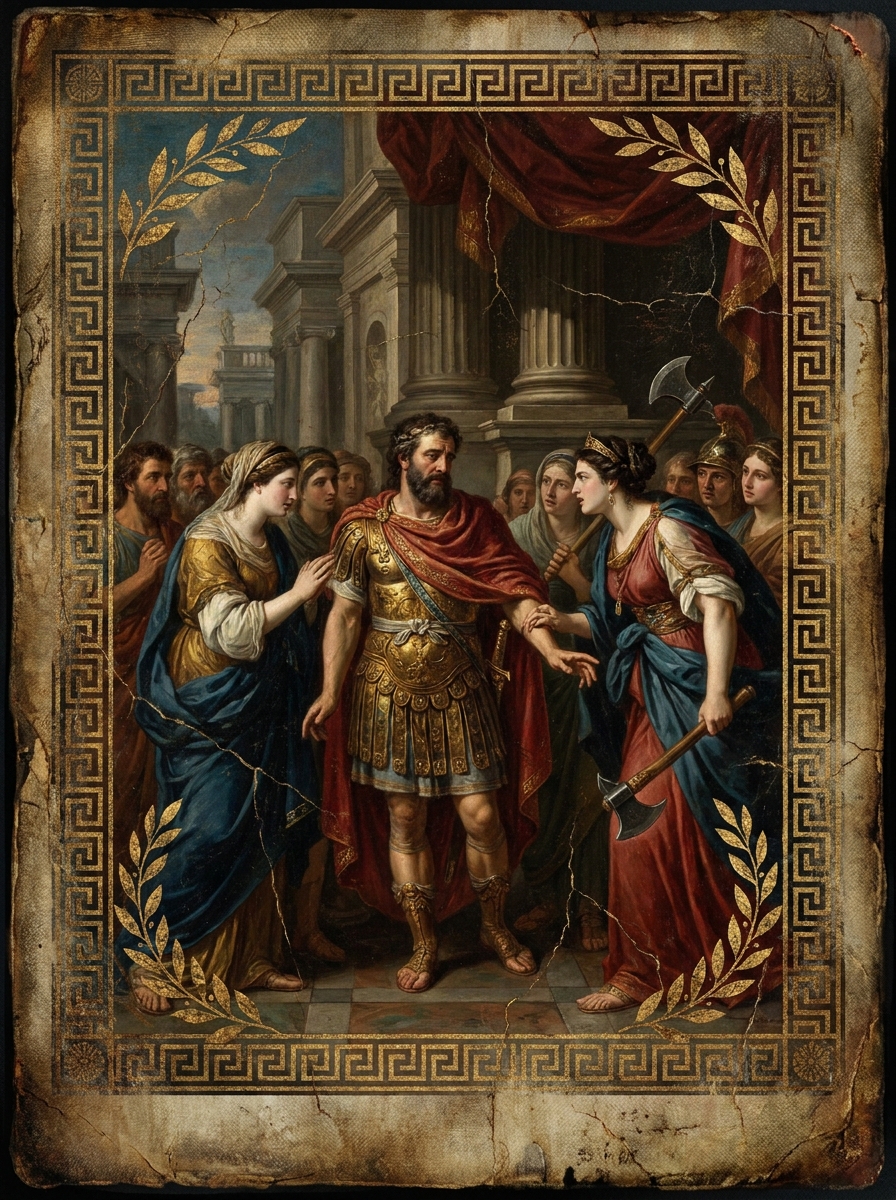
After the Trojan War, Agamemnon returned to Mycenae with victory behind him and Cassandra among his captives, unaware that Queen Clytemnestra and Aegisthus had long prepared his death. A crimson carpet, words of welcome, and a hot bath behind the palace doors led the king who had campaigned for ten years toward his own end.
Article
Summary
Clytemnestra came out richly dressed to welcome her husband. She ordered deep red fabrics to be spread before him and invited Agamemnon to enter the palace like a conqueror. At first Agamemnon thought such honor too close to the worship of a god and refused it, but under the queen’s persuasion he removed his sandals, stepped onto the crimson path, and entered the palace already made ready for him. Cassandra, brought home with him from Troy, saw the ruin hidden inside the house. She spoke of the old bloodguilt of the House of Atreus and foresaw that Agamemnon and she herself were about to be killed. Yet Apollo’s curse lay upon her: whenever she told the truth, no one believed her. In the end, knowing she could not escape, she still crossed the threshold. In the bath, Clytemnestra trapped Agamemnon in a garment like a net and struck him down with an axe. She killed Cassandra as well. Before the elders she admitted what she had done, saying she had avenged her daughter Iphigenia. Aegisthus also stepped forward and declared that he had repaid the ancient hatred between his father’s line and the house of Atreus. Agamemnon had taken Troy, but he died inside his own palace. Clytemnestra and Aegisthus seized power in Mycenae. Orestes was sent away from the palace, while Electra remained behind to endure humiliation. The blood-feud of the House of Atreus was not over; it had only entered a new time of waiting.
The King Brought Home by the Sea Wind
After Troy had burned, the Greek army left the coast of Asia Minor with gold, bronze, captive women, and ships heavy with exhaustion. Ten years of war were at last ended. Many men believed that if they could only cross the sea, they would see the smoke rising from their own hearths and the olive trees in their own fields.
But the sea would not let them go home easily. The wind suddenly turned. Wave after wave rose and broke over the ships; the sails strained as if they would tear apart. Near Cape Malea, storms scattered Agamemnon’s fleet. Oarsmen rowed through day and night, and sailors gripped the ropes until they bit into their palms, barely keeping the hulls from being dashed against the rocks. When the weather softened at last, they had been driven far from their course and had to seek harbor until a favorable wind returned.
Agamemnon stood at the prow and looked over the gray-white water. He was king of Mycenae and the commander whom the Greek kings had chosen above themselves. Troy had fallen now. Priam’s palace was a ruin. Yet many heroes had not lived to sail home. Achilles had died on the battlefield; Ajax the Greater had died by his own sword; many others lay buried in foreign earth. Agamemnon was still alive. As he thought of the stone steps of his palace, the smoke above the altar, his wife Clytemnestra, and the children left at home, his heart slowly eased.
He sent men ashore to learn what had happened in Mycenae. When they returned, they told him that the kingdom still stood and that no great disorder had broken out in the city. Aegisthus, they said, lived near the palace and, as a kinsman of the king, had helped the queen govern the realm.
Agamemnon was pleased to hear it.
The name of Aegisthus carried old blood within the House of Atreus. Agamemnon’s father, Atreus, had once destroyed his own brother Thyestes by a dreadful act, and Aegisthus belonged to the line of Thyestes. But the war had lasted too long. Agamemnon had seen too many corpses at Troy to wish to drag family hatred on from one generation to the next. He thought that if Aegisthus had truly governed peacefully, perhaps the gods had granted the House of Atreus a chance at reconciliation.
He also believed Clytemnestra would welcome him. Ten years earlier, to let the Greek fleet sail from Aulis, he had led his daughter Iphigenia to the altar. That deed had been like a hidden knife, cutting open the life of the family. Yet Agamemnon imagined that the long years might have worn down his wife’s hatred.
At last the wind turned fair. The sailors raised the sails, and the fleet made for Mycenae. On board, Agamemnon offered sacrifice to the gods, thanking them for bringing him back from fire and sea. The smoke of the offering drifted upward, and he believed the hardest road was behind him.
The Crimson Carpet Before the Palace
The people of Mycenae had heard the news early. The gates were opened, and the streets filled with those who had come to greet the king. Some wished to see the spoils of Troy. Some wished to see whether the king who had been gone ten years still carried his old majesty. Others simply followed the crowd.
Aegisthus came out with the elders of the city and his attendants. He wore a respectful smile, like a loyal kinsman who had guarded his master’s house. Agamemnon suspected nothing. He went forward, clasped his hand, and thanked him for watching over the kingdom through the years.
Before long, Clytemnestra came out from the palace as well. She wore splendid garments, with maidservants gathered behind her, and the children were brought to stand nearby. She did not rush into her husband’s arms like an ordinary wife. Instead, before the people, she spoke many words of blessing. She told how she had waited through the years, how she had feared for him, how again and again false reports had come and filled her with anguish. Her speech was graceful, and there was gladness on her face; but the gladness was too perfectly arranged, like a mask prepared long before.
Agamemnon listened. His heart was full of victory and homecoming, and he did not look closely into her eyes.
Then the maidservants carried out from the palace piece after piece of deep red fabric and spread them on the ground, all the way to Agamemnon’s feet. In the sunlight the color was heavy as blood, and rich as the most precious cloth in the royal treasury. Clytemnestra invited him to enter the palace upon that crimson path, saying that such honor befitted the king who had broken Troy.
Agamemnon stepped back. He knew the ceremony was too grand, almost like a welcome offered to a god. For a mortal to walk upon such costly fabric might stir the envy of heaven. He told his wife not to treat him as one of the gods above. He was only a mortal man returned from war.
Clytemnestra did not give way at once. Softly she urged him on. If Troy had won, she said, it would have welcomed its king with even greater splendor. The people of the city had longed for him for ten years, and this carpet was no more than Mycenae’s tribute to the victor. Step by step she pressed him, not like one arguing, but like one casting an invisible net.
At last Agamemnon yielded. He took off his sandals and set his bare feet upon the dark red cloth. The crowd cried out in celebration, and the palace doors stood open before him. Clytemnestra stood aside and watched him walk inward, step by step. There was no clear smile at her mouth, yet she looked like a hunter seeing the prey already inside the fence.
Behind Agamemnon came a silent woman. She was Cassandra, daughter of Priam, king of Troy, and a prophetess once granted the gift of prophecy by Apollo. After the city fell, she had been allotted to Agamemnon and carried to Greece like part of the spoil. She sat in the chariot, her hair disordered, but her eyes fixed on something no one else could see.
The Blood Cassandra Saw
After Agamemnon entered the palace, Clytemnestra sent someone to summon Cassandra from the chariot and invite her inside to be entertained with her master. The maidservants came forward and urged her down, but Cassandra did not move.
She stared at the roof of the palace, and her face slowly changed. Others saw stone walls, doorposts, and the freshly washed ground before the steps. She saw the blood of the House of Atreus, spilled many years before. It was as if she saw murdered children, platters laden with flesh, and the curse of brother harming brother. Then she saw a cloth falling like a net in the bath, an axe lifted high, and the king’s blood spraying into the steam.
When she began to speak, her voice seemed to come from far away. She said this house was not a peaceful home, but a lair that swallowed human beings. She said a lioness lay with a wolf inside, waiting for the lion to return. She said neither she nor Agamemnon would escape that day.
Those standing near could not understand her words. They thought the Trojan woman was raving. Some pitied her; others found her ill-omened. But Cassandra spoke more and more clearly. She knew her own fate. Apollo had once loved her and given her the power of prophecy. Later she rejected the god, and he made it so that every truth she spoke would be disbelieved. All her life she had seen disasters coming, and all her life others had dismissed her words as madness.
She still wore the emblems of a prophetess. Suddenly she tore them away and flung them to the ground, like charms that had lost all power to protect her. She knew that even if she refused to enter, she could not escape. Troy had been destroyed; her father was dead; her brothers were dead. She had come here as a captive, only to pass from one fire into another bloodshed.
At last Cassandra stepped down from the chariot. She did not beg anyone to save her. She only turned toward the palace and spoke her final prophecy: her blood would not go unavenged, and Agamemnon too would not be left without a champion. One day a son would return and demand payment for his father’s death.
Then she went inside. The palace doors closed behind her, and those outside heard only faint footsteps from deep within the house.
The Net in the Bath
Inside the palace, everything had already been arranged. Clytemnestra did not strike in front of the people. She waited for a moment when no outsider could intervene.
Agamemnon was dusty from the road, returned from war and sea, and he needed to bathe. Hot water was carried into the bath chamber, and steam rose along the walls. The king took off his war-cloak and his weapons and loosened his shoulders. Perhaps he was still thinking of the sacrifice he would soon offer to the gods, of how he would count the spoils, of how he would sit again upon the throne of Mycenae.
Then Clytemnestra acted.
She brought out a specially made robe—or, as some said, a wrapping cloth—broad and without an opening. As soon as Agamemnon put it on, his arms were trapped, like a fish caught in a finely woven net. Before he could reach for a weapon, the axe had risen. Clytemnestra struck with all her strength. The first blow wounded him, the second brought him down, and the third fastened ten years of waiting hatred into the bloody water of the bath.
Outside the palace, the people heard the king cry out. The sound came suddenly and faded quickly. The elders looked at one another in alarm. Some wanted to rush in, but fear held their feet. The heavy palace doors stood before them, and no one knew how many blades might still be waiting within.
Soon the doors opened.
Clytemnestra stood inside, spattered with blood. Agamemnon lay at her feet, and Cassandra too had been killed. The queen did not hide, nor did she pretend to mourn. Facing the elders of the city, she admitted that she had killed her husband with her own hands.
She said this was not a moment of madness, but a revenge long prepared. Years before, when Agamemnon wished to sail to war, he had sent their daughter Iphigenia to the altar and bought a favorable wind with the child’s blood. If a father could do such a thing to his own child, why should a mother not make him pay? She also said that Agamemnon had brought Cassandra back from Troy and led a new woman into her house, adding fresh fuel to her hatred.
Behind her, Aegisthus appeared as well. He no longer played the loyal kinsman, but showed the pride of a victor. He said the House of Atreus owed his father’s line a blood debt, and that debt had at last been collected. His father Thyestes had once been deceived by Atreus and made to eat the flesh of his own children. That old hatred had burned in Aegisthus for years. Now Agamemnon was dead, and the line of Atreus had received its punishment.
The elders raged at them and cursed them. They asked Aegisthus why he had not struck the blow himself, instead of hiding behind a woman. Shamed and furious, Aegisthus threatened to hold Mycenae down by force. But Clytemnestra stopped the quarrel. She had gained what she wanted, and she did not wish the palace gates to be filled at once with another battle.
The Palace Sinks into Silence
After that day, the palace of Mycenae had new masters. Agamemnon’s body was laid out, but his victory had brought him no peace. He had broken Troy and brought home countless spoils, yet he died under his own roof. He had escaped enemy spears, stones from the city walls, and the storms of the sea, but he had not escaped the old hatred in his house.
Clytemnestra and Aegisthus held the royal power. Lamps still burned in the palace; smoke still rose from the altar; people still bowed at the doors. Yet everyone knew that the blood of the king and the prophetess had just flowed through that house.
Agamemnon’s son Orestes was still young and could not avenge his father at once. Fearing that he too would be killed, someone quietly sent him away from Mycenae. His daughter Electra remained in the palace, watching her mother and Aegisthus sit in her father’s place, while grief and anger sank deeper in her heart day by day.
Clytemnestra believed her vengeance was complete. Aegisthus believed the throne of the House of Atreus had finally fallen into his hands. But the words Cassandra spoke before her death were like an ember buried in ash, not yet extinguished. Agamemnon’s blood had fallen in the palace, and it had fallen also into the hearts of his children.
When the cries of welcome for the returning king had faded, only a heavy silence remained in Mycenae. The crimson carpet was taken away. The bloodstains in the bath were washed clean. The palace doors were shut again. But some things cannot be washed away, and some things cannot be locked inside. So the death of Agamemnon brought the last shadow of the Trojan War back into his own home.