Greek Mythology
The Death of Achilles — Greek Mythology
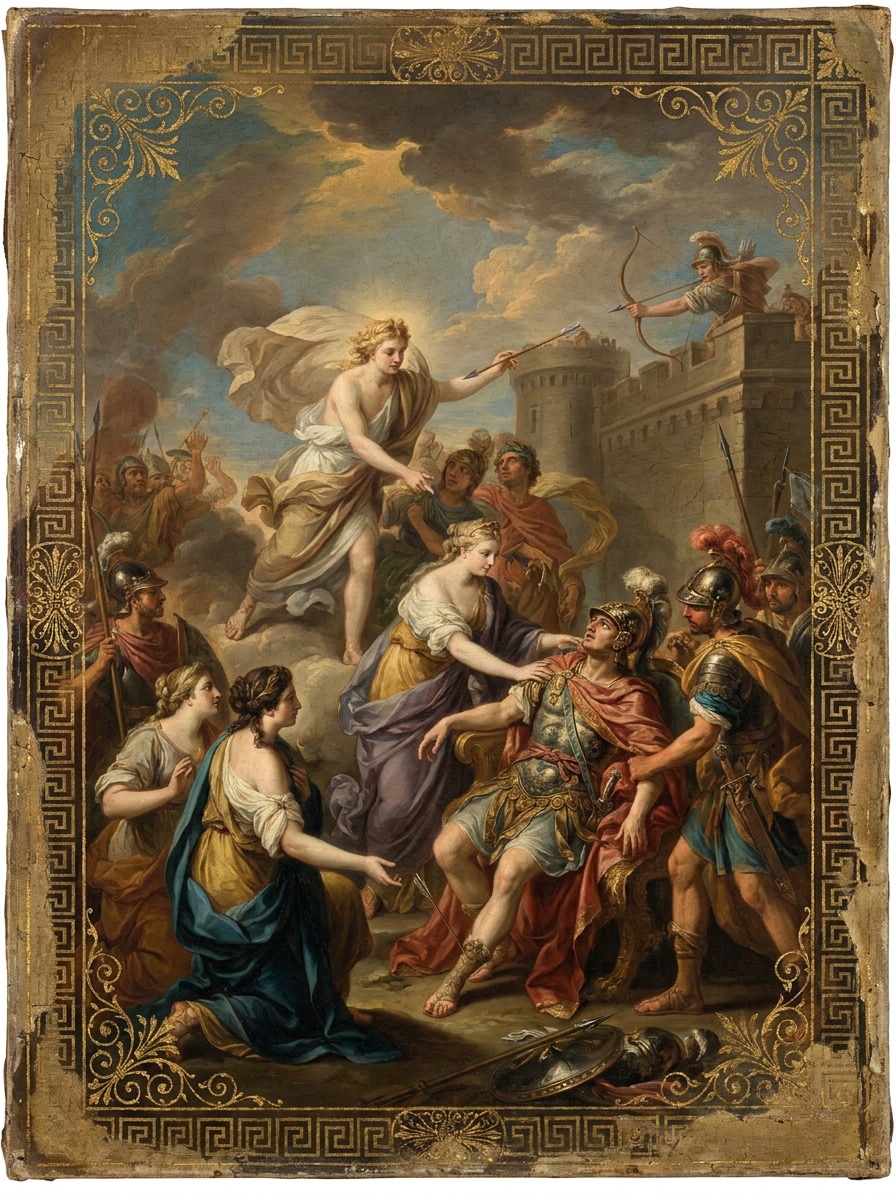
After slaying Memnon, Achilles drove the Trojans back to the gates of Troy. There Apollo guarded the city, guided Paris’s arrow to its mark, and the Greeks fought to win back their fallen champion’s body so they might give him a great burial.
Article
Summary
After Memnon’s death, the Trojans fled toward the gates, but Achilles would not stop. He pursued them all the way to the Scaean Gate and seemed almost ready to carry the war into Troy itself. People on the walls cried out in terror, while the gatekeepers feared both closing the gates too soon and leaving their own men outside. Apollo would not watch Achilles break the city he favored, so he aided Paris near the walls. Paris, hidden by the gate or on the battlements, waited with his bow for an opening. Guided by Apollo, his arrow flew through the dust and struck Achilles in the most vulnerable place, at the ankle. Achilles understood that a god had intervened, yet he still tried to stand and fight back. When the Trojans saw him wounded, they rushed from the city, hoping to seize his body and his god-forged armor. The hero who had terrified Troy at last fell before its gates, and a new battle immediately erupted around his corpse. Ajax the Greater was first to shield Achilles’ body, using his broad shield to hold off spears and stones. Odysseus came too, keeping the retreat ordered and checking the pursuers. The Greeks fought desperately to win the body back to the ships, with Ajax bearing the heavy corpse while Odysseus and the other warriors resisted the Trojans behind him. When Thetis heard of her son’s death, she rose from the sea with the Nereids and wailed for Achilles. The Greeks built his funeral pyre, placed his ashes with those of Patroclus, and held games in his honor. The Greek camp had lost its most fearsome warrior, but Troy did not truly gain peace, for the war still had to move toward its end.
The Chase at the Gates
After Achilles killed Memnon, the Trojan side seemed to lose its backbone at once. The Ethiopians scattered, and the Trojans no longer dared hold the plain. They fled toward the city gates, dust flying behind them, chariots crowding one another, the wounded limping forward with their shields as supports.
Achilles did not stop.
He had only just avenged the death of Antilochus, and his fury had not yet cooled. That day he came on in shining armor, spear in hand, striding through the wreckage of bodies and broken wheels. Whoever stood in his way was either struck down or forced to drop his weapon and run. The Trojans heard his footsteps as though Thanatos himself were drawing near, and none of them dared look back.
Ahead of him rose the Scaean Gate. The walls were crowded with old men, women, and the city’s defenders, all staring down at the plain. Some shouted to shut the gates at once; others feared they would leave comrades outside, trapped between death and safety. The entrance seethed with confusion—horses screaming, wheels grinding, cries for help all tangled together.
Achilles reached the wall and nearly carried the war into Troy itself. His spear flashed in the sunlight, and his shield was smeared with blood and dust. He looked up at the towers as though the city that had resisted so long might at last open before him.
Apollo Stands Beside the Wall
But Troy still had gods to defend it.
Apollo had never liked Achilles. The Greek hero was too fierce, too relentless. He had slain so many Trojans, and had once piled the river itself with corpses until its waters ran choked. Now he was at the foot of a city beloved by the gods, as if a mortal hand could truly shake a wall guarded from above.
On the ramparts, Paris saw Achilles too.
Paris was no warrior like Hector. He knew the bow better than the spear, and he knew how to look for an opening from afar. He stood hidden near the wall or at the gate, bow in hand. When he drew it, the string gave off a thin, taut note. He aimed at the dreadful enemy below.
By himself, Paris’s arrow might never have succeeded. Achilles was too quick on the battlefield, and his armor too strong; many weapons could not find a path to his vitals. So Apollo drew near. He did not shout like a mortal. He simply lent his power where the gods could see it, steadying the arrow and sending it on the cruelest path.
The shaft leapt from the string and cut through the dust before the gate.
Just as Achilles pressed forward again, a sharp pain struck low in his ankle, the one place he could not properly guard. Blood ran down over his heel and into the earth. He swayed, still clutching his spear, but he could no longer stand as firmly as before.
The Hero Falls
Achilles looked down at the arrow and understood that a god had acted.
He did not fall at once. Heroes of his kind do not easily show weakness, not even at the last moment, before their enemies. Clenching his teeth, he tried to pull free the shaft and take one more step toward the gate. The Trojans nearby stared in disbelief. Then someone cried out, “Achilles has been struck!”
The shout spread over the walls like fire.
A few Trojans gathered their courage and rushed from the gate, hoping to kill him before he collapsed, or to seize his body. To carry off Achilles’s corpse would have brought them great glory; to strip his armor would have shamed the whole Greek camp.
With what strength remained, Achilles swung his weapon and drove off the first who came too close. But blood kept flowing, and the ground beneath him turned slick. His knees gave way, his shield struck the earth with a heavy sound, and the man who had made the Trojans tremble at night finally fell before their gates.
For a moment the plain seemed to go still.
Then both sides surged forward.
Fighting for the Body
When the Greeks saw Achilles fall from their ships and camp, their hearts sank. No one wanted to believe it. The man who had chased Hector around the walls, the man who had hurled himself into battle for Patroclus, could he really be brought down by one arrow from Paris?
But there was no time for grief. The Trojans were already closing around the body.
Great Ajax was the first to charge in. Tall and massive, he lifted his broad shield and bore down on the enemy like a wall. Spears struck against him; he met them with his shield. Stones flew and rang off the bronze before dropping away. He stood over Achilles and would not let the enemy near.
Odysseus arrived as well. He did not fight by sheer force as Ajax did, but he was quick-eyed and quick-handed, knowing when to guard the body and when to turn and strike back. The Greek warriors gathered around them, swords and spearpoints flashing through the dust. Again and again the Trojans rushed in, and again and again they were forced back.
The struggle lasted a long while. Dead Achilles lay on the ground, and yet around him another battle raged as fiercely as any before. One man clutched at his armor and was cut down at once; another tried to drag the body away and was driven off by Ajax. In the end, the Greeks won back their hero’s remains.
Ajax bent and lifted Achilles’s heavy body onto his shoulders. The armor pressed down upon him, and blood dripped from the plates. Odysseus and the others fought behind him, step by step covering the retreat toward the ships. The Trojans shouted after them, but they never recovered the corpse.
Mourning by the Sea
When the news reached the shore, there was no cry of victory in the Greek camp. The warriors gathered around Achilles and looked down at him in silence. They had seen many men die, but this was different. While Achilles lived, they believed Troy would fall in time. Now he lay motionless, and even the sea wind that moved his hair could not make him stir.
Thetis heard of her son’s death in the depths of the sea.
She rose from the waves, and many Nereids came with her. At once the water was filled with lamentation, like surf beating against black rocks. The goddess came to the ships and embraced Achilles’s body. She had known long before that her son’s life would be brief, and had heard him say that if he stayed at Troy, his fame would be long but his days would not be. Yet when that day truly came, she wept like any mortal mother.
The Greeks mourned him too. Some cut their hair and laid it beside the body; others stood with hands pressed to their chests in silence. Through the night, torches burned through the camp as the armor was removed and the wounds washed clean. The man who had been like fire on the battlefield now lay quietly on a bier.
Later they raised a great funeral pyre for Achilles. The wood was piled high, with fat and offerings set beside it. When the flames rose, thick smoke climbed straight into the sky. The Greeks stood outside the firelight, hearing the logs crack and watching the fire consume the hero’s body.
When the fire burned out, they gathered his ashes and laid them together with Patroclus’s. In life they had fought side by side; in death they were placed together as well. By the shore the Greeks raised a mound for Achilles, so that passing ships could see it from far off.
To honor him, they held funeral games. Chariots raced, boxers struck, warriors hurled discs, and prizes were set before everyone’s eyes. Yet no matter how lively the contests became, they could not fill the empty place Achilles had left behind. His tent still stood, his horses still stood, and his weapons were still there—but he would never again come forth to use them.
The Trojans had slain their most terrible enemy, but they did not win true safety. The Greeks had lost their strongest fighter, but they did not at once leave Troy. Achilles’s death remained like a deep wound between the camp by the sea and the city walls. When later generations spoke of the Trojan War, they always spoke of the arrow Paris shot, the one Apollo guided to its mark, and of the hero who fell before the gates.