Greek Mythology
Daedalus and Icarus — Greek Mythology
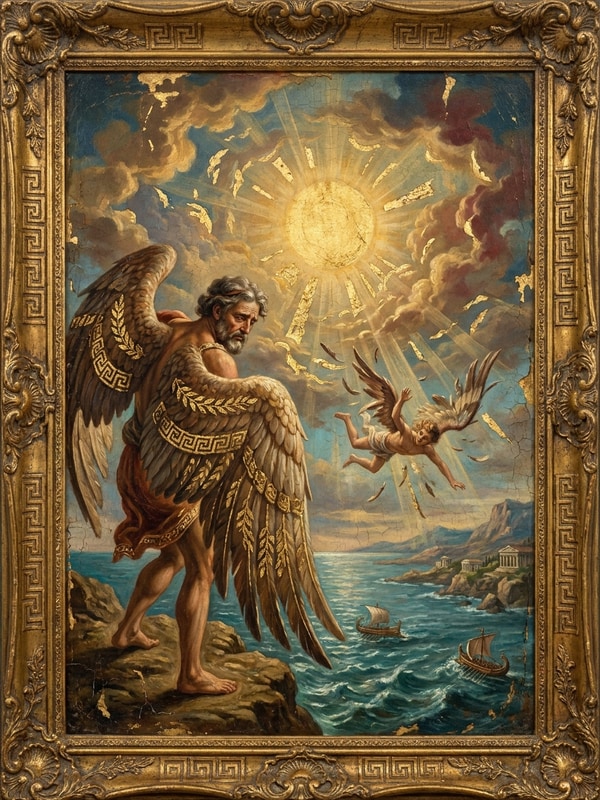
Daedalus was the cleverest craftsman in Athens, but jealousy drove him to a terrible crime. After fleeing to Crete, he was imprisoned by King Minos. With feathers and wax he made wings for himself and his son Icarus, and father and son flew away from the island. But Icarus forgot his father’s warning, rose too near the sun, and fell into the sea.
Article
Summary
Daedalus was born in Athens, a craftsman of astonishing skill, able to make devices ordinary people could scarcely imagine. He took on a gifted boy as his apprentice, and the boy soon showed remarkable talent, inventing tools such as the saw. Afraid that the child would surpass him, Daedalus pushed him from a height. When the crime came to light, he fled Athens and came to Crete. King Minos of Crete kept Daedalus at his court and put his skill to use. In time Daedalus built the winding Labyrinth, where the dreadful Minotaur was shut away. When the Athenian hero Theseus came to Crete, Ariadne received help from Daedalus and used a ball of thread to find the way out. When Minos learned of this, he was furious. He trapped Daedalus and his son Icarus on the island and forbade them to leave by ship. Daedalus looked at the sails on the sea and the birds in the sky, and he imagined a path of escape no one had ever taken. He gathered feathers and joined them with thread and wax into wings, testing them first himself before fastening another pair onto Icarus. Again and again he warned his son: do not fly too low, or the sea will soak the wings; do not fly too high, or the sun will melt the wax. At last father and son rose from Crete. At first Icarus followed close behind his father, growing steadier with every beat of the wings. But the joy of flight overwhelmed him, and little by little he climbed higher. The sun softened the wax, the feathers came loose one by one, and though he reached wildly for the air, he could grasp nothing. He plunged into the sea. Daedalus cried out his son’s name, but saw only feathers drifting on the water. From then on, that sea was called the Icarian Sea.
The Craftsman of Athens
In Athens there lived a man named Daedalus. He was not a king, nor was he a warrior, yet many in the city knew his name. Where other men saw wood and thought of firewood or roof beams, Daedalus saw hinges, oars, and the moving joints of statues. Where others took up a sheet of bronze and hammered it into a vessel, he could file it into fine teeth and make it bite into timber, cutting little by little through the hard grain.
People said the statues he made were so lifelike that, if no one watched them, they might walk away in the night. Such tales were surely exaggerated, but they show how famous his craft had become.
In time, Daedalus took a boy as his apprentice. In some traditions the boy is called Talos; in others he is called Perdix, a child of Daedalus’ own family. He was still young, but his eye was keen and his hand was steady. Daedalus taught him to polish, measure, and bore holes, and the boy learned quickly. Sometimes, before the master had finished speaking, the apprentice already understood what the next step must be.
One day the boy picked up a fishbone. He looked at the tiny teeth along its edge, and then at the spine of a snake, joint linked to joint, and an idea came to him. He took a thin strip of iron, cut close-set teeth along its edge, and tried it on a piece of wood. The sawdust fell away in layers, and the board was cut cleanly apart.
People gathered around in delight and said the child would one day become extraordinary.
Daedalus stood behind the crowd, and his face slowly darkened. He heard them praising the boy, but felt no joy. Instead it was as if a sharp thorn had lodged in his heart. He had been the most honored craftsman in Athens, and now a child who had only just begun to learn was already astonishing everyone. The more Daedalus thought on it, the more afraid he became—afraid that one day people would remember only the apprentice and forget the master.
Jealousy is like a hidden fire. At first it is only a small spark; then it burns until the heart is blackened.
A Push from the Height
Not long afterward, Daedalus led the boy up to a high place. The walls, rooftops, and distant roads lay below them, and the wind swept along the stones, snapping at their clothes. The boy suspected nothing. He thought his master had brought him there to see some new work.
But Daedalus waited until he was unguarded, and pushed him down.
The boy fell from the height. Some say Athena pitied his cleverness and changed him into a bird before he struck the ground, so that he skimmed away close to the earth. That bird, people said, never dared to fly very high afterward, but kept low among hedges and bushes, as though it still remembered the terror of that fall.
Yet Daedalus’ guilt did not vanish. Word of the deed soon spread, and Athens could no longer shelter him. He left his homeland, carrying with him both his skill and his troubled heart, and fled across the sea to the island of Crete.
The Labyrinth of Crete
The king of Crete was named Minos. His palace was broad and rich, with stone steps rising level by level, and courtyards filled with pillars, altars, and storerooms. Sea wind could blow through the open porticoes. When Minos heard of Daedalus’ skill, he received him and kept him at the palace to work.
Daedalus made many ingenious things in Crete, but the most famous of them was the Labyrinth.
It was no ordinary building. Inside were twisting corridors, walls behind walls, doors behind doors. Once a person entered, the way back seemed to disappear. Footsteps echoed between the stone walls. To the left there seemed to be an exit, but the path only turned into deeper shadow; to the right there seemed to be a dead end, but on coming near one found a narrow door. It had not been built for people to live in. It had been built so that they would lose their way.
In the depths of the Labyrinth Minos shut away the Minotaur, a monster half man and half bull. It had a human body and the head and horns of a bull; its breath came heavy, and it fed on human flesh and blood. Minos locked it inside so that it could not escape into the world, and so that those who entered would not easily come out again.
Many years later, the Athenian hero Theseus came to Crete, determined to enter the Labyrinth and kill the Minotaur. Ariadne, the daughter of Minos, fell in love with him and could not bear to see him die in those dark passages. She found a way to get Daedalus’ advice, and gave Theseus a ball of thread. Theseus tied the end of the thread at the entrance and let it unwind as he went in. After killing the monster, he followed the thread back into the light.
That the Labyrinth had failed to hold Theseus was a deep humiliation to Minos. He soon understood that only the maker of the Labyrinth could have taught someone how to escape it. In anger, Minos refused to let Daedalus go free. He imprisoned Daedalus and Daedalus’ son Icarus on Crete, and set guards over the harbors and ships.
The sea lay at the island’s edge, and sails could be seen far off, but they could not board a vessel. Every road and every quay was watched.
Seeing the Birds Pass Over
After Daedalus was trapped, he often stood on high ground and looked out to sea. By day the water shone; by night it turned black. Ships came from far away and went away again, but not one belonged to him. Minos controlled the land and the sea routes, as though the whole island had become another, larger Labyrinth.
Icarus was still young. He had not lived through as much as his father, and his heart moved between fear and wonder. He would chase birds in the courtyard and watch feathers drift down through the air; he would sit beside his father and watch him silently handle scraps of wood, lengths of thread, and lumps of wax.
One day Daedalus looked up and saw a flock of birds flying over the sea. They used no roads, relied on no oars, and feared none of Minos’ soldiers. The wind carried their wings. They crossed the water, crossed the cliffs, and flew toward the distance.
Daedalus watched them for a long time. Then he said softly, “Minos can close the roads. He can close the sea. But he cannot close the sky.”
From then on, he began to gather feathers. The larger ones he placed on the outside, the smaller ones within, layer upon layer like the wing of a bird. He bound the middle feathers with fine thread and fastened the bases with wax. The feathers were so light that one gust could scatter them; the wax was so soft that a thumbprint remained when pressed. Daedalus worked slowly, testing and changing each part bit by bit.
Icarus helped at his side. Sometimes he picked up feathers from the floor and held them in the sunlight; sometimes he rolled the wax into little balls and laughingly stuck them to the back of his hand. The boy did not yet understand that this thing concerned life and death. To him it seemed like a marvelous toy his father was making.
Daedalus did not laugh. He knew that if he made even the smallest mistake, what awaited them would not be a prison, but the bottom of the sea.
Wings of Wax and Feather
At last the wings were finished.
Daedalus first fastened one pair to his own shoulders. He stood on a low place, spread his arms, and leapt lightly into the wind. At first he merely glided a few steps and nearly fell; then he found the way of the air. The wings trembled, and his body was lifted. When he came down again and set his feet on the ground, there was light in his face for the first time.
Next he fastened the other pair of wings onto Icarus. The straps passed over the boy’s shoulders and chest, and the feathers spread along his arms. Icarus trembled with excitement and kept turning to look at his shadow.
Daedalus held him by the shoulders and spoke to him with great seriousness.
“Listen to me, child. You must fly after me. Do not strike out on your own. If you fly too low, the damp of the sea will weigh down the feathers. If you fly too high, the sun will soften the wax, and the wings will fall apart. Keep the middle way. Watch me, and follow me.”
Icarus nodded and promised.
Daedalus was still not at ease. He touched the seams of wax once more and tightened the knots. His fingers rested for a moment on his son’s shoulder, as if there were more he wished to say. In the end he only said, “Do not go too far from me.”
That day the wind by the sea was right. Father and son stood on a height. Behind them were the stone walls and palaces of Crete; before them stretched the wide sea. Daedalus leapt first. His wings opened, and the wind bore up his body. Icarus clenched his teeth and sprang after him.
In the next moment, the earth fell away beneath them.
Flying from Crete
At first, Icarus was filled with terror. The sea swayed below him, its white waves flashing like broken silver. The rocks grew smaller and smaller, and human voices could no longer be heard. By instinct he beat his arms; the wings carried him down and up again, and the wind roared past his ears.
Daedalus flew ahead, looking back at him and signaling with his body for him to steady himself. Icarus followed his father’s example. He let the wings glide with the wind, and little by little his panic eased.
They passed above fishermen near the island’s shore. The fishermen looked up and saw two winged figures crossing the sky, and in astonishment forgot to haul in their nets. Shepherds leaned on their staffs on the hillsides; sailors rested their oars. They thought gods were passing overhead. Daedalus paid them no attention. He kept his eyes on the sky and the surface of the sea, judging the wind and avoiding the clouds.
But Icarus grew happier and happier.
He had never seen the world like this before. The islands looked like stones floating on the sea; the fields like cloth spread open; the ships like tiny insects. The wind held him, the sunlight shone on him, and he no longer felt like a boy imprisoned on Crete. He felt like a true bird—almost like someone who might overtake the gods.
His father’s calls ahead of him were torn apart by the wind. He still remembered the warnings, but delight rose through him in waves and drowned out caution. He wanted to go a little higher and see farther; a little higher, closer to the clouds.
So he left the path behind his father and flew upward into the brighter sky.
The Falling Boy
Daedalus soon realized his son was no longer in his place. He turned and saw Icarus climbing, his wings flashing white in the sunlight.
“Icarus!” he cried.
The sea wind snatched the sound away.
The sun rose higher, and its light grew stronger. Still Icarus climbed. His face burned with heat, but he thought only of opening his arms toward the shining sky. Then suddenly he felt something loosen at his shoulder.
A feather drifted down beside him.
He glanced at it, but before he could understand, more feathers came free. The wax holding the quills had softened in the sun and slipped loose like melting honey. The wings no longer obeyed him. First one side sagged; then the other came apart.
Icarus panicked. He beat his arms with all his strength, but only ragged feathers and soft wax clung to them. The air slipped through his fingers, and his body plunged downward.
Only then did he cry out his father’s name.
Daedalus saw his son falling from the height and turned at once to fly toward him. But what human being can overtake a fall? The shadow of Icarus swept over the water, and the waves swallowed him. Only feathers remained, floating one by one on the surface, rising and falling with the swell.
Daedalus circled in the air, crying, “Icarus! Icarus!”
There was no answer. The sea held only wind and waves.
At last he came down nearby and looked out over that water, his heart hollowed out. It was not Minos’ prison, nor the darkness of the Labyrinth, yet it weighed more heavily than either. By his own cleverness he had made a path of escape, and with his own eyes he had watched his son die upon that path.
In later days, people called the sea where Icarus fell the Icarian Sea, and linked a nearby island with his name. Daedalus lived on, carrying his skill with him, and also the memory of the feathers scattered over the water that day. Whenever people told of the father and son who flew from Crete on wings of wax and feather, they remembered the boy who flew too high, and the father who called to him in the wind.