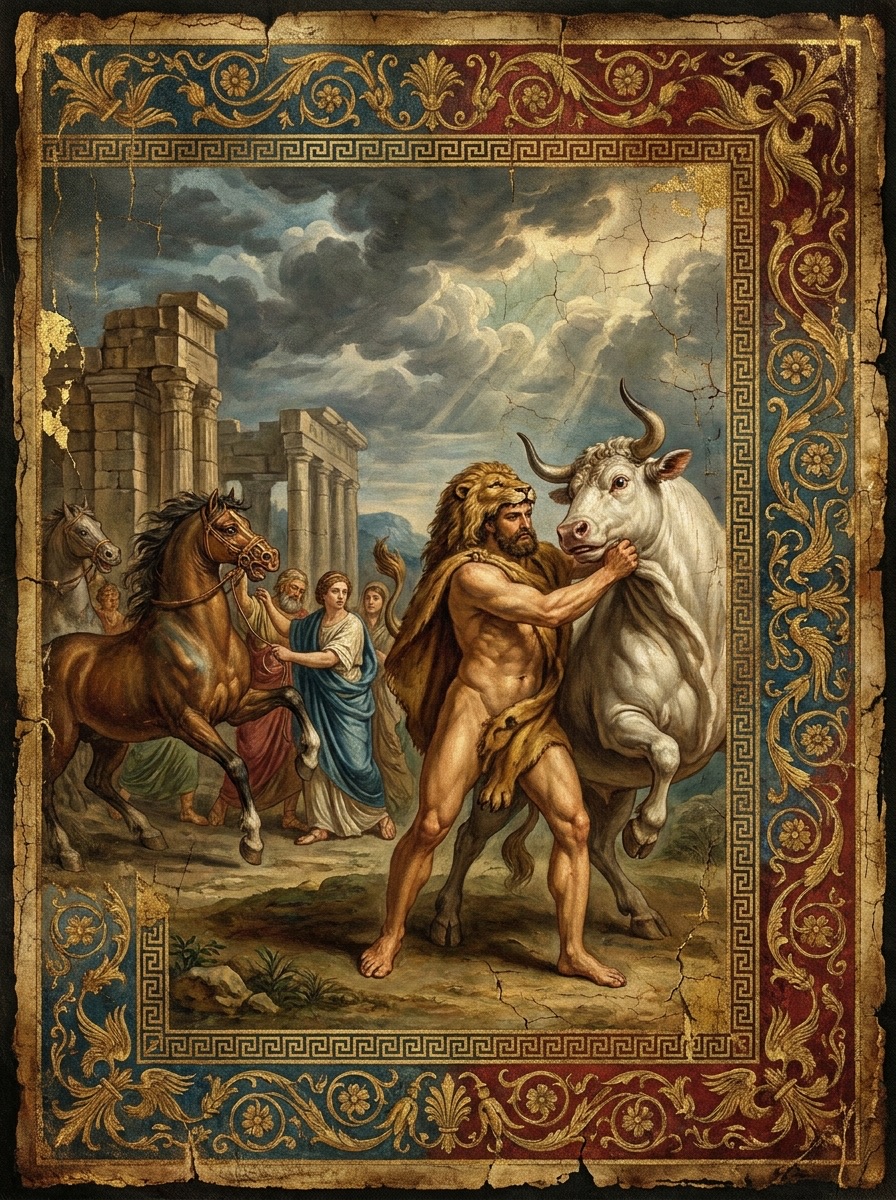
Greek Mythology
Cretan Bull and the Mares of Diomedes — Greek Mythology
Heracles is ordered to bring back the maddened bull from Crete and then sent to Thrace to seize the man-eating mares of Diomedes. Neither task can be won by strength alone: he must subdue wild beasts, face a savage king, and pay for victory with the loss of a companion.
Article
Summary
Again and again, Eurystheus sends Heracles on dangerous errands. This time he tells him to sail to Crete and bring back alive the bull that has been raging across the island. Heracles crosses the sea, meets King Minos, and sees for himself the beast that has thrown fields and villages into unrest. Minos refuses to send help, so Heracles follows the bull alone by the crushed crops, broken branches, and deep hoofprints it has left behind. When it charges in the open, he catches it by the horns and neck. Because Eurystheus wants the animal alive, Heracles uses neither sword nor spear. He subdues it with his arms, binds it, carries it across the sea, and leads it back to Mycenae. After the bull is delivered, Eurystheus soon sends him to Thrace for the mares of Diomedes. This Diomedes is not the Achaean hero of the Trojan War, but a savage northern king whose horses have been fed on human flesh. They no longer behave like ordinary mares; chained at their manger, they strain toward the scent and sound of people like beasts hungry for blood. Heracles and his companions break into the stables, loosen the mares, and drive them out. When Diomedes and his men come in pursuit, Heracles leaves the horses in the care of his young friend Abderus and turns back to fight. But the mares, long accustomed to blood, turn on Abderus and tear him to death before Heracles can save him. Grieving but still in battle, Heracles defeats the pursuers, captures Diomedes, and throws the cruel king to his own horses. After feeding on their master, the mares grow strangely calm. Heracles buries Abderus and leaves a memorial to him before taking the horses back to Eurystheus. The Cretan bull and the Thracian mares have both been brought in, but this victory is forever marked by the death of a companion.
The Bull Across the Sea
By the time Eurystheus gave this command, Heracles had already endured many terrible labors. This time, however, the king did not tell him to kill a monster, but to bring one back alive.
The bull was on Crete.
Crete lay ringed by the sea, its mountains rising from the shore into the inland hills, its palaces, harbors, fields, and pastures spread across the island. The bull had not always been an ordinary beast. Tradition said it had once emerged from the sea, bright in color and strong in limb, as though wave and foam had carried it ashore. But later it lost all restraint, plunging headlong through fields, overturning trees, and smashing fences. Whenever people heard its hooves in the distance, they would hurry their children indoors and bar the doors fast.
When Eurystheus learned how hard the bull was to master, he set the task before Heracles. He wanted not the hide, nor the horns, but the whole living animal. He wanted to see how Heracles would drag such a raging thing back from an island of the sea to Mycenae.
Heracles said little. He made ready a ship, crossed the water, and came to Crete.
Minos Refuses Him
King Minos of Crete knew at once why Heracles had come.
Heracles asked for his help. After all, the bull was rampaging through Crete, and the island’s own people knew its paths best and where it might be trapped. But Minos would not lend a hand. He gave Heracles no men and sent no hunters with him. He left him to take the beast alone.
To Heracles, such a refusal was nothing new. He was often sent into strange lands to face wild animals, bandits, poisons, and death with no army at his back and no ally at his side. So he left the palace and headed for the places where the bull was said to roam.
Its trail was easy enough to follow. Flattened crops lay matted in the mud, broken branches hung beside the road, and deep hoofprints marked the earth. Heracles followed them until at last he saw the bull in an open stretch of ground.
It lifted its head, nostrils flaring white with breath. Its horns curved forward, its neck was thick, and the dust beneath its hooves flew in every direction. When it saw him approach, it first stood still, then charged.
Heracles did not retreat.
As the bull came crashing toward him, he slipped aside from the horns and seized them and the neck with both hands. The beast twisted, kicked, and thrashed to hurl him off. It had strength enough to drag down fences and smash walls, but Heracles held it in a grip like iron. The ground churned beneath them, grass roots tore loose, and dust settled over Heracles’s shoulders.
He did not use sword or spear. Eurystheus wanted the bull alive, so Heracles fought it only with his arms and all the force of his body. Again and again the bull charged; again and again he wrenched it down. At last its breathing grew heavy, and its legs began to fail. Then Heracles pressed it to the ground, looped a rope around its head and horns, and forced the island’s terror to bow its neck.
Back to Mycenae
Once the bull was mastered, Heracles led it to the shore.
It was no easy matter to take a raging bull from Crete back to mainland Greece. The wind beat at the sails, the ship rose and fell on the waves, and the bull, tied aboard, kept stamping and lowing. The sailors stayed well away, fearing it might snap the rope and smash the planks.
Heracles stood guard beside it. Whenever the bull struggled, he caught the rope and forced it down again. The ship took a long time to cross the sea, but at last it came into harbor. From there, Heracles drove the bull all the way to Mycenae and brought it before Eurystheus.
When Eurystheus saw the living beast, he was both startled and afraid. He had hoped Heracles would be trapped on the island or killed beneath the bull’s horns; instead, here he stood with the bull in hand. Even now its eyes were fierce, and its hooves struck the ground as though it might charge again at any moment.
Heracles had completed the command. As for the bull, Eurystheus did not keep it to tame. It was later let loose and wandered on elsewhere. But for Heracles, the labor was done: he had brought back the living prize the king demanded.
Soon enough, a new command arrived.
The Stables of Thrace
This time Eurystheus ordered Heracles to fetch a set of mares.
Mares did not sound as terrible as lions, boars, or birds of prey, but these belonged to Diomedes of Thrace. This was not the Achaean hero of the same name from the Trojan War, but a savage king of the north. He lived by the Thracian coast, and in his stables stood mares of dreadful temper. They did not feed on hay or lower their heads peacefully to grain, but were given human flesh.
Diomedes threw foreign travelers to his horses. In time, the mares grew savage and ungovernable. Their teeth tasted blood, and the moment they heard a human voice, they grew restless. They were chained by iron at the manger, striking the ground with their hooves, their stall as grim as a slaughterhouse.
These were the mares Eurystheus wanted.
Heracles took companions with him and sailed to Thrace. The northern wind was cold, the shore broad with grass, and the sound of horses carried from far off. After landing, they approached Diomedes’s stable in silence.
Heracles saw the mares chained there, their manes wild, their eyes bright. As soon as they caught the scent of strangers, they strained at the iron and ground their teeth. Ordinary horses shy away from people; these lunged like beasts.
Heracles did not hesitate. He and his companions rushed into the stable, cut or loosed the bridles, and drove the mares out. Diomedes’s men soon discovered them, and cries broke out across the camp. The king came after them with his warriors, determined to take his horses back.
The Death of Abderus
Heracles could not both fight and hold the mares at the same time. He entrusted them to his young companion Abderus and turned to meet the pursuers.
Abderus was a friend Heracles loved dearly. He had traveled with him willingly and was ready to guard whatever dangerous thing was placed in his keeping. He held the reins and tried to keep the mares together. But they had been fed on blood for too long and would not submit to any man. Catching the scent of a human beside them, they suddenly went wild and leaped at Abderus with shrieks and snapping teeth.
The youth tried to hold them fast, but it was too late. Their teeth and hooves fell on him together, biting and trampling him to death. When Heracles looked back during the fighting, Abderus was already lying on the ground and could no longer answer him.
Grief seized Heracles, but the enemy was still before him. He hurled himself into Diomedes’s ranks, drove the pursuers back, and finally seized Diomedes himself.
Then came the most terrible moment of all.
Heracles dragged Diomedes before the very mares his cruelty had fed. The king who had once given countless strangers to his horses now stood before their manger in their teeth. The mares lunged and devoured their master.
After they had eaten Diomedes, they grew strangely calm. They no longer thrashed in the same frenzy, as though the blood-soaked hand that had nurtured their ferocity had been cut away, and the stench of the stable had begun to thin.
The Little City by the Sea
Heracles did not leave at once.
Abderus’s body still lay on the ground. The young man had not been slain by an enemy’s spear or sword, but by the very mares he had been set to guard for Heracles. Heracles buried him there and raised a tomb over his grave. Later, a city in that region came to be called Abdera, and people said its name was meant to honor Abderus.
Only after that did Heracles set out with the mares. He brought the once man-eating horses back to Eurystheus.
Again Eurystheus saw that Heracles had done the deed. The Cretan bull had been brought back, and so had the Thracian mares. Those labors had sounded like journeys into death itself: one beast raging across an island, the other fed on human flesh in a stable of blood. Yet Heracles had gone in and come out again with the answer.
The mares were not left in Heracles’s care forever. Tradition says they were later turned loose in the wild and finally died there.
As for Heracles, when he left Mycenae, he still remembered Abderus. Many great deeds are sung by men, but some names remain by way of dust, sea wind, and burial mound. The mares of Diomedes were taken away, the cruel king died before his own horses, and the young man who had held the reins for the hero stayed in the story from that day on.