Greek Mythology
The Cicones and the Lotus-eaters — Greek Mythology
After the Trojan War ended, Odysseus set sail for home with his fleet, only to suffer a counterattack in the city of the Cicones after his men lingered over plunder, and then nearly to lose the very desire for home in the land of the Lotus-eaters. These two encounters taught him that the dangers of the sea did not come only from spears and swords, but also from delay, indulgence, and forgetfulness.
Article
Summary
After Troy falls, Odysseus leads twelve ships away from the shore, hoping to bring Ithaca’s warriors home. The wind first carries them to Ismarus, the city of the Cicones, where the Greeks, still moving with the violence of war, storm the town, kill its defenders, and seize treasure, food, and wine. Odysseus quickly sees that they cannot remain there and orders his men back to the ships. Many of his companions ignore him, drawn by meat, wine, and the pleasure of dividing spoils on the beach. By morning, Ciconian reinforcements arrive from inland, numerous and skilled in open battle. The Greeks are forced to fight beside their ships from dawn until late day, and only after losing six men from every vessel do they cut the cables and escape. The fleet tries again to find the homeward course, but a violent north wind drives them far from their route for nine days and nights. Exhausted, short of water, and unable to read the sky clearly, they finally reach a soft and unfamiliar shore on the tenth day. Odysseus, wary of the land’s calm appearance, sends two men and a herald inland to learn who lives there. They come among the Lotus-eaters, who do not attack them but offer a sweet fruit. Once the scouts taste it, the desire for home slips away: ships, Ithaca, family, and Odysseus’ command all become distant and unimportant. They want only to remain among the Lotus-eaters and go on eating the fruit of forgetfulness. Odysseus understands that this gentle oblivion is more dangerous than open weapons. He drags the men back by force, binds them beneath the benches, and orders the whole crew to leave at once. The Cicones have shown the cost of greedy delay, and the Lotus-eaters reveal a quieter peril: the loss of the will to return. The voyage continues only because Odysseus still remembers that home must be reached.
The Fleet Leaves Troy
The flames of Troy slowly fell away behind them. Sea wind filled the sails, and at last Odysseus led his companions away from the land where they had fought for ten long years.
They were men of Ithaca. They had come as warriors, but they were not the same men now. Many carried wounds on their bodies; many carried the names of dead friends hidden in their hearts. Twelve black ships stretched across the waves. In their holds lay stolen bronze, garments, and weapons brought out from the battlefield. Every man longed to see again the hills and fields of home, his wife, his children, and the smoke rising from his own hearth.
But the road home did not open according to their wishes.
The wind drove the fleet to the land of the Cicones. Near that coast stood a city called Ismarus. Its people were allied in sympathy with Troy, and Odysseus and his men had only just come out of war. Their hands were still closed around weapons, and the fierceness of the battlefield still burned in them.
As soon as the ships touched shore, Odysseus led his men against the city. The Greeks cut down those who resisted, seized goods, and divided women and plunder among the ships. Cries rose through the streets, and smoke climbed between the roofs. To men who had just left a war behind, it seemed only one more swift raid.
The Delay on the Shore
Odysseus soon saw that they could not linger.
He knew that although the city had been taken, the Cicones would not accept defeat so easily. Their kinsmen and allies lived nearby. If word spread inland and reinforcements came, the Greeks would have the sea at their backs and their ships still drawn up on the shore. They would not be able to fight at ease.
So he urged his companions to board the ships.
“Go now,” he told them. “Load the goods, and while the enemy has not yet gathered, let us leave at once.”
But many would not listen. They had just won plunder, and they saw cattle, sheep, and wine by the shore. They slaughtered the animals and roasted meat on the sand. Some lifted cups of wine; some sorted the treasure allotted to them; some sat laughing beside the ships, as if, after years of hardship, they had at last seized a little payment for their suffering.
Again and again Odysseus called to them, but his voice was scattered by the wind and by the noise of the men. They thought the city had fallen, the enemy had been beaten—why hurry away like fugitives? They did not see the dust slowly rising in the distance. They did not hear the tread of men coming from inland.
By morning, the Ciconian reinforcements had arrived.
They came in great numbers from the interior and were skilled at fighting on the plain. As soon as sunlight touched the shore, the enemy drew up in dense ranks and pressed toward the Greek ships. Only then did Odysseus’ companions hurry to put on their armor, seize shields and spears, and form a line before the vessels.
The battle lasted from morning until the sun bent toward the west. The Cicones came on in wave after wave. Spears struck shields; dead men fell upon the sand; the edge of the sea was soon stained dark with blood. The Greeks were brave, but they were trapped by the shore and could not maneuver freely as they might have done on an open battlefield.
At last Odysseus had no choice but to order retreat.
Six men from every ship did not return. They too had once hoped to go home. Perhaps only the night before they had spoken of Ithaca’s vineyards and hearth fires, yet now they lay on a foreign beach, where no kin could gather their bodies. The survivors cut the mooring ropes and pushed the ships into the sea. The rowers clenched their teeth and pulled at the oars; sails bellied overhead; and only then did the fleet escape the pursuit of the Cicones.
As they left, the pride of victory no longer filled their hearts. The shore dwindled behind them, but the names of their dead companions remained aboard, heavy as stones in every man’s chest.
Nine Days of Storm
The fleet sailed on southward, trying to round the headland and find the familiar routes home. But the winds in the sky turned against them.
A violent north wind raised the waves and drove the ships again and again from their course. The sails snapped under the strain; the masts groaned; seawater crashed into the holds. The sailors lashed down their gear with ropes and bailed water with wooden scoops until their palms were raw, yet still they dared not stop.
For nine days and nine nights they were swept across the sea. By day they could see no trustworthy shore; by night even the stars were hard to read. Men slumped beside the oars in exhaustion, only to be slapped awake by spray. Food and fresh water dwindled little by little, and none of them knew where the storm had carried them.
On the tenth day, the wind at last eased. Far across the water a low strip of land appeared. The fleet drew near and saw no sign of city walls, no ordered army waiting on the shore. The climate was mild, the grass and trees quiet, as if a soft place had suddenly emerged from the storm.
Odysseus first sent his companions ashore to fetch water. After so much tossing at sea, they were desperate to drink and to stretch their stiffened legs. Fresh water was poured into skins, and voices returned for a while beside the ships.
But Odysseus did not dare trust a strange land too quickly. He chose two companions and sent a herald with them. They were to walk inland and learn what people lived there: whether they were violent enemies, or men willing to receive strangers.
The three left the shore and went in among the trees and grass.
The Men Who Ate the Lotus
That land was inhabited by the Lotus-eaters.
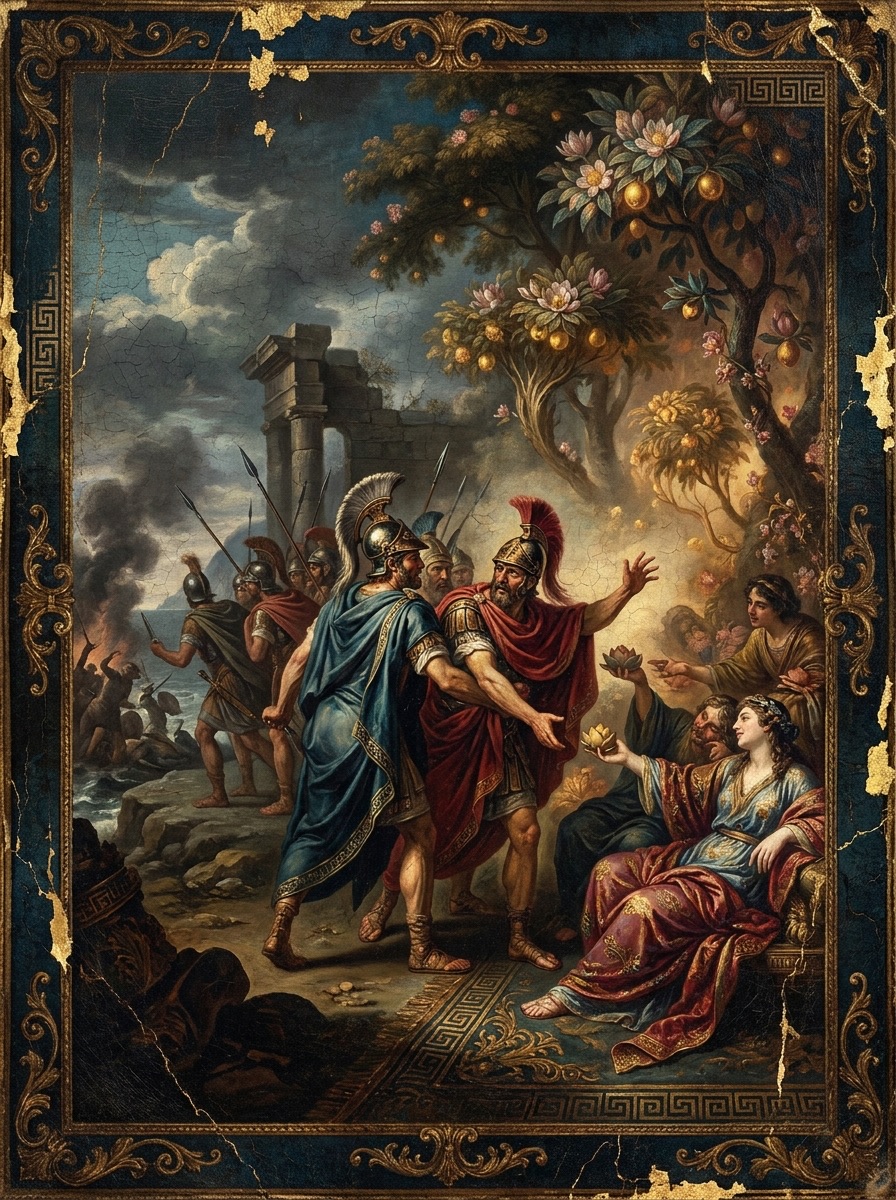
They did not raise weapons against the strangers or chase the foreign sailors away. Instead, they welcomed the men and gave them a sweet fruit to eat. It was soft on the tongue and fragrant with a soothing sweetness. After so much suffering at sea, the moment the sailors tasted it, the tightness in their hearts seemed to loosen like a knot.
They sat down.
The sound of the waves seemed far away. The ships seemed far away too. The doorways of Ithaca, the house of a father, a wife’s loom, a child’s face—all grew dim, as if seen through mist. The men who should have returned with their report suddenly no longer wished to travel on. They no longer longed for home; they no longer remembered Odysseus’ command. They wanted only to remain among the Lotus-eaters, to go on eating that sweet fruit, and to live there quietly.
Those by the ships waited a long time, but the three did not return. Odysseus grew uneasy and went himself with men to search for them.
When he found them, they were not bound, nor were they wounded. They were simply sitting there, calm-faced, like sailors who had forgotten who they were. They would not rise; they would not return to the ships. Someone urged them, “The vessels are still by the shore. Everyone is waiting for you.” But they only shook their heads, as though that were a distant and unimportant matter.
Odysseus saw at once that this fruit was more dangerous than swords.
If an enemy charged with a spear, a man knew to lift his shield. If a wave struck the ship, he knew to seize the rail. But this sweet forgetfulness made a man abandon the road home of his own accord, without even struggling. If they delayed any longer, more companions might be drawn away, until the whole fleet remained there and no one remembered Ithaca at all.
He wasted no more words.
Odysseus ordered his men to drag the companions away by force. They wept and struggled, unwilling to leave; some still reached back toward the fruit. Odysseus had them hauled to the shore, taken aboard, and tied beneath the rowing benches so that they could not leap overboard and run back.
The others shuddered when they saw it. A place that had seemed, only moments before, fit for water and rest now looked like a net spread in the dark. Odysseus ordered everyone aboard at once. No one was to linger, and no one was to taste the fruit.
The rowers returned to their places, and the wooden oars dipped together into the sea. The ships pulled away from shore, and the land of the Lotus-eaters slowly receded. The bound men still strained in the holds, murmuring that they wished to return to that gentle place. But the ships had already moved out over the water; the wind rose again, and spray broke over the prows.
Still Bound for Home
On the shore of the Cicones, Odysseus lost many companions. In the land of the Lotus-eaters, he nearly lost the desire that kept the rest of them alive—the desire to go home.
The first danger had been greed for plunder and feasting; the second was a sweet fruit that made men forget their homeland. The two seemed different, yet both pulled the fleet away from the road of return.
Odysseus did not stop. He made his companions row, and the ships went on. Ithaca still lay far across the sea, but as long as they remembered that they must return, the journey home was not yet broken.