Greek Mythology
The Ceryneian Hind and the Erymanthian Boar — Greek Mythology
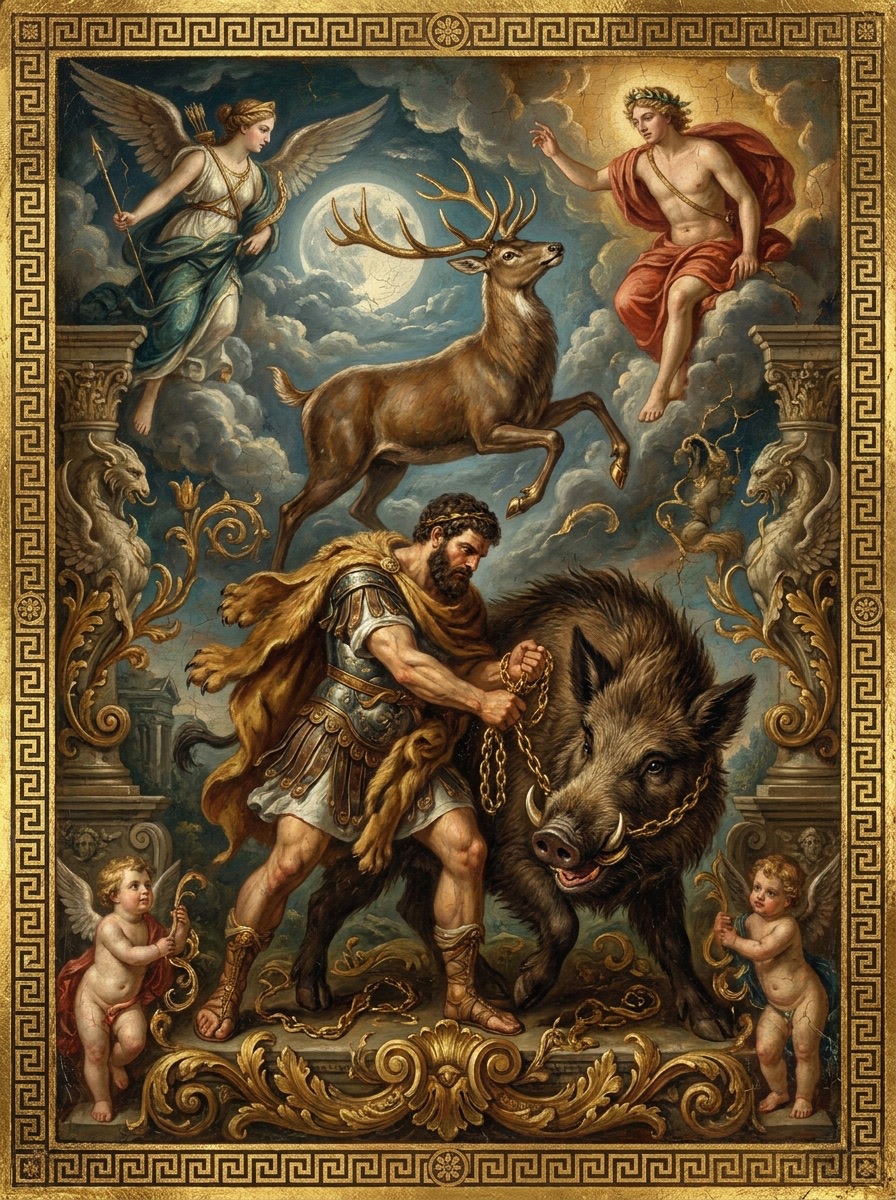
At Eurystheus’ command, Heracles first hunted the Ceryneian Hind sacred to Artemis, then captured alive the wild boar of Mount Erymanthus. Both tasks seemed at first to be mere hunts, yet each tested his patience, restraint, and strength.
Article
Summary
Heracles pursued the hind over mountains and through valleys, refusing to give up for a full year. At last he wounded it beside a river, but did not kill it. Artemis stopped him and demanded an answer; when Heracles explained that Eurystheus had forced the task upon him, the goddess allowed him to take the hind away for a time. When he reached Mycenae, Eurystheus wanted to keep the hind for himself. Heracles deliberately invited the king to take it with his own hands; then, the moment Heracles let go, the hind sprang free and fled back to the wild hills. In this way he fulfilled the command without betraying Artemis’ will. Afterward Eurystheus ordered Heracles to bring back alive the boar of Mount Erymanthus. On the road, Heracles visited the centaur Pholus. When a jar of wine was opened, other centaurs came raging to the cave, and the fight that followed brought grievous deaths from Heracles’ poisoned arrows. Heracles then climbed the mountain and drove the boar through deep snow. He forced it into the heaviest drifts, waited until it was trapped, then leapt upon it and bound it fast. Carrying the living beast back to Mycenae, he so terrified Eurystheus that the king hid in a bronze jar. Thus these two labors came to an end.
The Tracks of the Golden-Horned Hind
After Heracles killed the Nemean Lion and destroyed the Hydra of Lerna, King Eurystheus of Mycenae grew more uneasy than ever.
He had thought those monsters would be enough to drag the hero from Thebes to his death in the wilderness. Yet Heracles had returned, bearing the lion’s skin, and there was now about him a force that made men hesitate to meet his eyes. Eurystheus no longer wished to stand before him in person. Often he kept close to the great bronze jar in his palace and sent heralds out to speak in his place.
This time the task he devised was not the clean, brutal work of monster-slaying.
“Go and bring me the hind of Ceryneia,” the command came to Heracles. “Alive.”
This hind was no common deer of the hills. It had golden horns and swift feet, and it could race over rocky ridges and through tangled woods like a flash of light. Worse still, it belonged to the goddess Artemis. To kill it would be an offense against the goddess; yet to capture it without harming it seemed almost impossible. That was exactly the difficulty Eurystheus wanted: Heracles must obey, but in obeying he might bring down divine anger on his own head.
Heracles said little. He took up his bow, wrapped the lion’s skin about him, left the haunts of men behind, and made his way toward Ceryneia.
The paths narrowed as he climbed. Pines and oaks cut the sunlight into broken patches. Beside a stream he saw small hoofprints; in the damp earth he found grass bent by a light step. The hind had passed that way, but it had not lingered. It moved like a wind over stones and through thickets, leaving only a brief glimmer of gold far ahead.
Heracles did not rush to shoot. He knew this arrow could not be loosed as one might loose an arrow at a savage beast. If the hind died, he could not bring it back to Mycenae; more important still, Artemis would not forgive the slayer of her sacred creature.
So he began to follow.
The hind ran northward, and Heracles followed it over ridges and down into valleys. By day he watched for hoofmarks and broken branches; by night he rested against tree trunks, hearing wolves cry in the dark and rivers moving below him. Always, just as he drew near, the hind escaped. Its golden horns flashed once between the trees, and then it was gone.
Spring passed. Hot winds moved over the slopes. Then autumn rains came, filling the mud with fresh tracks. After that the cold set in, and frost whitened the grass. Still Heracles followed. Many men hunt with a burst of strength that soon burns out; he endured like a stone worn smooth by time, silent and unyielding.
The chase lasted an entire year.
One day the hind came to the bank of a river. The water was cold and swift, striking against the stones. For a moment it paused, perhaps from weariness, perhaps seeking a ford. Heracles at last came close. He drew his bow, but did not aim for the heart. He aimed at the hind’s leg.
The arrow flew and grazed the animal, leaving it unable to run for the moment. Heracles stepped forward at once and held it down. He did not draw a knife, nor break its horns. He lifted it carefully and bound it lightly with a cord, leaving it breath and life.
Just as he was preparing to take the hind back, the forest seemed suddenly to grow colder.
Artemis appeared. She held her bow in her hand, and about her seemed to move the clear air of the mountains. Apollo stood nearby. When Artemis saw the wounded hind, her face darkened.
“Heracles,” said the goddess, “why have you hurt my deer?”
Heracles did not boast, and he did not lie. He lowered his voice and answered, “Goddess, I did not come for my own desire. Eurystheus laid this task upon me, and I had to bring the hind for him to see. If I am guilty, it is because his command drove me here.”
Artemis looked at him, and then at the hind, still living. His arrow had not taken its life, and he had not acted like a hunter greedy for antlers or hide. Little by little the goddess’ anger eased. She allowed him to take the hind to Mycenae, provided it was afterward returned.
Heracles thanked the goddess, then set out again, bearing or leading the golden-horned hind on the road home.
Eurystheus Reaches for Nothing
When Eurystheus heard that Heracles had returned, he was both astonished and vexed. He had not expected this task—so difficult because the animal could neither be killed nor easily caught—to be completed.
He wanted to keep the hind as his own prize, or at least use it to humiliate Heracles further. So he declared that he would receive the animal himself.
Heracles remembered Artemis’ command and would not allow Eurystheus truly to possess the hind. He came before the palace with the animal beside him, its golden horns bright in the sun. Eurystheus sent men from his hiding place to take it, and perhaps even hoped to seize it with his own hands.
Heracles said, “If you want it, come and take it yourself.”
The instant he released his hold, the hind sprang away as if it had long been waiting for that very moment. Its wound no longer hindered its flight. Its four hooves skimmed the dust, and in a heartbeat it had burst through the crowd and fled toward the hills. Eurystheus’ outstretched hand closed on empty air, and he could only watch as the golden horns vanished into the distance.
Heracles, however, had fulfilled the order. He had caught the hind and brought it to Mycenae. That it had returned to the mountain woods of Artemis was exactly the outcome he had intended.
Eurystheus found no fault he could use against him, and so he had to devise another labor.
The Boar in the Deep Snow
Not long afterward, Eurystheus gave a new command: Heracles was to go to Mount Erymanthus and bring back alive the boar that haunted its slopes.
Mount Erymanthus was thick with trees and steep ground, and in winter the snow lay deep. The boar crashed through the mountain country, its tusks sharp, ruining fields and scattering livestock and men alike. It was no fleet sacred creature like the hind, but a black shape of rage. If met on a narrow path, it could overturn man and horse together.
Heracles took his bow and spear and traveled toward Arcadia. On the way he came to the dwelling of the centaur Pholus.
Pholus was unlike many of the wilder centaurs. He was gentle to guests, and when he saw Heracles coming from far away, he invited him into his cave to rest. Inside there was the smell of roasted meat, and there was also wine kept sealed away. The wine was not Pholus’ alone; it belonged to the centaurs in common, strong and fragrant, long stored in a great jar.
Heracles had traveled far and wished to drink. Pholus hesitated. “This wine belongs to all of us,” he said. “I do not dare open it lightly.”
Heracles told him not to be afraid, and Pholus broke the seal. As soon as the jar was opened, the rich scent drifted out of the cave and spread on the mountain wind. The centaurs nearby smelled it and grew furious. They seized stones, tore up pine branches, some carrying torches, and came rushing toward the cave with shouts.
They had not come to reason. They crowded the entrance, hurling rocks against the walls so that sparks leapt from the stone. Heracles took up his bow and fought them off. His arrows had been dipped in the poisoned blood of the Hydra of Lerna, and even a scratch from them could kill. One centaur after another fell, and the rest fled in terror.
In the confusion, the wise centaur Chiron was also wounded. Chiron should never have been Heracles’ enemy. He knew healing, music, and the arts of wisdom, and he had taught many heroes. But the poisoned arrow struck him, and pain would not leave him thereafter. Pholus, too, later examined one of the arrows, and by accident was wounded by its poison and died in his own cave.
Heracles was heavy-hearted, but he could not remain in the mountains. Eurystheus’ command still waited.
He continued upward toward Mount Erymanthus. The wind sharpened, snow clung to the branches, and the frozen ground creaked beneath his feet. The boar’s trail was not hard to read: torn earth, broken brush, deep confused hoofprints in the snow, all leading toward the higher woods.
At last Heracles heard harsh breathing ahead. The thicket shook, and a huge boar burst from the trees, its bristles standing high, its tusks smeared with mud and snow. The moment it saw a man, it lowered its head and charged.
Heracles did not meet it head-on. He turned and ran toward the deeper snow, shouting as he went, using voice and movement to enrage it. The boar thundered after him. Its great body plunged into the heavy drifts, and little by little it slowed. The more it struggled, the deeper its hooves sank. Snow dragged at its chest and belly, and its roar became a gasping snort.
This was the moment Heracles had been waiting for.
He turned and leapt upon it, pressing down its head and neck with his powerful arms. The boar thrashed wildly; its tusks scraped against the lion skin, and snow flew everywhere beneath its struggling feet. Heracles clenched his teeth, looped ropes around its legs, and bound it fast. When at last the beast could no longer move, he hoisted the living monster onto his shoulders and carried it down the mountain through the snow.
The King in the Bronze Jar
From far off, the people of Mycenae saw Heracles returning and hurried out of the road. No one wished to come near the Erymanthian Boar. Even bound, it twisted on Heracles’ shoulders, white breath steaming from its mouth, its tusks knocking again and again against the ropes.
When Eurystheus heard the news, terror seized him. He did not dare stand before the palace gates to inspect the completed task. Instead he scrambled into the bronze jar he had prepared for hiding. The jar had sheltered him before, and now it served him again.
Heracles carried the boar before the palace and set it down. The beast struck the ground with a heavy thud, splashing dust and melted snow across the stone pavement. The people inside cried out and drew back.
From within the jar came only Eurystheus’ frightened voice. He would not come out to look properly, and he would not admit his fear. He merely ordered his servants to send Heracles away.
Heracles stood outside and looked at the bronze vessel that held the king. Eurystheus had demanded a living boar, and Heracles had brought one. Eurystheus had tried to crush him beneath dangerous commands, yet each time the command only revealed the king’s own cowardice.
The Ceryneian Hind had returned to the goddess’ wild hills, and the Erymanthian Boar had been brought to Mycenae. Heracles said nothing more. He turned away from the palace gates, and the cries behind him slowly faded. The snow on the mountains, the chase through the woods, the goddess’ rebuke, and the king hiding in his bronze jar—these were the memories left by the two labors.