Greek Mythology
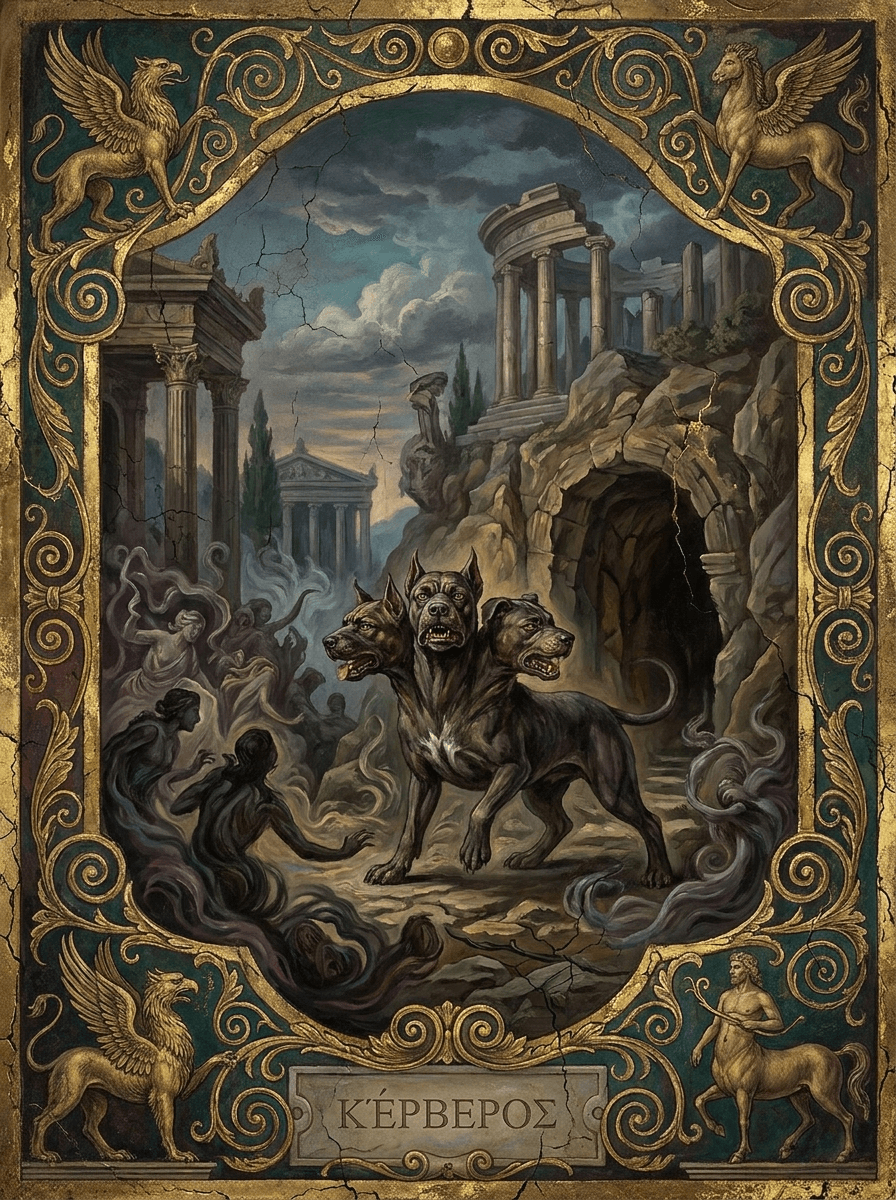
Cerberus — Greek Mythology
Eurystheus gave Heracles one final command: descend into the Underworld and bring the watchdog Cerberus alive into the world above. After purification and initiation into sacred rites, Heracles entered the dark realm of the dead, subdued the monstrous hound with his bare hands, and then, as promised, returned it to Hades.
Article
Summary
Again and again Eurystheus sent Heracles into deadly labors, yet none of them killed him. At last he devised a task that seemed almost impossible: Heracles must go down into the Underworld and bring back Cerberus, the watchdog of Hades.
The Last Labor
Eurystheus hid in his palace at Mycenae, listening as report after report came in: Heracles had returned alive. Each time, the king grew more uneasy.
He had hoped those labors would rid him of this terrifyingly strong man. The Nemean Lion had not torn him apart. The many-headed Hydra of Lerna had not poisoned him. The birds by the lake of Stymphalus, the bull of Crete, the man-eating mares of Diomedes, the girdle of the Amazon queen, the cattle of Geryon—none had brought him down. Instead, Heracles’ fame spread farther and farther. In many lands, when people spoke his name, they thought not of fear, but of the disasters he had driven away.
Eurystheus did not want it to end like that. He sat upon his throne for a long time, brooding, until at last he gave his final command:
“Go down to the Underworld, and bring me Cerberus, the watchdog of Hades.”
This was no hunt in the mountains, no raid to drive cattle from a distant shore. The Underworld was not a place the living could enter at will. There was no sunlight there. The shades of the dead drifted through darkness, and Hades and Persephone ruled over the land of those who had passed from life. Cerberus stood guard at the gate, keeping the dead from escaping back to the world above, and keeping the living from trespassing where they did not belong.
The hound had three heads, and from its open jaws foul spittle dripped. Serpents writhed along its neck and back, and its tail lashed like a dragon. Whoever came before it and heard its roar felt their knees weaken beneath them.
Heracles heard the command and did not argue. He knew this was the task on which Eurystheus most hoped he would fail. Yet he took up his lion skin and club, as he always did, and set out.
Purification at Eleusis
To enter the Underworld, strength alone was not enough. One could not walk into that place as though passing through the gates of an ordinary city.
Heracles first came to Eleusis in Attica. There the people honored Demeter and Persephone, and the priests knew the secret rites that stood between life and death. Heracles had once killed centaurs in the violence of battle, and blood-guilt still clung to him. Before he could descend to the realm of the dead, he had to be purified.
At Eleusis, the priests cleansed him of defilement. Clear water ran over his arms and chest, and the firelight before the altar shone upon his face. Afterward he was initiated into the mysteries, learning how to face the road that led to the country of the dead.
Heracles had met death before. But this time, he would go to the very threshold of death himself.
When all was ready, he traveled to Taenarum at the southern end of the Peloponnese. There the land looked out over a sullen sea, and people said that in the caves and clefts among the coastal rocks lay an entrance to the Underworld. Wind breathed from the black openings like a cold sigh rising from beneath the earth.
Heracles stood before the entrance. Hermes, guide and messenger of the gods, came to lead him, and Athena also gave him hidden help. Heracles bent his head and stepped down into the darkness under the stone. Behind him, the daylight grew farther away; beneath his feet, the path grew colder.
Shades in the Darkness
The deeper he went, the stiller everything became. There was no birdsong, no rustle of leaves, only dim shapes moving far off in the gloom.
Heracles came into the borders of the Underworld. The sorrowful dead saw a man of flesh and blood approaching and drew back. The scent of the living was strange to them. Some shrank into the shadows; others slid past him like mist.
Suddenly, a dreadful form stood in his way. Heracles recognized the ghost of Medusa the Gorgon and at once drew his sword to strike. Hermes quickly caught his hand and said:
“Do not swing your blade. The dead here are only shadows. Iron cannot wound them.”
Heracles lowered his sword and went on.
Before long he met the shade of Meleager. The once-brave hunter stood in the gloom, pale now and drained of the color of life, yet still bearing the dignity of a hero. He spoke with Heracles about his family, and about his sister Deianeira. Heracles listened closely and promised that, if he returned to the sunlight, he would remember what had been said.
Farther on, he saw two men trapped upon stone seats. They were Theseus and Pirithous.
In their arrogance they had once forced their way into the Underworld, intending to seize Persephone from beside Hades himself. Hades had not killed them at once. He had merely invited them to sit. But once they sat down, they could not rise again, as though stone and chains together had pinned them in place.
When Theseus saw Heracles, he stretched out his hand and begged for help. Heracles went to him, seized his arm, and pulled with all his strength. The stone seat groaned, and at last Theseus was torn free, as though a heavy shell had been ripped away from his body.
Pirithous too reached out to him. Heracles tried to save him as well, but suddenly the earth shook, and from the depths of the darkness came a terrible force. This was not a decree that even Heracles could shatter with a club. He had to stop. Taking Theseus with him, he left that place behind and continued toward the palace of Hades.
The Lord of the Dead Sets His Terms
The palace of Hades stood deep within the shadowed land. It did not gleam with the bright gold of palaces above the earth. There were heavy doors, cold stone steps, and shades wandering all around. Persephone sat beside the lord of the dead, like the shadow of spring beneath the ground, and also like a night that would never lift.
Heracles came before Hades and stated why he had come:
“Eurystheus has ordered me to bring Cerberus into the world above. I have not come to seize the throne of the Underworld, nor to release the dead. I ask only to take the hound for him to see, and then I will bring it back.”
Hades looked at him. The lord of the dead did not like living men entering his kingdom, and he liked still less the thought of anyone laying hands upon his watchdog. Yet Heracles had come this far without hiding and without lying. After a while, Hades consented, but he set a condition:
“You may take Cerberus. But you must use no sword and no club. If you truly have the strength, master him with your bare hands.”
Heracles nodded and laid down his weapons. He still wore the skin of the Nemean Lion, which no blade or spear could easily pierce. After so many perilous roads, it remained his surest protection.
He went toward the gate of the Underworld. Before he reached it, a deep growl rolled out of the darkness like thunder under the earth.
The Three-Headed Hound
Cerberus stood guard at the gate.
All three of its heads lifted at once, and six eyes fixed upon Heracles. The serpents along its back hissed and writhed. Its dragon-tail swept the ground, stirring up cold ash. It caught the scent of a living man and sprang.
Heracles drew no sword and raised no club. He waited until the hound rushed close, turned aside from the fiercest snapping mouth, and locked both arms around the middle neck. The other two heads lunged from either side. Their teeth scraped against the lion skin with a harsh grating sound. Venomous drool splashed onto the ground, smoking with a chill like black water.
Cerberus rolled and struggled with all its strength. Its tail lashed at Heracles’ legs, and the snakes upon its back coiled toward his arms. Heracles clenched his teeth and tightened his grip. His fingers dug into the hound’s coarse hair; his knee pressed against its chest, keeping it from finding its feet again.
The beast roared until the very gates of the Underworld seemed to tremble. The shades drew far away and dared not come near. Serpents bit Heracles’ arms, and the dog’s claws tore at his shoulders, but he would not let go. He knew that if he loosened his hold for even a moment, Cerberus would turn on him and drag him back into the depths of darkness.
The struggle lasted a long time. At last the hound’s roaring sank lower. One by one, its three heads drooped. It still panted, but it could no longer break free from Heracles’ arms.
Heracles fastened it with a chain and, with Hades’ permission, led it up from the Underworld toward the world of men.
Back into the Sunlight
They climbed the road by which he had come. The nearer they drew to the surface, the warmer the air became. Cerberus had never left the Underworld. When the first ray of sunlight struck its body, all three heads howled together, as though the brightness of the living world were hateful to it. Its claws scraped against the rock as it tried to retreat. Heracles gripped the chain with all his strength and dragged it out through the mouth of the cave.
Sea wind blew across the shore, and sunlight fell upon the lion skin. Heracles stood once more on the earth of the living, with the watchdog of the Underworld panting at his side.
He led Cerberus all the way to Eurystheus. When the people of Mycenae saw the three-headed hound from afar, they cried out and fled. Even the guards at the palace gate dared not approach; they only stumbled backward in fear.
Eurystheus had believed Heracles would never return. But now he heard the heavy tread and the monstrous barking, and his face turned pale. When he saw the three heads of Cerberus and the serpent-wreathed necks, he forgot all royal dignity and scrambled into the bronze jar he had prepared for himself, trembling inside it.
Heracles stood before the palace, holding the hound’s chain, and said nothing. The final labor was done.
Eurystheus did not dare keep Cerberus. He wanted only for it to vanish as quickly as possible. So Heracles, keeping the agreement he had made, returned the monstrous hound to the Underworld and gave it back to Hades. Cerberus took its place once more before the dark gate, barking at the dead and baring its teeth at the living.
From then on, Eurystheus could no longer torment Heracles with such labors. The long series of terrible tasks had come to an end, and the tale of how Heracles brought back the hound of the Underworld became one of the most astonishing of all his deeds.