Greek Mythology
The Cattle of Geryon — Greek Mythology
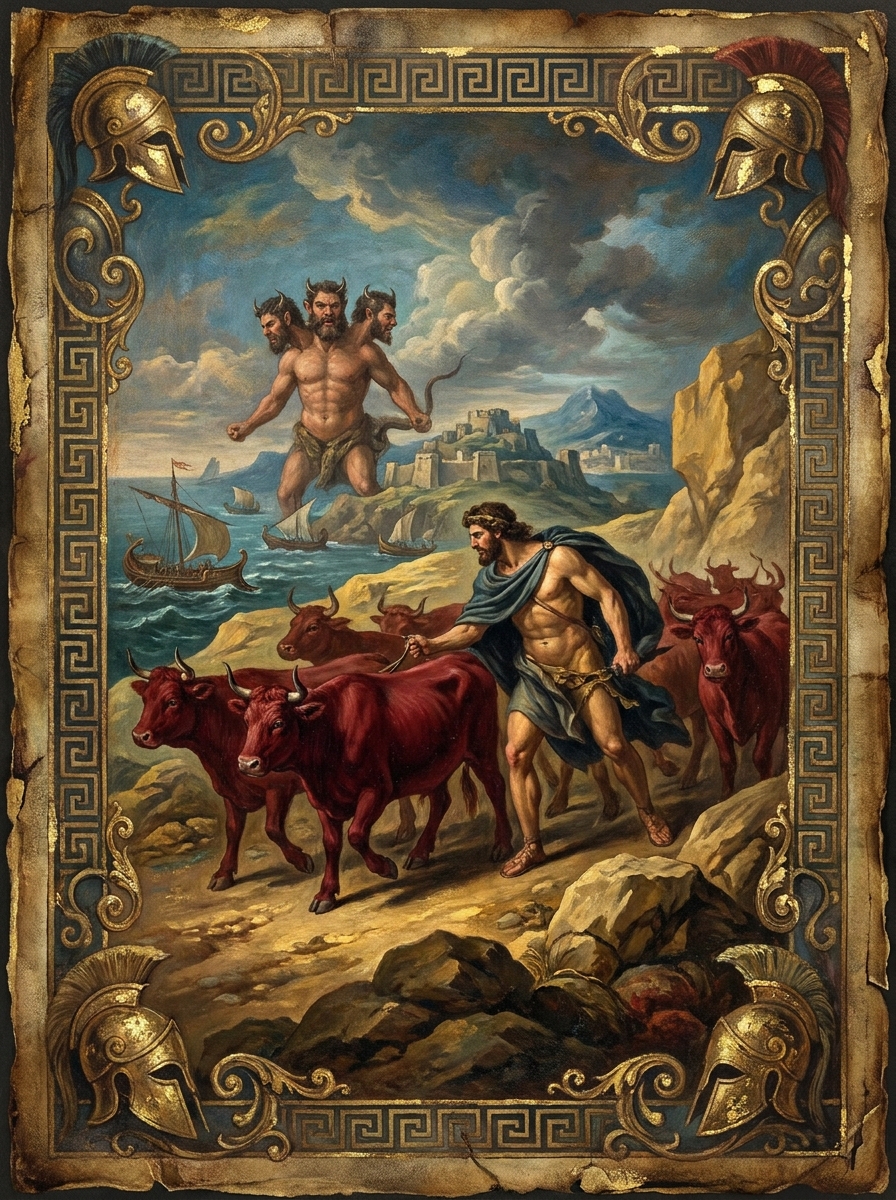
Eurystheus ordered Heracles to journey to the far western edge of the world and bring back the red cattle of Geryon, the giant with three bodies. Heracles crossed Libya and the sea, borrowed the golden cup of Helios, killed the watchdog, the herdsman, and Geryon himself, and at last drove the herd back to Mycenae.
Article
Summary
After Heracles brought back the belt of Hippolyta, Eurystheus devised a task even more distant and dangerous: Heracles must go to the island of Erytheia and return with the cattle of Geryon. Geryon lived beside the encircling Ocean. He had three bodies, and his red cattle were guarded by the two-headed hound Orthus and the herdsman Eurytion. No ordinary man would have dared even to approach them. Heracles traveled west through many lands and came to the heat and barrenness of Libya. There the giant Antaeus forced travelers to wrestle, drawing new strength from the earth whenever his feet touched the ground. Once Heracles understood the secret, he stopped throwing him down. He lifted Antaeus into the air and crushed him there, cut off from his mother Earth. Then he went on to the narrow sea passage at the western edge and set up the pillars later called the Pillars of Heracles. The cattle still lay beyond Ocean, where no ordinary ship could carry him. Scorched by the sun, Heracles raised his bow against Helios himself. The sun god did not punish him; he marveled at his courage and lent him the golden cup in which he crossed Ocean by night. Heracles sailed in that strange vessel to Erytheia, struck down Orthus the two-headed watchdog, killed the herdsman Eurytion, and began gathering the red herd toward the shore. Geryon soon came after him in armor, all three bodies moving as one, like three warriors joined into a single monster. Heracles did not let the giant close around him. He drew his bow and shot an arrow dipped in the Hydra's venom. Geryon staggered and fell, his three bodies unable to support one another. With no guardian left on the island, Heracles drove the cattle back across Ocean in the cup of Helios and reached the mainland again. The return was another labor in itself. Cattle could scatter, panic, or draw thieves wherever the road passed; Hera made the journey worse by sending a gadfly that drove the red herd in every direction. Heracles crossed mountains, rivers, and bays, guarded the animals by night, fought off those who tried to seize them, and recovered the lost cattle one by one. At last he brought the herd to Mycenae. Eurystheus had to admit the task was done, and the cattle from the far west were sacrificed to Hera.
The King’s New Command
Heracles brought the belt of Hippolyta back to Mycenae and laid it before Eurystheus. When the king saw that the hero had returned alive once more, he was not pleased. He gave Heracles no rest, but soon set him another command: he must go to the farthest west and bring back the cattle of Geryon.
These were no common cattle. Geryon lived on Erytheia, an island encircled by Ocean, close to the world’s end, where at sunset the sea seemed to burn red with bronze fire. Geryon himself was no ordinary giant. He had three bodies, three heads, and six hands; when he stood upright, he looked like a moving tower. His cattle, so the story went, were bright red in color and grazed in herds across the island meadows, watched over by the two-headed hound Orthus and the herdsman Eurytion.
Eurystheus did not send Heracles there because he truly expected the cattle to be brought home. He thought the distance, the sea, and the monster on the island would surely destroy him somewhere along the way.
Heracles heard the command and said little. He slung on the lion skin, took up his bow and arrows and his heavy club, left Mycenae, and set out toward the west.
Toward the Edge of the World
He passed through many lands until he came to Libya. There were bare stones there, hot winds, and wide empty stretches of sand. By day the sun seemed to press down from above, and the ground shone with heat; by night the wind moved through the dunes like some beast breathing far away.
In that country a giant named Antaeus waylaid travelers. Antaeus was a son of Earth, and so long as his feet touched the soil, strength flowed back into him. He delighted in forcing strangers to wrestle, killing them, and displaying what he had taken from them.
When Heracles met him, Antaeus opened his great arms as he always did and challenged him to fight. The two locked together, trampling deep pits into the sand beneath their feet. Heracles threw him down several times, but each time Antaeus touched the earth he rose again, stronger in the shoulders and back than before. Heracles soon understood the secret.
He stopped hurling the giant to the ground. Instead he seized Antaeus around the waist and lifted him clear into the air. Antaeus kicked and struggled, desperate to set his feet again upon his mother Earth, but Heracles’ arms tightened around him like iron bands. The giant’s strength ebbed away little by little, and at last he died suspended above the ground.
Heracles went on westward. He crossed coasts and wastelands and cleared the road of beasts that harmed travelers. At last he came to the narrow place of the sea, where the rocky shore of Europa stood on one side and the mountains of Libya on the other. There, tradition says, he set up two pillars to mark the western limit of his journey. Later generations called them the Pillars of Heracles.
The Golden Cup of Helios
Yet even after reaching the world’s far west, Heracles still had not come to Erytheia. The cattle lay beyond Ocean, where ordinary ships could scarcely cross. Worse still was the sun. It beat straight down from the sky, whitening the rocks and making the sea blaze so fiercely that a man could hardly keep his eyes open.
Scorched by the heat, Heracles grew angry. He looked up at the sun in the heavens, drew his bow, and aimed an arrow at Helios, as though he meant to shoot into the sky.
Helios saw this mortal daring to raise a bow against him in the furnace of noon. He did not punish him. Instead, he marveled at his courage. Each day Helios drove his chariot across the sky, and each night he returned to the east across Ocean in a great golden cup. He lent that cup to Heracles so the hero could cross the waters.
Heracles lowered his bow and climbed into the cup. It floated on the deep-blue Ocean like a little boat of gold. Waves rose and slid past its rim, and far away the line of sky and water became one. With his weapons in hand, Heracles let the golden cup carry him toward Erytheia.
The Red Cattle on the Island
At last Erytheia appeared upon the sea. There were grassy fields on the island, and rocks, and trees bent by the salt wind. The red cattle were grazing in the meadow, their horns shining in the sun, their backs dark as burnished copper.
No sooner had Heracles stepped ashore than Orthus, the two-headed watchdog, caught the scent of a stranger. It sprang out from beside the herd, both mouths opening at once to show its sharp teeth, its mingled roar like two wild beasts crying together.
Heracles did not retreat. He raised his club, waited until the hound leapt close, and struck it down with a single blow. Orthus fell to the ground, and neither head moved again.
Eurytion the herdsman heard the barking break off and came running at once. He carried weapons and meant to defend his master’s cattle. Heracles had no wish to waste time with him. He turned to meet him, and before the herdsman could drive him away, Heracles struck him down in the grass.
Suddenly the island was quiet, except for the frightened breathing of the cattle. Heracles gathered the red herd together and began driving them toward the shore. He knew their true master would soon come.
The Three-Bodied Giant Gives Chase
Geryon soon heard what had happened. He armed himself, and all three of his bodies moved together as he came after Heracles with weapons in hand. From a distance he looked like three warriors joined side by side into one being, his heavy steps making the ground resound.
Heracles halted near a river or by the shore and turned to face him. Geryon’s six hands moved at once, and spear and shield flashed in the sunlight. His three heads fixed on Heracles together, as if he meant to overwhelm him from three directions.
But Heracles did not lose heart. He drew his bow and set a poisoned arrow to the string. That arrow had been dipped in the venomous blood of the Hydra, and it carried a deadly chill. The bowstring sang; the arrow flew through the air and struck Geryon. The giant’s huge frame swayed. His three bodies could no longer support one another, and at last he crashed to the ground.
With Geryon dead, no one on Erytheia remained who could stop Heracles. He drove the red cattle to the shore and crossed Ocean again in the golden cup of Helios. The sea wind drove the waves; the cattle crowded uneasily in the narrow space, while Heracles shouted, used his club and ropes to keep them together, and finally brought them back to the mainland.
The Long Road Home
Taking the cattle was not the same as finishing the labor. Heracles still had to drive them all the way back to Eurystheus. Cattle cannot be carried over the shoulder like spoils of war. They startle, scatter, and run astray in unfamiliar places. Heracles passed through mountains, rivers, and bays, traveling by day and guarding the herd by night, keeping wild beasts from coming near and thieves from stealing them.
In some places, men heard that he was driving divine cattle from a far-off land and tried to seize them. Again and again Heracles beat them back. The road was long. The cattle’s hooves crossed dust, shallow water, and cold mountain tracks.
Later Hera brought him more trouble. She sent a gadfly to sting the herd. Maddened by pain, the red cattle suddenly scattered in every direction. Some fled into valleys, some ran along rivers, and some rushed out onto strange plains. Heracles had to chase them down and recover the lost cattle one by one. Under the burning sun he was covered in dust; in the dark of night he listened for bells and hoofbeats to find his way.
Once, too, he met resistance by a river, where men tried to stop him from bringing the cattle across. Heracles forced a passage by strength and drove the herd onward. After a long time, he finally returned to Greece and made his way toward Mycenae.
Cattle for Hera
Eurystheus had believed that this time Heracles would never come back. But once again the lowing of cattle sounded outside the city gates. One after another the red cattle were driven in, raising dust beneath their hooves. Heracles stood beside the herd, wearing the lion skin, his club still in his hand.
When the king saw him, he had no choice but to admit that the labor had been accomplished. The cattle brought from the western edge of the world were at last sacrificed to Hera.
Heracles received no peaceful reward for this deed. For him, it was only the end of another hardship. Yet ever after, when people told how he reached the far west, crossed the sea in the golden cup of Helios, and killed Geryon of the three bodies, they remembered how that red herd was driven all the way from the shore of Ocean back to Greece.