Greek Mythology
Cadmus Founds Thebes — Greek Mythology
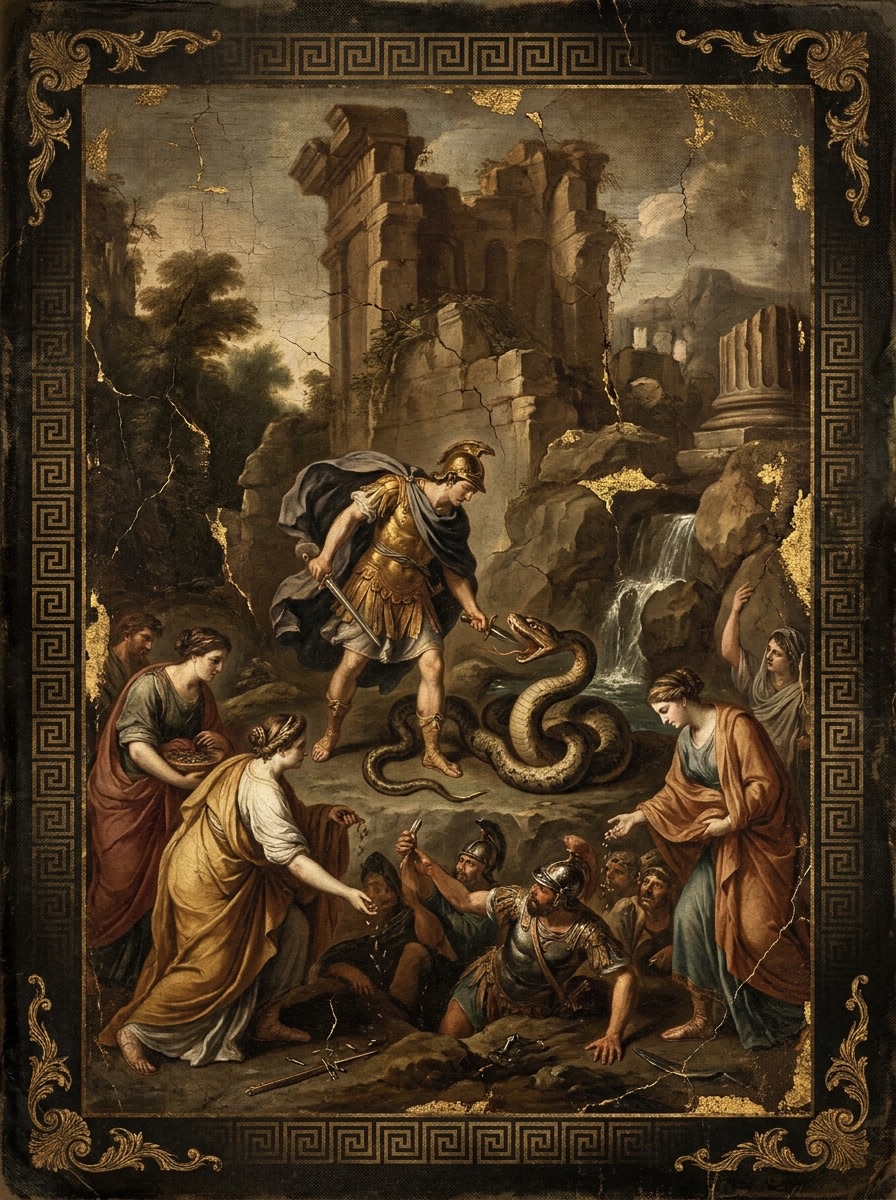
Cadmus, a Phoenician prince, was sent by his father to search for his sister Europa, whom Zeus had carried off. When the search brought him nowhere, he turned to the oracle at Delphi. There he was told to follow a cow, and where it finally lay down, he was to found a city. In that strange new land he killed a venomous dragon, sowed its teeth, and raised the city that would become famous as Thebes.
Article
Summary
Cadmus, prince of Phoenicia, was sent by his father Agenor to search for Europa, the sister whom Zeus had carried away. He wandered along coasts and through inland roads, questioning travelers, shepherds, and old men at city gates, but he found no certain trace. Unable to recover Europa and unable to return home empty-handed, he went to Delphi to ask Apollo’s oracle. The oracle did not tell him where Europa was. Instead, it ordered him to stop searching and follow a cow that had never worn a yoke. Cadmus obeyed and followed the animal over hills, grassland, and shallow water until it lay down in an open place in Boeotia. He understood that this was the land appointed by the god and prepared to sacrifice and found a city. For the sacrifice, Cadmus needed clear water, so he sent his followers to a nearby spring. When they did not return, he went after them and found the jars overturned, his men dead, and a dragon sacred to Ares coiled by the water. In grief and anger, Cadmus fought the monster with stone, spear, and sword until he killed it. Athena then appeared and told Cadmus to pull out the dragon’s teeth and sow them in the earth. The soil split open, and armed warriors rose from below, immediately turning against him. Following the goddess’s counsel, Cadmus threw a stone among them; they suspected one another and fought until only five remained. These survivors laid down their weapons and made peace with him. The five Sown Men helped Cadmus raise the walls of the city that would become Thebes. Because he had killed Ares’s dragon, Cadmus still had to serve the war god in atonement. When that service was over, he married Harmonia, and the gods themselves came to the wedding. Thebes was born from the failed search for Europa, but from the beginning it carried divine command, dragon blood, and the shadow of future family tragedy.
The Missing Sister
On the Phoenician coast there was a prosperous city ruled by King Agenor. He had several sons and one daughter, Europa. Young and beautiful, she often played with her companions among the flowers by the sea. Then Zeus set his desire on her. He took the shape of a gentle, splendid bull, carried her away from the shore, and bore her across the sea to a far-off land.
When the news reached the palace, Agenor was struck as if by lightning. He summoned his sons and commanded them to go at once and search for their sister. His word was harsh: until Europa was found, none of them was to return to Phoenicia.
Cadmus was among those sons. He set out with his followers and searched far and wide, along the coast and deep inland. One man claimed to have seen a strange white bull in a harbor; another spoke of a girl’s crying out at sea; others only shook their heads and said they had never heard the name. Cadmus questioned shepherds, sailors, merchants, and old men by the gates, but Europa seemed swallowed by the sea, leaving no sure trace behind.
Days passed. His followers grew weary, and their money ran out. Cadmus knew he could neither find his sister nor return home to face his father empty-handed. He refused to wander blindly any longer, and so he turned toward central Greece and came to Delphi to seek the oracle of Apollo.
The Oracle at Delphi
The rocks of Delphi rose high and stark, and cold water ran down from the cracks in the stone. Cadmus entered the shrine, made his offering, and asked the god where Europa was and what path he should take.
The oracle gave him no answer about his sister. Instead, it pointed him toward another fate. He was told to give up the search for Europa. Once he left the shrine, he would meet a cow that had never worn a yoke or felt the plow. He was to follow it, never driving it, never turning it aside. When it grew tired and lay down, there he was to build a city.
Cadmus listened in astonishment and silence. He had come asking for his sister, but the god told him to abandon that hope. Yet no other road was open to him, and he could only obey.
He left Delphi and, as the oracle had promised, soon saw a cow on the road. No rope marked its neck; it walked with an easy step, calm and untamed. Cadmus did not go near it, but kept his people at a distance behind. The cow crossed grassland, went down slopes, forded shallow water, and moved on along a rich plain. The sun climbed high and then began to sink, yet still it walked slowly on, as if it knew exactly where it was headed.
At last it reached the land of Boeotia and stopped in an open place. It lowered its head to sniff the grass, folded its legs, and lay down quietly on the earth.
Cadmus looked about him. There were plains, springs, and a height fit for a stronghold. The oracle had come true. He decided to offer sacrifice there, thank Apollo, and ask the land to receive him.
The Dragon by the Spring
The sacrifice needed water. Cadmus sent his followers to a nearby spring. They left with bronze jars and water skins, and a long while passed without their return.
At first Cadmus thought they had simply stopped to rest by the spring. But after more time had gone by, there was still no sound from the woods, no steps, no voices. Uneasy, he took up his spear and sword and went after them.
The spring lay deep in the shade of the trees. The ground was damp, and drops of water clung to the blades of grass. When Cadmus came near, he saw the bronze jars overturned on the ground, water spilled everywhere, and his men strewn beside the spring, their bodies covered in blood.
A huge dragon coiled by the water. Its scales shone against the wet stone. Its back arched, and its serpent body wrapped around the spring’s mouth. Its eyes burned like embers. When it opened its jaws, sharp teeth gleamed, and a poisonous breath poured out so fiercely that the leaves seemed to shrivel before it.
Cadmus was struck by grief and rage. He seized a great stone from the ground and hurled it at the dragon. It struck the scales with a heavy blow, but did not kill it. The dragon lunged at him at once, sweeping down trees with its tail and snapping its jaws at him. Cadmus leaped aside and drove his spear into it. The spear sank between the scales, and the dragon writhed in pain, churning the spring water to mud.
It wound itself around the spear and tried to twist the weapon from his hands. Cadmus did not retreat. He drew his sword, waited until the dragon reared up, and then rushed in to plunge the blade under its throat. The creature struggled for a long time, smashing stones and breaking branches, until at last it fell beside the spring. Black blood ran through the earth into the grass, and only the sound of rough breathing remained.
Cadmus stood before the dead dragon, his body smeared with mud and blood. He gathered his followers’ bodies, then lifted his eyes to the strange sky above him. The city had not yet been built, and already he had paid dearly for the land.
Sowing the Dragon’s Teeth
Then Athena came before him. Her arrival was not noisy, but like a clear light falling through the trees. She told Cadmus that the dragon belonged to Ares, and its body could not simply be abandoned. She then ordered him to pull out its teeth and sow them in the earth.
Cadmus dared not disobey a divine command. He knelt and took one sharp tooth after another from the dragon’s jaws. They were cold and hard as stone, still stained with poisonous blood. He cut shallow furrows in the ground, scattered the teeth into them, and covered them with earth.
At once the soil began to move.
First there were fine cracks, then something rose from below, pushing upward through the ground. Cadmus gripped his sword and stepped back. One hand after another broke through the earth, clutching shield and spear; then came helmets, breastplates, shoulders, and whole bodies. In a moment the field was full of armored warriors. They were neither infants nor boys, but men fully grown the instant they emerged from the soil, fierce-faced and armed with bronze.
As soon as they saw Cadmus, they raised their spears as if to kill him on the spot. Cadmus stood alone before them and knew that if he fought them head-on, he would die. Athena gave him a thought. He picked up a stone and flung it into their midst.
The stone struck the ground. At once the warriors cried out at one another. “Who hit me?” “Who struck first?” Newly born from the earth, filled only with rage, they would not stop to think. One stabbed the man beside him; the other answered with his shield and sword. Spears rang against breastplates, blades struck helmets, and those who had risen together from the same soil were suddenly killing one another.
Cadmus did not join the fight. He only watched as shouts, clangs of bronze, and the thud of falling bodies echoed across the clearing. After a long while the dust settled, and the ground lay strewn with armored corpses. Only five warriors remained standing.
At last they put down their weapons and made peace with Cadmus. Later they came to be called the Spartoi, the Sown Men, because they had sprung from the dragon’s teeth buried in the earth. They became Cadmus’s first companions and helpers, and the ancestors of noble houses in Thebes.
Raising the Walls
Cadmus did not forget the oracle. He marked the place where the cow had lain down as the center of the new city, and on higher ground he chose a site for the stronghold. The five men born from the earth helped him carry stones, measure the land, and set up the gates. The wild grass was cleared away, stone was stacked layer upon layer, wooden posts were raised at the entrances, and altars were built as well.
That city would later be called Thebes. Its upper citadel often bore Cadmus’s own name, the Cadmeia. From a prince searching for his lost sister, Cadmus had become the founder of a city.
Yet the dragon’s death did not end there. The beast had been sacred to Ares, and Cadmus had slain it, so he had to pay the war god back for the deed. According to the tale, he served Ares for many years, enduring punishment like a servant in the god’s house. Only when his time of atonement was over did the gods allow him to settle in peace.
Later, Cadmus married Harmonia. She was the daughter of Ares and Aphrodite. Their wedding was held in the new city, and the gods themselves came to the feast and brought gifts. That day there was song in the streets of Thebes, firelight in the houses, cups full of wine, and the splendor of a king and queen newly made.
Cadmus no longer wandered the coast in search of a distant rumor. He had not brought Europa home, but under the guidance of the oracle he had left behind a city. Its walls stood on Boeotian ground, and the descendants of the dragon’s teeth lived within them. Many years later, Thebes would know heroes, royal houses, prophecies, and wars. But its first story begins with a prince who lost his sister, a cow that lay down at last, a spring in the woods, and dragon’s teeth sown into the earth.