Greek Mythology
Brothers in Duel — Greek Mythology
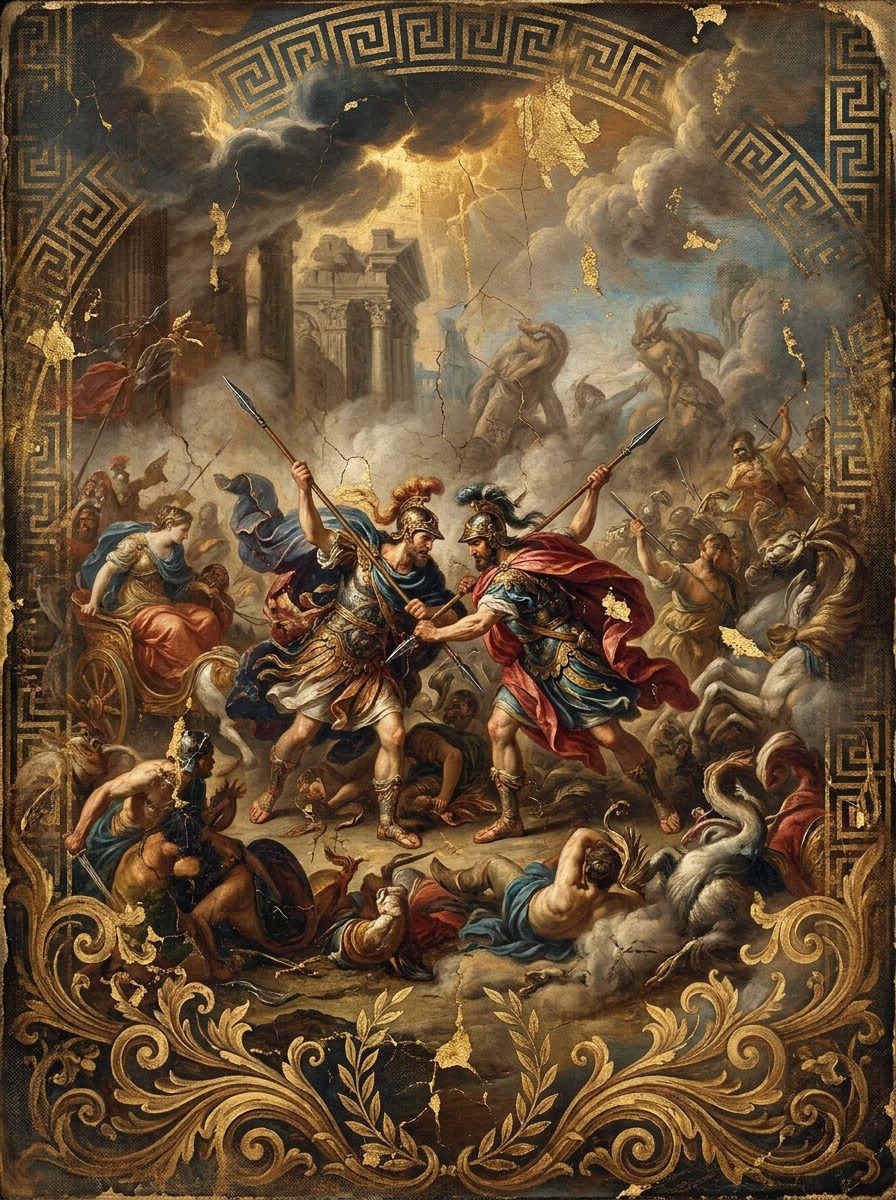
At the end of the Seven’s assault on Thebes, Eteocles and Polynices meet before the gate. Their duel ends with both brothers dead and the city divided over burial.
Article
Summary
By the time the Argive army reaches Thebes, the brothers’ quarrel has become a public war. Their mother tries to draw them back from ruin, but the battle at the seven gates drives Eteocles and Polynices toward each other. In the duel that follows, each kills the other, and the curse of Oedipus’ house passes into the question of burial.
Before the Gates
The earlier quarrel over the throne had already done its work. Polynices had found allies in Argos, and Eteocles had chosen to hold Thebes by force. By the time this story begins, the private dispute has become a siege, and the brothers can no longer speak as men inside one house. They face each other through walls, armies, and the old curse of their father.
The Mother Before the Gate
Thebes soon heard that the enemy was coming.
People climbed the walls and saw dust rolling in the distance, horses neighing, bronze shields flashing together under the sun. Women ran to the temples, clung to the images of the gods, and prayed to Athena, Ares, and all the powers that guarded the city not to let enemy fire enter their homes. Old men stood in doorways, murmuring about the ruin of Oedipus’ house, saying that this war was like a buried fire that had at last broken through the ground.
Eteocles would not yield. He put on his armor, called his captains together, and assigned men to defend the city. Thebes had seven gates, and the enemy had seven leaders; so he set a champion at each gate. He listened to the scouts’ reports: which enemy stood before which gate, what device was painted on his shield, what oath he shouted before the walls.
At last the scout came to the seventh gate.
There stood Polynices.
He carried his shield and stood with the Argive army, openly challenging his own brother. He had not come to slip around the walls, nor merely to ask for terms. He had come to reclaim the kingship at the gate of his native city.
When Eteocles heard this, his face darkened. He resolved to defend that gate himself.
Some urged him not to go. For brother to kill brother was an evil thing, and the house of Oedipus already carried too much blood and grief; it must not let two men born of the same father settle their cause with swords beneath the walls. But Eteocles’ heart was caught as if on an iron hook. He said the enemy stood outside the city; if he did not go, he would seem afraid of his brother. If he gave way, Thebes would fall into the hands of a foreign host.
In another ancient telling, aged Jocasta was still alive. When she heard that her two sons meant to fight outside the gate, she hurried between them. She had already lost her husband and endured the shame of the royal house; now all she wanted was to keep her sons alive.
She saw Polynices coming from the camp, and Eteocles coming out through the gate. One wore the armor he had brought back from exile; the other wore the armor of a king. Across dust and spears, they faced each other.
Jocasta stretched out her hands and clung to them. She begged them to remember the same mother, the same roof, the same table at which they had eaten as children. To Eteocles she said that a throne could not preserve a man’s life. To Polynices she said that even if he won, to bring foreigners against his homeland would leave blood no water could wash away.
Polynices answered that he asked only for the year that had once belonged to him. Eteocles answered that once he surrendered the kingship, Thebes would fall into still greater disorder. As they spoke, old bitterness rose again, and their words cut at each other like knives.
Their mother’s pleading could not stop them.
The Battle at the Seven Gates
The battle flared outside the city.
The Argive trumpets sounded. Chariots rushed forward, their wheels grinding over the hard earth. The attackers lifted their shields and advanced toward the gates; the defenders hurled stones and javelins down from the walls. Bronze clashed on bronze until men’s ears rang. Frightened horses reared high, and dust mixed with sweat and the smell of blood struck men in the face.
At each of the seven gates, a fierce struggle raged.
Some leaders shouted boasts, vowing to burn Thebes to ash. Others advanced in silence, waiting only for the moment when they could mount the battlements. The Theban defenders did not give way. They knew that if a gate broke, the old men, wives, and children in their homes would fall into enemy hands. So they braced the bars, pressed their shields together, and held their posts beneath arrows and stones.
Eteocles came to the gate where Polynices stood.
The wind before that gate seemed colder than elsewhere. The brothers faced each other across ground trampled by feet and wheels. Behind Polynices stood the chariots and standards of Argos; behind Eteocles rose the walls of Thebes and the men who defended them. Both knew that no one else could now bring this matter to an end for them.
Once more, some begged Eteocles to return within the city and let another captain meet the challenge. Others urged Polynices to step back, withdraw the army, and submit the quarrel to the gods. Neither brother listened.
They came forward and raised their spears.
Brothers in Duel
When the duel began, those around them drew back.
Their shields struck first, with a heavy, muffled sound. Spears slid out past shield-rims and were beaten aside. Dust rose under their feet as they circled, each watching the other’s shoulder and wrist, searching for a single opening.
Eteocles attacked first. He lowered his shield and drove his spear toward Polynices’ chest. Polynices turned aside; the spearhead scraped along his armor with a harsh shriek of metal. He answered at once, aiming his own spear beneath his brother’s ribs. Eteocles knocked it away with the edge of his shield. The blow numbed his arm, but he did not retreat.
They had grown up in the same palace. Perhaps they had once trained together, learning each other’s favorite movements. That made the fight more terrible than any struggle against a stranger. Every feint might be seen through; every hesitation might be death.
When their spears broke, they drew their swords.
The blades were shorter now, and the distance between them narrowed. Their breathing grew heavy. Sweat ran down from beneath the rims of their helmets. Polynices swung at Eteocles’ shoulder; Eteocles raised his shield, caught the blow, and thrust forward in the same motion. The sword-point found a gap in the armor and entered Polynices’ body.
Polynices staggered, almost falling to one knee.
A cry went up from the walls of Thebes, and the Argive ranks stirred in alarm. Eteocles thought the battle decided and pressed closer. But the wounded Polynices did not yet fall. With the last of his strength he steadied himself, and when Eteocles came near, he thrust out his sword.
That stroke also found its mark.
Eteocles’ body stiffened. The shield in his hand slowly drooped. Almost together, the two brothers fell into the dust. Blood ran from beneath their armor and sank into the soil of the homeland they shared.
For a moment the gate was terribly still.
Men who had been shouting for slaughter looked down at the two bodies on the ground. Eteocles had not saved himself; Polynices had not regained the throne. One died defending the gate, the other outside it. The kingship they had fought over for a year had come at last to two bloodstained swords and two fallen shields.
If Jocasta was there, then when she saw her sons fall one after the other, her heart broke with them. The story says she drew a sword beside their bodies and killed herself, collapsing between them. So another layer of blood was added to the house of Oedipus: mother and sons dead in the same calamity.
The Bodies Left After Battle
After the brothers died, the war too reached its end.
Most of the Argive leaders were killed. Amphiaraus, while retreating, was swallowed by a cleft in the earth. Adrastus escaped in his chariot and became one of the few survivors. Thebes was not taken, but there was no shout of triumph in the city. Those who had held the gates looked at their dead king and knew this was no victory worth celebrating.
The bodies of Eteocles and Polynices were carried away, one toward the city, the other beyond it. One was called the king who had defended Thebes; the other, the traitor who had led an army against it. Yet they had been sons of the same father and brothers born of the same mother.
Creon, the new ruler, stepped forward to settle the aftermath of the war. He ordered the Thebans to bury Eteocles with honor, as a hero and guardian of the city. As for Polynices, Creon decreed that he was not to be buried, not to be mourned with rites. His body was to be left outside the walls for birds and wild dogs to tear.
When the order spread, people in the city whispered among themselves, but none dared oppose it openly. The war had only just ended; blood still marked the gates; no one wished to invite danger before the new king.
Only Antigone heard the command and found no peace in her heart.
What she saw was not merely the corpse of a traitor, but the body of her brother. Whatever wrong he had done, whatever disasters he had brought, the dead still ought to return to the earth, and kin still ought to scatter a handful of dust over kin. But that belongs to the beginning of another sorrowful story.
On the day the brothers fought, Thebes kept its walls, but lost both sons of Oedipus. The dust outside the gate drank their blood dry, and buried the quarrel over the throne into a deeper hatred.