Greek Mythology
The Bow Contest — Greek Mythology
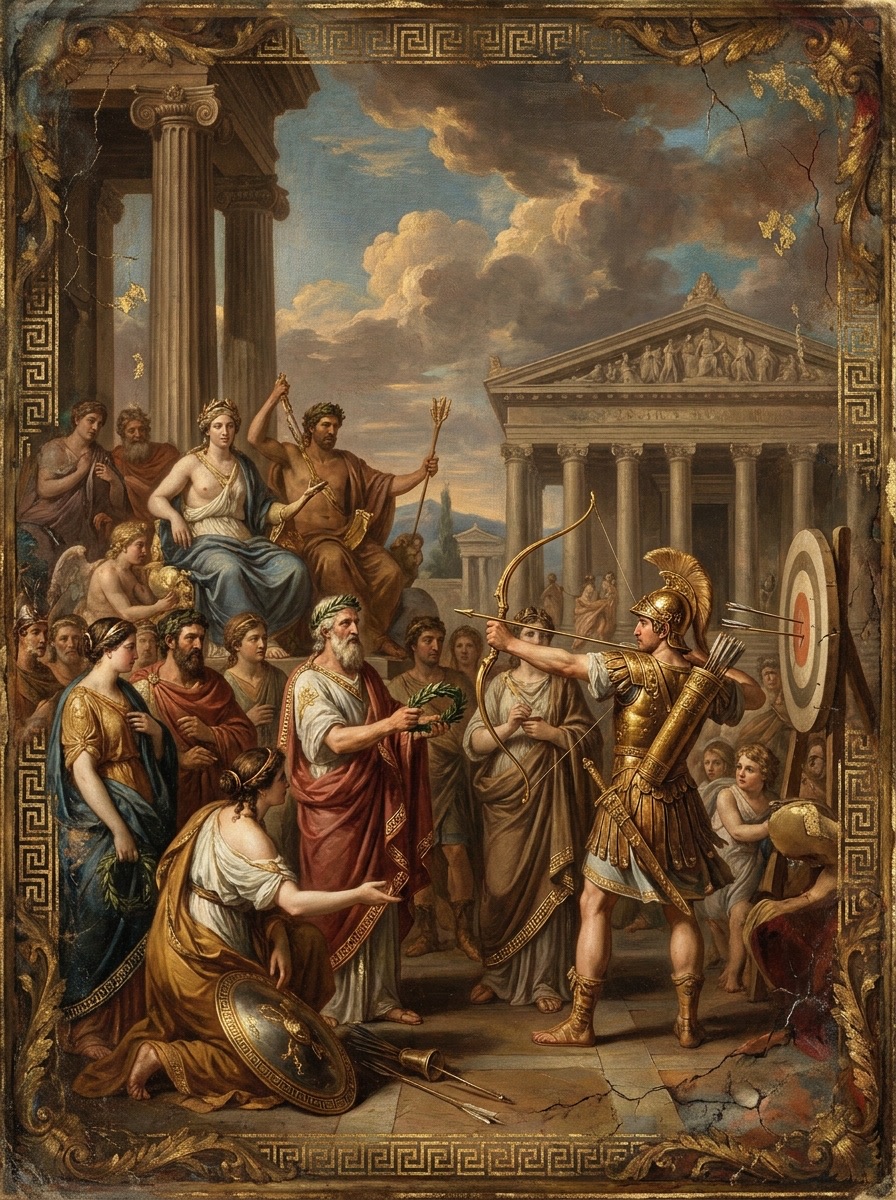
Pressed by the suitors until she can delay no longer, Penelope decides to bring out Odysseus’ great bow. Whoever can string it and send an arrow through the holes of twelve axes, she says, shall be her husband. Odysseus, disguised as a beggar, sits in the hall and watches them fail one by one—until at last he takes up his own bow and looses the first arrow of his return.
Article
Summary
In the palace of Ithaca, the suitors feast day after day, slaughtering sheep, drinking wine, and pressing Penelope to marry again. Penelope knows she can no longer delay forever, so she proposes a contest: bring out Odysseus' hard old bow, set up twelve axes, and let the man who can string the bow and shoot an arrow through the axe-holes lead her away from the house. The next day she personally brings the bow from the storeroom. It is one of Odysseus' old possessions, hard and dry with age, and only someone who knows it well can string it properly. She also has the twelve axes set in a straight line, their holes aligned to form a narrow path for the shot. The suitors try the bow one by one, but none of them can bend it. Some warm it by the fire, others smear it with fat, and all of them strain before the whole hall. Telemachus makes a try as well and comes close, but Odysseus secretly stops him, so he sets the bow down and pretends he is still too young to succeed at the test. When the ragged beggar asks to try, the hall breaks into laughter. But Odysseus has already regained his wits while still wearing his disguise. His loyal servants hand over the bow, Telemachus orders no one to interfere, and Odysseus handles the weapon like a musician checking a long-unplayed instrument. With one easy pull, he strings it and locks the bowstring into place. The hall goes silent at the clear ring of the string. Odysseus fits the first arrow, sends it cleanly through the twelve axe-holes, and then turns on Antinous with a second shot that kills him outright. What began as a contest becomes the opening of a reckoning, and the suitors' feast, boasting, and laughter end in blood.
The Queen Brings Out the Old Bow
The palace of Ithaca had not been quiet for a long time.
By day, the suitors sat in the hall and ate and drank. They ordered servants to bring in sheep and fat swine, carved the meat, roasted it, and passed cup after cup of wine. By night, they sang, laughed, quarreled, and spoke as though the house already belonged to them. Odysseus had been gone for many years, and many said he had died at sea. Yet his wife Penelope still lived upstairs, keeping watch over the household.
She had delayed them for a long time. She said she must first finish weaving a burial shroud for old Laertes; by day she wove, and by night she secretly unraveled the work. But at last a maid betrayed the trick, and the suitors would wait no longer. They crowded around her and pressed her to choose a husband. Her son Telemachus had grown to manhood, but he did not yet have the strength to drive them out.
It was then that a ragged beggar came to the palace. Almost no one thought him worthy of notice. The suitors insulted him, threw a footstool at him, and laughed at him for eating greedily. Only a few loyal servants pitied him, and Telemachus quietly looked after him.
That beggar was Odysseus himself.
He had returned to Ithaca, but Athena had changed his appearance so that he looked like an old wanderer, worn by years on the road and covered with dust. He could not reveal himself at once. There were too many suitors in the hall—young, strong, and armed. First he had to see who remained faithful and who had betrayed him; then he had to find the right moment to strike.
That night Penelope had the beggar brought to her. She wanted to learn from this stranger whether he had heard anything of her husband. Odysseus sat beside the fire with his head lowered and told her a tale he had carefully shaped: he had once seen Odysseus; the hero was still alive and was already on his way home.
When Penelope heard this, an old wound stirred inside her. She wanted to believe him, yet feared she was only being comforted. She said that dreams came through two gates: one made of horn, from which true dreams passed; the other made of ivory, from which false dreams came to deceive. She did not know through which gate her own hope had come.
At last she told him what she had decided for the next day.
“I can delay no longer,” she said. “Tomorrow I shall bring out Odysseus’ bow—the hard bow he once loved best. I shall have twelve axes set in line. Whoever can string the bow and send one arrow through the holes of all twelve axes, with that man I shall leave this house.”
The beggar heard her words and showed no alarm. He looked at her and said the contest should be held, and not postponed again. Before those men truly won, Odysseus would come home.
Penelope took this only as the blessing of a poor man. She returned upstairs with a heavy heart. But Odysseus, sitting in the corner of the hall, knew that the next day would be the day of reckoning.
The Twelve Axes
The next day, the great hall of the palace was cleared.
Penelope came down from the upper rooms with her maids beside her. She went to the storeroom door and took down the key. In that chamber were many things Odysseus had left behind: bronze, iron, garments, and the hard bow.
It was no ordinary bow. It had once belonged to Eurytus, then passed into the hands of Iphitus, and at last was given to Odysseus. Odysseus had treasured it while he lived in Ithaca, but he had not taken it with him to Troy; he had left it at home. Many years had passed, yet the bow still lay deep within the house, its curved body tough and resilient, its string kept apart, never handled carelessly.
When Penelope carried the bow out, she could not keep herself from weeping. She remembered her husband standing in the hall long ago, drawing that bow with ease and sending arrows far across the room. In those days the palace had a master; there had been order and laughter. Now the same hall was filled with men who meant to seize her household.
She dried her tears and ordered the bow to be brought before the suitors. Then she had twelve axes carried out. Their handles were fixed into the ground, and the holes in the axe-heads were set one after another in a straight line. The contestant had first to string Odysseus’ hard bow, then shoot from a distance and drive the arrow cleanly through those holes.
This was not a feat of brute force alone. The hand had to be steady, the eye exact. The string had to go onto the bow, and the arrow had to fly along a narrow, invisible path.
The hall burst into noise. The suitors looked at the bow; some were eager to try, others laughed as though it were nothing. Day after day they had devoured Odysseus’ cattle and sheep, used his wine and servants, and now they fixed their eyes on his wife. Yet when a thing that truly belonged to Odysseus lay before them, many felt fear for the first time.
Penelope stood before them all and gave the rule: whoever could string the bow and shoot through the twelve axe-holes would be her husband.
When Telemachus heard this, his heart tightened. He knew his mother had been driven to the last possible step. He also knew that the beggar sitting in the hall was no stranger, but his father. Father and son had already recognized one another in secret; during the night they had carried most of the weapons out of the hall, leaving only a few swords and spears in plain sight, with the excuse that smoke might spoil them.
Now everything stood at the threshold.
Telemachus rose first. He said he too would try. If he could string the bow and shoot through the axe-holes, his mother would not have to leave the house.
He set the axes straight, then took up the bow. The first time he strained at it, the string would not go on. The second time he clenched his teeth and tightened his arms, but still fell short. The third time, he nearly succeeded.
Odysseus, sitting nearby, quietly gave him a sign.
Telemachus understood. He must not string the bow now. If he succeeded, the suitors would grow suspicious, and his father’s plan might be ruined. So he laid the bow down, deliberately sighed, and said he was still young and lacked the strength. Let the suitors try.
The Suitors’ Hands
The suitors began to come forward one by one.
First they had Leodes try. Leodes was their seer, and he had never much liked their reckless feasting. He took up the bow and tried to bend it, but the bow was like a piece of hard wood that would not bow its head. It would not yield. His palms grew sore, and at last he set it down, saying that this bow would bring death to many men, and no one should take it lightly.
Antinous did not like the sound of that. He was the proudest of the suitors, often the first to insult Telemachus and the beggar. He would not admit that the bow had defeated them. He said that since the day was sacred to Apollo, they should make sacrifice first and continue the contest the next day.
Yet he too was anxious. The suitors ordered fat to be brought, and they warmed and rubbed the bow, hoping to soften the wood and horn. Some held it near the fire; others smeared oil along its curved limbs. The smell of grease and roast meat drifted through the hall as the suitors gathered around the bow like men circling a wild beast they could not tame.
One man after another tried.
They stretched their arms, braced the bow against their knees, and turned red in the face. One strained so hard his knuckles whitened; another, after only a few pulls, pretended the bow was too slippery so that no one would laugh at him; another managed to set the string halfway before it slipped loose and snapped back, numbing his wrist.
Little by little, the laughter in the hall died away.
They were used to boasting of their strength and of their worthiness to marry Penelope. Yet one bow left behind by Odysseus kept them outside the door.
Then Odysseus, still in disguise, spoke from his seat. He was still dressed in rags, like an old man who lived on other people’s charity. He said he too wished to try the bow and see whether, after all his wandering, a little strength remained in his hands.
The hall erupted at once.
The suitors cursed him for his greed. A beggar, they said, had eaten a few scraps of meat and drunk a few cups of wine, and now he had forgotten his place. Antinous was especially furious. It was not that he feared the beggar would succeed; he feared that after so many noble men had failed, a beggar might even be allowed to touch the bow. That alone would cast shame on them.
But Penelope said, what harm was there if the guest made a trial? Even if he did string the bow, she would not marry a wandering beggar. She was willing to give him a cloak and a sword and send him away with gifts.
Then Telemachus stood up, his voice firmer than before. He said the bow was part of his household and that its use was his to decide. He asked his mother to return upstairs, to attend to her maids and her loom; the affairs of the hall, he said, belonged to the men.
When Penelope heard her son speak so, she felt both astonishment and sorrow. She knew Telemachus was no longer the child who could only hide in a corner. She did not argue further. With her maids, she went back upstairs. She still did not know that once she left the hall, the true Odysseus would soon stand revealed.
The Swineherd Hands Him the Bow
After Penelope left, only the suitors, Telemachus, the beggar, and a few loyal servants remained in the hall.
Odysseus had already tested those servants. Eumaeus the swineherd and Philoetius the cowherd had stayed faithful. They had watched their master’s house abused and had suffered in silence. Odysseus had called them outside and asked whether, if Odysseus returned, they would stand with him. They answered that if the gods truly brought their master home, they would be at his side.
Then Odysseus showed them the old scar on his body, the mark left when, as a young man, he was gashed by the tusk of a wild boar while hunting. The two servants knew their master and wept as they embraced him. But Odysseus told them to restrain themselves and show no sign inside the hall. He ordered them to bar the doors, watch the women, and let no message escape.
Now Eumaeus took up the bow and prepared to carry it to the beggar.
The suitors shouted him down. They threatened the swineherd, saying that if he dared hand the bow to the beggar he would suffer for it later. Eumaeus paused, troubled and uncertain.
Telemachus rebuked him at once. “Take the bow to him. I am master here.”
Eumaeus obeyed the young lord and placed the bow in Odysseus’ hands. At the same time, Philoetius went outside and bolted the courtyard gate. Old Eurycleia kept the women shut inside and forbade them to run about.
The suitors in the hall were still laughing. They watched the beggar bend his head over the bow and thought he was merely reluctant to put down so precious a thing.
Odysseus paid them no heed.
He held the bow in his hands as a skilled singer might take up a lyre long set aside. First he examined the wood to see whether worms had eaten it. Then he pressed his fingers along the curve, testing whether its strength remained. After that, with one smooth motion, he strung it.
There was no struggle, no awkwardness, no cry of effort.
The bowstring gave a clear note, like the brief cry of a swallow darting beneath the eaves.
The hall fell silent.
The men who had been laughing only moments before felt their smiles stiffen on their faces. At last they understood that the ragged man before them was no ordinary beggar. But before they could grasp the truth, thunder sounded outside, as though Zeus were sending a sign from far away.
Odysseus heard the thunder and knew the god had given consent.
The First Arrow
Telemachus stood beside his father, sword in hand. Eumaeus and Philoetius each took his place. The doors were shut, most of the weapons had been removed, and the suitors still sat in the hall with only cups and carving knives near at hand.
Odysseus set an arrow to the string.
He did not rise from his seat, nor did he pretend the task was difficult. He lifted the bow and looked toward the row of axe-holes. The twelve axes stood straight, their iron openings making a narrow path across the hall. The arrowhead found the first hole, and the bowstring was drawn tight.
For a moment, it seemed that nothing existed in the hall but the sound of the string.
The arrow flew. It passed through the first axe, the second, the third—on through all twelve holes without swerving, without striking the iron aside. With a thin, sharp rush of air, it cleared the last opening and struck beyond.
The contest was over.
But Odysseus did not lower the bow.
He turned to Telemachus and said that the guests’ contest was finished; now it was time to set before them another feast. His voice no longer sounded weak like a beggar’s. It was steady, like the voice that had once commanded this palace.
Telemachus at once tightened his belt, took up his sword, and stood beside his father.
The suitors had not yet fully understood. Antinous was lifting his cup to drink. He had never imagined death would come at that moment. He thought the archery had been only a contest; he thought Penelope was merely delaying them once more; he thought that even if the beggar had strung the bow, he would not dare do anything before them.
Odysseus had already drawn a second arrow.
It flew from the string and struck Antinous in the throat. The wine cup fell from his hand, blood burst forth, and bread and meat were overturned upon the table. When he collapsed to the floor, the suitors cried out in sudden terror.
At first they thought the beggar had killed a man by accident, and they shouted that he must pay with his life. Then Odysseus stood up and cast off the weakness of his disguise. He told them he was Odysseus, returned from far away. For years they had devoured his goods, pressed his wife, and plotted against his son. Now not one of them would escape.
Only then did the suitors truly fear.
They searched everywhere for weapons, but most of the spears and shields that had hung on the walls were gone. The doors were locked, and the way to the courtyard was barred. Eurymachus tried to lay the blame on Antinous, saying that he had been the ringleader and that they were willing to repay everything in cattle, sheep, gold, and silver. Odysseus would not accept it. He knew these men had not merely lost their senses for a moment. They had abused his house for years and had even meant to kill Telemachus.
So the hall of the bow contest became a hall of judgment.
The first arrow, flying through the twelve axe-holes, proved that Odysseus was still master of the bow. The second, striking Antinous down, declared that he had come home. The suitors’ noise was crushed by fear, and no one outside could save them. Upstairs, Penelope still did not know what had happened; she heard only faint cries from far away.
And in the middle of the hall stood Odysseus, bow in hand, beside his son. After twenty years of wandering, the master of the house no longer spoke in a beggar’s voice.