Greek Mythology
The Birth of Perseus and the Oracle — Greek Mythology
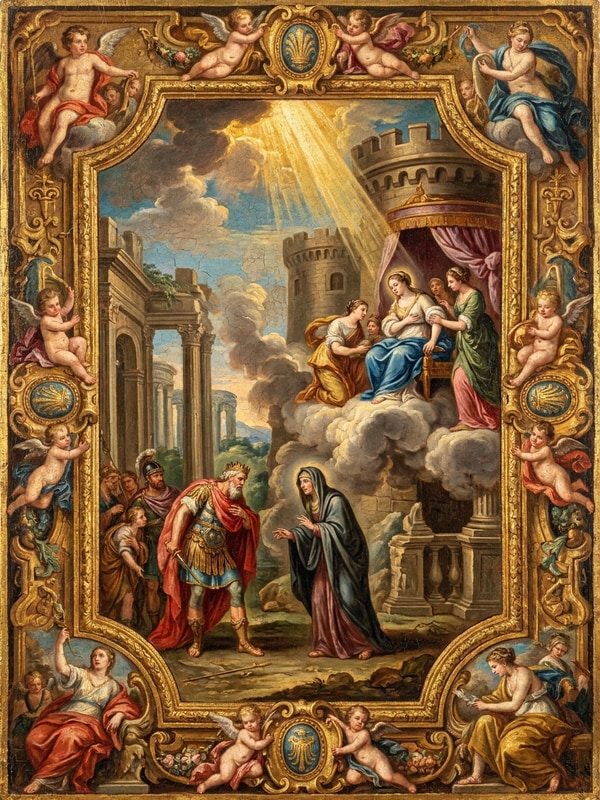
Acrisius, king of Argos, hears an oracle that he will die at the hands of his grandson, and so he shuts his daughter Danae away in a bronze chamber. Yet Zeus still comes to her; after Perseus is born, mother and child are sealed in a wooden chest and cast into the sea, until at last they drift to Seriphos and are rescued by the fisherman Dictys.
Article
Summary
Acrisius, king of Argos, has no son, and the lack troubles him. He consults the oracle hoping to learn how his line and throne might be secured, but the answer gives him no comfort: his daughter Danae will bear a boy, and that grandson will one day kill him. The danger is not beyond the walls or in an enemy camp; it has been planted inside his own house. Acrisius dares not murder his daughter, so he orders a hidden chamber made and shuts Danae away from streets, fields, and marriage. He believes bronze walls, bolts, and guards can bar the path of fate. But human doors cannot keep out the gods of heaven. Zeus descends into the chamber as a shower of gold, and in time Danae gives birth to a son, Perseus. When the infant's crying reaches the king, Acrisius understands that the thing he feared has already happened. Danae says that Zeus is the child's father, but the king is not reassured. Too afraid to strike mother and child with his own hand, he has them sealed in a wooden chest and pushed out into the sea, leaving the waves to do the cruelty he will not perform openly. Inside the dark chest, Danae clings to Perseus and prays to Zeus while wind and water carry them away from Argos. Acrisius thinks he has handed his danger over to the deep, but the sea does not sink the child. The chest drifts to Seriphos, where the fisherman Dictys hauls it onto the shore and opens it to find the pale mother and the living infant. On Seriphos, Danae and Perseus are, for a time, beyond the fear of the Argive palace. Perseus is still only a child, unaware of the oracle spoken over his life or of what his grandfather has done to escape it. Yet the oracle has not vanished in the bronze chamber or drowned with the chest. The more Acrisius tries to flee it, the more surely the story moves toward the place it must reach.
The King of Argos Is Afraid
In the city of Argos there was once a king named Acrisius. He had a palace ringed with high walls, gates watched by armed guards, and subjects who bowed to him in the marketplace. Yet one anxiety lay heavy on his heart: he had no son.
His daughter Danae had grown into womanhood. She was beautiful and quiet in her bearing, and many in the palace loved her. But to Acrisius, the more beautiful she became, the more uneasy he grew. He wanted a son to inherit his throne, and he had only a daughter. He feared, too, that when she married, another household would reach its hand into the kingship of Argos.
At last, one day, Acrisius could bear the uncertainty no longer. He ordered horses and chariots made ready and sent to ask the oracle. He expected the god to tell him how he might gain a son, or how he might keep his throne secure. Instead, the answer that came back fell before him like cold iron:
Danae would bear a son, and when that child was grown, he would kill his grandfather.
Acrisius’s face changed when he heard it. He had seen weapons drawn and rebellions put down, but this danger did not stand outside his walls or in the camp of an enemy. It was inside his own house, hidden in the future child of his own daughter.
The more he thought, the more fear mastered him. If he killed Danae, he dared not easily take on the guilt of murdering his child. If he let her live as before in the palace, the words of the oracle would lie there like a seed already planted, waiting for the day it would break open.
So he devised a cruel plan.
The Daughter in the Bronze Chamber
Acrisius ordered craftsmen to build a hidden room underground. Some traditions say the chamber was lined with bronze, with hard walls and heavy bolts; others say it lay deep within a stone enclosure, guarded from outside by soldiers. In any case, it was a place without streets or fields, and no strange man could come near it.
When Danae was led there, perhaps she still did not understand what her father truly feared. She saw the torchlight shining against the bronze walls and heard the door hinges groan behind her. When the door was shut, the footsteps outside faded away, until only the echo of the empty room remained.
Acrisius thought he had barred the path of fate. He left his daughter food and attendants, but took away her freedom. Day after day Danae lived in that sealed chamber, with only a small patch of light high above her. She could not walk in the courtyard, could not freely make offerings before the altar, and could not, like other young women, speak of marriage.
But once an oracle has been spoken, human bolts do not always keep out the gods of heaven.
Zeus looked down from above and saw Danae. She had done no wrong, yet her father had imprisoned her to suffer for a prophecy not yet fulfilled. Then one day, from the roof of the chamber, a fine golden light began to fall. It was not ordinary sunlight, nor the spark of a torch, but something like a shower of gold, slipping quietly into the room and falling beside Danae.
In that strange radiance, Danae met with Zeus.
Afterward, she conceived a child.
The Cry of the Infant
The days passed, and a new sound came from the hidden room. Danae gave birth to a boy and named him Perseus.
At first the child was only a tiny infant who cried and reached out with his hands. He knew nothing of oracles, nothing of his grandfather’s terror. Wrapped in swaddling clothes, he lay in his mother’s arms; when he was hungry he cried, and when he slept his breath was soft. Danae looked at him with both joy and fear. She knew that if her father discovered the child, there would be no peace.
But an infant’s cry cannot be hidden.
However deep the bronze chamber lay, it could not shut out the ears of the guards. When the news reached Acrisius, it was as if a viper had struck him. He understood at once that the very thing he feared had come to pass. His daughter had known no mortal man, and yet she had borne a son. The oracle had not been kept outside the bronze walls; it had come true beneath his own eyes.
Acrisius demanded that Danae tell him who the child’s father was. Danae answered that Zeus had come to her.
The king was not comforted. Perhaps he did not dare call her a liar aloud, nor openly set himself against Zeus; but still less could he endure the child’s remaining in the palace. So long as Perseus lived, the oracle hung above him like a sword.
Should he kill the baby? The child was his own grandson. Should he kill his daughter? She was his own blood. Acrisius was cruel, but he was also afraid. He would not drive the blade into them with his own hand, and so he decided to let the sea do the deed for him.
The Chest Cast into the Sea
He ordered a strong wooden chest to be made. Its boards were nailed tight and its seams sealed, like a little boat without oars or sail. When Danae and the infant were brought out, the daylight may have stung her eyes. She had been shut in darkness for so long; now she saw the sky again, not to be set free, but to be sent toward death.
The soldiers placed her and the child inside the chest. Danae held Perseus close, afraid the rough planks would bruise him. The lid came down; the light narrowed little by little, until there was only darkness. She heard men lifting the chest, heard the waves striking the shore, heard low voices outside.
Then the chest was pushed into the sea.
The waves lifted it and dropped it again. Water heaved all around; wind passed over the wooden sides with a hollow moan. In the darkness Danae clutched her child while the chest pitched beneath them. She had no sailor, no rudder, and no knowledge of where she was being carried. She could only press Perseus to her breast and pray to Zeus, begging him to watch over his son and over the mother and child who had been abandoned.
The chest drifted through wave after wave. Sometimes the sea rose as if to swallow it; sometimes the surface grew calm, and only the soft slap of water sounded against the boards. Acrisius remained in Argos, believing he had handed his danger over to the deep. But the sea did not carry the child away into its darkness as he wished.
Wind and wave bore the chest toward Seriphos.
The Fisherman by the Shore
Seriphos was an island in the sea, a place of rocks, fishing boats, and grasses bent by the salt wind. On that day Dictys was fishing by the shore. He was a man of the island and had dealt with the sea all his life; he knew what driftwood looked like, and torn nets, and wreckage from broken ships.
Suddenly he saw a chest on the water, moving slowly toward the beach with the waves. It was no ordinary piece of floating timber. It rose and sank heavily, as though something were shut inside.
Dictys put down his fishing gear and waded out. He caught the edge of the chest and dragged it with effort onto the sand. Seawater dripped from the seams, and the wet shore sucked at his feet. He pried open the lid, expecting perhaps to find treasure or the remnants of some drowned voyager. Instead, curled inside, he found a young woman and a child.
Danae’s face was pale, but the infant in her arms was alive.
Dictys started in astonishment, then helped them out. The sea wind touched Danae’s face, and at last she came back from that cramped darkness into the world of the living. Perseus stirred in his mother’s arms, as though waking from a terrible dream.
Dictys did not push them back into the sea, nor did he drive them away as a burden. He took mother and child home with him, gave them food, and offered them a place to rest. The ruler of Seriphos, Polydectes, was Dictys’s brother; on that island Danae and Perseus were, for a time, beyond the fear that haunted the palace of Argos.
The Oracle Left Behind
Acrisius thought that once the chest had gone into the sea, all would be quiet. He would not have to see his daughter, nor the grandson who might one day take his life. He shut himself within his throne and his city walls, hoping silence would cover the oracle.
But Perseus did not die.
On Seriphos he survived and slowly grew beside his mother. The waves had not swallowed him; the chest had not become his tomb; his grandfather’s fear had not erased him from the world.
At this time Perseus was still only a child. He did not know how his fate had once been spoken of in the palace of Argos, nor what his grandfather had done to escape the oracle. He knew only that he had a mother, people who had taken them in, the wind by the shore, and the sky above the island.
And the oracle remained far behind them. It had not vanished because of the bronze chamber, nor sunk beneath the sea with the wooden chest. The more Acrisius tried to flee it, the more surely he drove the story toward the place it was destined to reach.