Greek Mythology
The Birth of Athena — Greek Mythology
Zeus married the wise Metis, but then heard a dreadful prophecy: the child she bore would threaten his throne. To escape that fate, Zeus swallowed Metis. Later, when a terrible pain split his head, Athena sprang from his skull, fully armed.
Article
Summary
From the cleft in Zeus’s skull, a goddess leapt forth in full armor, gripping a spear and raising a ringing war cry. She was Athena. She did not come into the world as a helpless infant, but as a goddess already bearing wisdom, courage, and the gear of war. From that day onward, Olympus had a new and mighty divine power.
Metis Carries a Child
After Zeus overthrew Kronos, the throne on Mount Olympus at last belonged to him. Thunderbolts rested in his hand, the sky obeyed his command, and the gods began to gather around their new ruler.
Yet Zeus was not wholly at peace.
He knew that kingship among the gods had never passed calmly from one generation to the next. In the beginning, Ouranos had oppressed his own children and was cast down by his son Kronos with a sickle. Kronos, fearing that his children would seize power from him in turn, swallowed them one by one as soon as they were born, and still he fell at last to Zeus. Zeus had done such a thing with his own hands, and so he understood better than anyone: a father’s throne might be lost through the strength of his child.
At that time, Zeus took Metis as his wife.
Metis was a goddess of extraordinary intelligence. She did not win by brute force, but by counsel, timing, and subtle thought. When Zeus struggled against Kronos, she had helped him. She knew what potion would make Kronos vomit up the children he had swallowed, and she knew how words should be spoken so that danger would go unnoticed.
In time, Metis conceived a child.
It should have been joyful news. But before long, Zeus heard a prophecy that robbed him of rest. Gaia and Ouranos told him that Metis would first bear him a daughter, a child who would have her father’s strength and her mother’s wisdom. If afterward she bore a son, that child would become so powerful that he would overthrow Zeus and take the kingship of heaven.
When Zeus heard this, his heart grew heavy.
He looked out over the clouds of Olympus and remembered the palace of Kronos, remembered how his father had fallen by his hand. Fate seemed like a road no one could avoid. His grandfather had walked it; his father had walked it. Was it now to be his turn?
Zeus Swallows Metis
Zeus did not take up chains, nor did he shut Metis away in a deep pit. He chose another way.
Metis was skilled in transformation and could take many forms. So Zeus spoke with her gently, as he often did, praising her cleverness and her endless powers of change. Step by step, he coaxed her into displaying her skill, asking her to become this shape and then another.
Metis did not sense the danger at once. She trusted her husband, and she trusted her own wit. But this was the moment Zeus had been waiting for.
When she had changed into a tiny form, Zeus suddenly opened his mouth and swallowed her whole.
Metis, carrying her child, vanished from the outer world.
No sound of battle rang across Olympus. No great crack split the earth. Yet something momentous had happened: Zeus had hidden the prophecy inside his own body. He believed that, by doing so, the child who might threaten him could never be born, and fate itself would find its path blocked.
But the body of a god is no dead prison. After Metis entered Zeus, she did not dissolve like ordinary food. She lived on in the darkness, still bearing her wisdom, still guarding the child within her.
That child grew in the hidden depths of her father’s body. She could not hear the winds of earth or see the sunlight on Olympus, but she was no sleeping shadow. In secret she took shape, like a weapon slowly honed, like a flash of lightning concealed inside a cloud.
The Pain in the Skull
After some time, Zeus began to feel that something was wrong.
At first, his forehead only felt heavy, as if a stone had been set between his brows. Then the pain grew sharper and deeper, striking from within his skull until even the god of thunder could not help but frown.
He sat on his throne with the thunderbolt in his hand, yet he could not command this pain to leave him. He could shake the sky and scatter the storm clouds, but inside his own head a tempest seemed to be gathering, louder and louder the more he tried to hold it down.
When the gods saw Zeus suffering, they hurried to him. Hera stood nearby, watching him closely. The other gods scarcely dared to speak. On the height of Olympus, only Zeus’s heavy breathing could be heard.
At last the pain became unbearable.
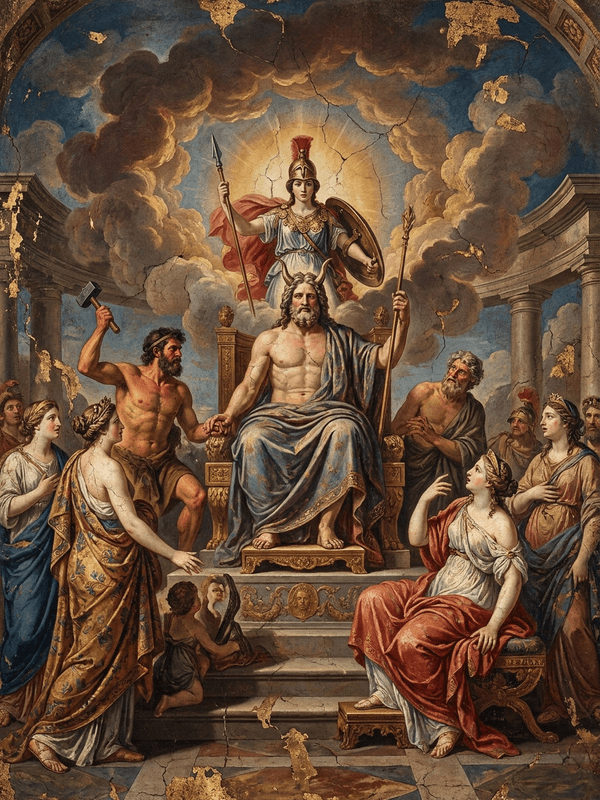
Then someone brought an axe. Some traditions say that Hephaestus was the one who lifted it; others say that Prometheus performed the deed. Whoever held it, the axe rose high, and its cold edge flashed before the divine halls.
Zeus did not draw back.
The blade came down and split open his skull.
The Armored Goddess Leaps Forth
In that instant, Mount Olympus shook.
From the cleft in Zeus’s head there came no ordinary blood, and no helpless infant tumbled out. The gods saw a blaze of light burst from Zeus’s skull, and then a goddess sprang before them, clad from head to foot in armor, a spear in her hand.
When she landed, her shield rang clear. Her eyes were bright and steady, as if they could pierce the dust of the battlefield and the tricks hidden in the human heart. She did not cry. She did not curl helplessly in swaddling clothes like a newborn child. From the first moment, she was a complete goddess: helmeted, armored, and standing in majesty upon Olympus with a commanding cry.
This was Athena.
Because she was born from the head of Zeus, all the gods knew that she was deeply bound to wisdom. Because she came forth in armor, she was not a goddess of still thought alone. She understood strategy as well as battle lines. She would guard cities, and she would help heroes find their way through danger with a clear mind.
Zeus’s pain ceased.
He looked upon the daughter standing before him. The prophecy he had swallowed had not vanished after all; it had entered the world in another form. Yet Athena was not the son who would overthrow him. She became instead one of the most important goddesses at his side.
A New Goddess on Olympus
From then on, Athena held her own place among the Olympians.
She was not like Ares, who loved the confusion and frenzy of slaughter. On the battlefield, she valued order, judgment, and the proper moment to strike. Nor was she a deity who cared only for pleasure in shining halls. She loved bright city walls, solid houses, the thread upon the loom, the tools in a craftsman’s hand, and the calm intelligence of heroes who could keep their senses in their darkest hour.
When later generations told of her birth, they never forgot the scene: Zeus wracked by a splitting pain, the axe descending, and the armored goddess leaping from the wound, spear in hand, helmet flashing.
Metis did not return among the gods in her former shape, but her wisdom was not lost. It came into the world with Athena, becoming the goddess’s clear gaze, steady hand, and unshaken mind amid the turmoil of war.
Zeus had tried to escape fate, but he had not made fate disappear. He had only caused this child to be born from the strangest place of all. So Athena stood forth among the gods of Olympus: the goddess born from her father’s skull, and the sign that wisdom and martial courage had come into the world together.